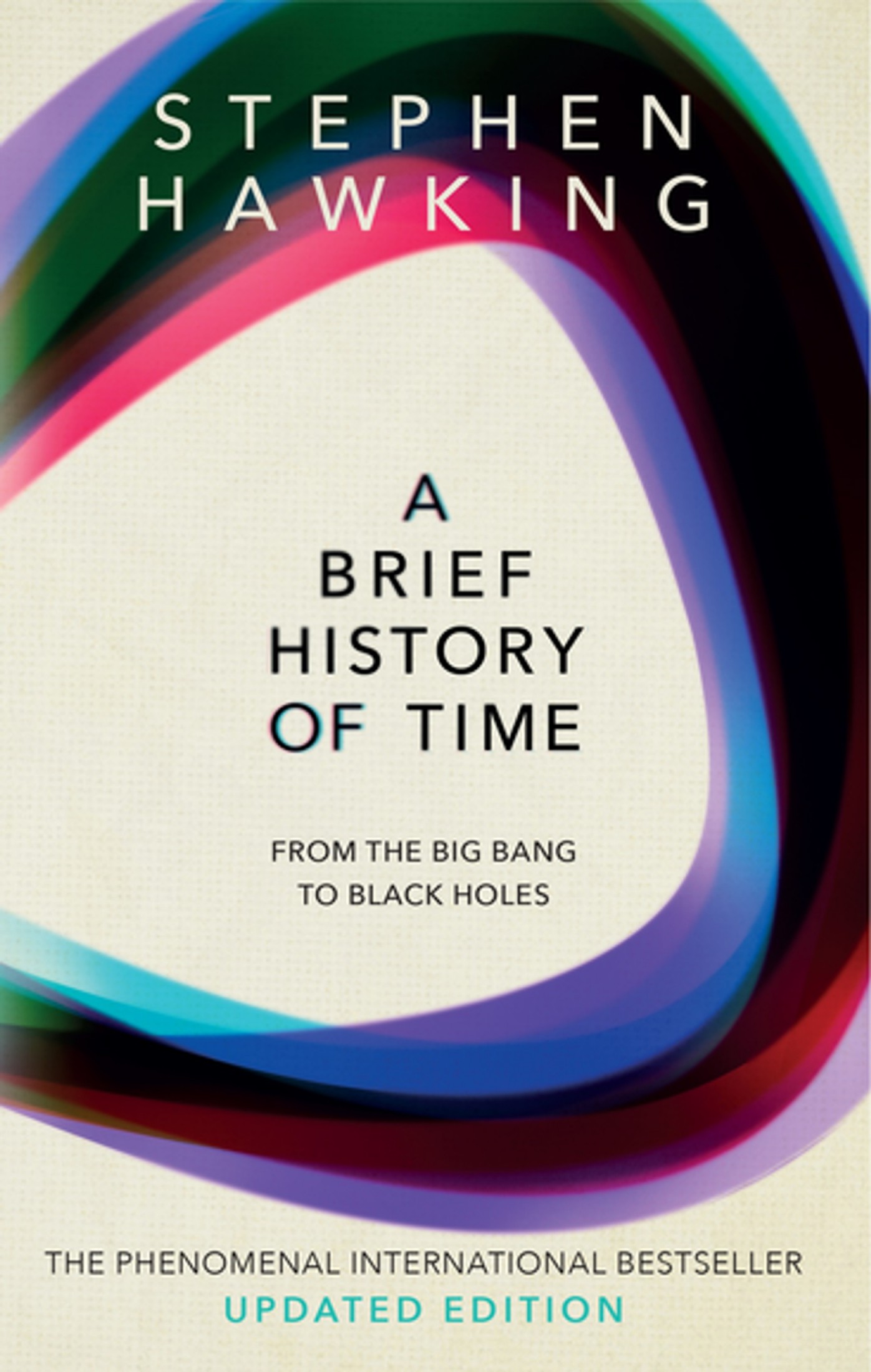
A Brief History of Time
Author: Stephen Hawking Publisher: Bantam Books (1988, revised edition 1998) Pages: 226
Why Read This
A Brief History of Time is a physics book that held a place on the London Sunday Times bestseller list for 237 consecutive weeks. Stephen Hawking did not design it for the popular book market; he simply wanted to answer the biggest questions humanity has ever asked. Where did the universe come from, does time have a beginning, do black holes truly exist, and is there a single theory capable of explaining everything.
The book builds an intellectual journey from first principles: what a scientific theory actually is, how humanity's picture of the cosmos shifted from Aristotle to Hubble, why the universe is expanding, where singularities arise, how black holes emit radiation, and finally a question that exceeds the capacity of physics itself: what breathes fire into the equations so that there is a universe for them to describe.
For anyone who pursues truth seriously, this book offers something rare: an honest map of where human knowledge stands, and where it stops. Hawking does not pretend to have reached the edge; he marks that boundary with precision and shows why advancing beyond it is the most important work remaining.
Who This Is For:
Anyone curious about the great cosmological questions and willing to engage with modern physics without a background in advanced mathematics. The book suits readers already at home in popular science and those just beginning, provided they are prepared to meet ideas that genuinely challenge everyday intuition.
Core Idea 1: Scientific Theory as a Falsifiable Model
Epistemology as Foundation
Before entering cosmology, Hawking lays his epistemological groundwork. His definition of a scientific theory is deliberately simple and powerful.
"I shall take the simpleminded view that a theory is just a model of the universe, or a restricted part of it, and a set of rules that relate quantities in the model to observations that we make. It exists only in our minds and does not have any other reality (whatever that might mean)."
A theory lives inside our minds. It is a representation of reality that can be tested, a map useful for navigating territory we do not yet fully understand. A good theory does two things: it describes many observations using only a few basic assumptions, and it makes testable predictions about observations yet to be made.
"Any physical theory is always provisional, in the sense that it is only a hypothesis: you can never prove it. No matter how many times the results of experiments agree with some theory, you can never be sure that the next time the result will not contradict the theory."
The Principle of Falsifiability
This is Karl Popper's principle of falsifiability, which Hawking summarizes cleanly. A million matching experiments do not prove a theory. One contradicting experiment is enough to overturn it. Science advances by falsification: a theory that survives the next attempted refutation survives one step further, until something better arrives to replace it.
This perspective carries implications far beyond physics. Every mental model we hold about business, about people, about social systems is a theory in Hawking's sense: useful as long as it predicts well, and to be released when contradicting evidence appears. Newton worked for more than two centuries before Einstein superseded him; most of the mental models we carry today about business, organization, or strategy have a shorter shelf life before they need updating. Decision-makers fail most often by clinging to theories that have already died, long after the data signaled it was time to revise.
Core Idea 2: Space and Time as Active Participants
The Einstein Revolution
The deepest shift Einstein brought to physics is this: space and time are active participants, shaped by everything that happens within them. Before Einstein, both were regarded as passive containers.
"Before 1915, space and time were thought of as a fixed arena in which events took place, but which was not affected by what happened in it."
Special relativity (1905) shattered the idea of absolute time. Because the speed of light is the same for all observers, the time experienced by each person depends on their individual speed and position.
"The theory of relativity put an end to the idea of absolute time! It appeared that each observer must have his own measure of time, as recorded by a clock carried with him, and that identical clocks carried by different observers would not necessarily agree."
Gravity as Curvature
General relativity (1915) went further still. Gravity is the curvature of spacetime itself, shaped by the presence of mass and energy. The picture of invisible strings between planets and the sun was abandoned entirely.
"Einstein made the revolutionary suggestion that gravity is not a force like other forces, but is a consequence of the fact that space-time is not flat, as had been previously assumed: it is curved, or 'warped,' by the distribution of mass and energy in it."
Planets move in paths that appear circular because they follow the straightest possible routes through curved spacetime. The effect is precisely like an aircraft flying straight above the earth, whose path appears to curve when projected onto a flat map.
"Space and time not only affect but also are affected by everything that happens in the universe."
The consequences for the universe as a whole are enormous. A universe containing matter and energy cannot stand still; it must move. This prediction, that the universe must be expanding or contracting, was confirmed by Edwin Hubble in 1929.
The idea that apparently passive systems actually shape what happens within them is a pattern that appears far beyond physics. Organizational structures, company culture, even the rules of a market all curve the behavior of the people moving inside them, just as the sun's mass curves the orbits of planets. Designing a system means designing that curvature.
Core Idea 3: The Expanding Universe and the Big Bang as the Beginning of Time
The Implication of Expansion
From the expansion of the universe that Hubble observed, one unavoidable implication follows: run time far enough backward, and there is a point where all matter occupied a single location. That is what we call the Big Bang.
"One may say that time had a beginning at the big bang, in the sense that earlier times simply would not be defined."
Hawking explains that the question of what happened "before" the Big Bang loses its meaning: time is a property of the universe and began together with the universe itself. Saint Augustine had already articulated this intuition long before modern physics. Time is part of what was created.
Where Our Theories Break Down
The fundamental problem: at the Big Bang singularity itself, all of our physical theories collapse.
"All our theories of science are formulated on the assumption that space-time is smooth and nearly flat, so they break down at the big bang singularity, where the curvature of space-time is infinite."
The most accurate theories we possess acknowledge their own limits precisely at the point we most want to understand. Answering the question of the universe's origin requires a theory of quantum gravity, a theory that does not yet fully exist. Hawking and Penrose proved mathematically that the Big Bang singularity must exist, provided general relativity is correct.
"However, one cannot really argue with a mathematical theorem."
Core Idea 4: The Uncertainty Principle and the End of Determinism
Laplace's Dream, Shattered
Before quantum mechanics, physicists held an enormous dream. Laplace formulated it: if we knew the position and velocity of every particle in the universe at one moment, we could calculate its entire future. Heisenberg demolished that dream at its roots.
"Heisenberg's uncertainty principle is a fundamental, inescapable property of the world."
To measure the position of a particle with precision, we must illuminate it with short-wavelength light. Short-wavelength light carries large energy. That large energy disturbs the particle's velocity in unpredictable ways. The more precisely we measure position, the greater the uncertainty in velocity. This limitation is embedded in the nature of the universe itself.
"Quantum mechanics therefore introduces an unavoidable element of unpredictability or randomness into science."
Einstein's Refusal
This principle ignited a debate that became one of the greatest ironies in the history of science.
"Einstein never accepted that the universe was governed by chance; his feelings were summed up in his famous statement 'God does not play dice.'"
The person most responsible for developing the ideas that led to quantum mechanics refused its deepest consequence. The majority of physicists ultimately accepted quantum mechanics for one reason: it matches every experiment ever performed with perfect consistency, and it underpins almost all of modern technology.
From quantum mechanics came a picture of particle motion far stranger than anything previously imagined. A particle does not travel along a single path from A to B.
"Instead it is supposed to go from A to B by every possible path."
This approach by Feynman, called the sum over histories, would become the foundation of Hawking's most radical proposal about the origin of the universe.
The end of Laplace's determinism is often misread as bad news. Quantum uncertainty means science speaks in the language of probability, and that is a strength in its own right. The best leaders and strategists operate similarly: managing distributions of possibility with appropriate posture, releasing the illusion of certainty that was never genuinely available.
Core Idea 5: Black Holes and Hawking Radiation
The Most Extreme Objects in the Universe
A black hole is an object where gravity is so strong that even light cannot escape. Its boundary is called the event horizon.
"One could well say of the event horizon what the poet Dante said of the entrance to Hell: 'All hope abandon, ye who enter here.' Anything or anyone who falls through the event horizon will soon reach the region of infinite density and the end of time."
What is striking about black holes is their simplicity. From the outside, all the complexity of the collapsing star that formed them vanishes without a trace. The final properties of a black hole depend only on its mass and rate of rotation.
"A black hole has no hair."
Two black holes with the same mass and rotation are indistinguishable from each other, regardless of the stars that formed them. All information about the original star is lost. This raises profound questions about the conservation of information in physics.
A Discovery Made at Bedtime
In November 1970, Hawking arrived at his most famous discovery under unusual circumstances.
"Before 1970, my research on general relativity had concentrated mainly on the question of whether or not there had been a big bang singularity. However, one evening in November that year, shortly after the birth of my daughter, Lucy, I started to think about black holes as I was getting into bed. My disability makes this rather a slow process, so I had plenty of time."
He discovered that the area of the event horizon can never decrease. Its resemblance to thermodynamic entropy was immediately striking. Jacob Bekenstein then proposed that the entropy of a black hole is proportional to the area of its event horizon. Hawking initially rejected this and wrote a paper to refute it. Then he performed the calculation himself.
"However, when I did the calculation, I found, to my surprise and annoyance, that even non-rotating black holes should apparently create and emit particles at a steady rate."
Bekenstein turned out to be right. Black holes emit radiation, lose mass gradually, and eventually evaporate entirely. The source of this radiation lies in quantum mechanics: near the event horizon, virtual particle-antiparticle pairs continuously arise from the vacuum. One member of each pair falls inward; the other escapes. The escaping particle is what we observe as Hawking radiation.
"The idea of radiation from black holes was the first example of a prediction that depended in an essential way on both the great theories of this century, general relativity and quantum mechanics."
This was the first meeting point of two great conflicting theories. To produce a single prediction, both had to work together.
Core Idea 6: The No-Boundary Proposal
A Universe Without an Edge
At the heart of this book is the proposal Hawking developed with Jim Hartle: that the spacetime of the universe may be finite yet have no boundary or edge whatsoever.
"Space-time would be like the surface of the earth, only with two more dimensions. The surface of the earth is finite in extent but it doesn't have a boundary or edge: if you sail off into the sunset, you don't fall off the edge or run into a singularity."
In classical theory, spacetime has boundaries: the Big Bang singularity at the beginning and a possible Big Crunch at the end. At those boundaries, all physical laws cease to apply, and something or someone must specify initial conditions from outside. If there is no boundary, the need for conditions from outside falls away.
The technical key to this proposal is the concept of "imaginary time": by measuring time using imaginary numbers in mathematics, the distinction between time and space disappears entirely. In this Euclidean spacetime, Feynman's sum over all possible histories can be carried out without stumbling over singularities.
"One could say: 'The boundary condition of the universe is that it has no boundary.' The universe would be completely self-contained and not affected by anything outside itself. It would neither be created nor destroyed. It would just BE."
The Context Hawking Recounted with a Smile
Hawking presented this proposal for the first time at a cosmology conference hosted by the Jesuits at the Vatican, shortly after the Pope had asked him not to investigate the moment of creation. Hawking wrote with a concealed smile that his paper at the time was so mathematical that the implications for the role of God in creation went largely unnoticed.
If the no-boundary proposal is correct, the question of "what happened before the Big Bang" loses its meaning, just as the question "what lies south of the South Pole" does.
"But if the universe is really completely self-contained, having no boundary or edge, it would have neither beginning nor end: it would simply be. What place, then, for a creator?"
Core Idea 7: The Arrows of Time
Three Arrows
The laws of physics are symmetric with respect to time: run forward or backward, the equations still hold. Reality is asymmetric: a cup breaks but does not reassemble on its own. Where does the direction of time come from?
"There are at least three different arrows of time. First, there is the thermodynamic arrow of time, the direction of time in which disorder or entropy increases. Then, there is the psychological arrow of time. This is the direction in which we feel time passes, the direction in which we remember the past but not the future. Finally, there is the cosmological arrow of time. This is the direction of time in which the universe is expanding rather than contracting."
The thermodynamic arrow arises from simple statistics: there are vastly more disordered states than ordered ones. When a system evolves randomly, it almost certainly moves from order toward disorder. There are more destinations available in the territory of chaos.
The psychological arrow is tied to the thermodynamic arrow. Memory, and in all likelihood the brain itself, records in a way that increases overall disorder.
"Our subjective sense of the direction of time, the psychological arrow of time, is therefore determined within our brain by the thermodynamic arrow of time."
A Rare Admission
In this chapter Hawking also acknowledges something rare among physicists: he had been wrong. For years he believed the arrow of time would reverse when the universe began to contract. Two colleagues, Don Page and Raymond Laflamme, showed him his error.
"It seems to me much better and less confusing if you admit in print that you were wrong. A good example of this was Einstein, who called the cosmological constant, which he introduced when he was trying to make a static model of the universe, the biggest mistake of his life."
That admission is worth more than many of the physics formulations in the same chapter. Hawking demonstrates that genuine intellectual strength lies in the readiness to revise one's position when the evidence changes. For any leader or thinker, the ability to acknowledge error openly is harder than the ability to generate new ideas, and rarer.
Core Idea 8: The Unification of Physics and the Question Science Cannot Answer
Two Mutually Inconsistent Theories
Physics today rests on two theories, each extraordinarily accurate within its own domain, and yet incompatible with each other within any single framework.
"Today scientists describe the universe in terms of two basic partial theories — the general theory of relativity and quantum mechanics... Unfortunately, however, these two theories are known to be inconsistent with each other — they cannot both be correct."
Gravity is deeply resistant to unification with quantum mechanics. The uncertainty principle requires that "empty space" be filled with virtual particle pairs continuously arising and vanishing. These pairs carry enormous energy. Through Einstein's equations, large energy means large mass, which means a powerful gravitational pull, which means the universe should already have collapsed. The renormalization techniques that work for other forces fail entirely for gravity.
String theory emerged as a candidate for unification: the fundamental objects of the universe are one-dimensional vibrating strings. Different patterns of vibration of the same string produce different particles, electrons, photons, gravitons, all different notes of a single instrument.
"I believe there may not be any single formulation of the fundamental theory any more than, as Gödel showed, one could formulate arithmetic in terms of a single set of axioms. Instead it may be like maps — you can't use a single map to describe the surface of the earth or an anchor ring."
The unified theory may take the shape of a collection of overlapping maps, each valid for its own region, together forming a complete picture.
The Fire Inside the Equations
On the final pages of this book, Hawking leaves one question that no scientific method can answer.
"What is it that breathes fire into the equations and makes a universe for them to describe? The usual approach of science of constructing a mathematical model cannot answer the questions of why there should be a universe for the model to describe. Why does the universe go to all the bother of existing?"
Physics can answer "how" and "what." The question of why anything exists at all stands at a different edge entirely. Hawking closes the book with an open invitation: if a unified theory is ever achieved, the question of why we exist becomes everyone's together.
"Then we shall all, philosophers, scientists, and just ordinary people, be able to take part in the discussion of the question of why it is that we and the universe exist. If we find the answer to that, it would be the ultimate triumph of human reason — for then we would know the mind of God."
Connections and Patterns Across Chapters
Hawking constructs one layered argument from beginning to end: from a static picture of spacetime toward a dynamic one, from Laplace's determinism toward Heisenberg's uncertainty, from singularities as barriers to knowledge toward a no-boundary proposal that dissolves those singularities, and from partial theories in conflict toward a vision of a unified theory that may take the shape of a collection of maps.
Throughout that journey, one constant holds:
"The most important point: that the universe is governed by a set of rational laws that we can discover and understand."
A repeating pattern runs through every chapter: each time physics successfully explains something, the boundary of its ignorance shifts to a deeper question. Newton explained planetary orbits, then the question of the universe's origin arose. General relativity explained the expanding universe, then a singularity appeared that could not be explained. The no-boundary proposal may dissolve the singularity, then the question of why those equations exist at all arises.
Hawking's definition of scientific theory aligns directly with Popper's falsifiability. The weak anthropic principle he uses to explain the direction of time connects to the selection effect in statistics: we can only ask questions from within conditions that make asking possible.
Key Takeaways
-
Scientific theories are provisional models, and holding them with open hands is the most productive intellectual posture available. Hawking states from the first page that theories live inside our minds, are useful as long as they predict well, and must be released when contradicting evidence appears. Newton functioned for more than two centuries before Einstein superseded him; the models we carry today about business, organizations, or strategy have a shorter shelf life before they require updating. Decision-makers fail most often by clinging to theories that have already expired, long after the data signaled the time to revise.
-
The Big Bang is the beginning of space and time simultaneously. Asking "what happened before the Big Bang" carries the same structural oddity as asking what lies north of the North Pole.
-
Hawking radiation brings general relativity and quantum mechanics together in a single prediction. Black holes emit radiation, lose mass, and eventually evaporate. Hawking arrived at this while lying in his room, his disability giving him, as he put it, "plenty of time to think." Two giant theories that had stood apart were compelled to work together to produce one forecast.
-
Heisenberg's uncertainty principle ends Laplace's determinism permanently. This uncertainty is embedded in the nature of the universe itself; no measuring instrument can overcome it. Einstein resisted to the end of his life with the words "God does not play dice," becoming the greatest irony: the primary architect of modern physics standing against its deepest consequence. Quantum physics was ultimately accepted because it matches every experiment ever performed, and because it supports nearly all of modern technology.
-
The Hartle-Hawking no-boundary proposal describes a universe that is self-contained, requiring no initial conditions from outside. Hawking himself marks the line between this bold speculation and established, tested theory.
-
Hawking acknowledged his error openly and turned it into a lesson. For years he believed the arrow of time would reverse as the universe contracted; Don Page and Raymond Laflamme showed him his mistake. Hawking then cited Einstein, who called his cosmological constant "the biggest mistake of my life." Updating one's position based on evidence is a mark of intellectual strength.
-
The book's final question is left open deliberately: why does a universe exist at all. Physics is skilled at answering "how"; the question of why anything exists at all lies beyond its methods, and Hawking extends the invitation to everyone to keep asking.
Critical Assessment
Strengths
1. Honesty about the limits of knowledge
Hawking does not pretend to answer questions that remain unanswered. He shows with precision where our theories collapse, where speculation begins, and why those limits exist. Readers receive an honest map of where human knowledge stands.
2. Hawking's original discoveries arrive with the stories behind them
Hawking radiation and the no-boundary proposal are explained together with the stories of their emergence: in a bedroom, at a Vatican conference, in a debate with Bekenstein. That context makes physics feel like something done by real human beings.
3. Building the foundation before the ascent
The book does not leap immediately to its most dramatic topics. Hawking first builds an understanding of what a scientific theory is, then planetary motion, then relativity, then black holes and cosmology. Each chapter becomes the foundation for the next.
Limitations
1. The book most purchased, least finished
Widely circulating anecdotal statistics describe A Brief History of Time as one of the books with the most lopsided buy-to-read ratio. The concepts in the second half, especially imaginary time and the sum over histories, genuinely demand full concentration.
2. The 1988 edition has been passed by significant developments
Physics has moved considerably since 1988, and even since the revised 1998 edition. String theory, loop quantum gravity, and the debate over the black hole information paradox have all advanced substantially. Readers seeking a current picture will need supplementary sources.
3. The no-boundary proposal remains a contested hypothesis
Hawking is generally clear about this distinction, but a less careful reader could come away with the impression that the Hartle-Hawking proposal stands on the same empirical footing as general relativity. It remains a hypothesis debated among physicists.
Verdict
A Brief History of Time is the best entry point into modern cosmology for non-specialist readers. Hawking writes as a scientist who cares that people understand what physics is doing at its frontier, and that care is felt on every page. Its limitations lie in the age of the content and one or two concepts that genuinely require more than one reading. For anyone who wants to stand at the edge of human knowledge and look into the darkness beyond, this book is the right place to begin. Rating: 5 out of 5.
Related Reading
- The Universe in a Nutshell by Stephen Hawking (2001). An update and expansion of this book, with richer illustrations.
- A Briefer History of Time by Stephen Hawking and Leonard Mlodinow (2005). A more condensed and accessible version.
- The Grand Design by Stephen Hawking and Leonard Mlodinow (2010). Deepens the argument about unified theory and M-theory.
- Black Holes and Baby Universes by Stephen Hawking (1993). A collection of essays on science and his personal life.
- The Elegant Universe by Brian Greene (1999). A highly readable introduction to string theory.
- Cosmos by Carl Sagan (1980). A cosmological perspective with a more humanistic and poetic approach.
FAQ
Q: Do I need a background in physics or mathematics to read this book? A: Hawking wrote the book with one stated constraint: no mathematical equations, except E=mc². The core concepts are accessible to anyone willing to read with concentration. The first half is more approachable; the second half, especially the sections on imaginary time and the sum over histories, rewards more than one reading.
Q: How long does it take to finish? A: The physics, across 226 pages, can be read in two to three days. Understanding it thoroughly takes longer. Many readers recommend reading it twice: once for the broad picture, a second time for the details that passed unnoticed on the first pass.
Q: Does Hawking discuss God or religion? A: Yes, in substantial portions. Hawking addresses the theological implications of the Big Bang, the no-boundary proposal, and unified theory. He does not take a strong theological position; he shows with precision where physics can and cannot speak to those questions. His closing line about "knowing the mind of God" is frequently quoted, and frequently misread.
Q: How does the 1988 edition differ from the 1998 revised edition? A: The revised edition adds several new sections, particularly on string theory and wormholes, and updates some discussions of unified theory. The core content remains the same. The edition most readily available today is generally the 1998 revision.
Q: Has Hawking radiation been confirmed experimentally? A: Direct confirmation has not yet been achieved. Hawking radiation from real black holes is too faint to detect with current technology. Laboratory experiments simulating its acoustic analogue (using superfluid currents) have produced results consistent with the prediction. The physics community broadly regards Hawking radiation as very likely correct, but direct observational confirmation from real black holes is still absent.
Q: What is the "no-boundary proposal" and why does it matter? A: The Hartle-Hawking proposal states that the spacetime of the universe is finite but has no edge or boundary, like the surface of a sphere, which is bounded but has no endpoint. If correct, the universe requires no "initial conditions" set by anything outside itself. The question of what existed "before" the Big Bang loses its meaning. Hawking presents it as one possible answer to the question of creation.
Q: How controversial is this book among physicists? A: The content on general relativity and basic quantum mechanics is entirely uncontroversial; that is established physics. The Hartle-Hawking no-boundary proposal sits in more debated territory: many physicists regard it as stimulating speculation, others remain skeptical. Hawking's interpretation of its philosophical and theological implications has drawn extensive responses from physicists and theologians alike.
Q: What should I read next after this? A: That depends on where your interest leads. For deeper cosmology from a more personal perspective, The Elegant Universe by Brian Greene or Cosmos by Carl Sagan. To continue with Hawking's own work, The Universe in a Nutshell, published thirteen years later, is the natural continuation, with far richer illustrations.