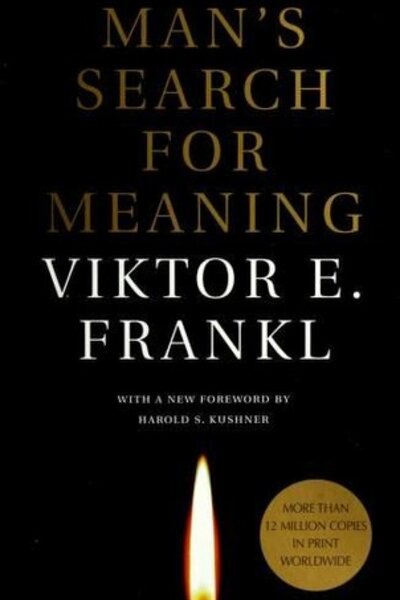
Why Read This
Viktor Frankl wrote this book from Auschwitz. The logotherapy and will to meaning he discovered there remain relevant seven decades later.
The structure of this book is unusual: the first part is a memoir of the concentration camp, the second a systematic account of logotherapy. The two hold each other up in a way neither could manage alone. The story gives blood to the theory; the theory gives a backbone to the story. Frankl wrote it across nine days in 1945, meaning to publish it anonymously, convinced that the message mattered more than its author. The book went on to pass a hundred printings in English and was translated into more than twenty-one languages.
The postscript added in 1984 completes the whole edifice. There Frankl names the sickness of modern civilization, millions of people who have enough to live by, empty-handed of anything worth living for.
This book is for anyone wrestling with the question of meaning, with endurance in hardship, or with how to face suffering that cannot be avoided. It also serves anyone drawn to existential psychology and to the history of logotherapy as a system of psychotherapy.
The Last Freedom That Cannot Be Taken
In the concentration camp, everything could be stripped from a person. A name replaced by a tattooed number. Families parted on the Auschwitz platform by the flick of an SS officer's finger. Health, work, freedom of movement, the right to speak. All of it could be taken.
Across those years of observation, Frankl saw one thing that could not be seized. The prisoners who walked through the barracks and gave away their last piece of bread to others proved that a freedom remained in the prisoner's own hands: the way he chose to bear what befell him.
"everything can be taken from a man but one thing: the last of the human freedoms—to choose one's attitude in any given set of circumstances, to choose one's own way."
This freedom operates in a dimension different from physical freedom. It does not depend on outer conditions. Every day, every hour in the camp offered the chance to make that decision.
"Every day, every hour, offered the opportunity to make a decision, a decision which determined whether you would or would not submit to those powers which threatened to rob you of your very self, your inner freedom."
Those who endured both psychologically and physically were the ones who kept making that decision. Dostoevsky once wrote: "There is only one thing that I dread: not to be worthy of my sufferings." Frankl watched the martyrs in the camp prove that line with their own lives.
Implications for Everyday Life
This proposition reaches far beyond the extreme situation. In ordinary life we face conditions we did not choose: the family we were born into, the body we inherited, the economy around us. Between all those conditions and our response to them, a gap always remains. That gap is the space of freedom and responsibility.
"It is this spiritual freedom—which cannot be taken away—that makes life meaningful and purposeful."
Will to Meaning: The Primary Human Drive
Freud built his psychoanalysis on the assumption that humans move because they want pleasure, the will to pleasure. Adler built his psychology on the assumption that humans move because they want power, the will to power. Frankl acknowledged both as psychological facts. The root runs deeper: the will to meaning, the will to find meaning.
"Man's search for meaning is the primary motivation in his life and not a 'secondary rationalization' of instinctual drives."
A survey of 7,948 students at forty-eight American universities supports this finding empirically. Seventy-eight percent stated that their main goal was "finding a purpose and meaning to my life," far above the sixteen percent who chose "making a lot of money." In France, eighty-nine percent of respondents admitted that a human being needs something worth living for.
This search is unique and personal. A person's meaning cannot be delegated to anyone else.
"This meaning is unique and specific in that it must and can be fulfilled by him alone; only then does it achieve a significance which will satisfy his own will to meaning."
Existential Frustration and Noögenic Neuroses
When the will to meaning is blocked, Frankl calls it existential frustration. This frustration is natural and belongs to the normal human condition. The danger appears when the frustration goes unresolved and grows into noögenic neuroses: disorders rooted in the existential dimension, far above the conflict of drives and instincts.
Frankl tells of an American diplomat who underwent psychoanalysis for five years in New York, pushed to see his job dissatisfaction as veiled resentment toward his father. After a few sessions, a far simpler truth emerged: the diplomat was genuinely unhappy with his work and wanted to change careers. He did. For more than five years afterward he felt content.
"Existential frustration is in itself neither pathological nor pathogenic. A man's concern, even his despair, over the worthwhileness of life is an existential distress but by no means a mental disease."
Three Roads to Meaning
Logotherapy identifies three concrete ways a person finds meaning. All three are available in nearly every life situation, including the most constrained.
The first road: through creation and deed. Completing a work, carrying out a task, doing something worthy in the world. Every piece of work done with full awareness of its meaning holds this dimension.
The second road: through experience and encounter. Experiencing beauty, truth, goodness. Deepest of all: loving someone. Love within the frame of logotherapy is a primary phenomenon in its own right.
"Love is the only way to grasp another human being in the innermost core of his personality. No one can become fully aware of the very essence of another human being unless he loves him."
In the camp, under the most primitive conditions, Frankl experienced this truth directly. Marching toward the work site before dawn, his body stumbling over the large stones in the dark, the face of his distant wife suddenly present in his mind with a strange and piercing clarity.
"A thought transfixed me: for the first time in my life I saw the truth as it is set into song by so many poets, proclaimed as the final wisdom by so many thinkers. The truth—that love is the ultimate and the highest goal to which man can aspire."
The third road: through suffering. This is the hardest to accept and the most often misunderstood. Frankl sets a clear fence: suffering that can be avoided should be avoided. Suffering without reason is masochism. When suffering truly cannot be avoided, one freedom remains: the way a person bears it.
An elderly doctor who had lost his wife came to Frankl in deep depression. Frankl gave no advice. He asked a single question: had the doctor died first and his wife had to survive, what would have happened? The doctor answered at once: she would have suffered terribly. Frankl said: that is the suffering you have spared her; you pay its price by surviving and grieving now.
The doctor said not a word. He shook Frankl's hand and left in peace.
"In some way, suffering ceases to be suffering at the moment it finds a meaning, such as the meaning of a sacrifice."
A Wise Architecture
These three roads work as a comprehensive map. Those who cannot create a work because of physical or situational conditions still have the second road: to love. Those who cannot love actively still have the third road: how they bear what befalls them. Meaning stays available until the last breath.
The Reversal of the Question: Life Asking Us
One of the most powerful conceptual moves in this book is the reversal of the question about meaning. We are used to asking: "What is the meaning of my life?" Frankl turns it around: life is asking us, every day, every hour. We are the ones who must answer, and that answer always takes the form of concrete action.
"What was really needed was a fundamental change in our attitude toward life. We had to learn ourselves and, furthermore, we had to teach the despairing men, that it did not really matter what we expected from life, but rather what life expected from us."
One very bad night in the camp, after an announcement of death sentences for acts now counted as sabotage, the lights went out. The block warden asked Frankl to speak. Frankl himself was sick, hungry, exhausted. He spoke anyway. In that darkness he laid out this fundamental reversal. When the lights came back on, he saw the figures of his comrades walking toward him with tears on their faces.
Meaning is concrete and always unique to one person at one particular moment. From this reversal comes what Frankl calls the categorical imperative of logotherapy:
"Live as if you were living already for the second time and as if you had acted the first time as wrongly as you are about to act now!"
Imagine you have already lived once and acted wrongly. Now you are given a second chance, here, now. Nothing, Frankl says, rivals this image for awakening a person's sense of responsibility toward his own life.
Existential Vacuum and the Meaning Crisis of Our Age
Frankl identifies a crisis that has already swept over millions: the existential vacuum, the inner void. This condition sets in when the will to meaning has gone wholly dull, silent, no longer felt at all. What dominates life is boredom.
Two layered losses explain why this emptiness has become a mark of the modern human. First, humanity lost the animal instinct that once guided the behavior of other creatures automatically. The human being must choose, and choice demands direction. Second, in the modern era, the tradition that once gave that direction also weakened.
"No instinct tells him what he has to do, and no tradition tells him what he ought to do; sometimes he does not even know what he wishes to do. Instead, he either wishes to do what other people do (conformism) or he does what other people wish him to do (totalitarianism)."
The most common manifestation of this emptiness is the "Sunday neurosis," the depression that strikes people when the rush of the work week stops and the inner void is suddenly felt. Frankl's surveys speak plainly: twenty-five percent of his European students showed signs of the existential vacuum; among American students the figure was sixty percent. About thirty percent of patients entering the psychiatric clinic brought problems tied to the absence of meaning.
Frankl identifies three faces of this mass neurotic syndrome: depression, aggression, and addiction.
"people have enough to live by but nothing to live for; they have the means but no meaning."
That sentence describes a condition spreading wider in this age of hyperconnectivity. Materially, more people have access to more things than at any point in history. Rates of depression, anxiety, and addiction keep climbing alongside it. Through Frankl's frame, this makes sense: material prosperity does not answer the existential question.
Noö-Dynamics and Tragic Optimism
A Healthy Tension
Frankl rejects a common misunderstanding in mental health: that a person needs balance, calm without tension, homeostasis. Balance is the right concept for a machine. The human soul needs something different.
"What man actually needs is not a tensionless state but rather the striving and struggling for a worthwhile goal, a freely chosen task. What he needs is not the discharge of tension at any cost but the call of a potential meaning waiting to be fulfilled by him."
This condition is called noö-dynamics: the existential dynamic in a polar field between the meaning waiting to be fulfilled and the person who must fulfill it. The tension between the two is what gives life.
In the camp, when his already-finished manuscript was confiscated upon entering Auschwitz, the deep desire to rewrite it helped him survive. In the Bavarian camp, when he fell ill with typhus, he jotted fragments of thought on scraps of paper. The mental reconstruction of the lost manuscript, by Frankl's own account, helped his heart hold on.
Tragic Optimism
The 1984 postscript introduces the concept that crowns Frankl's entire intellectual edifice: tragic optimism. This is the optimism born after a person looks directly at life's tragic triad, suffering, guilt, and death, and still says yes to life.
"an optimism in the face of tragedy and in view of the human potential which at its best always allows for: (1) turning suffering into a human achievement and accomplishment; (2) deriving from guilt the opportunity to change oneself for the better; and (3) deriving from life's transitoriness an incentive to take responsible action."
Jerry Long, a young man from Texas paralyzed from the neck down after a diving accident at seventeen, wrote to Frankl:
"I view my life as being abundant with meaning and purpose. The attitude that I adopted on that fateful day has become my personal credo for life: I broke my neck, it didn't break me."
Frankl cites a survey in Austria: those most respected by the majority of respondents were the ones who bore heavy burdens with their heads held high. High achievers from the arts, sciences, or statecraft ranked lower on that list.
Key Takeaways
-
The freedom to choose your attitude is the last freedom that cannot be taken. Frankl witnessed this at Auschwitz, where names became tattooed numbers and every physical freedom was stripped away. The prisoners who shared their last bread amid conditions that made kindness nearly impossible proved that one freedom stays whole: how a person responds to what befalls him. This proposition changes how we see human agency at the root. Modern psychology often sees the human as a product of conditions, and there is truth there. The concentration camp proved that conditions do not fully determine. A gap always remains, however small, for choosing.
-
The will to meaning is the primary motivation, deeper than pleasure or power. Frankl placed the will to find meaning above the will to pleasure (Freud) and the will to power (Adler). The finding is supported by a survey of 7,948 students at forty-eight American universities: seventy-eight percent named meaning as their main goal, far above the sixteen percent who chose money. Pleasure and power tend to work as escapes when meaning goes unfound; a person who has found strong meaning feels no need to chase enjoyment compulsively.
-
Three roads to meaning stay open even in the most constrained conditions. Through creation, through love, through the way one bears suffering. This architecture is wise because it does not depend on success or capacity. A paralyzed person, one who has lost everyone he loves, one who can no longer create, still has access to the third road. The story of the elderly doctor who lost his wife shows the third road at its most intimate: the suffering he bears is the price he pays so that his wife is spared a heavier grief.
-
Life is the one asking us. The question "what is the meaning of my life?" traps people in an abstract loop. Frankl's reversal turns it into: what does this situation ask of me, here, now? That question is concrete and demands action. It connects directly to the categorical imperative of logotherapy: live as if you were living for the second time, and as if the first time you had acted carelessly.
-
The existential vacuum is a quiet, spreading crisis. Sixty percent of American students in Frankl's survey showed its signs. Depression, aggression, and addiction root in the same emptiness. In the age of hyperconnectivity, stimulation without meaning hastens the existential hollowing, filling time without filling the soul.
-
The human soul grows through meaningful tension. Noö-dynamics is the distance between what has been achieved and what still must be fulfilled. Homeostasis is the right concept for a machine; the soul withers when no task awaits it. Frankl proved it himself: the desire to rewrite the manuscript confiscated at Auschwitz helped him survive physically.
-
Tragic optimism is born after a person sees the dark side fully, then still chooses yes. That order is what separates it from toxic positivity. Frankl does not counsel shutting one's eyes to suffering, guilt, and death. He counsels seeing them directly, then choosing one's attitude toward them.
Critical Assessment
Strengths
1. Evidence from a laboratory without equal
Frankl speaks as Prisoner Number 119,104 who lost his wife, his parents, and the first manuscript of his book at Auschwitz. His theory was tested in conditions no other psychologist ever lived through as both subject and observer. That epistemic ground is what makes logotherapy's claims far sturdier than theories born in the safe consulting room.
2. A consistent reversal of assumptions
Frankl consistently takes a commonly accepted assumption and turns it over: success cannot be pursued directly, it must come as the fruit of devotion. Life asking us. Transitoriness as the strongest argument for acting meaningfully now. Genuine optimism born after looking at the dark side. Each reversal yields a clarity that a casual approach cannot reach.
3. A mutually supporting structure
The two parts of this book, memoir and logotherapy, are designed to work together. Psychology books usually separate the two; Frankl integrates them. The result is a text that reads at once as testimony and as a system of thought.
Limitations
1. Limited empirical verification
Frankl puts forward many empirical claims from his observations in the camp, and most never passed rigorous replication. Even the surveys he cites use specific samples. Logotherapy as a therapeutic modality does not yet have an evidence base as strong as cognitive behavioral therapy by the standards of modern clinical psychology.
2. The danger of generalizing from extreme conditions
There is a risk in drawing universal conclusions from the most extreme conditions that ever existed. The message about the freedom to choose one's attitude can be misused to validate indifference toward the social conditions that produce systemic suffering: if a person can always choose his attitude, why change the conditions?
Conclusion
This book deserves to be read by anyone asking about meaning, about endurance in hardship, or about how to face suffering that cannot be avoided. It also serves anyone drawn to the history of existential psychology. Five out of five for its unmatched source of evidence, its intellectual courage in overturning assumptions, and its relevance that holds even seven decades after it was written.
Read it if you want an understanding of human motivation that reaches past pleasure and power, or if you are facing suffering that cannot be avoided. Do not expect a practical checklist; this book asks something larger of its reader.
Related Reading
- The Denial of Death (Ernest Becker): how awareness of death shapes human motivation
- Antifragile (Nassim Nicholas Taleb): the human spirit growing through meaningful tension, from a different angle
- A Confession (Leo Tolstoy): a great writer's struggle with the question of meaning that nearly drove him to the edge
- The Courage to Be (Paul Tillich): existential philosophy on anxiety and courage, from Frankl's own era
- Suicide (Émile Durkheim): the sociological root of anomie, a conceptual sibling of the existential vacuum
FAQ
Q: Is this book psychologically heavy to read? A: The camp memoir is indeed hard. The descriptions of physical conditions, death, and loss are real and unsanitized. Frankl did not write to please the reader; he wrote to convey the truth he witnessed. Some readers find that part draining; others feel that the very harshness of the description is what gives weight to the logotherapy that follows it.
Q: Which edition should I read? A: The Beacon Press edition with the Ilse Lasch translation is the most widely circulated and the easiest to find. Make sure to choose an edition that includes the 1984 postscript "The Case for a Tragic Optimism," since that is the part that completes the whole argument. An edition without the postscript loses the crown of the edifice.
Q: Frankl has his own controversies. Is there anything to know? A: There are questions from some historians about the accuracy of certain memoir details, and about Frankl's choice not to join the underground resistance in the camp. Historian Timothy Pytell is the most vocal in this critique. The controversy is real and worth reading. For most readers, it does not topple the core of his philosophical argument. The point is to avoid swallowing the memoir as a flawless historical record.
Q: How does logotherapy differ from ordinary psychotherapy? A: Most psychotherapy works at the level of conflict between drives, past trauma, or faulty thought patterns. Logotherapy works at the level of the existential dimension: the question of meaning, the freedom to choose one's attitude, and responsibility toward one's own life. It does not replace other therapies; Frankl himself placed it as a complementary approach working in a territory other therapies were not designed to touch.
Q: Has this "will to meaning" been tested scientifically? A: There is partial empirical support. The surveys Frankl cites support the idea that meaning is prioritized over money and achievement. Research on purpose in life (Victor Strecher, Michael Steger) is also consistent with this frame. Logotherapy as a therapeutic modality is already used clinically, especially in palliative care. Its weakness: the evidence base for formal logotherapy remains thinner than that for CBT or DBT in evidence-based clinical standards.
Q: This book is about a Nazi camp. What relevance does it hold for someone who has never gone through extreme suffering? A: That is precisely its strength. Frankl himself wrote that his theory applies in every life situation. The question "what does this situation ask of me?" works just as well when facing a stalled career, a fractured relationship, or a loss of direction as it does when facing a life-threatening situation. The scale of suffering differs; the mechanism of choosing one's attitude is the same.
Q: How does this book compare with Stoicism, especially Marcus Aurelius or Epictetus? A: There is a large overlap: both speak of a freedom that cannot be taken from within. Frankl even quotes Epictetus. The difference: Stoicism tends toward reducing emotion and a passive acceptance of transitoriness. Frankl turns transitoriness into active urgency: every meaningful act taken now is stored forever in a permanent past. That is a layer Stoicism does not hold.
Q: Do I need to read both parts of the book, or is one enough? A: Both must be read together. The memoir without logotherapy is only trauma. Logotherapy without the memoir is only theory. The strength of this book lies exactly at the meeting point of the two: every logotherapy claim is tested directly by the real story that precedes it.