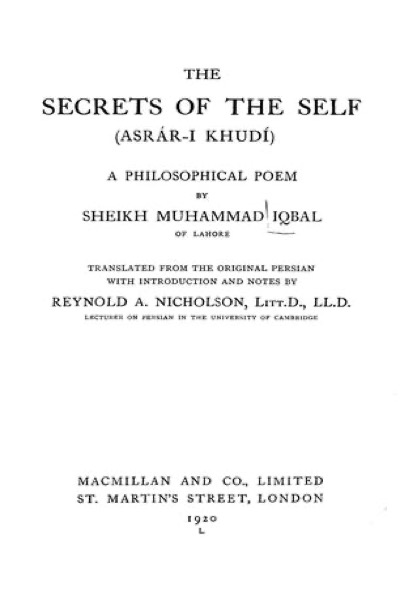
The Secrets of the Self (Asrar-i Khudi)
Why Read This
Asrar-i Khudi by Muhammad Iqbal defends the reality of the Self as civilization's core: strengthen Khudi (selfhood, the ego in its positive and striving sense) through obedience, self-mastery, and divine vicegerency on earth.
Written in Persian in 1915 and translated into English by R.A. Nicholson in 1920, this poem grew from genuine urgency. Iqbal witnessed Muslim intellectual life caught between two equally corrosive currents: the Sufi pantheism that taught the dissolution of the self into the Divine, and the Western idealist philosophy that regarded the individual as illusion. Both currents arrived at the same destination, a human being who no longer trusted the reality of his own existence.
Asrar-i Khudi is Iqbal's answer. He declares that Khudi, genuine and valuable selfhood, is the most solid fact in the universe. The Self must be affirmed, strengthened, and educated through three sequential stages: obedience, self-mastery, and divine vicegerency (niyabat ilahi, the human role as God's representative and trustee on earth). The book speaks to anyone who wants to understand how Islamic philosophy frames the relationship between the individual, God, and civilization.
Iqbal's relevance extends well beyond its historical context. In a modern era that weakens individuals through consumerism, digital dependency, and rootlessness, his vision of a strong and self-reliant Khudi speaks with clarity. This poem invites readers to ask again: what makes life worth living? Is my Self real, or an illusion to be abandoned? How can I contribute to civilization?
Key Points
-
Khudi is the foundation of the universe - Iqbal declares that every form of existence is an effect of the Self. One's vitality is proportional to the strength of Khudi within. A drop of water that absorbs the lesson of Selfhood becomes a pearl; a wave that maintains itself rides the ocean.
-
Desire is a cosmic principle - Every organ, every intellectual achievement, every work of art springs from a single root: desire pressing outward from within. Intellect itself is the offspring of desire; desire asks first, and intellect seeks the answer afterward. The extinction of desire is death to the living.
-
Ishq strengthens the Self - Ishq (love, in Iqbal's expansive and cosmological sense) precedes the physical elements and serves as the fuel that makes Khudi more enduring, more alive, more radiant. Muhammad appears in this poem as Love's supreme embodiment, uniting a community across the boundaries of lineage and geography.
-
Asking is the slowest poison - Dependence, petitioning, and accepting charity erode personality in silence. A debt of gratitude is a psychological shackle that bows the neck of its receiver, unlike a monetary debt that numbers can discharge. Self-reliance is an act of piety.
-
Freedom is the fruit of discipline - The first stage of Khudi's education is obedience. The camel that carries its load and walks without complaint is the teacher. "Liberty is the fruit of compulsion," Iqbal writes. Those who wish to master the universe must first allow themselves to be bound by law.
-
Self-denial is the weapon of the conquered - The allegory of the tiger and the sheep reveals how strength can be extinguished from within. A cunning old sheep becomes a "prophet" and preaches to the tigers that power leads to ruin. The tigers who swallow that teaching lose their teeth and courage without a single physical battle. This resonates with mental models of ideological influence: the mind becomes a battlefield without bloodshed.
-
Pressure forges the diamond - Coal and diamond share the same carbon origin; process is what separates them. A mature personality forms inside pressure, tested, compacted, then made luminous. "In solidity consists the glory of Life; weakness is worthlessness and immaturity."
Khudi as the Center of the Universe
Iqbal opens Asrar-i Khudi with a statement at once cosmological and ontological:
"The form of existence is an effect of the Self, Whatsoever thou seest is a secret of the Self."
Every form in nature is an effect of the Self. The universe originates in a Khudi that is expressing itself in a thousand shapes. In every atom, the force of the Self sleeps, waiting to be awakened.
Iqbal builds his argument with pedagogical parables drawn from nature. A drop of water that absorbs the lesson of Selfhood into its heart becomes a pearl. A wave that remains a wave rides the ocean. A mountain that loses its Self crumbles into sand. Earth that stands firm in its own existence holds the moon in orbit.
Personality in Iqbal's philosophy is a "state of tension." It exists in struggle, absorption, and creation. When that active tension disappears, personality begins to dissolve. From this premise Iqbal derives a clear standard of value: whatever strengthens personality is good; whatever weakens it is evil. Art, religion, and ethics are all measured from this single point.
The implication reaches deep into cosmology. Reality grows alongside the growth of the individuals who compose it. Creation is still in progress, and humanity participates in it.
Desire and Ishq: Two Fuels of Khudi
Desire as the Pulse of Life
Iqbal affirms one law that holds from the smallest to the greatest: life persists only as long as purpose remains.
"Keep desire alive in thy heart, Lest thy little dust become a tomb."
Desire is a cosmic principle. Intellect itself is the offspring of desire; desire asks first, and intellect searches for the answer afterward. Iqbal reverses the common assumption about knowledge:
"The object of science and art is not knowledge, The object of the garden is not the bud and the flower."
Knowledge severed from Life has lost its soul. The purpose of science surpasses knowledge itself. The purpose of the garden surpasses the bud and the flower. Both are vehicles that strengthen Khudi.
"Negation of desire is death to the living, Even as absence of burning extinguishes the flame."
Ishq as the Fire That Builds
Ishq, love in Iqbal's expansive and philosophically precise sense, is the fuel that keeps the luminous point of the Self burning and enduring:
"The luminous point whose name is the Self Is the life-spark beneath our dust. By Love it is made more lasting, More living, more burning, more glowing."
Iqbal places Love far above ordinary emotion. Love precedes the physical elements. At its peak, "Love of God at last becomes wholly God." For the Self to grow, it must touch a force greater than itself, and Love is the entrance into that force.
Muhammad appears in this canto as Love's supreme embodiment. From the Cave of Hira arose a community, a law, and a civilization. His Love burned away distinctions of lineage:
"He burnt clean away distinctions of lineage, His fire consumed this trash and rubble."
The opposite of Love is dependence and petition. A person who borrows others' thinking without genuine struggle is an intellectual beggar. Intellectual independence is a precondition for mature Love.
Asking Is Poison
Iqbal writes with force that asking, depending, and accepting charity is the slowest poison for Khudi:
"Asking disintegrates the Self And deprives of illumination the Sinai-bush of the Self."
The poison works slowly and invisibly. A person who once collected tribute from lions is transformed into a fox through need. A debt of gratitude is a psychological shackle that bows the neck of its receiver, far different from a monetary debt that numbers can discharge.
"Are his hands empty? The more is he master of himself. Do his fortunes languish? The more alert is he."
"Sweet is a little dew gathered by one's own hand."
A small dew gathered by one's own hand is sweeter than a drink begged from another. Iqbal anchors this argument in religion: God loves the person who earns his own livelihood. Self-reliance is an act of piety.
Three Stages of Khudi's Education
This is the heart of the entire Asrar-i Khudi. Iqbal arranges a three-rung ladder: obedience, self-mastery, and divine vicegerency. The three stages form one sequential journey that cannot be reversed.
First Stage: Obedience
Iqbal chooses the camel as the teacher of obedience. The camel carries its load, walks, and does not complain. Then comes the line that inverts modern logic:
"Liberty is the fruit of compulsion."
Freedom is the fruit of submission to discipline. The wind is bound by the fragrant rose. The stars move toward their destination with heads bowed to the law of gravity.
"Whoso would master the sun and stars, let him make himself a prisoner of Law!"
Those who wish to master the universe must first allow themselves to be bound by its rules. Freedom that arrives before discipline drifts without direction.
Second Stage: Self-Mastery
The human soul resembles an untamed camel. The task is to seize the reins from within:
"He that does not command himself becomes a receiver of commands from others."
Iqbal details Islam's four pillars as a systematic exercise in self-mastery. Prayer is a blade that slays sin from within. Fasting attacks hunger and thirst, subduing the fortress of appetite. The pilgrimage teaches separation from the homeland, shattering narrow attachments. Almsgiving erodes love of wealth from within. The four combine into one cohesive system for the formation of the soul:
"Thou art impregnable, if thy Islam be strong."
Third Stage: Divine Vicegerency
When a person succeeds in mastering himself, he will master the world. The one who has passed through obedience and self-mastery becomes God's vicegerent on earth, the Niyabat-i Ilahi (divine vicegerency, the human being as God's trustee and representative).
"When that bold cavalier seizes the reins, the steed of Time gallops faster."
History moves faster under his leadership. He is the axis that drives civilization.
"Mankind are the cornfield and thou the harvest, thou art the goal of Life's caravan."
The Doctrine of Self-Denial: Weapon of the Conquered
The canto of the tiger and the sheep is the most unsettling passage in the entire poem. Iqbal uses this allegory to dissect how thought itself can be weaponized for conquest.
A cunning old sheep chooses a far subtler weapon than claws: ideas. He becomes a "prophet" and preaches to the tigers:
"Whoso is violent and strong is miserable: Life's solidity depends on self-denial."
"Paradise is for the weak alone, Strength is but a means to perdition."
The exhausted tigers swallow all of it. Their teeth blunt. Their courage recedes. Their souls die even as their bodies still stand.
"The wakeful tiger was lulled to slumber by the sheep's charm: He called his decline Moral Culture."
Iqbal reads this as a diagnosis of history. Strength extinguished from within is far more total than strength defeated from without. Every system of thought that glorifies passivity, that teaches the highest luxury to be detachment from the world, kills Khudi before the enemy has a chance to act.
Critique of Plato and the Philosophy of Escape
Iqbal's critique of Plato centers on one fundamental defect: Platonic philosophy severs the soul from action.
"'To die,' said he, 'is the secret of Life: The candle is glorified by being put out.'"
Plato's world of Ideas is a silent museum of eternity. Its deer have no grace of step. Its birds carry no breath. Its seeds feel no will to grow.
"Sweet is the world of phenomena to the living spirit, Dear is the world of Ideas to the dead spirit."
Plato's influence seeped into Islamic Sufism, spreading a longing for stillness and non-existence. Generation after generation inherited a flight from the world, without realizing that the inheritance traced back to a Greek philosopher who could not bear the noise of living.
Against Plato, Iqbal places Love. There is a story of a brilliant scholar who fills his room with philosophy books while his heart remains cold and untouched. Shams-i Tabriz arrives with a single inward flame and burns that pile of books. Intellect dried of Love is frozen snow.
Diamond and Coal: The Process of Self-Maturation
Coal and diamond are born from the same womb, composed of the same carbon. Process is what separates them:
"Dark earth, when hardened, becomes in dignity as a bezel. Having been at strife with its environment, it is ripened by the struggle and grows hard like a stone."
"In solidity consists the glory of Life; weakness is worthlessness and immaturity."
External pressure meets internal resistance, and from that encounter something luminous is born. The true Self emerges inside pressure.
The diamond radiates light from its own density. Dew, however beautiful in appearance, has no density. It is absorbed by the needs of other creatures and disappears without trace.
"Be a diamond, not a dewdrop!"
This principle runs through the entire architecture of Khudi's philosophy: the right question is whether a person is hardening or softening under the pressure he faces.
Time as a Sword
Iqbal borrows Imam al-Shafi'i's expression, "time is a sword that cuts," and extends its meaning far inward:
"Life is a part of Time, and Time is a part of Life: Do not speak evil of Time, commanded the Prophet."
Time is the medium in which will and Life meet. Two ways of seeing time exist: as a line stretching from yesterday to tomorrow, or as something that blossoms from within consciousness. A person who measures time only by the length of day and night has built his own prison.
Moses parted the Red Sea because he gripped the sword of time. Ali conquered Khaybar because the strength of his arm flowed from the same source. Time is the raw material worked by a strong Khudi.
Closing Prayer: The Khudi That Knows When to Kneel
Iqbal closes the entire Asrar-i Khudi with a prayer. This choice carries deep spiritual logic. The whole journey is about strengthening the Self, and at the journey's end, Iqbal kneels.
"We are dispersed like stars in the world; though of the same family, we are strange to one another. Bind again these scattered leaves, revive the law of love!"
"I taught the candle to burn openly, while I myself burned unseen by the world's eye."
"I am the Bush of Sinai: where is my Moses?"
A Khudi that is truly mature knows when to kneel. The genuine strength of the Self knows to whom it owes its roots. At the end of all the struggle to build oneself, what remains is prayer, and within that prayer lives the most honest acknowledgment: that even the strongest Self is a Self that knows it needs a source beyond itself.
Related Content
For readers drawn to Iqbal's philosophy of Khudi, these resources complement one another:
- Philosophy of Self and Identity: Explore how various traditions understand the essence of selfhood, from Western phenomenology to Islamic Sufism, in essays on self-awareness and consciousness.
- Sufism and Modernity: Follow the dialectic between traditional spirituality and modern life in essays on reconciling religious heritage with contemporary existence.
- Mental Models on Ownership and Agency: Understand the concept of owning one's own life as a practical mental model, a vision that runs alongside Iqbal's Khudi in its emphasis on self-reliance and independence.
- Islamic Revival in the 20th Century: Explore the historical context surrounding Iqbal, other Islamic thinkers, and their efforts to reconcile tradition with modernity.
Reading these resources together deepens understanding of the relationship between the self, society, and civilization from an Islamic perspective.
FAQ
Q: What does Khudi mean in Iqbal's philosophy?
Khudi means selfhood, identity, or ego in a positive and affirmative sense. For Iqbal, Khudi is the real and valuable center of experience, the foundation of all human life and creativity.
Q: Why did Iqbal write in Persian?
Iqbal chose Persian so that his message would reach the entire Muslim world beyond the borders of India. Persian was also richly equipped for expressing philosophical ideas with poetic beauty, carrying centuries of mathnawi (rhyming philosophical verse in the tradition of Rumi's Masnavi) as a living form.
Q: What are the three stages of Khudi's education?
The three stages are Obedience (submission to law), Self-Mastery (commanding one's own lower self), and Divine Vicegerency (becoming God's trustee on earth). The stages are sequential and mutually reinforcing.
Q: How does Iqbal's vision of the ideal human being compare with Nietzsche's Ubermensch?
Both envision a human being who surpasses the average. Iqbal's ideal person grows from faith and lives for the community; the Ubermensch stands on an atheistic foundation with an aristocratic character. The two visions share a vertical ambition while diverging on the metaphysical ground and relational purpose from which elevation becomes possible.
Q: Why does Iqbal criticize the doctrine of self-annihilation?
Iqbal reads the doctrine of self-annihilation as a source of communal weakness. When people are taught to regard themselves as illusion, they lose the drive to act, create, and stand for values. A community that denies the reality of the Self will find it difficult to build anything durable.
Q: Who is this book most suited for?
Readers drawn to philosophy, Sufism, the history of Islamic thought, and reflection on self-development amid the challenges of modern life will find the most to engage with here.
Critical Assessment
Strengths
Iqbal weaves philosophical depth with poetic beauty. His argument about Khudi remains relevant for modern readers wrestling with questions of meaning, agency, and self-development.
Limitations
Iqbal's critique of Sufi pantheism is sharp. He treats the rich and varied dimensions of Sufi spiritual experience as a single monolithic block. The Sufi tradition itself contains currents that do not all flow toward the passivity he condemns.
Conclusion
Asrar-i Khudi stands among the most important works of Islamic philosophy produced in the twentieth century, and it arrives in the form of a poem. It deserves to be read by anyone who wants to understand how Muhammad Iqbal builds his argument for civilizational renewal from the deepest possible root: the conviction that the Self is real, valuable, and worthy of strengthening. The rating of 4.5/5 reflects the strength of its argument and the beauty of its verse, with the note that several internal tensions in his thinking remain open for discussion.