Why Read This
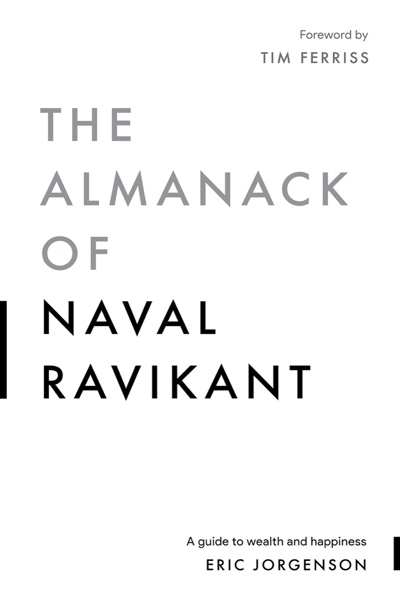
A compilation of Naval Ravikant's wisdom on building wealth and happiness. Eric Jorgenson curated philosophy from tweets, podcasts, and writings over a decade. Naval is the co-founder of AngelList and an angel investor in 200+ companies including Uber and Twitter.
This book is unique because it wasn't written directly by Naval. Eric Jorgenson collected Naval's thoughts scattered across various platforms for over ten years. The result is a comprehensive guide that divides Naval's wisdom into two major parts: Wealth (building wealth) and Happiness (achieving inner peace).
What makes this book powerful is the combination of practical and philosophical perspectives. Naval teaches how to make money, why we chase it, and how to stay calm after getting it. This is a long-term thinking framework that takes years to fully understand and apply, rooted in deep patience.
This book centers on fundamental principles that hold across decades. Naval teaches us to think from first principles, build unique specific knowledge, leverage modern tools, and understand that happiness is a skill that can be learned like any other.
The ideal reader is anyone who wants to understand wealth creation deeply while not losing inner peace in the process. This is a book for long-term thinkers willing to do the hard mental work.
Key Takeaways
-
Wealth is assets working while you sleep - Naval distinguishes wealth (income-generating assets), money (value transfer tool), and status (social position). Focus on building ownership of the means of production.
-
Specific knowledge cannot be taught in school - It's a unique combination of DNA, life experiences, and our response to them. It feels like play to us but looks like work to others. Naval found his specific knowledge in the combination of: absorbing data, analytical ability, sales, and experimenting with technology.
-
Modern leverage is code and media - The digital era provides permissionless leverage. We don't need bank permission for capital or to recruit large teams. A developer can build an app for millions from a laptop. Content creators can reach global audiences without media companies.
-
Accountability opens doors to trust and equity - Taking business risks under your own name opens access to leverage. Warren Buffett is the ultimate example: paid for judgment because of a stellar reputation built over decades.
-
Judgment is the highest-leverage skill - In an age of leverage, one correct decision can win everything. Warren Buffett spends a year deciding and a day acting. That action lasts decades. Being right 80% versus 70% yields hundreds of times the return.
-
Mental models are decision-making tools - Naval uses evolution, game theory, microeconomics, complexity theory, inversion, and compound interest to make better decisions. Brain capacity is limited; mental models are reminders to recall fundamental principles.
-
Reading is the most important meta-skill - One hour of reading per day about science, math, and philosophy will likely place you at the highest level of human success in seven years. Naval reads 1-2 hours daily and believes this alone explains the material success and intelligence he has.
-
Happiness is a state when nothing is missing - It comes from the absence of desire for external things. Every desire is a contract with yourself to be unhappy until you get what you want. Naval transformed from 2/10 to 9/10 on the happiness scale in ten years.
The Wealth Creation Formula
Specific Knowledge × Leverage × Accountability
Naval simplifies wealth creation into a simple mathematical formula. These three components must exist and work together.
Specific Knowledge is expertise that cannot be taught in a classroom. If society can train you, they can train someone else and replace you. Specific knowledge is found by pursuing genuine curiosity and passion.
Its characteristics are easy to recognize: it feels like play to you but looks like hard work to others. Often highly technical or creative. Resistant to outsourcing or automation. Learned through direct apprenticeship.
Naval gives a personal example. As a teenager, his mother said "You're going to do great in business." At the time Naval wanted to be an astrophysicist. Turns out his mother was right. Naval's specific knowledge lies in the combination of: obsessively absorbing data, analytical ability to make money, sales skills, and experimenting with technology.
How to find your specific knowledge: look at what you do almost effortlessly since childhood. Ask your mother or best friend because they notice. Pay attention to where you can get 100% immersed in something. Follow the edge of knowledge that's just being figured out.
This concept frees us from exhausting competition. When we compete with others, it's because we're imitating them. We're trying to do the same thing. Every human is different. Nobody can compete with you on being yourself.
Key insight: No one can compete with you on being you. Most of life is a search for who and what needs you the most.
Leverage: Multiply Your Output
Leverage is a force multiplier for our judgment. There are three broad classes: Labor (people working for you), Capital (money), and Code/Media (permissionless leverage).
Code and media are the most democratic in the modern era. These are products with no marginal cost of replication. We don't need anyone's permission, just a computer and creativity. Software and media work for us while we sleep.
Naval illustrates with a real estate example: from laborer ($15/hour) with zero leverage, to general contractor ($50K/project) with some leverage, to real estate developer ($500K-$1M/project) with high leverage, to real estate tech company (billions) with massive leverage from code + capital + high-quality labor.
In the digital era, leverage is available to everyone. Previous generations needed permission, had to convince banks for capital, had to recruit large teams. Now a developer can build an app used by millions from a laptop. Content creators can reach global audiences without media company permission.
Practical question: how can we use code or media to multiply output? If not a developer, can we collaborate with developers? If not a content creator, can we learn to create content? Or at least, are we working at a company that gives equity so we own a piece of the leverage?
Key insight: Code and media are permissionless leverage. An army of robots is freely available, it's just packed in data centers for heat and space efficiency. Use it.
Accountability: Risk Under Your Own Name
Accountability means taking business risks under your own name. Society will reward you with responsibility, equity, and leverage. Without accountability, you have no incentives. Without accountability, you can't build credibility.
The risk of accountability is failure in public, humiliation under your own name, financial loss. In modern society, downside risk stays manageable. Personal bankruptcy can wipe clean debts. People forgive failures as long as you're honest and high-integrity.
Naval gives a personal example. Around 2013-2014, he widened his Twitter presence beyond startups, talking openly about philosophy and psychology. People in the industry messaged: "What are you doing? You're ending your career." He took the risk. The result? He gained far more followers and influence.
Warren Buffett is the ultimate accountability example. Reputation built over decades produces value thousands of times over talent without compound interest.
Most people fear accountability because they fear failing in public. This is the paradox: people who dare to fail under their own names actually gain extraordinary power. Accountability opens doors to trust, equity, and leverage that cannot be obtained any other way.
In careers, this means: step out from the company brand. Build a personal brand. Publish work under our name. Take credit and criticism for our decisions.
Key insight: Clear accountability is important. The people who have the ability to fail in public under their own names actually gain a lot of power.
Judgment: The Most Underrated Skill
Judgment sits among the most underrated skills in modern work. In an age of leverage, one correct decision can win everything. The direction we're heading carries enormous weight relative to speed.
Naval defines: wisdom is knowing the long-term consequences of our actions. Judgment is wisdom applied to external problems. Being right 80% of the time versus 70% yields hundreds of times the return because of leverage.
Warren Buffett is the ultimate judgment example. Paid purely on the basis of his judgment. No one asks how many hours he works or when he wakes up. He wins because of extraordinary credibility. Highly accountable, proven right repeatedly in public, extremely high integrity. People give him unlimited leverage because of his judgment.
Buffett's decision style: spend a year deciding and a day acting. That action lasts decades. We waste time with short-term thinking and useless busywork. Being slightly better at judgment can yield hundreds of times the payout.
Building Judgment
Master the fundamentals. True knowledge is innate, built from scratch. The smartest people can explain complex things to children. Clear thinking relies on your own authority, built from direct understanding through years of work.
Face reality. Remove ego. Desire clouds reality. The more we want, the harder it is to see the world as it is.
Create empty space to think. If you don't have 1-2 days per week without meetings, you can't think. You won't have good ideas. Only after we feel bored do great ideas emerge.
Learn mental models from basic sciences. Evolution, game theory, microeconomics, complexity theory, probability, statistics. The point is sharper decisions with leverage.
Key insight: In an age of leverage, one correct decision can win everything. Direction matters more than speed.
Mental Models for Decision-Making
Mental models are concise ways to recall fundamental principles. Brain capacity is limited. Think of mental models as pointers or reminders to help recall principles for which we have fundamental experience to support them.
Naval uses several key mental models:
Evolution
Many aspects of modern society are explained through evolution. Civilization exists to answer who gets the opportunity to reproduce. Evolution, thermodynamics, information theory, and complexity have tremendous explanatory and predictive power.
Inversion
Naval focuses on eliminating what won't work. Success comes from avoiding mistakes consistently.
Complexity Theory
Helps Naval understand the limits of our knowledge and prediction capability. We're fundamentally ignorant and very bad at predicting the future. Accepting this makes us more humble and careful in decisions.
Microeconomics & Game Theory
Fundamental to business. Can't succeed without an extremely good understanding of supply-demand, labor-versus-capital, game theory, principal-agent problem.
Principal-Agent Problem is the single most fundamental problem in microeconomics. Principal (owner) cares. Agent (doing on behalf) doesn't care, optimizes for themselves. If you don't understand this, you won't be able to navigate the business world.
Compound Interest
Compound interest rules far beyond finance. In intellectual domains, it dominates outcomes. A business with 100 users growing 20% per month becomes millions quickly. Relationships that compound over decades become most valuable.
Mental models are practical decision-making tools. When facing complex decisions, having mental models allows us to rapidly assess situations from various angles.
Practical example: we're offered a startup partnership. Principal-agent problem asks: are founders fully committed or do they treat this as a side project? Compound interest asks: what's the monthly growth rate and is it sustainable? Evolution asks: does the product align with fundamental human needs?
Key insight: The more you know, the less you diversify. If all your beliefs line up into neat little bundles, you should be highly suspicious.
Reading: The Ultimate Meta-Skill
Reading one hour per day about science, math, and philosophy will likely place you at the highest level of human success in seven years. True love for reading, when developed, is a superpower.
We live in an Alexandria era, every book and knowledge is at our fingertips. The scarce resource is the desire to learn. Naval reads 1-2 hours daily, placing him in the 99.9999th percentile. He believes this alone explains whatever material success and intelligence he has.
How Naval Reads
Read what you love until you love reading. It almost doesn't matter what we read. Eventually we'll read enough that it dramatically improves our life. Just like the best exercise is what we're excited to do every day, the best book is what makes us excited to read all the time.
No obligation to finish. Number of books finished is a vanity metric. The more we know, the more books we leave unfinished. Focus on new concepts with predictive power.
Read many books simultaneously. At any given time, Naval reads 10-20 books simultaneously. Read fast. Skip parts if boring. Start from the beginning, move fast. If not interesting, grab a summary or skim.
This frees us from guilt about not finishing books. School taught us books are sacred, must be finished. That habit holds us back. Reading summaries of 10 books and absorbing key ideas yields more than slogging through 1 boring book.
Building a High-Quality Foundation
Stick to science and fundamentals. Math is a solid foundation. Hard sciences are solid. Microeconomics is solid. Build your reading diet around these durable disciplines.
Read originals and classics. If interested in evolution, start with Darwin. For economics, start with Adam Smith, von Mises, or Hayek. Classics have been filtered through thousands of years and many people.
Old problem, old solution principle. The older the problem, the older the solution. For driving cars or flying, read modern. For keeping body healthy, staying calm and peaceful, educating family, older solutions are likely better.
Key insight: Read what you love until you love reading. The smartest people can explain things to a child. If you can't explain it to a child, then you don't know it.
Happiness: A Learnable Skill
Happiness is a highly personal skill that can be learned, like fitness or nutrition. Happiness is the default state when we remove the sense that something is missing in life.
We're survival and reproduction machines that are highly judgmental. We constantly think "I need this" or "I need that," trapped in a web of desires. Happiness is the state when nothing is missing. When nothing is missing, the mind stops and stops running to the past or future.
In that absence, for a moment, we have internal silence. When we have internal silence, we're content and happy.
Happiness Beyond Positive Thinking
Every positive thought essentially contains a negative thought within it. It's all duality and polarity. If Naval says he's happy, it means he was sad at another point. If he says someone is attractive, it means others are not.
Happiness centers on the absence of desire, especially desire for external things. The fewer desires Naval has, the more he can accept the present condition, the less his mind moves.
Reality is neutral. Reality holds no judgments. For a tree, the world simply unfolds. We're born, we have a set of sensory experiences, then we die. How we choose to interpret it is up to us.
Desire Is a Contract for Unhappiness
This is a total paradigm shift. Most people believe they'll be made happy by external conditions. This is a fundamental delusion. The idea that we'll change something in the external world and it will bring lasting happiness is a delusion.
Every desire is a contract with yourself to be unhappy until you get what you want. Naval doesn't think most of us realize that. We want things all day and wonder why we're not happy. Naval likes to stay aware of that so he can choose desires very carefully.
Success operates on a different axis from happiness. Happiness is being satisfied with what we have. Success comes from dissatisfaction. Choose one. Naval struggled his whole life for material and social success. When he achieved it, he realized people around him who achieved similar success carried the same restlessness.
Naval's Transformation: 2/10 to 9/10
Ten years ago, Naval might have given himself 2/10 or 3/10 on the happiness scale. Today, he's 9/10. Having money played a small role. Most came from learning over the years that happiness is the most important thing to him.
This proves transformation is possible. It requires conscious effort, consistent practice, and willingness to do the work.
Key insight: Happiness is the state when nothing is missing. Desire is a contract you make with yourself to be unhappy until you get what you want.
Saving Yourself
Health, fitness, and learning come from personal ownership. Doctors, nutritionists, and teachers act as guides. Ultimately, we have to take responsibility. Save yourself.
Naval's number one priority in life, above his happiness, above his family, above his work, is his own health. This starts with physical health. Second, mental health. Third, spiritual health. Then family health.
Morning Exercise: Game-Changer
Daily morning exercise has been a complete game-changer. Because physical health became the number one priority, he can never say he doesn't have time. In the morning, he exercises, and however long it takes is however long it takes.
He doesn't start his day until he's exercised. The world can wait thirty more minutes.
Principle: habit-building methods are flexible. Do something every day. The activity itself stays open. The key is daily consistency. The best exercise for us is what we're excited enough to do every day.
Easy Choices, Hard Life
Jerzy Gregorek (Naval's physical trainer) always says: "Easy choices, hard life. Hard choices, easy life."
If we make easy choices now, eat junk food, skip exercise, long-term life will be hard. We'll be sick, unhealthy. If we make hard choices now, overall life will be far easier.
This is radical prioritization. Most people say health is important, but they don't act like it. They skip workouts because busy. They eat junk food because convenient. Naval says if something is the number one priority, we'll do it.
Meditation: Intermittent Fasting for the Mind
Meditation is intermittent fasting for the mind. Too much sugar makes the body heavy. Too much distraction makes the mind heavy.
Breath is one of the few places where the autonomic nervous system meets the voluntary nervous system. Many meditation practices place emphasis on breath because it's the gateway to the autonomic nervous system.
Key insight: Doctors won't make you healthy. Ultimately, you have to take responsibility. Easy choices, hard life. Hard choices, easy life.
FAQ
Q: How long does it take to build wealth according to Naval? A: Naval thinks in long-term horizons, decades at a time. Specific knowledge takes time to develop. Leverage takes time to accumulate. Judgment takes decades to sharpen. Great people have great outcomes, give them enough time.
Q: Can anyone achieve financial freedom? A: Yes, in the modern era with code and media as permissionless leverage. We don't need bank permission or to recruit large teams. A developer can build an app for millions. Content creators can reach global audiences. What's needed is specific knowledge + leverage + accountability.
Q: How do I find my specific knowledge? A: Look at what feels like play to you but work to others. What have you done almost effortlessly since childhood? Ask your mother or best friend because they notice. Pay attention to where you can get 100% immersed in something. No one can compete with you on being yourself.
Q: What's the difference between wealth and money? A: Wealth is assets that earn while you sleep, factories, robots, computer programs, reinvested money. Money is how we transfer wealth, a kind of IOU from society for value we've already created. Status is position in social hierarchy. Focus on building wealth.
Q: Why does judgment carry such weight in a leveraged world? A: In an age of leverage, one correct decision can win everything. Direction sets the trajectory. Warren Buffett spends a year deciding and a day acting. That action lasts decades. Being slightly better at judgment yields tens of times the payout because of leverage.
Q: How do I build happiness as a skill? A: Reduce desires because every desire is a contract to be unhappy. Develop presence and internal silence through meditation. Prioritize physical and mental health. Accept reality as neutral, our interpretation shapes our experience. Naval transformed from 2/10 to 9/10 in ten years.
Q: How long does Naval read each day? A: Naval reads 1-2 hours daily. He believes this alone explains whatever material success and intelligence he has. One hour of reading per day about science, math, and philosophy will place you at the top echelon of success in seven years.
Q: Do I have to finish every book I read? A: No. Number of books finished is a vanity metric. Naval reads 10-20 books simultaneously. If not interesting, grab a summary or skip. Absorbing key ideas from 10 books beats slogging through 1 boring book. Read what you love until you love reading.
Q: What are the most important mental models according to Naval? A: Evolution (explains human behavior), inversion (eliminate what won't work), compound interest (results from patience), principal-agent problem (fundamental in business), game theory and microeconomics (navigate incentives). Mental models work as decision-making tools.
Q: How do I take accountability without fear of failure? A: Understand that downside risk stays manageable in modern society. Personal bankruptcy can wipe debts. People forgive failures as long as we're honest and high-integrity. People who dare to fail in public under their own names gain extraordinary power because accountability opens trust, equity, and leverage.
Critical Assessment
Strengths
1. Combination of Practical and Philosophical
Naval bridges the gap between tactical business writing and abstract philosophy. He teaches that pursuing wealth and pursuing happiness work as complementary tracks. His framework can be applied wherever we are in the journey.
2. First Principles Thinking
Naval teaches fundamental principles that hold across decades. Specific knowledge, leverage, accountability, judgment, these are timeless principles applicable across contexts.
3. Authenticity and Track Record
Naval has skin in the game. He's the co-founder of AngelList, angel investor in 200+ companies including Uber and Twitter. He built wealth using the same principles he teaches. His credibility is extremely high.
4. Accessible and Free
This book was released free in digital format as a public service. Naval takes no profit whatsoever. This is a gift to the world from someone who truly understands that wealth creation is a positive-sum game, everyone can win together.
Limitations
1. Silicon Valley Bias
Naval's experience is heavily shaped by the Silicon Valley tech ecosystem. Code and media as leverage are indeed powerful, but not everyone has access to or interest in technology. His framework remains applicable, but examples are heavily weighted toward tech entrepreneurship.
2. Less Structured
Because this is a compilation from tweets and podcasts, the structure isn't as coherent as if Naval wrote a book from scratch. There's repetition. Some concepts are explained from various angles without clear progression. This can be overwhelming for readers who prefer linear, structured learning.
3. Privilege Not Fully Addressed
Naval acknowledges he's privileged, immigrated to the US, educated, access to opportunities. But the book doesn't dig deep into how someone without these advantages can apply the principles. The framework remains strong, but execution might be harder for some.
4. Happiness as Absence
Naval's definition of happiness as "absence of desire" may not resonate with everyone. There are other philosophies that view happiness as the presence of meaning, connection, or purpose. Naval's approach is very Buddhist and Stoic, which may not fit all cultural or personal frameworks.
Conclusion
The Almanack of Naval Ravikant is an extraordinary blueprint for building wealth and happiness simultaneously. His framework, Specific Knowledge × Leverage × Accountability, is a simple but powerful formula for wealth creation in the modern era.
What's most valuable is the integration of practical and philosophical. Naval teaches that we need wealth to solve money problems so we can focus on happiness. And we need happiness so we don't keep chasing more wealth in an endless cycle.
This book is ideal for anyone who:
- Wants to understand wealth creation at the level of fundamental principles, beyond tactical tips
- Thinks long-term and is willing to do the hard mental work
- Seeks balance between material success and inner peace
- Is interested in first principles thinking and mental models
What resonates most is the concept that no one can compete with us on being ourselves. In the social media era where everyone compares themselves to everyone else, this is a radical idea. Build unique specific knowledge that's uniquely ours.
Naval's journey from 2/10 to 9/10 on the happiness scale proves transformation is possible. It requires conscious effort, consistent practice, and willingness to save ourselves. The work is ours alone.
The Almanack is a blueprint. Now it's up to us to build it.
Further Reading
If this book caught your attention, here are some related resources to deepen understanding:
- Mental Models: Learn more about mental models and how to use them for decision-making
- Philosophy of Stoicism: Deep exploration of Stoic philosophy underlying Naval's views on happiness
- Startup and Entrepreneurship: Practical application of the Specific Knowledge × Leverage × Accountability framework
- Personal Development and Meditation: Concrete techniques for improving physical, mental, and spiritual health
Rating: 5/5 - Must-read for anyone serious about wealth creation and happiness.