Why Read This
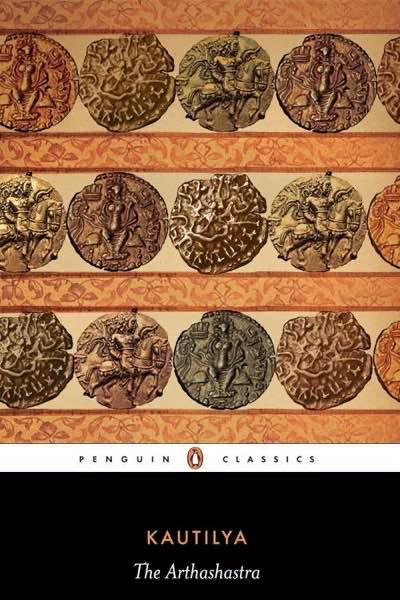
The Arthashastra is a comprehensive manual on governance and strategy written by Kautilya, the chief minister of Chandragupta Maurya, to build the Mauryan Empire (one of the largest empires in ancient India). Written around 300 BCE, this text served as an operational weapon used to overthrow the Nanda dynasty and establish one of the greatest kingdoms in Indian history.
The word "artha" means wealth or territory along with its entire population. "Arthashastra" is the science of how to acquire and protect that wealth. This is a manual for running a state: from selecting honest ministers, building tax systems, regulating trade, managing armies, to conducting intelligence operations and warfare.
What makes the Arthashastra exceptional is its methodological precision. Kautilya employs 32 logical and stylistic devices to ensure zero ambiguity. Every concept is clearly defined, every argument proven with reasoning, every rule provided with exceptions when necessary. This is an operational manual written with the precision of a scientific treatise.
Written nearly 2,300 years ago, the Arthashastra remains relevant because it understands human nature and organizational dynamics with profound depth. Principles about leadership, anti-corruption systems, diplomacy, and military strategy still apply today. For anyone who wants to understand how organizations work, whether states, businesses, or communities, the Arthashastra offers timeless wisdom.
Key Takeaways
-
The state as an interdependent system - A state consists of seven elements: the king, ministers, territory with population, fortified city, treasury, army, and allies. None stands alone. True strength is how these elements work together.
-
Just punishment is the foundation of order - Without fair coercion (danda), the law of the jungle prevails. Punishment too harsh breeds resentment, too lenient creates anarchy. Only proportional and impartial punishment protects society.
-
Corruption cannot be fully prevented, but it can be detected - Just as it's impossible to avoid tasting honey on the tip of the tongue, officials handling state money will be tempted. A good system makes corruption easy to detect through strict accounting, layered audits, and constant surveillance.
-
A healthy economy is state power - State wealth comes from mining, agriculture, trade, and industry. The king must facilitate economic activity with good infrastructure, fair taxes, and protection from exploitation. The prosperity of the people is the prosperity of the state.
-
Intelligence is the king's eyes and ears - Without a strong spy network, the king is blind to threats. Secret agents must be recruited based on specific expertise and tested loyalty. Information confirmed by three independent sources is considered true, cross-validation prevents disinformation.
-
Diplomacy is better than war if results are equal - There are six methods of foreign policy: peace, war, neutrality, mobilization, seeking protection, and dual policy. War is expensive in lives, money, and time. If you can get what you want without war, do it.
-
Justice builds long-term legitimacy - A king who protects his people according to law will be loved. An unjust king will be hated and eventually overthrown. Law functions as the social contract between ruler and ruled.
Foundations of State and Leadership
Seven Elements of the State
Kautilya builds his theory of state upon seven constituent elements that cannot stand alone. This is an interdependent system.
The king is the head of state, like the head to the body. Whatever character the king possesses, the other elements will also possess. The ideal king has three groups of qualities: leadership (born of noble family, courageous, decisive), intellectual (eager to learn, understand, reflect), and energy (brave, quick, skilled).
Ministers are policy executors. One person cannot rule alone. The king needs ministers who are wise, honest, and loyal. They must be natives, educated in all arts, possess logical ability, and be steadfast in loyalty.
Territory and population (janapada) are the source of all wealth. Fertile land without working people produces nothing. Productive people are the state's greatest asset. All economic activity originates from the countryside.
The fortified city (durga) is where treasury and army are protected. Without fortifications, state wealth will fall to enemies. Fortifications also serve as bases for covert operations and control over the population.
Treasury (kosa) is the financial heart of the state. A king with an empty treasury will consume the vitality of his own people. Wealth must be acquired legitimately and be large enough to withstand prolonged calamity.
Army (danda) is the instrument of coercion. The ideal army is well-paid, respected, unified, and never abandoned. Forces composed of people whose loyalty has been tested are more valuable than large mercenary armies.
Allies (mitra) are external constituent elements. The best allies are those with long-term interest in your success, drawn together by shared stakes that outweigh purchased loyalty. Allies based on hereditary friendship or fear of a common enemy are more reliable.
Key insight: What's impressive about Kautilya's model is understanding that state power flows from how the elements work together. True power emerges from their integration. A bad king can destroy a wealthy kingdom. A good king can build a kingdom from weak foundations.
The King as Rajarishi
Kautilya has a unique ideal for the king: rajarishi (king-sage). This is a combination of temporal power and spiritual wisdom, woven into one figure.
The king must master six internal enemies before he can master external enemies: lust, anger, greed, vanity, arrogance, and recklessness. Many kings were destroyed by falling to one of these. Ravana (the demon king in the Hindu epic Ramayana) was destroyed by lust. Duryodhana (a character in the ancient Indian epic Mahabharata) was destroyed by vanity. A king who cannot defeat himself will never lead wisely.
The king's life is not about unlimited luxury. Of 24 hours per day, only 10.5 hours for personal matters (eating, recreation, sleep). The rest for administration, defense, intelligence, and serving the people. A lazy king creates lazy subjects. A diligent king creates a prosperous state.
Most importantly: "In the happiness of his subjects lies his happiness. In their welfare lies his welfare." This is an operational principle that shapes every decision. A king who cares only for his own pleasure will be hated and overthrown.
The rajarishi concept is relevant for modern leadership. Effective leaders are those who can control themselves, work tirelessly for a purpose greater than themselves, and place the welfare of the team or organization above personal interests. Kautilya teaches that true leadership begins with self-discipline.
Anti-Corruption Systems and Administration
Realism About Human Nature
Kautilya is not naive about human honesty. He writes one of the sharpest observations about corruption in a famous analogy: "Just as it is impossible not to taste honey or poison placed on the tip of the tongue, it is impossible for one dealing with public funds not to taste a little of the state's wealth."
"Just as fish in water drink undetected, government officials managing state funds can misappropriate money without visible traces."
This is realism about how power and money interact with human nature. A good system is one that makes corruption easy to detect.
Three Types of Misappropriation
Kautilya identifies three ways officials "eat" state wealth:
First, collecting too little, causing loss of state revenue. Second, collecting too much, draining the people and destroying their productive capacity. Third, spending all without surplus, consuming labor without creating value.
All three are forms of misappropriation. The ideal is collecting fair revenue and managing expenditures to leave a surplus.
Anti-Corruption Mechanisms
Kautilya builds a layered system to detect and prevent corruption:
Strict accounting systems. Every transaction must be recorded with dates. All accounts must be audited periodically. Account books must be written clearly without corrections. Late submission of accounts will be punished.
Job rotation. Department heads must not remain permanently in one job. This prevents them from building deep corruption networks or feeling untouchable.
Fair salaries. Total state payroll should be about a quarter of state revenue. Well-paid officials are less tempted to steal. This is anti-corruption strategy expressed through the wage budget.
Layered surveillance. Secret agents monitor civil servants. Accountants monitor department heads. Auditors check all accounts. No single person goes unmonitored.
Proportional punishment. Officials proven corrupt must repay what was stolen, be fined according to offense severity, and be transferred to other jobs. If the offense is serious, property is confiscated and the official dismissed.
Key insight: Kautilya's anti-corruption system is remarkably modern in concept. We often think corruption is a character problem. Kautilya reminds us: corruption is a systems problem. Good people in bad systems will fall. Ordinary people in good systems will endure. Build systems that make honesty easier than corruption.
State Economy and Consumer Protection
Treasury as the Heart of Power
"Just as an elephant is needed to capture an elephant, wealth is needed to capture more wealth."
All state activities depend on the treasury. A king with an empty treasury will consume the vitality of his own people and state. State wealth comes from several main channels:
Crown property includes farmland cultivated directly or leased, mines of precious metals and iron, productive forests, and irrigation works.
State-controlled activities include textile industry, salt, liquor, and gambling. These sectors carry too much weight to be left entirely to the private market, and they generate revenue at the same time.
Taxes include customs duties (20% for imports), transaction taxes (automatic through use of different weights and measures), share of agricultural production (1/6), and various service fees.
Trade generates profit margins on sales of monopoly goods and exports of Crown commodities to profitable markets.
Principles of Fiscal Policy
"Just as one picks fruit from a garden when ripe, the king must collect revenue when due. Just as one does not gather unripe fruit, he must avoid taking wealth not yet due because it will anger the people and damage that revenue source itself."
This is wisdom about timing. Taxes too high or too early will drain people's productive capacity. Taxes too low or too late will cause opportunities to be lost. The art of governance is knowing the right time.
Consumer Protection Is Not Secondary
Kautilya understands that merchants, though important for the economy, have incentives to cheat. He provides detailed descriptions of how goldsmiths can steal from customers: fraud in weighing, metal substitution, exchange of contents from hollow items, scraping gold with sharp tools.
The consumer protection system includes standardization of weights and measures, all measuring instruments must be purchased from the state, inspected and stamped every four months. Profit margin controls set at 5% for local goods, 10% for imports. Violating merchants are fined. Prohibition of fraudulent practices like cartel formation, counterfeiting, and selling damaged goods as good, all heavily punished. Guild guarantees ensure all goods entrusted to craftsmen are guaranteed by the guild. The guild is responsible if goods are lost or damaged.
Kautilya teaches that a free market without regulation is an invitation to fraud. Consumer protection is about justice and about maintaining the trust that makes the economy function. When consumers don't trust merchants, trade collapses. A wise state facilitates trade by ensuring honesty and refusing to permit exploitation.
Law and Justice
Four Sources of Law
Every dispute must be decided based on four sources of law, in order of increasing importance:
First, dharma, universal truth or righteousness applicable to all people. Second, evidence, testimony from trustworthy people. Third, custom, traditions accepted by people in a region. Fourth, written law, laws proclaimed by the king.
This hierarchy provides flexibility while remaining grounded in moral principles. When conflict occurs, dharma is the ultimate moral compass.
Judges as Enforcers of Dharma
Judges are called dharmastha, enforcers of dharma (righteousness or cosmic law). This is a sacred duty that carries administrative responsibility. Judges must be objective and impartial to gain people's trust.
Prohibited judicial behaviors are very specific: must not threaten plaintiffs, must not abuse anyone, must not give instructions on how to answer questions, must not coach witnesses, must not refuse cases with pretexts, must not create unnecessary delays.
If judges violate these rules, they are fined. If repeated, fined double and dismissed. These are concrete checks and balances.
Protection for the Weak
Judges must take up the affairs of gods, Brahmins (priests in the Hindu caste system), ascetics, women, minors, the elderly, the sick, and the helpless, even if they do not approach the court. No cases from them may be refused.
This is legal protection for the weak. The state has a proactive obligation to ensure justice for those who cannot fight for it themselves.
Proportional Punishment
"Only the force of punishment, when executed impartially according to the fault, and regardless of whether the punished is the king's son or an enemy, protects this world and the next."
Basic principle: punishment must fit the offense. Too light, no deterrent effect. Too heavy, creates resentment and rebellion. For every crime, there are three levels of punishment: highest, medium, and lowest. Judges must determine which level by considering context.
Kautilya's legal system teaches that justice depends on good laws and on their consistent and impartial application. People want rules and they want certainty that rules apply to everyone, without exception. A just king will be loved. An unjust king will be hated and eventually overthrown.
Intelligence Operations and Secret Warfare
Intelligence as the King's Eyes and Ears
After appointing ministers, the next high-priority task is creating a secret agent network. Why? Because these agents are necessary to ensure kingdom security and advance expansion goals.
Kautilya's intelligence system is highly sophisticated. There are agents who stay in one place (samstha) and those who roam (sattri). There are assassins (tikshna), poisoners (rasada), and wandering nuns (parivrajika). Each has specific expertise.
Agents can disguise themselves as monks, merchants, physicians, entertainers, domestic servants, even criminals. There are 29 categories of disguise with 50 subtypes. The right disguise is determined for each situation.
Intelligence is gathered from roaming spies, collected at stationary spy bases, and sent through codes. If transmission is difficult, messages are sent through songs, signs, or hidden inside musical instruments.
Important principle: information confirmed by three different spies is considered true. This is cross-validation. One source could be wrong or lying. Three independent sources provide high confidence.
Subversion Is More Efficient Than Frontal Attack
"Extraordinary results can be achieved by practicing methods of subversion. One assassin can accomplish, with weapons, fire, or poison, more than a fully mobilized army."
Kautilya advocates using covert operations to weaken enemies from within: bribing key enemy officials to betray, creating distrust between enemy king and his generals, spreading false rumors to weaken morale, using propaganda to make enemy troops desert, and secretly killing the enemy king with poison or assassins.
This is force multiplication. Why send 10,000 troops if one trained agent can kill the enemy king?
For modern readers, Kautilya's intelligence system might seem like an Orwellian dystopia. From Kautilya's perspective, this is a necessity for survival. A kingdom without good intelligence is a blind kingdom. A blind kingdom will be defeated by enemies who can see. This principle still applies: information is power. Cross-validation is a universally good principle. Never act on information from one source alone.
Foreign Policy and Diplomacy
The Circle of States: Mandala Rajanam
The most famous concept from Kautilya's theory is mandala rajanam (circle of states). This is a model of geopolitical relationships based on geographic proximity.
Basic principle: your neighbor's enemy is your friend. Why? Because you both have a shared interest in weakening the enemy between you. This is about interests structured by geography, set firmly above sentiment.
The circle model starts from vijigishu (the conqueror), yourself. Then ari (enemy), your immediate neighbor. Then mitra (ally), your enemy's neighbor. And ari-mitra (enemy in the rear), your enemy's ally. This pattern continues up to a maximum of twelve kings.
There are also two special actors: madhyama (the Middle King), stronger than both conqueror and enemy, sharing borders with both. And udasina (the Neutral King), even stronger than the Middle King, sharing no borders.
Six Methods of Foreign Policy
The conqueror must master six methods and use them flexibly:
Sandhi (peace) is making treaties with certain conditions. Vigraha (war) includes open battle, secret war, or diplomatic attack. Asana (neutrality) is a pause in implementing already-started policy. Yana (mobilization) is preparation for military campaign. Samsraya (seeking protection) is an option for weak kings. Dvaidhibhava (dual policy) is playing both sides simultaneously.
Important principle: peace is preferable to war if both choices yield the same result. War involves loss of troops, costs, and absence from home. If you can get what you want without war, do it.
General guideline: make peace with kings equally strong or stronger. Wage war only with weaker ones. Then there are series of exceptions when contrary policies must be followed, this shows Kautilya's flexibility.
Advice for the Weak King
"One must not surrender spineless or sacrifice oneself in foolish courage. Better to adopt such policy that will allow one to survive and live to fight another day."
Options for weak kings include seeking protection from a stronger king, taking refuge in a fortress until the situation changes, making unfavorable peace to avoid total destruction, using secret warfare if unable to win in open battle, and waiting for opportunity, the aggressor may face problems that weaken him.
Kautilya's foreign policy theory has universal validity. Geography still determines natural alliances. Relative power still determines policy. Peace is still better than war if results are equal. Alliances are still built on interests, with friendship as a secondary thread. What distinguishes Kautilya is the detail and logic of his analysis.
Defense and Warfare
The Ideal Army
The ideal army must be well-paid, respected, kept strong, free from traitors, unified, and never abandoned. Morale determines victory more than raw strength.
There are six types of forces, from most to least reliable: standing army (natives, loyal by heredity), territorial troops (raised for specific campaigns), organized militia (natives, acting as groups), allied forces (hired or bought from other kings), foreign forces (fighting for their own reasons), and forest tribe forces (commanded by their own chiefs).
Better to mobilize those earlier in the list than later. Foreign forces and forest tribes both have plunder as their goal, they are equally untrustworthy.
Four Types of War
Mantra yuddha (war with counsel) uses diplomacy, especially when the king is in a weaker position. Prakasa yuddha (open war) is pre-arranged battle with determined place and time. Kuta yuddha (concealed war) uses psychological warfare and incitement of treachery. Guda yuddha (secret war) employs covert methods, usually assassination.
"The archer who releases arrows may kill one person, but the wise man who uses his intelligence can kill even to the womb."
The wise strategist knows when to use each. Diplomacy is cheaper than war. Secret war is more efficient than frontal battle.
Ethics of War: Dharma in Conquest
Even in war, there are moral rules. War according to dharma determines place and time of battle beforehand. This is agreed-upon battle where both sides have equal opportunity to prepare, far removed from dishonorable surprise attack.
In conquered territories, the conqueror must continue the practice of all customs consistent with dharma, and must introduce those not previously observed. Likewise, he must stop practices inconsistent with dharma.
Important principle: the conqueror must not destroy local culture unless it contradicts dharma. Justice builds long-term legitimacy. A cruel conqueror will face constant rebellion. A just conqueror will build a lasting kingdom.
Kautilya teaches that victory means defeating enemies on the battlefield and building stable peace afterward. True victory is the lasting order that follows war. War is a tool to achieve peace, and peace is the destination. This is what distinguishes the wise conqueror from the brutal conqueror.
Critical Assessment
Strengths
1. Extraordinary methodological precision
The Arthashastra uses 32 logical and stylistic devices to ensure zero ambiguity. Every concept is clearly defined, every argument proven with reasoning. This is an operational manual that can be implemented directly, written with the discipline of a technical treatise.
2. Comprehensive and layered systems
Kautilya goes beyond general principles. He provides concrete systems with checks and balances mechanisms. His anti-corruption system with layered audits, job rotation, and cross-validation is remarkably modern in concept. The intelligence system with 29 disguise categories shows depth of operational thinking.
3. Deep understanding of human nature
Kautilya is realistic about human motivation. He builds systems that work with human nature as it actually is, accepting tendencies toward self-interest and corruption as constants to be designed around. This makes his principles more durable and more applicable.
4. Relevance across time and context
Principles about systems being stronger than brilliant individuals, corruption as a systems problem not character problem, diplomacy better than war if results are equal, all these remain valid 2,300 years later. The Arthashastra teaches universal principles about organization and power.
Limitations
1. Situational morality that can be abused
Kautilya advocates using deception, subversion, and even assassination as policy tools. While he frames it within dharma context, the line between wise realpolitik and amoral Machiavellianism can be very thin. Uncritical readers could misuse these principles to justify unethical actions.
2. Rigid social hierarchy
The Arthashastra was written in the context of a rigid varna (caste) system. While Kautilya emphasizes protection for the weak, he doesn't question the hierarchical social structure itself. For modern readers who believe in fundamental equality, this aspect will feel outdated.
3. Lack of discussion about popular participation
Kautilya's model is top-down: a wise king rules for the people's welfare. There are no mechanisms for popular participation in decision-making or democratic accountability. In modern context, this is a significant limitation.
4. Extreme pragmatism that can erode values
Exclusive focus on effectiveness and results can erode deeper value considerations. Questions like "Is this goal worth pursuing?" or "Is there a better way of life than merely accumulating power?" do not receive adequate attention.
Conclusion
The Arthashastra is a must-read for anyone serious about strategy, leadership, or governance. This is a manual to study, consider, and apply wisely, demanding active engagement at every page.
Who should read this: organizational leaders, strategists, policy makers, entrepreneurs, anyone who wants to understand how power works in organizations. Who should not read this without criticism: those seeking justification for unethical actions, or those who cannot distinguish between pragmatism and amorality.
Rating 5/5 because no other work teaches the reality of power and organization with equal depth and precision. The Arthashastra has flaws, and yet it stands alone in its class. This is a strategy education equivalent to a full university in one book.
Related Content
Explore further concepts and applications:
- Mental Model: Second-Order Thinking, Systemic thinking as Kautilya taught about long-term consequences
- Essay: True Leadership, Deep exploration of rajarishi and self-discipline in leadership
- Mental Model: Geopolitical Mandala, Kautilya's circle of states theory in modern geopolitical analysis
- Resource: The Prince - Machiavelli, Comparison of Western and Eastern realpolitik
FAQ
Q: Is the Arthashastra only relevant for governance or also for business?
A: Highly relevant for business. Principles about anti-corruption systems, organizational structure, employee incentives, consumer protection, and competitive strategy can be directly applied in modern companies. Mandala rajanam is a model for understanding competitive ecosystems.
Q: How does the Arthashastra differ from Machiavelli's The Prince?
A: The Arthashastra is far more comprehensive and systematic. Machiavelli focuses on how to seize and maintain power. Kautilya provides a complete manual for running a state: economics, law, administration, and war. Kautilya is also more explicit about dharma as a moral framework.
Q: Is Kautilya's intelligence system ethical to apply in modern organizations?
A: Cross-validation and strategic information gathering are ethical and necessary. Assassination and subversion are clearly unethical in modern business context. What can be taken is the principle: information is power, cross-validation prevents disinformation, and identify threats before they threaten you.
Q: What is meant by the rajarishi concept and why is it important?
A: Rajarishi is king-sage: combination of temporal power and spiritual wisdom. The king must master six internal enemies (lust, anger, greed, vanity, arrogance, recklessness) before he can lead wisely. This teaches that true leadership begins with self-discipline.
Q: How does Kautilya handle the dilemma between pragmatism and morality?
A: Kautilya frames all actions within dharma context. Punishment must be just and proportional. War must follow certain rules. Conquered territories must be treated justly. While pragmatic about methods, he doesn't abandon the moral framework entirely.
Q: Is Kautilya's anti-corruption system realistic to implement?
A: Highly realistic. Transparency, layered audits, job rotation, competitive salaries, and constant surveillance are best practice in modern organizations. What's brilliant about Kautilya is understanding that corruption is a systems problem rooted in structure as much as in individual character.
Q: What is the most important lesson from Kautilya's foreign policy theory?
A: Geography determines interests, interests determine alliances. Peace is better than war if results are equal. Alliances based on long-term interests are more reliable than those bought with money. Weak kings must survive to fight another day.
Q: How can the seven-element state concept be applied in organizations?
A: In business: leader (CEO), executive team (ministers), productive employees (people), headquarters (fortress), capital (treasury), enforcement capacity (army), and strategic partners (allies). Organizational strength flows from how these elements work together, beyond the mere existence of each.
Q: Why does Kautilya emphasize consumer protection in an ancient state?
A: Because he understands that trust is the foundation of trade. When consumers don't trust merchants, trade collapses. Consumer protection is an economic strategy to keep markets functioning and the state prosperous, with justice for buyers as a built-in result.
Q: Is the Arthashastra still relevant in the era of modern democracy?
A: Principles about strong systems, checks and balances, protection for the weak, impartial justice, and leadership that serves the people, all very relevant. What needs adjustment are mechanisms for popular participation and democratic accountability that don't exist in Kautilya's model.