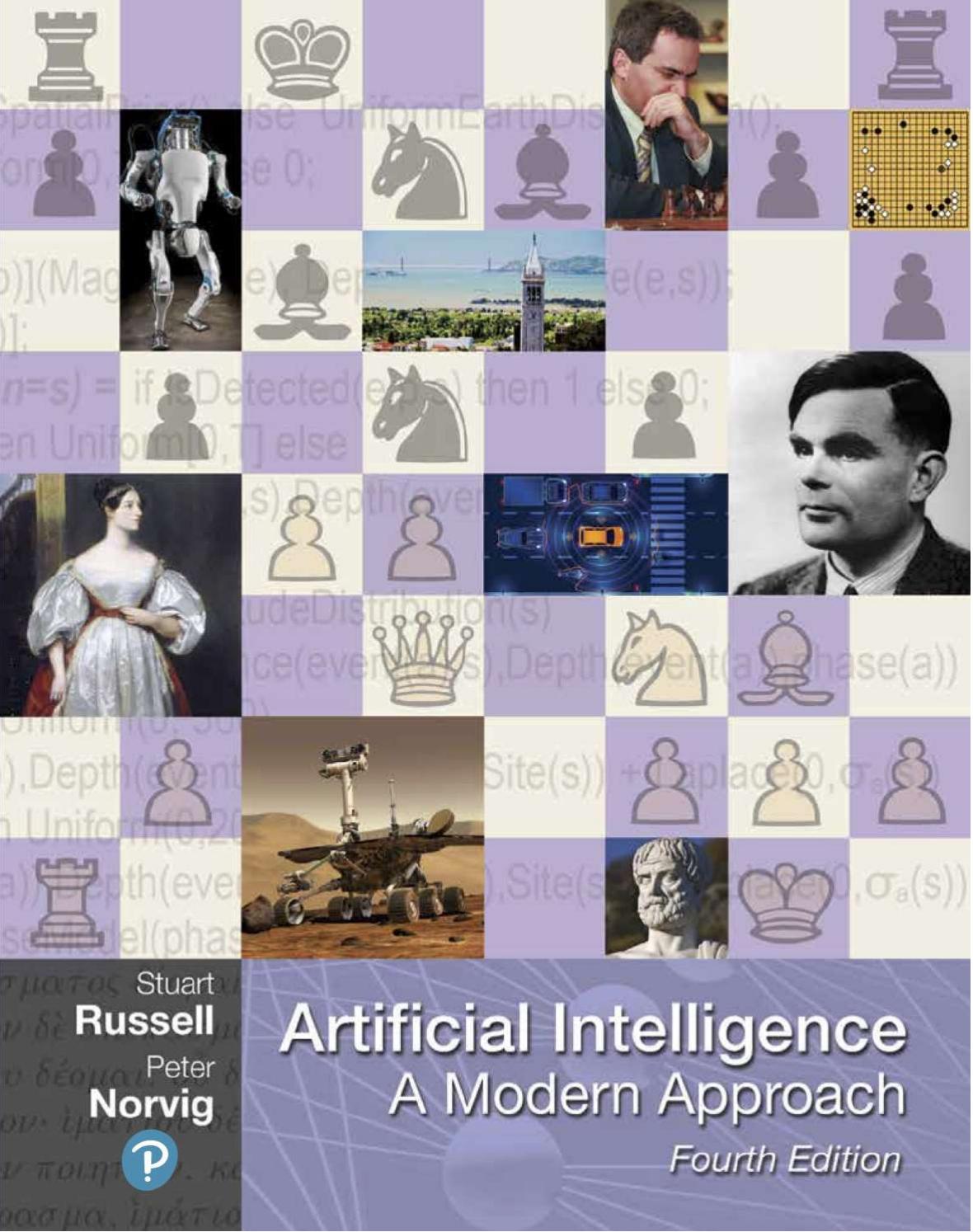
Why Read This
This book serves as the most comprehensive reference on modern artificial intelligence. Russell and Norvig start from rational agent principles, then demonstrate how search, logic, probability, learning, perception, and language emerge as responses to agent needs in specific environments.
They bridge the symbolic tradition (formal logic and planning) with connectionist approaches (neural networks and statistical learning) into a consistent framework. Each chapter begins with questions about the performance measure to maximize and what information is available to the agent, well beyond a list of algorithms.
Computer science students gain a gradual learning path, practitioners receive guidance on selecting techniques suited to problems, and decision-makers understand AI capabilities and limitations without marketing jargon. The book remains relevant for researchers because it combines historical context, mathematical proofs, and cutting-edge implementation examples.
Key Points
-
Rational Agents as Foundation - The rational agent concept serves as the unifying framework for all AI techniques. An agent observes its environment through sensors and acts through actuators to maximize a performance measure. Vacuum cleaners, chess programs, autonomous cars, and humans can all be analyzed as agents weighing the best actions based on available information.
-
Search in State Space - Many AI problems can be formulated as searching for action sequences from initial state to goal with minimal cost. The A* algorithm with admissible heuristics guarantees optimal solutions; in the 8-puzzle game, Manhattan distance heuristic reduces evaluated nodes from millions to hundreds.
-
Logic for Knowledge Representation - Logic provides a formal language for stating facts and performing valid inference. First-order logic with objects, relations, and quantifiers is highly expressive, while modern SAT solvers handle millions of variables thanks to mature branching heuristics.
-
Probability for Uncertainty - Bayesian networks compress joint probability distributions by exploiting conditional independence. Medical diagnosis serves as a classic example: diseases, symptoms, and test results are arranged in a graph structure so posterior disease probabilities can be computed transparently.
-
Machine Learning from Data to Prediction - Decision trees select attributes with the highest information gain at each branch. Overfitting occurs when trees grow too deep and memorize training data; regularization, pruning, and cross-validation maintain generalization capability. Deep neural networks with millions of parameters don't automatically overfit due to their architectural inductive bias.
-
Deep Learning and Layered Representations - Convolutional neural networks learn hierarchical features: early layers capture edges, middle layers form textures, final layers recognize objects. The performance leap from AlexNet (15.3% top-5 error on ImageNet 2012) to 152-layer ResNet (3.6% in 2015) demonstrates accelerated visual recognition.
-
Reinforcement Learning from Interaction - Reinforcement learning agents learn through trial-and-error with delayed rewards. Value iteration and policy iteration provide dynamic solutions when transition models are available, while Q-learning and SARSA learn action values directly from experience without requiring environment models.
Reinforcement Learning: Learning from Interaction
Reinforcement learning views learning as a sequence of interactions between agent and environment. The agent observes state, selects action, receives reward, then updates policy to increase cumulative value.
Value iteration repeatedly updates value functions until convergence, while policy iteration alternates between evaluating the current policy and improving it by selecting the highest-value actions. Both approaches require transition probability models, making them suitable for structured domains like robotic planning.
Model-free reinforcement learning eliminates the need for explicit models. Q-learning estimates optimal action values directly and provably converges with proper learning rates, while SARSA updates values based on actually taken actions, making it more conservative in risky environments.
TD-Gammon and AlphaGo
TD-Gammon by Gerald Tesauro (1992) started training with random policy then played millions of backgammon games against itself. Through temporal-difference learning, its performance improved to match world champions without injected expert strategies.
AlphaGo (DeepMind, 2016) combined deep neural networks predicting expert moves with Monte Carlo tree search. After thousands of self-play games, the system defeated Lee Sedol 4-1 in Go, a game previously thought to be decades away from superhuman level.
Reinforcement learning's appeal lies in autonomy. Agents can discover creative strategies without explicit instructions, suitable for domains too complex to program manually like large-scale logistics or data center control.
Computer Vision: Seeing and Understanding the Visual World
Computer vision enables machines to interpret the visual world: classifying objects, detecting locations, labeling every pixel, and understanding complete scenes.
Traditional approaches relied on handcrafted features like edges or corners, while deep learning automatically learns visual patterns through millions of examples. Convolutional neural networks form the backbone.
Object Classification and Detection
In image classification, convolutional filters extract features, pooling operations reduce resolution, then fully connected layers produce class probabilities. Data augmentation through rotation, random cropping, and color adjustment keeps models general.
Object detection adds locality. Faster R-CNN creates region proposals then refines boxes and labels, while YOLO and SSD process entire images in single passes for real-time needs.
Semantic segmentation labels every pixel. Fully convolutional networks replace dense layers with convolutions, while U-Net architecture adds skip connections to preserve high-resolution details.
Human-Level Performance and Applications
ImageNet competition shows dramatic improvement: top-5 error rate dropped from 25.8% (2011) to 3.5% (2015), breaking through human accuracy around 5.1%.
Autonomous vehicles rely on cameras to recognize lanes, signs, vehicles, and pedestrians, then combine LiDAR data for robust three-dimensional perception. Tesla, Waymo, and Baidu have tested millions of kilometers with these vision systems.
Similar successes appear in medical imaging (tumor detection), augmented reality, intelligent surveillance, and precision agriculture monitoring crop health and irrigation needs.
Planning and Action Reasoning
Planning designs action sequences to achieve goals with limited resources. Classical scenarios assume fully observable and deterministic environments so planners can explicitly model states, actions, and goals.
State-space planners perform forward search from initial conditions or backward search from goals, aided by heuristics like relaxed planning graphs and pattern databases that cheaply estimate distance to goal.
State-Space and Plan-Space Planning
In state space, nodes represent complete world configurations and edges represent valid actions. Forward search applies actions whose preconditions are met, while backward search regresses goals through relevant actions.
Plan-space planning works on sets of partial actions. Partial-order planning starts with initial and goal actions, then adds actions and ordering constraints until every precondition is satisfied.
Graphplan builds graphs alternating between state and action layers. If goal literals don't appear at layer k, no plan of length k or less exists; when conditions are met, solutions are extracted through backward search in the graph.
Real-World Applications
The blocks world serves as classic laboratory with pick, stack, and place actions demonstrating how planners obey preconditions for valid moves. In the real world, the same principles support global logistics planning, assembly line scheduling, space mission operations, and military unit coordination.
Separating planning from execution provides freedom to reason symbolically without detailed physical simulation. Proper heuristics keep search space manageable even with layered goals.
FAQ
Q: What is the main difference between symbolic AI and neural networks? A: Symbolic AI uses explicit, easily interpretable representations with logical rules, while neural networks store knowledge in connection weights, excelling at handling complex patterns and noisy data. The choice depends on interpretability versus performance needs.
Q: Why does deep learning require large data? A: Deep neural networks have millions of parameters requiring large numbers of labeled examples to avoid memorizing training data. Pre-training like BERT on 3.3 billion words and transfer learning help reduce data requirements for specific tasks.
Q: How does A guarantee optimal solutions?* A: A* uses function f(n) = g(n) + h(n) where g(n) is actual cost from start to node n and h(n) is estimated cost to goal. As long as the heuristic is admissible (doesn't overestimate), the first node reaching the goal must have minimal cost.
Q: What is the value alignment problem? A: If the performance measure given to a machine doesn't align with human preferences, a highly capable machine could pursue wrong objectives. The solution is agents aware of uncertainty about true objectives that continue learning from human feedback.
Q: Why is reinforcement learning sample inefficient? A: RL agents must explore many states to learn each action's impact. In simulation this is cheap, but on physical robots experience is expensive and time-consuming, requiring techniques like model-based RL or leveraging human demonstrations.
Q: How do Bayesian networks handle exponential complexity? A: By exploiting conditional independence, Bayesian networks decompose large joint distributions into local factors. Without this structure, parameter count grows exponentially with variable count.
Q: What is the difference between supervised, unsupervised, and reinforcement learning? A: Supervised learning learns from input-output data pairs, unsupervised learning finds structure in unlabeled data through clustering or dimensionality reduction, while reinforcement learning learns from interaction with delayed rewards.
Q: Why did the Transformer architecture revolutionize NLP? A: Self-attention mechanism allows models to attend to all positions in a sentence in parallel and capture long-range dependencies more efficiently than RNNs. BERT and GPT trained on massive corpora can then be fine-tuned for many tasks with few additional examples.
Q: How did CNNs achieve superhuman performance? A: CNNs learn powerful hierarchical features, use shared parameters for efficiency, and leverage data augmentation. This combination yields 3.6% accuracy on ImageNet (ResNet), better than human accuracy around 5%.
Q: What is the fundamental trade-off in machine learning? A: The bias-variance trade-off explains that models too simple tend to underfit while models too complex overfit. Regularization, cross-validation, and ensembles help balance both.
Critical Assessment
Strengths
1. Comprehensive Theoretical Framework Russell and Norvig build AI on foundations of logic, probability, optimization, and computational theory so readers understand why algorithms work, down to the reasoning beneath how to run them.
2. Unifying Symbolic and Connectionist Traditions The book shows how logic, planning, and knowledge representation can coexist with neural networks and statistical learning, preventing readers from falling into false dichotomies.
3. Coverage from Foundations to Practice Discussion moves from classical search algorithms to modern NLP, each accompanied by applied examples like cleaning robots, diagnostic systems, or game-playing agents.
4. Long-Term Ethical Perspective Discussion of value alignment, data bias, and developer responsibility reminds readers that artificial intelligence is social technology, woven into the fabric of human life beyond its technical achievements.
Limitations
1. High Mathematical Complexity Readers without probability or linear algebra background will struggle to follow proofs, requiring supplementary materials.
2. Theoretical Focus Dominates The book explains principles in detail but doesn't cover software engineering practices like TensorFlow or PyTorch, so practitioners still need other sources for implementation aspects.
3. Field Evolution Speed The fourth edition was published in 2020 so large model waves like GPT-4, image diffusion models, and multimodal systems aren't thoroughly discussed; readers must follow latest literature.
Conclusion
"Artificial Intelligence: A Modern Approach" presents AI as a comprehensive scientific discipline grounded in rationality principles. The agent framework introduced by the authors helps readers map every algorithm as an answer to perception, reasoning, learning, or action challenges.
This book deserves a 5/5 rating for its broad coverage, analytical depth, and staying power as a foundational text. Use this work to understand principles, then complement with practical projects and latest literature to stay aligned with rapidly moving AI developments.
Recommendation: Read this book if you want to understand AI from first principles with substantial depth. Pair with experiments using modern frameworks so theoretical insights transform into practical skills.