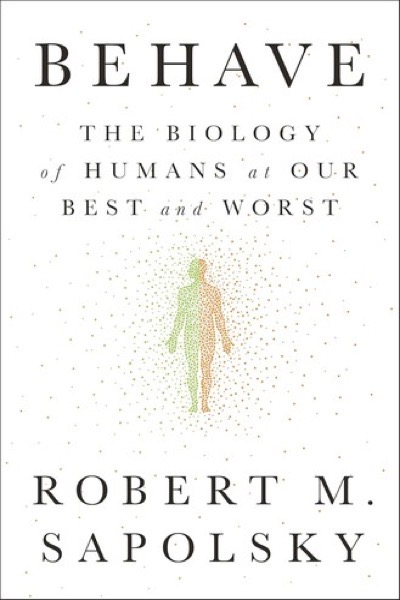
Why Read This
Sapolsky traces human behavior from brain activity seconds before an action, to hormones hours earlier, to childhood experiences, to evolution millions of years ago. Why do humans do what they do, both at their best and worst? This book answers by integrating neuroscience, endocrinology, behavioral genetics, and anthropology to demonstrate that behavior is the result of complex interactions between genes, hormones, culture, and evolutionary history.
What makes Sapolsky's approach so powerful is his refusal to simplify. We live in an era obsessed with easy answers, "it's in the genes," "it's childhood trauma," "it's culture." Sapolsky demolishes these false dichotomies by showing that every human action results from dozens of interacting layers of causality.
This book matters because it strikes directly at the heart of determinism, both biological and cultural. This understanding has major implications for legal systems (are criminals "destined" by genetics?), social policy (how to reduce violence?), and how we understand ourselves.
Key Takeaways
-
Gene-environment interactions determine behavior - The same genes can produce opposite behaviors in different environments. Genetically identical mouse strains showed 700% different responses to cocaine in different laboratories. IQ heritability is 70% in wealthy children, only 10% in poor children.
-
The "warrior gene" is a dangerous myth - The MAO-A variant only predicts antisocial behavior when combined with severe childhood abuse. In healthy environments, this variant predicts nothing. Sapolsky shows that in a Dutch family with MAO-A mutation, some members were violent, others merely exhibitionists.
-
Culture shapes biology, biology shapes culture - The dopamine gene variant DRD4-7R is found in 70% of Amazon populations (descendants of migrants), only 1% in East Asia. When Asians domesticated rice and built collectivist societies 10,000 years ago, there was massive selection against this sensation-seeking variant.
-
Social inequality has biological consequences - Relative poverty predicts poor health and crime more sharply than absolute poverty does. Inequality erodes social capital and increases chronic stress. Air rage study shows: if a plane has a first-class section, air rage incidents in economy class increase 4-fold.
-
Context is everything - The question "what does this gene do?" is almost always wrong. The right question is "what does this gene do in a specific environment?" Donald Hebb: "It's no more appropriate to say characteristic A is more influenced by nature than nurture than to say the area of a rectangle is more influenced by its length than its width."
-
Behavioral causality is layered - Every action results from brain activity seconds before, hormones hours before, childhood experiences years before, culture thousands of years before, evolution millions of years before. No single factor "causes" behavior deterministically.
Gene-Environment Interactions: Context is Everything
The question "what does this gene do?" is almost always wrong. The right question is "what does this gene do in a specific environment?" Nearly all genetic effects on behavior show dramatic gene-environment interactions, where the same gene can produce opposite behaviors in different environments.
Study of Genetically Identical Mice in Three Laboratories
Sapolsky presents a classic 1999 study examining genetically identical mouse strains in three different laboratories (Oregon, Alberta, Albany). Scientists obsessively standardized everything, mice were given the same van ride to simulate shipping jostles, tested at the same age and time, lived in cages of the same brand with sawdust of the same thickness, handled with surgical gloves of the same brand, fed the same food, kept at the same temperature.
The results were shocking. Take the 129/SvEvTac strain and measure cocaine's effect on activity. In Oregon cocaine increased activity by 667 centimeters per 15 minutes. In Albany, 701 centimeters. Pretty similar numbers. And in Alberta? Over 5,000 centimeters.
This is like identical twins pole-vaulting in different locations with identical training, equipment, and conditions, two people jump 18 feet, and the third jumps 108 feet. Extremely subtle (and still unidentified) environmental differences make massive differences in what genes do.
IQ Heritability Depends on Socioeconomic Status
IQ heritability is very high (around 70%) in children from high socioeconomic status families. In children from poor families? Only about 10%. This means genes are almost irrelevant to cognitive development if you grow up in terrible poverty, poverty's negative effects overwhelm genetics.
The implication is radical: we can't understand behavior by studying genes in isolated laboratories. The more different environments we study, the more we find that genetic effects are context-dependent, and the smaller the heritability scores become.
Key insight: This directly challenges the "nature versus nurture" concept that still dominates public discourse. Media loves headlines like "Gene for X found," as if there's simple genetic determinism. The reality is far more meaningful and complex.
The "Warrior Gene" Myth: Dangers of Genetic Determinism
The MAO-A gene variant called the "warrior gene" by media only predicts antisocial behavior when combined with severe childhood abuse. Without trauma, this gene variant predicts nothing. This sensational label has led to flawed legal decisions, including reduced prison sentences for murderers based on claims they were "genetically destined" for violence.
How the MAO-A Gene Works
The MAO-A gene encodes an enzyme that degrades serotonin in the brain. The low-activity variant produces more serotonin at synapses, which is associated with more fear reactivity and impulsive aggression. This effect only emerges in specific environmental contexts.
Avshalom Caspi's Study: MAO-A and Childhood Abuse
A 2002 study by Avshalom Caspi, one of Sapolsky's favorites, followed a large cohort of children from birth to age 26. The question: does MAO-A variant status predict adult antisocial behavior?
Answer: no. Having the low-activity version of MAO-A tripled the likelihood of antisocial behavior, but only in people with a history of severe childhood abuse. If there was no such history, the variant predicted nothing.
This is the essence of gene-environment interaction. What's the relationship between MAO-A and antisocial behavior? It depends on the environment.
The "Flasher Gene"? Exposing Media Oversimplification
Sapolsky notes that even in the famous Dutch family with MAO-A mutation, antisocial behavior varied widely. While some individuals were extremely violent, others showed exhibitionism (exposing genitals). So this gene may be equally responsible for explaining why some family members became flashers and others became aggressive. There's as much reason to call it the "flasher gene" as the "warrior gene."
Key insight: The "warrior gene" label is a perfect example of how science can be misused when oversimplified. In healthy environments, the MAO-A variant might only manifest as temperament variation within the normal range. The same characteristics, increased threat sensitivity, weaker emotional control, enhanced fear memory, in harsh childhood environments could predispose to overt aggression.
Collectivist vs Individualist Cultures: The Biology of Cultural Differences
The difference between collectivist cultures (East Asia) and individualist cultures (the West) runs deeper than taught social values, with profound biological correlates. From the distribution of dopamine gene variants, to how the brain processes visual information, to where eyes focus when viewing images. Culture is biology, and biology is culture, they mutually shape each other in feedback loops that have run for thousands of years.
The Feedback Cycle: Ecology → Culture → Genetics → Neurobiology
Ecological differences determine how people make a living (rice vs wheat, farming vs herding), which shapes whether intensive cooperation is required. This shapes cultural values (collectivist vs individualist), which provides selection pressure on certain genetic variants, which shapes how brains develop, which shapes how people think and behave.
The DRD4-7R Gene: Global Distribution and Migration
The dopamine D4 receptor gene variant (DRD4-7R) is associated with novelty seeking, extroversion, impulsivity, and ADHD. Its global distribution is striking:
- East Asia (China, Japan, Taiwan, Cambodia): ~1%
- Europe and Americas: ~23%
- Populations that migrated far (Maya): ~40%
- Amazon (Ticuna, Surui, Karitiana): ~70% (highest in the world)
When East Asians domesticated rice around 10,000 years ago and established collectivist societies, there was massive selection against the 7R variant. Why? Because rice requires intensive communal labor, terracing mountains, building irrigation systems thousands of years old, rotational planting and harvesting. The 7R variant with high impulsivity and novelty seeking didn't fit in a culture where group harmony and cooperation meant survival.
Meanwhile, the descendants of people who migrated from Africa to Asia, then to North America via the Bering land bridge, and kept walking another 6,000 miles to the Amazon have the world's highest 7R frequency. These are the descendants of people who, after successfully reaching future Anchorage, decided to keep walking.
Cognitive and Perceptual Differences
Cultural differences extend to fundamental things like visual processing:
- Show a picture of someone standing in the middle of a complex scene
- East Asians more accurately remember the scene (context)
- Westerners more accurately remember the person in the middle (subject)
- Eye tracking shows: Western eyes first focus on the center, East Asian eyes scan the whole
Even simple tasks differ:
- Question: monkey, bear, banana, which two go together?
- Westerners: monkey and bear (both animals, categorical thinking)
- East Asians: monkey and banana (monkey eats banana, relational thinking)
Key insight: The Dujiangyan irrigation system near Chengdu, China, irrigates over 5,000 square kilometers of rice agriculture and is over 2,000 years old. Imagine the social coordination required to build and maintain this across dozens of generations. No wonder collectivist culture developed, and no wonder gene variants that make people impulsive and sensation-seeking were selected out.
Social Inequality: Why Gaps Make Us Cruel
Economic inequality reaches far beyond statistics and abstract moral debate, it carries real biological consequences. The bigger the gap between rich and poor, the less social capital, the unhealthier people are, and the more violence there is. Relative poverty, the feeling of being poor amid plenty, predicts poor health and crime more sharply than absolute poverty does.
The SES Gradient and Health
Across culture after culture, the poorer you are, the worse your health, the higher the incidence of various diseases, and the shorter your life expectancy. The interesting thing: subjective SES, how you feel you're doing financially compared to others, predicts health more strongly than objective SES does.
Richard Wilkinson's work shows: poverty amid plenty makes people sick, well beyond what absolute poverty alone explains. Income inequality is a major predictor of poor health, independent of absolute poverty levels.
Inequality and Violence
Income inequality levels are major predictors of violent crime rates in American states and industrialized countries. Relative poverty drives crime far more reliably than absolute poverty does.
Sadly, when inequality triggers violence, most poor people prey on other poor people, far from any class warfare against the rich. Like shocked rats biting other rats to reduce stress, or low-ranking baboons displacing aggression onto even lower-ranking individuals.
"Air Rage" Study: Class Hierarchy on Planes
Air rage frequency (passengers losing control during flights) increases dramatically if:
- The plane has a first-class section: nearly 4x higher air rage likelihood in economy class
- Economy passengers must walk through first class when boarding: more than 2x additional increase
There's nothing like starting a flight by being reminded where you fit in the class hierarchy. And when air rage happens, the result is displaced aggression toward the elderly passenger nearby or the flight attendant, while first class remains untouched by any storm of revolutionary demands.
Key insight: If you want to reduce crime and improve public health, reducing inequality might be more effective than building more prisons or hospitals. The case rests on measurable biological consequences, with moral concerns layered on top.
FAQ
Q: Do genes determine our behavior? A: Not deterministically. Genes influence behavior, but their effects almost always depend on environmental context. Genetically identical mice showed 700% different responses to cocaine in different laboratories. IQ heritability is 70% in wealthy children, only 10% in poor children.
Q: Does the "warrior gene" make someone destined for violence? A: No. The MAO-A variant only predicts antisocial behavior when combined with severe childhood abuse. In healthy environments, this variant predicts nothing. The "warrior gene" label is a dangerous myth that oversimplifies complex science.
Q: Why do East Asian cultures tend to be collectivist and Western cultures individualist? A: Ecological differences thousands of years ago shaped cultures that then shaped biology. Rice requires intensive communal labor, creating massive selection against sensation-seeking gene variants in East Asia. This is an example of culture-biology coevolution.
Q: Is economic inequality only a moral issue? A: No. Inequality has real biological consequences. Relative poverty predicts poor health and crime more sharply than absolute poverty does. Inequality erodes social capital and increases chronic stress that's biologically measurable.
Q: How long did Sapolsky spend researching this book? A: Decades. This 800-page synthesis of neuroscience, endocrinology, behavioral genetics, and anthropology reflects his career studying wild baboons in Kenya and teaching biological sciences at Stanford University.
Q: Is nature or nurture more important? A: This question is wrong. Donald Hebb: "It's no more appropriate to say characteristic A is more influenced by nature than nurture than to say the area of a rectangle is more influenced by its length than its width." Both mutually shape each other in complex feedback loops.
Q: What are the implications of this book for legal systems? A: Genetic determinism is dangerous and wrong. Reducing sentences because of the "warrior gene" is a fundamental misunderstanding. But understanding gene-environment interactions shows the importance of considering context, trauma history, social environment, access to resources.
Q: How is this book different from other popular neuroscience books? A: Sapolsky rejects the simplification that dominates popular books. Every time there's an easy answer, he shows the reality is far more complex. He integrates dozens of disciplines to show that behavior results from dozens of interacting layers of causality.
Critical Assessment
Strengths
1. Extraordinary Multidisciplinary Integration
Sapolsky synthesizes neuroscience, endocrinology, behavioral genetics, primatology, and anthropology in ways never done before. Each chapter moves from brain activity seconds before action, to hormones hours earlier, to childhood experiences, to culture, to evolution millions of years ago.
2. Refusal to Simplify
In an era of sensational headlines about "gene for X found," Sapolsky is the antidote we need. He consistently shows that reality is far more complex and meaningful than biological or cultural determinism.
3. Stunning Data
From mice in three laboratories to 2,000-year-old irrigation systems in China, from air rage studies to global distribution of dopamine genes, every claim is backed by strong empirical evidence.
4. Clear Practical Implications
This book reaches well beyond academic theory. Sapolsky shows concrete implications for legal systems, social policy, education, and self-understanding.
Limitations
1. Intimidating Length and Density
800 pages with high information density can be daunting. Many readers might struggle to finish this book, even though every section is valuable.
2. Complexity Can Be Paralyzing
While refusal to simplify is a strength, it can also make readers feel that "everything depends on everything" and there are no clear answers to any question.
3. Focus on Western Literature
Although Sapolsky discusses Asian-Western cultural differences, most studies cited come from WEIRD (Western, Educated, Industrialized, Rich, Democratic) populations. More data from non-Western cultures would strengthen the arguments.
Conclusion
Behave is a monumental work that transforms how we understand human behavior. Rating 5/5 because this book successfully synthesizes dozens of disciplines, rejects dangerous simplifications, and provides clear practical implications.
Read this book if you:
- Want nuanced understanding of nature vs nurture
- Are interested in neuroscience, behavioral genetics, or anthropology
- Want to challenge assumptions about genetic determinism
- Seek scientific foundation for social policy
- Are ready for complexity and committed to 800 pages
Don't read if you:
- Seek simple answers or practical checklists
- Aren't interested in scientific details
- Don't have time for significant reading commitment
Related Content
This book deeply explores gene-environment interactions and their implications. For a more complete learning journey, check out:
- Related Mental Models: Second-Order Thinking, Complexity Thinking, Feedback Loops, Systems Thinking
- Related Books: Thinking, Fast and Slow (Kahneman), Educated (Tara Westover), The Righteous Mind (Jonathan Haidt)
- Related Essays: On nature vs nurture, the role of genetic determinism in social policy, and implications for education
Further Reading
-
Original Studies:
- Caspi, A., et al. (2002). "Role of genotype in the cycle of violence in maltreated children." Science
- Wilkinson, R., & Pickett, K. (2009). The Spirit Level: Why Greater Equality Makes Societies Stronger
-
Works by Sapolsky:
- A Primate's Memoir
- Why Zebras Don't Get Ulcers
- Monkeyluv
-
Related to Gene-Environment:
- The Gene: An Intimate History (Siddhartha Mukherjee)
- Epigenetics (David A. Sinclair)