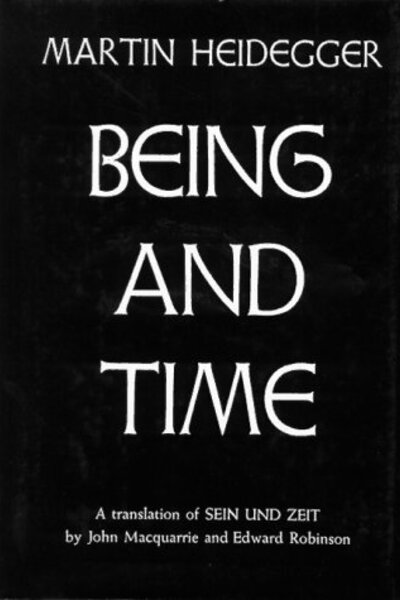
Being and Time: Heidegger's Ontology of Existence
Why Read This
Heidegger dismantles two thousand years of Western philosophy through Dasein: the being whose own existence is always at issue for it, bound to time, death, and care.
Being and Time (1927) is one of the most frequently cited works of philosophy and one of the most rarely read to the end. The reputation has its reasons: Heidegger advances a new thesis while building a new language to carry it. Every technical term, Dasein, care, thrownness, attunement, das Man, anticipatory resoluteness, is a philosophical decision he accounts for inside the text itself.
The book suits three kinds of reader: those who want to understand the roots of phenomenology and existentialism straight from the source; those who have read Sartre, Camus, or Frankl and want to grasp the ontological foundation beneath ideas about authenticity, anxiety, and death; and those who wonder whether the way they live their days is a genuine choice or a continuation of what "one usually does."
The Question Behind Everything
Being and Time grows out of one deeply unsettling suspicion: that we, heirs to two thousand years of Western philosophy, do not actually know what "being" means. The word "is" appears in every sentence ever spoken. Every science moves within some understanding of how things are. Questioned in earnest, the meaning of "being" itself stays wholly dark.
Heidegger opens with three prejudices that make the question of being feel unnecessary. First, being is the most universal concept, so it must already be the clearest. Second, being resists definition by the ordinary means (genus and difference), so the question should be dropped. Third, everyone understands the word "being" in conversation, so there is no problem.
He turns each prejudice over. Precisely because being is most universal, it overflows every ordinary conceptual tool, and that makes it darkest. Precisely because it resists definition by ordinary means, a wholly different way is required. And precisely because everyone "understands" it without being able to explain it, something very deep lies hidden.
"The fact that we live already in an understanding of being and that the meaning of being is at the same time shrouded in darkness proves the fundamental necessity of retrieving the question of the meaning of 'being.'"
Heidegger calls his critique of the philosophical tradition "destruction" (Destruktion), a productive dismantling. The tradition covers over its own origins; when a concept becomes "self-evident," that is the sign its original question has been forgotten. This move is the most radical version of what later became known as second-order thinking: questioning whether the question itself was framed rightly before seeking any answer.
Dasein: The Being Whose Existence Is at Issue for It
Heidegger's entry into the question of being is Dasein. The choice has a strong structural reason. Dasein is the only being whose own existence is always already a concern for it. A stone, a tree, a galaxy exists without its being demanding any stance from it. Dasein always takes a stance toward its own being, in every choice, in every way of living a day.
"Dasein is a being that does not simply occur among other beings. Rather it is ontically distinguished by the fact that in its being this being is concerned about its very being."
Two core discoveries about Dasein support the entire analytic that follows. First, the essence of Dasein lies in its existence. Unlike a table with fixed attributes (four legs, a flat surface), Dasein has no properties that cling to it like paint on a wall. What looks like a "property" of Dasein is a way to be, an existential possibility it can take up or let go.
"The 'essence' ['Wesen'] of Dasein lies in its existence [Existenz]. The characteristics to be found in this being are thus not present 'attributes' of an objectively present being which has such and such an 'outward appearance,' but rather possible ways for it to be, and only this."
Second, the being of Dasein is always my own (Jemeinigkeit, mineness). Dasein cannot be spoken of impersonally. Heidegger refuses to begin from "the subject" or "consciousness" in general precisely because the being of Dasein is always held in the first person.
From these two pillars comes the distinction between authenticity (Eigentlichkeit) and inauthenticity (Uneigentlichkeit). The distinction is ontological, purely about ways of being. Inauthenticity can occur even in a person's most alive, most passionate, most enjoyable moment. The difference lies in how Dasein relates to its own being: whether it grasps its possibilities as its own, or surrenders the determination of itself to something anonymous.
Being-in-the-World and the World of Equipment
Heidegger introduces one idea that immediately dismantles modern philosophy's largest prejudice: being-in-the-world [In-der-Welt-sein] is the primordial constitution of Dasein, a single phenomenon. Dasein is always already alongside the world. The root of "in" in Old German means "to dwell, to reside": to live, habitare. "Ich bin" means "I dwell near." Being-in is the way Dasein inhabits its world, familiar with it, caring for it.
"Being-in is not a 'property' which Dasein sometimes has and sometimes does not have, without which it could be just as well as it could with it. It is not the case that human being 'is,' and then on top of that has a relation of being to the 'world' which it sometimes takes upon itself."
From here, the classic epistemological problem of how a subject can reach an object loses its footing. The question already presupposes a subject that is fundamentally worldless. Dasein is always already outside, alongside the beings it encounters.
To show the structure of the world, Heidegger analyzes equipment. A hammer exists in order to hammer. Hammering exists in order to fasten. Fastening exists for protection. Protection exists for the sake of Dasein's existence. This "in-order-to" chain comes to rest in Dasein itself. The way equipment is in its use is handiness [Zuhandenheit], which differs ontologically from objective presence [Vorhandenheit], the way a thing is as something merely present at hand.
"The act of hammering itself discovers the specific 'handiness' ['Handlichkeit'] of the hammer."
The most surprising finding: the more a craftsman is absorbed in using a well-functioning hammer, the more the hammer becomes invisible. It withdraws into its reliability. Only when the hammer breaks does the world suddenly surface into awareness. The breakdown of equipment is the moment when the usually hidden web of significance flashes into view. From here opens the decisive difference between how science and how everyday life relate to the world: theoretical knowledge is a relation that has already suspended everyday involvement, a derivative posture from the direct involvement that came first.
The whole interlocking web of "in-order-to" is what Heidegger calls significance (Bedeutsamkeit), and significance is the structure of the world itself.
Das Man: The Faceless Dictatorship
The analysis of being-with shows that Dasein is always already alongside others. From there Heidegger opens the phenomenon most decisive in everyday life: das Man, "the they."
The they is the anonymous structure that regulates ways of being in everyday life. "People say...," "it is customary...," "it is usually done...." Such sentences operate without an identifiable sender, without a member who can be called by name, without a center that can be traced.
"In this inconspicuousness and unascertainability, the they unfolds its true dictatorship. We enjoy ourselves and have fun the way they enjoy themselves. We read, see, and judge literature and art the way they see and judge. But we also withdraw from the 'great mass' the way they withdraw, we find 'shocking' what they find shocking."
The they exercises its power through leveling down: every distinction is pulled toward the average, everything original is flattened into something everyone already knows.
"Every priority is noiselessly squashed. Overnight, everything that is original is flattened down as something long since known. Everything won through struggle becomes something manageable. Every mystery loses its power."
Most slippery of all, the they is present everywhere, yet the moment Dasein presses for a genuine decision, the they has already vanished. It is the perfect escape from responsibility.
"The they is everywhere, but in such a way that it has always already stolen away when Dasein presses for a decision. However, because the they presents every judgment and decision as its own, it takes the responsibility of Dasein away from it."
The startling conclusion: the everyday self of Dasein is the they-self. The "I" that first shows up for Dasein in ordinary life is an I already shaped by the anonymous generality.
"Everyone is the other, and no one is himself. The they, which supplies the answer to the who of everyday Dasein, is the nobody to whom every Dasein has always surrendered itself, in its being-among-one-another."
The they is one of the most piercing discoveries in the history of philosophy. It describes something we feel every day, something that had no language to be articulated before Heidegger articulated it. The pressure to be "like others," the interpretation of what matters, what is fitting, what must be done, all of it is already in place before we have a chance to choose. The they works most invisibly precisely when it is strongest: it does not coerce, it merely settles what counts as "obvious."
Anxiety, Care, and Death
Heidegger needed one attunement that could open Dasein as a whole in a single movement. The choice falls on anxiety (Angst), which differs fundamentally from fear.
Fear is always directed at something specific: a dangerous thing, a particular situation. Anxiety works in a wholly different way. The entire web of relevance that ordinarily supports the everyday, equipment, tasks, the people around us, collapses into insignificance. The world still exists physically, yet it no longer offers a place to stand.
"What anxiety is about is completely indefinite. This indefiniteness not only leaves factically undecided which innerworldly being is threatening, it also means that innerworldly beings in general are not 'relevant.' Nothing which is at hand and present within the world functions as that which anxiety is anxious about."
Anxiety individualizes. It tears Dasein out of the comfort of the they and brings it face to face with itself as pure being-in-the-world. From anxiety, the total structure of Dasein becomes visible, and Heidegger formulates it as care [Sorge]: being-ahead-of-oneself-already-in-(the-world)-as-being-together-with. The three moments of care, namely (1) being-ahead-of-itself, (2) already-being-in, and (3) being-together-with, are a single phenomenon at work all at once in every moment of existence.
Division Two opens with a more pressing question: can we grasp Dasein as a whole? The only way to close that incompleteness is death. Heidegger distinguishes three things: perishing (the ending of biological life), demise (the clinical ending of Dasein), and dying (Sterben), Dasein's way of being toward its death. Only dying is relevant to the existential analysis.
"Death is a way to be that Dasein takes over as soon as it is. 'As soon as a human being is born, he is old enough to die right away.'"
Death as an existential possibility has three characters. First, ownmost: most properly Dasein's own, not transferable, no one can die in my place. Second, nonrelational: it severs every relation, throwing Dasein back wholly upon itself. Third, insuperable: it cannot be outstripped, there is no position "behind" death from which we could view it at a safe distance.
Anticipation (Vorlaufen), running ahead into the possibility of death without working to actualize it, is the way Dasein is authentically toward its death. Anticipation opens a deeper freedom: the freedom to choose one's factical possibilities authentically, released from the illusion of the they.
Conscience, Resoluteness, and Temporality
From where does Dasein receive the attestation that an authentic way of living is open to it? Heidegger finds it in conscience (Gewissen). Conscience here is a call (Ruf) rooted in the ontological structure of Dasein itself, far deeper than any moral censor or external voice.
The call is silent. It carries no concrete message, gives no instruction, opens no conversation.
"Conscience speaks solely and constantly in the mode of silence."
Who calls? Dasein itself, in its mode unknown to the everyday self: Dasein in uncanniness (Unheimlichkeit), Dasein thrown, not truly at home in the false comfort of life in the they.
Responding to the call rightly is "wanting to have a conscience": a readiness to be called. The existential structure of that readiness is resoluteness (Entschlossenheit): authentic openness that is silent, ready for anxiety, projecting itself upon its ownmost being-guilty. Resoluteness throws Dasein back into its concrete situation with fuller clarity.
The summit of the entire analytic is the answer to the question: what makes anticipatory resoluteness possible as the authentic wholeness of Dasein? The answer is temporality (Zeitlichkeit). Temporality here is the primordial movement of Dasein itself. Clock time and calendar time are products of a temporality already leveled down.
"Coming back to itself, from the future [Zukunftig], resoluteness brings itself to the situation in making it present. Having-been arises from the future in such a way that the future that has-been (or better, is in the process of having-been) releases the present from itself. This unified phenomenon of the future that makes present in the process of having-been is what we call temporality. Only because Dasein is determined as temporality does it make possible for itself the authentic potentiality-of-being-a-whole of anticipatory resoluteness which we characterized. Temporality reveals itself as the meaning of authentic care."
Primordial temporality consists of three ecstases: future, having-been, and present. Each is a way Dasein stands outside itself toward three directions at once, and the three always operate together; a timeline model with separate points fails to capture this. In primordial temporality, the future holds priority.
The difference between the "now" and the "Moment" (Augenblick) carries its own weight. The now is a point on the timeline where something happens. The Moment is a present held by the future and the having-been, so that Dasein is genuinely present in its situation. Without the Moment, what remains is busyness that merely rolls on.
Historicity and the Open Question
Historicity (Geschichtlichkeit) is a direct consequence of temporality. Dasein is historical because it is temporal in its ground; that historicity takes root long before Dasein happens to live within time.
"The analysis of the historicity of Dasein attempted to show that this being is not 'temporal' because it 'is in history,' but that, on the contrary, it exists and can exist historically only because it is temporal in the ground of its being."
From historicity comes the concept of fate (Schicksal): the way Dasein, in authentic resolution, hands itself down to itself, taking up the heritage of its factical possibilities freely. Repetition (Wiederholung) is the way resolution responds to existential possibilities that were once actual and can still be actual, since a possibility never "passes" in the ontological sense.
Being and Time ends with a question it leaves unanswered:
"Is there a way leading from primordial time to the meaning of being? Does time itself reveal itself as the horizon of being?"
The third division of Being and Time that would have answered that question was never written. The book ends just as the most fundamental question has been prepared enough to be asked in earnest. The last line of Being and Time is a question mark. It is a statement that the deepest question can never be closed by one book, one human being, or one generation.
Key Takeaways
-
Being-in-the-world is the primordial constitution of Dasein, a single phenomenon. Heidegger dismantles the foundation of modern philosophy that presupposes a subject locked inside itself, forced to reach a world outside. Dasein is always already outside, alongside the beings it encounters, within a web of significance that is present before any reflection. The consequence runs far: the entire epistemological problem of how a subject reaches an object is born of a mistaken assumption, and collapses on its own once that assumption is dismantled.
-
Das Man steers the everyday self through faceless generality. The "I" that first shows up in ordinary life is already shaped by the anonymous generality, complete with its measures of what matters and what is fitting, long before any conscious choice.
-
Death is the possibility most properly Dasein's own: ownmost, nonrelational, insuperable. It is carried from birth and works in every choice, active long before the biological event at the end of the line arrives. Anticipation, the movement of running ahead into that possibility, opens a freedom deeper than the life that keeps fleeing awareness of its own end.
-
Temporality is the ontological meaning of care, and here the book's great thesis comes to rest. The three moments of care (being-ahead-of-itself, already-being-in, being-together-with) receive their ground from the three ecstases of time: future, having-been, and present. Each is a way Dasein stands outside itself toward three directions at once, a unity that a timeline model with sequential points fails entirely to capture. The future holds priority: from the movement of coming-toward-oneself, the having-been and the present draw their meaning. Every earlier analysis, from understanding and anxiety through care, finally flows into time as the foundation of existence.
-
Practical involvement precedes theoretical knowledge. A craftsman hammering with skill does not think about the hammer; it withdraws into its reliability. Theoretical knowledge surfaces only when this involvement jams or is deliberately suspended.
-
Resoluteness is Dasein's authentic openness from within its concrete situation. Conscience calls in silence, summoning toward the most primordial being-guilty. Resoluteness answers that call with the readiness to grasp its possibilities as its own, from within the thrownness already there.
-
The destruction of tradition restores access to the closed question. A concept that feels "self-evident" marks an original question already forgotten; dismantling the hardened layers is the way back to it.
Critical Assessment
Strengths
1. The question it raises is genuinely original Heidegger succeeds in showing that "being" [Sein] is a question truly forgotten, buried under hardened layers of tradition. The move itself, questioning what is too obvious to question, is a philosophical contribution that endures far beyond the answers the book provides.
2. The analysis of das Man and authenticity has extraordinary diagnostic power The description of the they and how it operates through leveling, through "people say," through flight from genuine decision, is one of the clearest descriptions of the social condition ever written in the language of philosophy. That diagnostic power holds even for a reader who does not accept its ontological framework in full.
3. The phenomenology of practical involvement anticipates much of cognitive science The distinction between handiness and objective presence, between direct involvement and suspending contemplation, anticipates findings in cognitive science about embodied cognition and tacit knowledge that emerged only a generation or two later.
Limitations
1. The very thick technical language blocks access Heidegger builds a new language accounted for inside the text; the consequence is that the reader must learn that language while reading. Without adequate initial guidance, much of the text feels like a labyrinth. Joan Stambaugh's translation (2010) helps, while still demanding serious commitment from the reader.
2. Heidegger's political side is hard to ignore Heidegger's involvement with the Nazi regime in 1933-1934, and the debate over how far his philosophy connects to his political choices, is a question that cannot be settled here. The reader needs to know that context and decide for themselves how to place it within the reading.
3. The analysis of temporality and historicity demands a great deal of the reader Division Two, especially the chapters on temporality and historicity, is the densest and hardest to follow. The relation between primordial temporality and the "ordinary time" that flows is not always brought to a clear resolution within the text itself.
Conclusion
Being and Time is a book best read in two stages: first with a secondary guide (Dreyfus, Blattner, or Safranski), then back to the original text. It rewards anyone who wants to understand the foundation of phenomenology and existentialism; those who work with questions of consciousness, time, or authenticity; and those who sense that their everyday lives have drifted too far from the possibilities genuinely their own.
Heidegger hands us the instrument to question more precisely. That is at once its limitation and its greatest value; the directly applicable answers live in other books.
Related Reading
For context and continuation:
- Maurice Merleau-Ponty, Phenomenology of Perception (1945) - extends the analysis of the body's involvement with the world, a direct resonance with Heidegger's concept of handiness
- Hans-Georg Gadamer, Truth and Method (1960) - hermeneutics as a continuation of Dasein's historicity
- Rudiger Safranski, Martin Heidegger: Between Good and Evil (1998) - the finest philosophical biography, including the political context while honoring the weight of the thought
- Hubert Dreyfus, Being-in-the-World (1991) - the best analytic commentary on Division One, of great help before or after reading the original
- Viktor Frankl, Man's Search for Meaning (1946) - from a different, therapeutic angle, wrestling with the same question: what makes existence meaningful in the face of death
FAQ
Do I need to read other philosophy before reading Being and Time? A basic grounding in Descartes, Kant, and Husserl helps a great deal. Heidegger is in constant dialogue with that tradition, and without its context many of the argumentative moves feel unmoored. A solid introduction to modern Western philosophy is enough as a starting provision.
Which translation is recommended? Joan Stambaugh's revised translation (SUNY Press, 2010) is the most widely used in academic contexts today and reads more accessibly than the Macquarrie-Robinson translation (1962). There is no comprehensive Indonesian translation as of 2026.
Is Heidegger's authenticity the same as "being yourself" in the popular sense? Authenticity in Being and Time is far more specific and far weightier than that slogan. It is the way Dasein grasps its possibilities as genuinely its own, in full awareness of thrownness and death, from within the concrete situation already there. It can occur even in the most ordinary act.
Why did Heidegger choose the term "Dasein" instead of "human" or "subject"? The choice is a philosophical decision. "Human" carries too many biological or theological assumptions. "Subject" carries the Cartesian epistemological assumptions he wants to leave behind. "Dasein" (literally "being-there") emphasizes that the being in question is always already in the world, thrown into a particular situation, unfinished.
What is the relation between das Man and sociology or social psychology? Das Man is an ontological structure, operating at a layer deeper than anything sociology can measure. Heidegger is not describing conformism as a social phenomenon. He is showing that this anonymous, character-less self is the way Dasein is primordially, before any differentiation. Goffman's sociology of self-presentation, or social psychology's Asch conformity experiments, move at a different, more phenomenal and more measurable level.
Is Being and Time finished as a work? Explicitly, no. Heidegger planned three divisions; only two were published. The third division, which was to answer the question of time as the horizon for the meaning of being in general, never arrived. Many commentators hold that the two existing divisions form a coherent whole in themselves, and that the question left open at the end belongs to the philosophical integrity of the book.
Is Being and Time relevant to a non-academic reader? Relevant, with the right expectations. The book gives no life guidance or practical strategy. It gives a vocabulary for seeing more clearly: who is really making the decisions in my everyday life (Dasein or the they), whether the way I fill my days is time genuinely present or merely a string of "nows" rolling on without direction. Those questions need no philosophy degree to land hard.
How does Heidegger's involvement with Nazism bear on the book? This is a question that cannot be set aside. Heidegger joined the Nazi Party in 1933 and became rector of the University of Freiburg with a program supporting that ideology, though he stepped down a year later. The debate over how far his philosophy connects to his political choices continues to this day, sharpened by the publication of the Schwarze Hefte (Black Notebooks), which contain antisemitic statements. Being and Time itself, published in 1927, precedes that most controversial period. Readers are advised to read Safranski and Trawny for fuller context before deciding where they stand.