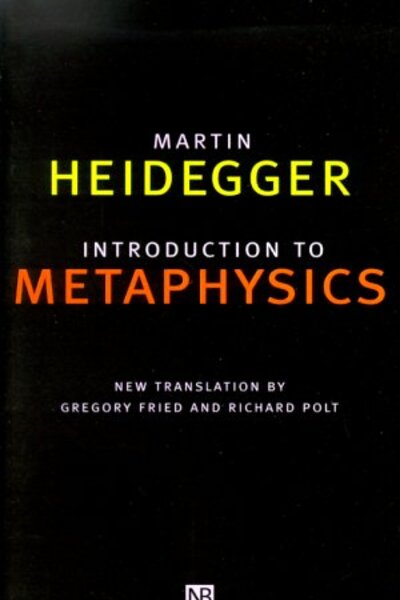
Why Read This
Heidegger's 1935 Freiburg lectures dismantle two millennia of forgotten Being, tracing a path from philosophy's most fundamental question to the spiritual crisis of the modern West.
The question that opens this book sounds deceptively simple: why are there beings at all instead of nothing? Heidegger calls it the broadest, deepest, and most originary question any human being can ask. He does not answer it. He shows instead that the entire history of Western philosophy has moved in such a way that this question has been forgotten, buried beneath grand systems built on foundations nobody ever examined.
This book belongs alongside Tolstoy, Camus, and Iqbal in the same series. Tolstoy confronted the question of existence through death and conversion. Camus through absurdity and revolt. Iqbal through will and relation to the Infinite. Heidegger takes a different path from all three: he excavates beneath every available answer, searching for an honest way of asking. For readers who want to understand why modernity feels rootless, and why questions of meaning keep returning without satisfaction, this book offers a diagnosis that runs deep and withholds all comfort.
The Question That Rebounds
Heidegger opens these 1935 lectures with a single sentence he calls anything but arbitrary:
"WHY ARE THERE beings at all instead of nothing? That is the question. Presumably it is no arbitrary question."
This question holds three ranks that place it above all others. The first rank: it is the broadest, encompassing all of being including the possibility that nothing exists at all. The second rank: it is the deepest, drilling down to ask whether there is any ground at the bottom or only an abyss that refuses to support. The third and strangest rank: it is the most originary, because when we ask about being as a whole, the question turns back upon the one asking it.
"What is asked in this question rebounds upon the questioning itself."
This rebound upon the questioner is the sign that the question cannot be raised casually. Heidegger reaches for the German word Ur-sprung, originary-leap, to describe what the question demands: the ground underfoot can only be reached by leaping, and that ground comes into being in the leap itself.
The question surfaces in three states of the soul: in great despair, when the weight of all things evaporates; in genuine joy, when delight makes everything appear as if for the first time; and in deep boredom, when the familiar world spreads out like a desert. All three are moments when the layer of daily habit cracks open. Ivan Ilyich in his terminal agony in Tolstoy encounters a question of this kind; Roquentin in Sartre's La Nausée grows nauseated before the sheer fact that things simply exist without reason. These states, Heidegger identifies as the most authentic existential conditions of human life.
Being as Evaporated Vapor
Having established the fundamental question, Heidegger steps back to ask the more pressing one: what is the condition of Being right now? The answer is honest and startling.
"The word 'Being' is then finally just an empty word. It means nothing actual, tangible, real. Its meaning is an unreal vapor."
This diagnosis originates with Nietzsche, who called Being "the last wisp of evaporating reality." Heidegger accepts the fact, then redirects the question inward: is this a failure of Being itself, or of something far deeper than individual negligence? The answer points to a third possibility: this is a historical event flowing through the West since the beginning of philosophy in Greece.
What presses harder still: we do not stand outside this fact as observers at a safe distance.
"We do not just stand before this fact as something alien and other, which we may simply ascertain as an occurrence in its Being-present-at-hand. The fact is such that we stand within it."
We live inside it. This condition touches the whole manner in which we relate to Being, and in recognizing it we have already taken the first necessary step. There is a kinship between Heidegger's diagnosis of Seinsvergessenheit, the forgetting of Being, and what Tolstoy renders through the peaceful death of Gerasim. Gerasim, the simple peasant who cares for Ivan, carries no conceptual layer between himself and reality. Ivan lived in the clamor of beings: rank, elegant furniture, socially correct relationships, without ever standing before the question of his own Being.
The Darkening of the World and the Tension of 1935
These lectures were delivered in 1935 in Germany. That fact adheres to every sentence.
Heidegger saw Europe, the center of Western civilization, caught in a vise between two forces:
"This Europe, in its unholy blindness always on the point of cutting its own throat, lies today in the great pincers between Russia on the one side and America on the other. Russia and America, seen metaphysically, are both the same: the same hopeless frenzy of unchained technology and of the rootless organization of the average man."
In his view, Russia and America were two metaphysical expressions of the same symptom: a world that has lost its roots, where the measure of everything is quantity, speed, and technical reach. Heidegger identified four signs of the darkening of the world: the flight of the gods, the destruction of the earth, the reduction of humanity to a mass, and the dominance of the mediocre. He proposed all four as a structural diagnosis of the spiritual condition of Western man. Pessimism and optimism alike, he noted, are "childish categories, long since a matter for laughter."
The spirit he meant to recover he formulated as:
"Spirit is neither empty acuity, nor the noncommittal play of wit, nor the understanding's boundless pursuit of analysis, nor even world reason, but rather spirit is originally attuned, knowing resolution to the essence of Being."
On the context of 1935 and the Nazi controversy. The Heidegger lecturing in Freiburg that year was the same man who, one year earlier, had served as Rector of the University of Freiburg under the Nazi government, delivering an inaugural address saturated with nationalist fervor. His involvement with that regime is a fact inseparable from this text, and readers deserve to know it before they open the first page. In the final chapter of this book appears a sentence that became one of the most contested passages in the entire Heidegger corpus:
"In particular, what is peddled about nowadays as the philosophy of National Socialism, but which has not the least to do with the inner truth and greatness of this movement [namely, the encounter between global technology and modern humanity], is fishing in these troubled waters of 'values' and 'totalities.'"
The phrase "inner truth and greatness of this movement" was spoken in 1935. The clause in square brackets is a retroactive addition Heidegger inserted in the 1953 printed edition, claiming that what he meant was "the encounter between global technology and modern humanity." Whether that constitutes honest philosophical clarification or post-facto rationalization is a question without a clean answer. Heidegger never offered a direct apology for his involvement with National Socialism. Serious readers of this text must sit with that tension, as part of the textual reality of the book itself.
Grammar, Etymology, and Why Being Feels Empty
After establishing the crisis, Heidegger turns to a linguistic investigation that is, in truth, the most serious philosophical inquiry in the book. Why does the word "Being" feel empty?
From the side of grammar: the word "Being" (das Sein) is formed from the infinitive "to be." The infinitive strips away person, number, tense, and mood, leaving only the most indeterminate verbal meaning. When that infinitive is then nominalized into a noun, it gets locked as though it were a name for something that stands still. A paradox forms: Being appears to be something that "is," yet only beings are.
From the side of etymology, the German verb "to be" is a fusion of three ancient stems. The stem es (Sanskrit: asus) means living, standing and moving from within itself. The stem bhu/bheu/phu means emerging to the surface, holding sway, coming into stability from within itself, the root of phusis. The stem wes means dwelling, lingering, remaining, the root of Wesen (essence), which etymologically means persisting as what is present.
"From the three stems we derive three initial and vividly definite meanings: living, emerging, abiding. Linguistics establishes them. Linguistics also establishes that today these initial meanings have died out, that only an 'abstract' meaning, 'to be,' has survived."
All three meanings are three ways of experiencing the same thing: the presence of something that stands on its own. For the Greeks, Being meant precisely that:
"This standing-there, this taking and maintaining a stand that stands erected high in itself, is what the Greeks understood as Being."
The Four Delimitations of Being
The largest portion of the book traces four pairs of opposition that have shaped and constrained the Western understanding of Being since Greece: Being versus Becoming, Being versus Seeming, Being versus Thinking, and Being versus the Ought.
Being and Becoming. The philosophical tradition conventionally sets Parmenides (Being, permanence) against Heraclitus (Becoming, flux). Heidegger rejects that opposition directly:
"Heraclitus, to whom one ascribes the doctrine of becoming, in stark contrast to Parmenides, in truth says the same as Parmenides. He would not be one of the greatest of the great Greeks if he said anything else."
Both stand on the same ground of phusis. Parmenides speaks of the staying-power of Being's presence; Heraclitus speaks of the movement of its emerging.
Being and Seeming. Phusis (root phu-) and phainesthai (root pha-, "to show itself") belong to one family. Being is appearing:
"Being means appearing. Appearing does not mean something derivative, which from time to time meets up with Being. Being essentially unfolds as appearing."
The collapse came when Plato and the Sophists turned seeming into "mere appearance" and elevated Being into a supra-sensory realm. That gap (khōrismos) was then occupied by Christian doctrine, and the whole of Western metaphysics has walked along the rift Plato opened.
Being and Thinking. This is the most consequential delimitation. Here Being is made into an object (Gegenstand) standing opposite thinking as subject, and thinking becomes the judge of Being. To grasp why this is a fall, Heidegger returns to Heraclitus: logos in its original sense is gathering, the gatheredness of beings that holds sway within itself, that is, Being itself.
"Logos is constant gathering, the gatheredness of beings that stands in itself, that is, Being. So kata ton logon in fragment 1 means the same as kata phusin. Phusis and logos are the same."
Then there is the Parmenidean statement most frequently misread: to gar auto noein estin te kai einai. The standard translation reads "thinking and Being are the same," but Heidegger breaks that rendering open. What Parmenides says is:
"The saying does not say, 'thinking and Being are the same,' but instead says, 'belonging-together reciprocally are apprehending and Being.'"
The human being is the one who co-occurs when Being shows itself. He belongs to the event of Being's own appearing.
The Human Being as the Most Uncanny. The book reaches its peak of intensity in the chapter on the choral ode from Sophocles' Antigone. The human being is to deinotaton, the most uncanny of all. The word deinon carries two charges simultaneously: that which is overwhelming because its sway cannot be mastered, and that which does violence by forcing its way into what overpowers.
"Humanity is violence-doing not in addition to and aside from other qualities, but solely in the sense that from the ground up and in its doing violence, it uses violence against the over-whelming."
The human being is pantoporos aporos: every path available, no way out. He ventures everywhere, builds language, founds cities, establishes law, and in all that venturing arrives nowhere that holds as a permanent home. Death is the one thing against which all human violence shatters at once.
Technē in the Greek sense is the capacity to set Being into the work, to bring the concealed into appearing. Dikē is jointure (Fug), the order that Being itself gives to its swaying motion. The human moves in technē, forcing his way out against dikē. In every such breach he is undone, because:
"For such a one, disaster is the deepest and broadest yes to the overwhelming."
Being and the Ought. The fourth delimitation grows from within Being itself. Once Plato fixes Being as idea and prototype, actual being perpetually falls short of its idea. That gap generated the entire philosophy of value: Kant with das Sollen, Fichte with the system of Being-versus-Ought, and the whole of neo-Kantianism. Heidegger notes a bibliography from 1928 that gathered 661 publications on the concept of value, and comments drily: "Probably by now there are a thousand. All this calls itself philosophy."
On Nietzsche: Nietzsche, who overturned all values, still thought within the framework of value. Overturning values is remaining in the same house, only standing on the other side of the room. To step outside that framework, one would have to question the framework itself. Nietzsche did not go there.
Da-sein and the Task That Remains
Heidegger closes the book with a task, something heavier than any system. The question of Being is the most fundamental question the human being can raise, and to chase beings while abandoning it is the real nihilism:
"But where is the real nihilism at work? Where one clings to current beings and believes it is enough to take beings, as before, just as the beings that they are... Merely to chase after beings in the midst of the oblivion of Being—that is nihilism."
From the inquiry into Being, Heidegger formulates the position of the human being:
"Within the question of Being, the human essence is to be grasped and grounded, according to the concealed directive of the inception, as the site that Being necessitates for its opening up. Humanity is the Here that is open in itself. Beings stand within this Here and are put to work in it. We therefore say: the Being of humanity is, in the strict sense of the word, 'Being-here' <'Da-sein'>."
Da-sein, Being-here, is the open "here" in which Being discloses itself. Without that open Da-sein, the question of Being has no place to resonate. The human being is the site Being requires in order to appear.
Within this series of existential reading, Heidegger's position stands apart. Iqbal in Asrar-i-Khudi places the human being at the center as creator of meaning, with will as the most basic reality. Heidegger places the human being as a passive-active site, the location Being requires for its own appearing. Both agree that something has gone missing in modernity; they differ on how to recover it. Camus responds to the groundless situation with conscious revolt; Heidegger responds by waiting within the question. Both refuse easy consolation.
The lectures close on the capacity for waiting:
"Being able to question means being able to wait, even for a lifetime. But an age for which the actual is only whatever goes fast and can be grasped with both hands takes questioning as 'a stranger to reality,' as something that does not count as profitable. But what is essential is not counting, but the right time, that is, the right moment and the right endurance."
And with Hölderlin's lines:
For the mindful god
does detest
untimely growth.
Philosophy is the territory where impatience is already failure.
Key Takeaways
-
The question "why are there beings at all instead of nothing" is the most fundamental question in philosophy. It is the broadest (encompassing all of being including the possibility of nothing), the deepest (drilling down to ground or Ab-grund), and the most originary (rebounding upon the questioner). What makes it extraordinary is the rebound: when raised in earnest, this question transforms the one who raises it. Heidegger says it demands an Ur-sprung, an originary-leap, because the ground underfoot only comes into being in the leap itself. The moments when the question surfaces most readily are great despair, genuine joy, and deep boredom, all three being moments when the crust of daily habit cracks.
-
Being has become vapor. "The word 'Being' is then finally just an empty word." Heidegger accepts Nietzsche's diagnosis in full, then shifts the question deeper: what happened historically to bring us here? The answer is Seinsvergessenheit, the forgetting of Being, a historical event flowing since Plato. We live inside it and do not even know that we do not know.
-
The word "to be" holds three lives that have gone extinct. From three ancient Indo-Germanic stems: es (living, moving from within itself), bhu/phu (emerging to the surface, holding sway, root of phusis), and wes (dwelling, lingering, remaining). For the Greeks, Being meant a presence that comes to itself, stands erect, and persists. When all three fused into an abstract infinitive and were then nominalized, the life stored within them went out. Heidegger's etymological investigation here is the book's core diagnostic work.
-
The human being is the most uncanny of all creatures. The Antigone chapter is the book's peak of intensity. Deinon carries two charges: the overwhelming and the violence-doing. The human being is pantoporos aporos, every path available and no way out. He forces his way into the overwhelming, builds language and cities, and is always shattered before one thing: death.
-
The four delimitations of Being form a single movement. Being versus Becoming, Being versus Seeming, Being versus Thinking, Being versus the Ought. All converge on one shift: phusis becomes idea, logos becomes assertion, alētheia becomes correctness, the human being becomes zōon logon echon. This is a description of one long interlocking fall.
-
The real nihilism is chasing beings while forgetting Being. Atheism, pessimism, the loss of traditional values, all are surface symptoms. The nihilism that runs deepest is the busyness that refuses to question. This diagnosis feels prophetic in the years after 1935, as the world Heidegger described kept accelerating.
-
Heidegger offers no answers. He offers the capacity to question, to wait, to remain in uncertainty without fleeing to available solutions. This is the position that sets him apart from the entire tradition of systematic philosophy before him, and it is also what makes the book frustrating for readers who arrive looking for resolution.
Critical Assessment
Strengths
1. A depth of historical diagnosis without parallel. No twentieth-century philosopher excavated the history of Western metaphysics with the depth and precision Heidegger brings here. His tracing from early Greece through Plato, Aristotle, and neo-Kantianism to Nietzsche is a diagnosis of how our own way of thinking was formed, and what was lost in the forming of it.
2. Language and etymology as philosophical method. The way Heidegger uses grammar and etymology to dismantle assumptions embedded in everyday words stands as one of the most original contributions in the philosophy of language. The investigation of the three stems of "to be" and the nominalization of the infinitive is a dismantling of the way Being has been locked inside the grammatical structures we inherited.
3. The Antigone chapter as philosophy that is also literature. Heidegger's reading of Sophocles' choral ode is one of the most intense and beautiful passages in his entire corpus. Here philosophy and literature run on a single track, and the argument about the human being as to deinotaton carries more life than thousands of pages of analytic philosophy on the nature of the human.
Limitations
1. A prose style that demands a high price. Heidegger writes with a density and pace that offer little space to readers unfamiliar with the German phenomenological tradition. His sentences often require multiple re-readings, and there are moments where the darkness of the style feels like a rhetorical choice that could have been written more clearly.
2. The shadow of 1935 and National Socialism. Heidegger's involvement with the Nazi regime in 1933-1934, followed by the 1935 lectures containing the phrase "inner truth and greatness of this movement," is a burden that cannot be set aside. Whether that involvement taints his entire philosophical system remains an open debate. What is clear: reading this book without knowing that context is a form of dishonesty, both toward the text and toward oneself.
3. The absence of a way out. Heidegger diagnoses with brilliance. He is far less clear about what one does after the diagnosis. The capacity to question and to wait is a philosophically legitimate answer, but difficult to operate in a concrete life. Camus, elsewhere in this series, provides a response more possible to hold: revolt, freedom, and passion as a way of living inside the absurd.
Conclusion
Introduction to Metaphysics is a book for readers willing to understand the deepest foundations of their own thinking, and willing to face the fact that those foundations have been cracked for a long time. It demands full patience and readiness to leave without answers. Within the existential reading series, it is the hardest and most unavoidable test. Heidegger earns a rating of 4.5 out of 5, with a point and a half withheld from perfection for a prose style that sometimes exceeds what is necessary and for a historical shadow that honest readers cannot ignore.
Related Reading
- The Myth of Sisyphus by Albert Camus - Absurdity as a response to a groundless world; a direct contrast with Heidegger's waiting inside the question.
- A Confession by Leo Tolstoy - Existential crisis lived personally; Ivan Ilyich as an illustration of life lived in Seinsvergessenheit.
- The Reconstruction of Religious Thought in Islam by Muhammad Iqbal - Will and selfhood as center; a direct tension with Heidegger's position on Da-sein.
- Secrets of the Self by Muhammad Iqbal - Khudi as a force in counterpoint to the dissolution of self in Being.
FAQ
Q: Is this book worth reading for someone outside academic philosophy? A: It asks a high price from its readers. Without prior exposure to Plato, Aristotle, Heraclitus, and Kant, many passages will feel like walking in fog. A better entry point to Heidegger is Being and Time, or a good secondary introduction before approaching this book. For readers who have already worked through Camus and Tolstoy in this series and feel the question "why any of this at all" pressing harder, this book is the next layer.
Q: How does Heidegger differ from Camus in facing the existential question? A: Camus responds to absurdity with revolt: we cannot escape the groundless condition, but we can answer it with passion, freedom, and conscious rebellion. Heidegger responds by waiting inside the question, dwelling in uncertainty, staying with what cannot yet be answered. Both refuse the consolation of religion and of philosophical systems that close the question off with premature answers. The difference lies in temperament: Camus is an artist, Heidegger is an archaeologist of language.
Q: How does this relate to Being and Time? A: These 1935 lectures serve, in many respects, as a bridge between Being and Time (1927) and Heidegger's later thinking about the history of Being (Seinsgeschichte). In Being and Time he still approaches Being from the side of individual human existence. Here he has already moved to the question of how Being itself has opened and closed across the history of Western civilization. Both can be read independently, but the sequence of Being and Time before Introduction to Metaphysics is more useful.
Q: How seriously should the shadow of Nazism weigh on a reading of this book? A: This is a question that deserves a careful answer. Heidegger joined the NSDAP in May 1933, served as rector with a speech explicitly supporting the regime, and resigned that position in February 1934. These lectures were delivered a year after that resignation, during what scholars call his withdrawal from active politics. The sentence about "inner truth and greatness of this movement" remains in the text. There is no way to read it as an editorial accident. Each reader must decide how to sit with that fact, but what cannot be done is pretending it is not there.
Q: Is Heidegger's diagnosis of technology still relevant today? A: Acutely so, and the sharpness has only grown. The "rootless organization of the average man" he described as a metaphysical symptom of Russia and America in 1935 is now instantiated in a global infrastructure far beyond anything imaginable then. The question "for what? toward where? and then what?" that he said hangs above the clamor of technology is a question that grows louder in an era when every human being carries the connected world in one hand.
Q: Where should a first-time reader start if the whole book feels too dense? A: Start with chapters one and two. The section on "why are there beings at all instead of nothing" and on the condition of Being as vapor is the most accessible and intuitively richest material. Chapter two on etymology is more technical but genuinely rewarding. Then move to the Antigone section in the middle of chapter four. The full chapter on the four delimitations of Being is the densest and most technical part; it is best read last, after the other sections have given some foothold.
Q: How does Heidegger use the word Da-sein as a "site"? A: Da-sein, Being-here, is Heidegger's term for the human being. His definition begins with position: the human being is the open "here," the place where Being discloses itself. Without a questioning human being, Being has no place to resonate. The human being is the opening within being that allows being itself to become a question. This is a reversal of the humanist tradition that places the human as a subject evaluating the world from outside; in Heidegger, the human being belongs to the event of Being itself.
Q: Is the Fried-Polt translation reliable? A: The Gregory Fried and Richard Polt translation (Yale University Press, 2000) is widely regarded as the standard English version. The translators include extensive footnotes addressing Heidegger's terminological choices, the difficulty of rendering compounds like Ur-sprung and Da-sein, and the contested passages including the 1935 Nazi-adjacent phrase. Their scholarly apparatus keeps the translation both readable and intellectually accountable.