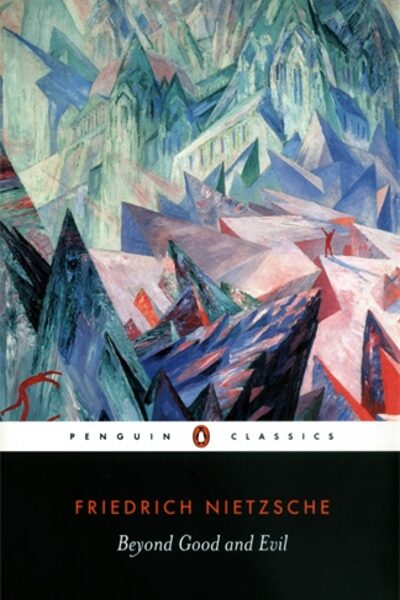
Why Read This
Nietzsche dissects two thousand years of Western philosophy with a blade: every moral system is a sign-language of the emotions, and Europe's herd morality was born of fear.
Beyond Good and Evil appeared in 1886 as Nietzsche's most systematic work written in his least systematic tone. Nine parts hold 296 aphorisms, a text closer to a scalpel than to a hammer. Here Nietzsche examines, one by one, the entire foundation that holds up the way Europe thinks about truth, goodness, and progress. Every page asks the same question in a different shape: what drive is really moving behind a moral claim that looks so lofty?
With his first movement he questions the will to truth itself, before he questions its content. With his second movement he maps Europe's herd morality as an inheritance of fear frozen into convention. With his third movement he opens a vision of new philosophers to come as law-givers, creators of value who set out from the abundance of life.
This book is for the reader who wants to understand where the values we inherit come from, who benefits from those values, and what it takes for a person to dare to create value from within.
Key Points
-
Philosophy is disguised autobiography - Every great system of philosophy is the unintended self-confession of its creator. Kant, Spinoza, Schopenhauer each defended his own prejudice while calling it universal truth. The best way to understand a system of philosophy is to ask: what morality is it fighting for?
-
The will to truth must be questioned before its content - Nietzsche opens the book with a question never posed before: why do we want truth? Why not untruth? The value of an opinion is measured by how far it furthers and cultivates life. Its correspondence to a reality detached from living is the wrong yardstick.
-
Herd morality is a product of fear - The herd instinct, fear as the mother of morals, works in a consistent way: courage, passion, ferocity that once served survival are now called "evil." The obedient, the average, the unremarkable are called "good." The morality that dominates modern Europe is the systematic extension of this logic across two thousand years.
-
Master morality and slave morality are two different origins - Master morality is born from a ruling caste that celebrates strength, fullness, and the capacity to give from abundance. The master is a creator of value who sets out from himself. Slave morality is born from those who are oppressed and who attach the word "evil" to the strength that frightens them, then raise patience and humility as virtues, since both serve the sufferer.
-
Long obedience in one direction gives birth to freedom - The finest language, music, and art in history grew from strict discipline that looked arbitrary. The great poets and orators spent their lives in hard obedience to the rules of rhyme and meter. The result is freedom, grace, and a striking certainty. This principle holds across almost every domain of deep mastery.
-
The true philosopher is a law-giver, a creator of value - The scientific scholar arranges and formalizes the inheritance of the past; that work is important and needed. The true philosopher does something wholly different: he determines where and why humanity moves, reaching for the future with a creating hand. To know, for him, is to create. To create is to give law.
-
The abyss gazes back - The most enduring aphorism of the whole book: whoever fights monsters risks becoming a monster himself. The abyss stared at too long begins to stare back. Every war against a degrading enemy carries the risk that the enemy's method and logic seep into the self.
The Prejudices of Philosophers: Dismantling from Within
Nietzsche opens the book with a step never taken before in the history of Western philosophy: he questions the desire to seek truth before he questions its content.
"Granted that we want the truth: WHY NOT RATHER untruth? And uncertainty? Even ignorance? The problem of the value of truth presented itself before us--or was it we who presented ourselves before the problem?"
Philosophers since Plato have spoken of the will to truth as though that will were already noble in itself. They never asked why. Nietzsche observes that we cannot live without logical fictions, without categories, without simplifications of reality. The judgments that are most doubtful epistemologically are also the ones most necessary for us to function. From here he draws a conclusion that changes everything:
"TO RECOGNISE UNTRUTH AS A CONDITION OF LIFE; that is certainly to impugn the traditional ideas of value in a dangerous manner, and a philosophy which ventures to do so, has thereby alone placed itself beyond good and evil."
Philosophy as Disguised Autobiography
In §6 a deeper accusation arrives. Every great philosophy is the self-confession of its creator, an autobiography that is unintended and unconscious:
"It has gradually become clear to me what every great philosophy up till now has consisted of--namely, the confession of its originator, and a species of involuntary and unconscious auto-biography; and moreover that the moral (or immoral) purpose in every philosophy has constituted the true vital germ out of which the entire plant has always grown."
Philosophers are in truth the advocates of their own prejudices:
"They are all advocates who do not wish to be regarded as such, generally astute defenders, also, of their prejudices, which they dub 'truths'"
The most fundamental metaphysical belief of the whole tradition, the conviction that good and bad come from different and opposing sources, is also the one least questioned:
"The fundamental belief of metaphysicians is THE BELIEF IN ANTITHESES OF VALUES."
The crack Nietzsche opens here works the same way as a crack in an old building: small, almost invisible, then spreading across the whole wall. Truth and falsehood may well come from a single well.
Will to Power as a Working Hypothesis
In §13, Nietzsche overturns one of the most casually accepted axioms of biology: that a living thing is driven above all by the instinct of self-preservation.
"A living thing seeks above all to DISCHARGE its strength--life itself is WILL TO POWER; self-preservation is only one of the indirect and most frequent RESULTS thereof."
This shift is cosmological. If life itself is Will to Power, then the entire ethical framework built on the premise of "survival" is mistaken at its root. The whole first part moves toward §23: psychology must become the queen of all the sciences, the path to the most fundamental problems.
"psychology shall once more be recognized as the queen of the sciences, for whose service and equipment the other sciences exist. For psychology is once more the path to the fundamental problems."
The Free Spirit: Mask, Solitude, and the Tempters
The second part opens with a meditation on how few people are truly free.
"It is the business of the very few to be independent; it is a privilege of the strong. And whoever attempts it, even with the best right, but without being OBLIGED to do so, proves that he is probably not only strong, but also daring beyond measure."
True independence is a dangerous act that multiplies the risks of ordinary life. The person who enters the labyrinth of independence cannot return, cannot be helped by those who never reached it.
In §40, Nietzsche gives a meditation on the mask that stands among the most enduring passages in the whole book:
"Everything that is profound loves the mask: the profoundest things have a hatred even of figure and likeness."
"Every profound spirit needs a mask; nay, more, around every profound spirit there continually grows a mask, owing to the constantly false, that is to say, SUPERFICIAL interpretation of every word he utters, every step he takes, every sign of life he manifests."
The mask grows of its own accord because the deepest things are always misread when they appear naked before those who are unready. The deepest insights must sound like crimes in the wrong ears:
"Our deepest insights must--and should--appear as follies, and under certain circumstances as crimes, when they come unauthorizedly to the ears of those who are not disposed and predestined for them."
The Philosophers of the Future
This part closes by launching a new group, whom Nietzsche calls "the tempters," successors far more dangerous than the ordinary free thinker. They know one principle:
"The great things remain for the great, the abysses for the profound, the delicacies and thrills for the refined, and, to sum up shortly, everything rare for the rare."
Apophthegms and Interludes: 123 Knife-Throws
The fourth part is 123 freestanding aphorisms, each cutting through one layer of falsehood. This is Nietzsche in his most economical and most quotable mode.
Memory, Pride, and Self-Revision
"'I did that,' says my memory. 'I could not have done that,' says my pride, and remains inexorable. Eventually--the memory yields."
Memory and pride do not negotiate as equals. Pride does not give way, and memory, which ought to be the most honest witness, surrenders. We revise the past to keep it consistent with the self-image we wish to preserve.
There Are No Moral Phenomena
"There is no such thing as moral phenomena, but only a moral interpretation of phenomena."
A single line that brings down a building of ethics thousands of years old. No act is intrinsically moral or immoral. What exists is the moral labeling done from a particular point of view, with a particular interest.
The Abyss and Love
"He who fights with monsters should be careful lest he thereby become a monster. And if thou gaze long into an abyss, the abyss will also gaze into thee."
"What is done out of love always takes place beyond good and evil."
On Nations and Great Men
"Insanity in individuals is something rare--but in groups, parties, nations, and epochs it is the rule."
"A nation is a detour of nature to arrive at six or seven great men.--Yes, and then to get round them."
Nations exist as vehicles for a few extraordinary individuals to emerge. Afterward the same nation makes sure those individuals do not hold power for too long.
Maturity
"The maturity of man--that means, to have reacquired the seriousness that one had as a child at play."
Maturity arrives when the intensity and earnestness of childhood play return, applied this time to the greatest things.
The Natural History of Morals: Fear as the Mother
The fifth part is the diagnostic summit of the book, where Nietzsche maps the origin of morality with the precision of a pathologist.
A Science of Morals That Forgot to Question Morality
"In every 'Science of Morals' hitherto, strange as it may sound, the problem of morality itself has been OMITTED: there has been no suspicion that there was anything problematic there!"
The moral philosophers came with one morality already in their heads, then spent their whole strength proving that this morality was true. The question of why this morality exists, who benefits from it, and from what condition of the soul it was born, was never raised.
Systems of Morals as Sign-Language
"In short, systems of morals are only a SIGN-LANGUAGE OF THE EMOTIONS."
When a person declares "this is evil," what he actually says is something about his fear, his desire for power, or his need for safety. Morality is no report about the world; morality is a report about its own maker.
Fear as the Mother of Morals
"fear is the mother of morals"
Once a community is safe from outside threat, its instinct turns inward. The instincts that once served survival, courage, passion, ferocity, are now seen as dangerous to the cohesion of the herd. So those instincts receive a new name: evil. The obedient, the average, the unremarkable receive a new name: good.
The diagnostic peak stands in §202:
"MORALITY IN EUROPE AT PRESENT IS HERDING-ANIMAL MORALITY, and therefore, as we understand the matter, only one kind of human morality, beside which, before which, and after which many other moralities, and above all HIGHER moralities, are or should be possible."
Long Discipline and True Freedom
In §188 there is a paradox Nietzsche commands completely: strict discipline gives birth to true freedom. Language grows strong through the pressure of meter, through the tyranny of rhyme and rhythm.
"The essential thing 'in heaven and in earth' is, apparently (to repeat it once more), that there should be long OBEDIENCE in the same direction, there thereby results, and has always resulted in the long run, something which has made life worth living; for instance, virtue, art, music, dancing, reason, spirituality"
Long obedience in one direction is the path to freedom, grace, and a striking certainty. This principle holds for writing, music, thought, and leadership.
The True Philosopher: Creator, Hammer, Law-Giver
The sixth part is the most discerning question of all: what is the difference between the scholar who records the inheritance and the philosopher who creates a new direction?
The Scholar as Mirror
"He is only an instrument, we may say, he is a MIRROR--he is no 'purpose in himself.'"
The objective man does not command, does not create, does not destroy. His soul is a mirror: valuable, precise, and a mirror all the same.
The Philosopher as Creator and Law-Giver
"THE REAL PHILOSOPHERS, HOWEVER, ARE COMMANDERS AND LAW-GIVERS; they say: 'Thus SHALL it be!' They determine first the Whither and the Why of mankind, and thereby set aside the previous labour of all philosophical workers, and all subjugators of the past--they grasp at the future with a creative hand, and whatever is and was, becomes for them thereby a means, an instrument, and a hammer. Their 'knowing' is CREATING, their creating is a law-giving, their will to truth is--WILL TO POWER."
To know, for the true philosopher, is to create. To create is to give law. The will to truth is Will to Power.
The Philosopher as the Bad Conscience of His Age
"It is always more obvious to me that the philosopher, as a man INDISPENSABLE for the morrow and the day after the morrow, has ever found himself, and HAS BEEN OBLIGED to find himself, in contradiction to the day in which he lives; his enemy has always been the ideal of his day."
The philosopher in earnest is a man who stands in structural contradiction with his age. He drives the knife of vivisection into the heart of the virtues most exalted by his era. That is his task: the greatest enemy of the philosopher is the ideal of today.
Our Virtues: Suffering, Cruelty, Honesty
The seventh part moves from moral diagnosis to the question of what remains for a soul that has already passed through that dismantling.
Suffering as Discipline
"The discipline of suffering, of GREAT suffering--know ye not that it is only THIS discipline that has produced all the elevations of humanity hitherto?"
Every depth ever granted to man, every elevation ever reached by humanity, was born from a struggle that cannot be loosed from suffering. From here Nietzsche makes an important distinction:
"In man CREATURE and CREATOR are united: in man there is not only matter, shred, excess, clay, mire, folly, chaos; but there is also the creator, the sculptor, the hardness of the hammer, the divinity of the spectator, and the seventh day"
Conventional sympathy is always aimed at the creature within man, at the clay that must be shaped. True sympathy is aimed at the creator within man, who must be protected from an endless softening.
Cruelty Transfigured
In §229, one of the boldest theses of the book:
"Almost everything that we call 'higher culture' is based upon the spiritualising and intensifying of CRUELTY--this is my thesis; the 'wild beast' has not been slain at all, it lives, it flourishes, it has only been-- transfigured."
The cruelty that once manifested in the Roman arena now lives in the painful delight of tragedy, in the ecstasy of metaphysics. Even in the pursuit of knowledge:
"even in every desire for knowledge there is a drop of cruelty."
Every time the spirit is forced to look beyond its inclination, to analyze what it would love unconditionally, an act of violence against the self takes place.
The One Virtue That Remains
"Honesty, granting that it is the virtue of which we cannot rid ourselves, we free spirits--well, we will labour at it with all our perversity and love"
Honesty is the one virtue that free spirits cannot loose from themselves. For that very reason they must tend it with all the persistence they possess, so that it does not turn into a sterile ornament.
Master Morality and Slave Morality
§260 is among the most important texts Nietzsche ever wrote. The typology of two moralities, until now only touched upon, here receives its complete formulation.
Master Morality is born from a ruling caste aware of its difference. "Good" means noble, strong, proud, honest with oneself. "Bad" means low, cowardly, of no account. The antonym of "good" here is schlecht (bad), the merely commonplace.
"The noble type of man regards HIMSELF as a determiner of values; he does not require to be approved of; he passes the judgment: 'What is injurious to me is injurious in itself;' he knows that it is he himself only who confers honour on things; he is a CREATOR OF VALUES."
Slave Morality is born from those who are oppressed, weary, powerless. Compassion, kindness, humility, patience receive honor because they are useful to the sufferer.
"Slave-morality is essentially the morality of utility."
In slave morality, the opposite of "good" is böse (evil), the word fastened onto strength, onto the dangerous, onto the master who frightens. "Evil" becomes a word of mastery from below.
Nietzsche shows that in historical reality the two moralities mix. We inherit both. The modern West, with its Christianity and its democratic ethics, inherits above all the slave morality that won through what he calls "the transvaluation of values."
The Pathos of Distance and the Elevation of Man
In §257, a claim designed to wound the democratic ear:
"EVERY elevation of the type 'man,' has hitherto been the work of an aristocratic society and so it will always be--a society believing in a long scale of gradations of rank and differences of worth among human beings, and requiring slavery in some form or other."
The key concept is the pathos of distance, the distance between classes that gives birth to a craving to widen the distance within the soul itself, to climb toward a higher condition. From this external pathos comes the "self-surmounting of man."
The Noble Soul
In §287, Nietzsche unfolds what truly determines nobility. Action is always ambiguous; the work can betray its author. What determines it is the fundamental conviction a noble soul holds about itself:
"THE NOBLE SOUL HAS REVERENCE FOR ITSELF.--"
Nobility is a reverence for oneself that needs no confirmation from outside.
The Mask as the Structure of Thought
"Every philosophy is a foreground philosophy--this is a recluse's verdict: 'There is something arbitrary in the fact that the PHILOSOPHER came to a stand here, took a retrospect, and looked around; that he HERE laid his spade aside and did not dig any deeper--there is also something suspicious in it.' Every philosophy also CONCEALS a philosophy; every opinion is also a LURKING-PLACE, every word is also a MASK."
Behind every cave there is a deeper cave. This book itself is a mask.
Farewell from the Heights
In §296, the book closes as an elegy for the thoughts already poured into words:
"Alas! what are you, after all, my written and painted thoughts! Not long ago you were so variegated, young and malicious, so full of thorns and secret spices, that you made me sneeze and laugh--and now? You have already doffed your novelty, and some of you, I fear, are ready to become truths, so immortal do they look, so pathetically honest, so tedious!"
The written thought is the dying thought. By the moment it is caught in words, it has already lost its morning freshness. What remains is the evening of that thought.
Connections within the Existential Series
Beyond Good and Evil is the headwater of many conversations running through this existential reading series. Where Thus Spoke Zarathustra is the dramatic poem of the crisis of nihilism and the effort to find affirmation, Beyond Good and Evil lays out its analytic argument in prose that is clearer and more systematic.
Nietzsche diagnoses that herd morality, the inheritance of two thousand years of fear frozen into convention, closes off the possibility of a higher type of man. From this point, three different responses were born a century later.
Camus in The Myth of Sisyphus inherits the diagnosis of the emptiness left after the collapse of transcendent foundations, then offers rebellion as a way. Sisyphus climbing the rock consciously, without hope of resolution, is Camus's absurd man.
Iqbal in The Secrets of the Self takes a divergent direction: Nietzsche's Will to Power is transformed into Khudi, the ceaseless growth of the self toward the Divine. Iqbal judges that Nietzsche had rightly diagnosed weakness as a disease, and that man needs a strength of soul that keeps growing.
From the position of Beyond Good and Evil, the reader can examine the values inherited from his own tradition with the same question Nietzsche drove into the ground: what drive is really behind this value? Who benefits from it? And from what condition of the soul was this value born?
Critical Assessment
Strengths
1. A Diagnostic Method That Endures
The most productive intellectual movement in this book is the way Nietzsche traces from a moral claim to the motive behind it. Modern social psychology, from Jonathan Haidt to Robert Cialdini, confirms that moral judgment often works as a post-hoc rationalization of a deeper drive. Nietzsche arrived there by intuition, and his aim was true.
2. The Aphorism as an Instrument of Thought
Beyond Good and Evil proves that the density of thought need not run in proportion to the length of an argument. Aphorisms such as "fear is the mother of morals" or "systems of morals are only a sign-language of the emotions" are statements that open a space for thinking and invite the reader to carry it forward. This is a rare intellectual mastery.
3. A Diagnosis of Herd Morality That Stays Relevant
Nietzsche's picture of how the herd instinct works, leveling the prominent, putting consensus before truth, giving the name "evil" to the dangerous and the different, is easy to recognize inside modern institutions, from corporations to academia.
4. A Stance That Stirs the Reader to Turn the Question Around
The best way to read Nietzsche is to use his method against himself: what drive lies behind Nietzsche? What condition of the soul gave birth to this text? That question yields insight into the book and into the reader at once.
Limitations
1. The Master-Slave Distinction Is Open to Prescriptive Abuse
As a genealogical analysis, the typology of master and slave morality is very sharp. As a prescription, it opens the way to the most dangerous misuse: a hierarchy justified on biological or racial grounds. Nietzsche himself explicitly rejected that reduction in his writing, yet the framing he chose leaves it open to a reading that refuses the difficulty.
2. The View of Women
Part VII contains several statements about women that reflect the limits of the age and the personal horizon of the author. Nietzsche himself acknowledges these as "my truths," the truths of a recluse formed outside a wider dialogue. The reader needs to place those passages in a narrow context.
3. No Dialogue with Traditions Beyond Europe
Nietzsche's entire dialogue runs within the framework of Western philosophy, from Plato to Schopenhauer. The Roman Stoic, the Sufi, and the Buddhist traditions that faced similar questions about value and the human condition do not appear. The absence of cross-traditional dialogue limits the reach of a claim that means to be universal.
Conclusion
Beyond Good and Evil is one of the greatest texts of dismantling in the history of Western philosophy. It offers no new system to replace the old one; it offers a method: trained suspicion, the question of the motive behind a claim, the courage to examine a foundation taken as certain.
The readers who gain the most from this book:
- Those who want to understand where the values they inherit come from and who benefits from them
- Those who have read Thus Spoke Zarathustra and want a more analytic argument in clearer language
- Those interested in the genealogy of morals as a method, including readers of Foucault and modern social psychology
- Those who want to understand why Camus, Iqbal, and other existential thinkers responded from the directions they chose
Rating: 4.5/5
Related Reading in the Existential Series
Beyond Good and Evil is part of the "Existential Reading" series on this platform.
- Thus Spoke Zarathustra (Friedrich Nietzsche) is his dramatic poem, the richest source for understanding the figure of Zarathustra and Nietzsche's struggle with nihilism at first hand.
- The Myth of Sisyphus (Albert Camus) inherits Nietzsche's diagnosis of the emptiness of value, then offers rebellion as a way that diverges from the Ubermensch.
- The Secrets of the Self (Muhammad Iqbal) builds the concept of Khudi as a response to Nietzsche's will to power from the direction of the Islamic tradition.
- A Confession (Leo Tolstoy) is the most honest document of the crisis of value that Nietzsche diagnosed from outside, written from within by a man who lived through it.
FAQ
Q: What does Nietzsche mean by "beyond good and evil"? A: Nietzsche shows that the categories "good" and "evil" are products of particular psychological and historical conditions. A philosophy that dares to recognize untruth as a condition of life has already placed itself beyond the old moral categories. "Beyond good and evil" means seeing morality as a symptom, as a report about the condition of its maker's soul.
Q: Does Nietzsche teach that all values are relative? A: Nietzsche rejects shallow moral relativism. He argues that certain values, those born of abundance, strength, and creativity, are higher than values born of fear and reactivity. What he questions is the claim to universality made by Europe's herd morality, the claim that its values hold for all human beings in all ages.
Q: What is herd morality in this book? A: Herd morality is the value system born from a group instinct that puts safety, conformity, and the restraint of the prominent first. Nietzsche identifies it as the inheritance of two thousand years of Christianity and democratic tradition rooted in fear: fear of the strong, the different, and the unpredictable. He judges herd morality to be the only moral system present in Europe, while other, higher moral systems ought to be possible.
Q: What is the difference between master morality and slave morality? A: Master morality begins from self-affirmation: "I am noble, strong, good," then its derivative, "the weak and the cowardly are bad." Slave morality begins from reaction: "that master is evil, dangerous, frightening," then its derivative, "I who am patient, humble, and harmless am good." This difference in direction, affirmative against reactive, determines the entire content and function of the value system born from each.
Q: What does Nietzsche mean by "will to power"? A: Will to Power is Nietzsche's cosmological hypothesis: that life itself, at the most fundamental level, is a drive to discharge strength and to grow. Self-preservation is a by-product of a far deeper drive. The implication: the entire ethical framework built on the premise of "survival of the fittest" is mistaken at its root, because what comes first in life is the discharge of strength, growth, and domination.
Q: Why does Nietzsche criticize Kant and Schopenhauer? A: Nietzsche shows that both did the same thing as the other philosophers they criticized: they defended their own prejudice in different dress. Kant hid his categorical imperative behind a rigid dialectic, as though formal sophistication proved the truth of the content. Schopenhauer, the pessimist who doubted everything, stopped right before morality and played the flute for the principle "harm no one" without questioning where that principle came from.
Q: Can this book be read without a background in philosophy? A: Yes, with one caveat. Most of the aphorisms in the fourth part can be read directly without context. The first, second, and fifth parts grow richer if the reader already knows the names mentioned: Kant, Plato, Schopenhauer, the Stoics. A minimal knowledge of Western philosophy makes Nietzsche's critique sharper and more provocative. The Helen Zimmern translation used in this edition includes adequate context.
Q: How does Beyond Good and Evil relate to On the Genealogy of Morals? A: Beyond Good and Evil lays out the diagnosis in dense, often startling aphorisms. On the Genealogy of Morals, published a year later in 1887, gives a longer and more systematic historical argument about the origin of master and slave morality, about guilt, debt, and conscience. The two complement each other: BGE is the dismantling, Genealogy is the archaeology.
Q: Is this book suitable for a religious reader? A: Beyond Good and Evil is most useful when read as a tool of audit, a way of examining where the values one holds come from and what condition of the soul gave birth to them. A religious reader who reads Nietzsche seriously will pass through the most piercing questions about the foundation of his belief. A belief that survives such an audit becomes more honest and more solid than a belief that was never brought face to face with the sharpest questions.
Q: In what order should one read Nietzsche? A: For the beginner, The Gay Science provides the most efficient context. Thus Spoke Zarathustra is his most famous dramatic poem and also the most easily misunderstood. Beyond Good and Evil gives his analytic argument in clearer prose. On the Genealogy of Morals completes his historical argument. This order lets the reader understand Nietzsche's diagnostic layer by layer, with a steadily stronger footing.