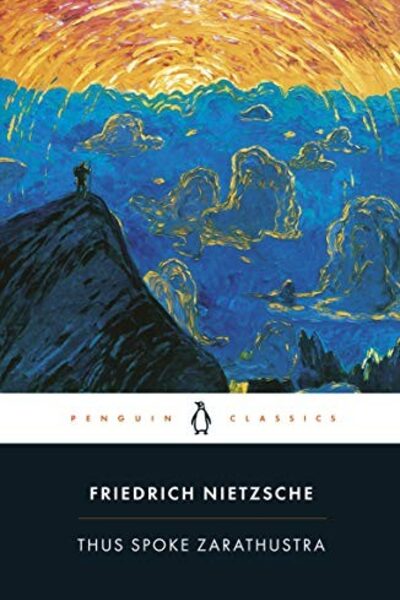
Thus Spoke Zarathustra: Nietzsche's Philosophy of Meaning
Why Read This
Friedrich Nietzsche wrote this dramatic poem as an attempt to find affirmation atop the ruins of moral foundations: on the death of God, the Ubermensch, and the will to live.
The original subtitle, Ein Buch fur Alle und Keinen, "A Book for Everyone and No One," is already a warning. Nietzsche wrote this as a dramatic poem moving between parody and prophecy, between laughter and destruction. Zarathustra is a dramatic figure who fails, learns, fails again, and finally arrives at an affirmation wrested from nearly being destroyed by his own ideas. The book was born from a single long intellectual crisis: for five years before 1883, Nietzsche traced the road of nihilism all the way to its end, demolishing every foundation, then stood at the end of that road with the way back sealed and the way forward yet to exist.
This book is right for readers who want to understand the roots of nihilism and the answers offered by Nietzsche, Camus, and Frankl together; who want to read philosophy that openly acknowledges the weight of its own problem; and who are ready to receive irony as a productive method of thinking.
Key Points
-
The death of God is a diagnosis of cultural emptiness - Nietzsche depicts a madman running into the marketplace carrying a lantern at noon, searching for God. The message is about the void that follows the destruction of meaning's foundation, when the old ground collapses and the new ground has not yet been built.
-
The Ubermensch is a direction, a project always ahead - Zarathustra himself acknowledges "There has never yet been a Superman." This is something that has not yet arrived, an aspiration pulling forward. The most dangerous misreading came from Elisabeth Forster-Nietzsche, Nietzsche's sister, who falsified the archive and dragged this concept into Nazi racial ideology, running in the opposite direction from what her brother wrote explicitly.
-
The will to power is an ontological statement about life's structure - Life at its most fundamental level is something that must continually overcome itself. The servant wills power over the weaker; the strongest wills to overcome themselves; moral values are expressions of the will of particular groups.
-
Eternal Recurrence arrives first as nausea, then as earned affirmation - This idea appears in Zarathustra as a riddle, then a serpent blocking the shepherd's breath, then a near-fatal nausea that lays Zarathustra low for seven days. Reducing it to "live each day fully" is an insult to the text.
-
The book builds its defense against Zarathustrian worship into itself - Zarathustra commands his disciples to forget him. The Ass Festival satire in Part Four shows his followers kneeling to worship a donkey. The figure of "Zarathustra's ape" shows how the vocabulary of freedom can be wielded as a weapon of resentment.
-
The Three Metamorphoses is the most honest model of the soul's growth - The camel carries the burden of existing values; the lion destroys external authority; the child begins again with sacred affirmation. The sequence cannot be skipped.
-
Zarathustra is the headwaters of the conversation answered by Camus and Frankl - Nietzsche diagnosed nihilism with an unmatched precision. Camus offered rebellion as his answer. Frankl offered the discovery of concrete meaning in specific situations. All three respond to the same illness from different angles.
-
Total affirmation of Eternal Recurrence is the heaviest psychological test - "Did you ever say Yes to one joy? O my friends, then you said Yes to all woe as well." To want a single moment of joy to return means affirming the whole of life, including everything most painful.
The Dramatic Arc: A Poem in Four Parts
Thus Spoke Zarathustra is a dramatic poem across four parts, each with its own emotional and philosophical movement. Reading it as a doctrinal manual is the most common misreading. The most honest way to read it is as the story of someone wrestling with their own ideas until nearly destroyed by them.
Part One: Descend, Fail, Learn
Zarathustra's prologue is a story of failure built with care. Zarathustra descends from the mountain after ten years alone, carrying wisdom he wants to share like a bee overburdened with honey. His first encounter is an old hermit in the forest still worshipping God. Zarathustra does not correct him. He passes on, carrying one sentence within him:
"Could it be possible! This old saint has not yet heard in his forest that God is dead!"
This opening irony already contains everything essential. The death of God is news that travels slowly. Zarathustra goes to the town square and preaches about the Superman to a crowd that came to watch a tightrope walker. The crowd laughs. The tightrope walker falls and dies. Zarathustra carries the corpse through the night while mocked by the buffoon from the tower.
Pedagogy that failed completely, and Nietzsche meant it that way. The lesson born from that crowd is about the audience:
"A light has dawned for me: I need companions, living ones, not dead companions and corpses which I carry with me wherever I wish."
"The creator seeks companions, not corpses or herds or believers. The creator seeks fellow-creators, those who inscribe new values on new tables."
From this illumination flow the discourses of Part One. The Three Metamorphoses (camel-lion-child) lay down the most concise framework for the soul's growth: the camel carries the burden of existing values; the lion destroys external authority with the cry "I will!"; the child begins again from the start with affirmation:
"The child is innocence and forgetfulness, a new beginning, a sport, a self-propelling wheel, a first motion, a sacred Yes."
Part One ends with Zarathustra commanding his disciples to leave and forget him, the most radical reversal of religious logic:
"Now I bid you lose me and find yourselves; and only when you have all denied me will I return to you."
Part Two: Deepen, Break, Admit Incapacity
Zarathustra returns to the mountain, then descends again into the world because of a terrible dream: his face in the mirror has become a devil's grimace. His teaching has been seized by enemies. His voice in Part Two is sharper, darker, more ironic.
On the Blessed Isles he formulates the replacement for God:
"God is a supposition; but I want your supposing to teach no further than your creating will."
"But to reveal my heart entirely to you, friends: if there were gods, how could I endure not to be a god! Therefore there are no gods. I, indeed, drew that conclusion; but now it draws me."
That last line is decisive. Zarathustra acknowledges that his argument about the non-existence of God moves from an inner compulsion, with cold reasoning as its vessel alone. He lets that tension remain visible.
The discourse "On Self-Overcoming" is the philosophical peak of Part Two. There the will to power is formulated most directly:
"Where I found a living creature, there I found will to power; and even in the will of the servant I found the will to be master."
The discourse "On Redemption" introduces the deepest problem in the entire book. The will is free forward, but held captive to the past:
"To redeem the past and to transform every 'It was' into an 'I wanted it thus!' – that alone do I call redemption!"
"'It was': that is what the will's teeth-gnashing and most lonely affliction is called. Powerless against that which has been done, the will is an angry spectator of all things past."
From the will's powerlessness over the past, resentment grows. From that resentment, the morality of punishment is born.
Part Two ends at "The Stillest Hour": Zarathustra knows his deepest teaching about Eternal Recurrence, but cannot yet speak it. He weeps and departs alone:
"It is the stillest words which bring the storm. Thoughts that come on doves' feet guide the world."
Part Three: Ordeal, Nausea, and Affirmation
This is the core of the book. Part Three is the story of someone who nearly drowns in their own ideas.
Zarathustra sails to the last mountain, alone. Aboard the ship he recounts his vision of Eternal Recurrence in the form of a riddle. A gateway named "The Moment." Two eternal lanes facing each other:
"Behold this gateway, dwarf! It has two aspects. Two paths come together here: no one has ever reached their end. The name of the gateway is written above it: 'Moment'."
"Must not all things that can run have already run along this lane? Must not all things that can happen have already happened, been done, run past? Must we not return eternally?"
Before this vision is complete, a great black serpent enters the throat of a sleeping shepherd. Zarathustra shouts: bite! Bite its head off! The shepherd bites, spits out the head, leaps to his feet, wrapped in light, laughing a laugh that had never before been heard on earth.
The climax arrives at "The Convalescent." Zarathustra calls "his most abysmal thought" up from the depths, calls Eternal Recurrence into its fullness. He collapses like a dead man. For seven days he lies still, eating nothing, making no sound.
What thought felled him? That great souls recur eternally, and small human beings recur eternally too:
"The man of whom you are weary, the little man, recurs eternally."
"The greatest all too small! – that was my disgust at man! And eternal recurrence even for the smallest! that was my disgust at all existence! Ah, disgust! Disgust! Disgust!"
This is the deepest nausea Nietzsche ever depicted. When Zarathustra rises, his animals summarize Eternal Recurrence into a beautiful, orderly song. Zarathustra refuses it with a smile:
"O you buffoons and barrel-organs! ... And you – have already made a hurdy-gurdy song of it?"
The warning is heavy. Eternal Recurrence is an ordeal that must be borne in flesh and soul, with its full weight, before it can be spoken again with meaning.
After rising, Zarathustra sings the Seven Seals, seven repetitions of the same affirmation:
"Oh how should I not lust for eternity and for the wedding ring of rings – the Ring of Recurrence! For I love you, O Eternity!"
Seven days of sickness, seven seals of healing. The Eternal Recurrence that nearly killed Zarathustra is now embraced in full.
Part Four: Dark Comedy and the Final Inoculation
Part Four is the satirical coda to the entire book. Nietzsche wrote it as an active warning against the Zarathustrian worship he himself foresaw would emerge.
Zarathustra is old now. Those who come to the mountain are a gallery of caricatures: two kings disgusted by the crowd; a scholar who has spent his life understanding the brain of a single small animal; an old sorcerer who lies even in his confessions; an old pope who has lost his God; and the Ugliest Man, the murderer of God.
Why did the Ugliest Man kill God? Because the all-seeing gaze of God was unbearable:
"His pity knew no shame: he crept into my dirtiest corners. This most curious, most over-importunate, over-compassionate god had to die."
"He always saw me: I desired to take revenge on such a witness – or cease to live myself. The god who saw everything, even man: this god had to die! Man could not endure that such a witness should live."
This is a psychological anatomy of atheism deeper than any intellectual argument.
The peak of the satire arrives at the Ass Festival. Immediately after Zarathustra delivers a long speech about laughter and freedom from worship, he finds all his guests kneeling to worship a donkey. Each guest has his own absurd justification. Zarathustra reproaches them, then forgives them, and calls it "a good festival." Laughter is the only remaining answer.
The book ends at dawn. The lion comes. Zarathustra rises alone. His children have not yet come. His work has not yet begun. Nietzsche leaves the narrative circle open:
"Thus spoke Zarathustra and left his cave, glowing and strong, like a morning sun emerging from behind dark mountains."
Four Core Ideas and Their Tensions
1. The Death of God: A Diagnosis of Cultural Crisis
"God is dead" in this book is a sentence carrying both grief and dread. Zarathustra speaks it inwardly, with a mixture of wonder and compassion toward the old hermit who does not yet know.
In The Gay Science, the text that precedes Zarathustra, Nietzsche depicts a madman running into the marketplace carrying a lantern at noon, searching for God, then delivering the news: "We have killed him. How shall we purify our hands? Must we ourselves become gods simply to seem worthy of it?"
This is a portrait of the void that follows the destruction of a foundation of meaning. When the old ground collapses and the new ground is not yet standing, what remains is nihilism: humanity suspended between two cliffs.
Zarathustra, in the discourse "On the Afterworldly," confesses he once felt the same pull toward escape into another realm. He speaks as someone who has passed through that sickness from the inside, with the scars still felt.
The tension accompanying this idea: the death of God creates a void that is always filled by something. Zarathustra sees the state as the first idol rushing to fill it:
"The state is the coldest of all cold monsters. Coldly it lies, too; and this lie creeps from its mouth: 'I, the state, am the people.'"
In Part Four, the higher men themselves create a new idol out of a donkey. The human need to kneel before something proves stronger than all of Zarathustra's arguments combined.
2. The Ubermensch: A Direction That Has Not Arrived
Nietzsche never gives a concrete description of the Ubermensch. He defines it through its negative image: the Last Man, the creature who "has discovered happiness" in uniformity and the herd's warmth, who blinks with his little eyes and rejects every challenge.
"Man is a rope, fastened between animal and Superman – a rope over an abyss. A dangerous going-across, a dangerous wayfaring, a dangerous looking-back, a dangerous shuddering and staying-still."
"What is great in man is that he is a bridge and not a goal; what can be loved in man is that he is a going-across and a down-going."
The Ubermensch is a direction, something that has not yet arrived. Zarathustra himself acknowledges in the text that he has not reached it: "There has never yet been a Superman."
The most dangerous tension attached to this concept comes from one specific historical event. Elisabeth Forster-Nietzsche, Nietzsche's sister, actively dragged this text into Nazi racial ideology after her brother's death. She falsified the archive, edited letters, and ran the Nietzsche-Archiv with an agenda running opposite to what her brother wrote. Nietzsche himself, in his letters, explicitly opposed antisemitism and German nationalism. He also wrote to a friend: "The last thing I want to be is a good German."
The Ubermensch in the text is a creator of values: someone who has moved beyond herd morality and creates their own values from abundance and love for the earth:
"Evaluation is creation: hear it, you creative men! Valuating is itself the value and jewel of all valued things."
3. Will to Power: The Ontology of Life Continually Overcoming Itself
"On Self-Overcoming" is the discourse where the will to power is formulated most directly. Life itself speaks to Zarathustra:
"'Only where life is, there is also will: not will to life, but – so I teach you – will to power!'"
This is an ontological statement. Life, at its most fundamental level, is something that must continually overcome itself. The servant wills power over the weaker; the strongest wills to overcome themselves; even the old moral values are expressions of the will to power of particular groups, religions, states, herds, holding their positions.
The implication for ethics:
"Truly, I say to you: Unchanging good and evil does not exist! From out of themselves they must overcome themselves again and again."
This is the most difficult position to accept: value systems grow from human will operating within particular historical and social contexts. From here the urgent question arises: who holds the right to create new values?
Zarathustra's answer: those who have passed through the three metamorphoses, who have carried the burden, shed external authority, and can begin again from the start with a child's clarity.
4. Eternal Recurrence: The Heaviest Burden, Then Earned Affirmation
The idea of Eternal Recurrence is the one most often reduced to "live each day fully." That reduction is an insult to the text.
Eternal Recurrence first appears in The Gay Science as a question posed by a demon to someone in the silence of their night: this life, exactly as you are living it now, you must live again and again, without end, without change. Will you curse it or welcome it?
Inside Zarathustra, the idea arrives in layers: first as a riddle, then the serpent blocking the sleeping shepherd's breath, then the near-fatal nausea that lays Zarathustra low for seven days.
What makes that nausea so deep is its darkest consequence: great souls recur eternally, and small human beings recur eternally too, all their smallness, all their pettiness turning in the same wheel without end.
To pass through that nausea and arrive at affirmation is the work Zarathustra performs across all of Part Three. The final affirmation in the Seven Seals is earned after nearly being destroyed by it.
"Did you ever say Yes to one joy? O my friends, then you said Yes to all woe as well. All things are chained and entwined together, all things are in love; if ever you wanted one moment twice, if ever you said: 'You please me, happiness, instant, moment!' then you wanted everything to return!"
Eternal Recurrence is a psychological test and a test of the will together: can a person affirm their life completely, with its full weight, including everything most painful, including the small human beings who also keep turning? This is amor fati in its heaviest and most lyrical form.
Why This Book Is Always Misused
Nietzsche built the defense against three kinds of misuse into the body of the text itself.
Motivational Sloganization
The mildest version: converting Zarathustra's passages into motivational posters. "Become who you are." "Live dangerously." "Dance!" All of that is in the text, and all of it always comes after passing through the nausea, the seven days collapsed in bed, biting the serpent from within. Without that context, the passages lose their entire weight and become decoration.
The inoculation against sloganization is already built into the text. When Zarathustra's animals summarize Eternal Recurrence into a beautiful, orderly song, he refuses it with a smile:
"O you buffoons and barrel-organs! ... And you – have already made a hurdy-gurdy song of it?"
Freedom Without Direction
Some readers make this book a legitimation for every form of rejecting social convention in the name of "creating one's own values." Zarathustra himself refuses that reading. He describes the path of the creator as the heaviest:
"You must be ready to burn yourself in your own flame: how could you become new, if you had not first become ashes?"
The question he always poses to those who claim freedom:
"Free from what? Zarathustra does not care about that! But your eye should clearly tell me: free for what?"
The discourse "Of Passing By" shows a figure called "Zarathustra's ape," someone who has learned the full vocabulary and rhetoric of Zarathustra and then uses it as a weapon of hatred. Zarathustra silences him and passes on. One principle he leaves behind:
"My contempt and my bird of warning shall ascend from love alone; not from the swamp!"
The Nazi Mythologization
The Nazi regime used Zarathustra as justification for racial hierarchy and violence. Two brutal operations were performed on the text: ignoring Nietzsche's entire critique of German nationalism and antisemitism, then freezing the concept of the Ubermensch into a biological and racial category, when in the text it is an ethical and aesthetic category.
Elisabeth Forster-Nietzsche played the central role in falsifying her brother's image after Nietzsche could no longer defend himself, having suffered a mental collapse in 1889. Nietzsche explicitly praised the Jewish people as one of the most creative peoples in European history. His own texts, Beyond Good and Evil and On the Genealogy of Morals, contain explicit criticism of antisemitism and nationalism.
Zarathustra as the Headwaters of Camus and Frankl
Reading Zarathustra after reading Camus and Frankl is like tracing a river back to its source. The same problem surfaces: how can human beings live meaningfully after the destruction of transcendent foundations. Three writers, three different answers, all resting on the same diagnosis.
Nietzsche diagnosed the illness with a sharpness that has not been matched. He saw that the death of God produces an emptiness that science, the state, or progress cannot fill, because all of those are new idols equally weak if their foundation of value still depends on something outside the human being. His path: humanity must become the creator of values, and must be strong enough to say yes to the whole of life, including Eternal Recurrence.
Camus took Nietzsche's diagnosis of absurdity, the encounter between humanity's hunger for meaning and the silence of a universe that gives no answer, and offered rebellion as his own way. One must imagine Sisyphus happy. There is a shared gesture between Zarathustra's affirmation and Sisyphus's affirmation. Camus refused every "leap" toward anything outside the human condition itself.
Frankl moved from a different path, carrying direct evidence from experience in the Nazi concentration camps. His conclusion: human beings can endure almost anything as long as they find meaning in their suffering. His method is the discovery of meaning that is specific and concrete in specific situations, one step at a time.
All three approaches complement each other as an inheritance for the contemporary reader. Zarathustra teaches that the depth of the nihilism problem runs deeper than is usually recognized, and the path through it requires work that is nearly fatal. Camus teaches that honest rebellion, without any leap toward illusion, is a form of courage in its own right. Frankl teaches that human beings possess a final freedom that no one can take away: the freedom to choose their attitude toward any condition.
The Drunken Song: The Final Affirmation
The peak of affirmation in Zarathustra is the Drunken Song in Part Four. Midnight strikes twelve. Zarathustra sings of the world's depth:
O Man! Attend! What does deep midnight's voice contend? 'I slept my sleep, 'And now awake at dreaming's end: 'The world is deep, 'Deeper than day can comprehend. 'Deep is its woe, 'Joy – deeper than heart's agony: 'Woe says: Fade! Go! 'But all joy wants eternity, 'Wants deep, deep, deep eternity!'
The argument: joy, in its very nature, demands eternity. If someone has ever wanted a single moment of joy to be repeated, they have already demanded the whole of eternity, because all things are connected to one another.
This is a way of thinking that inverts how we ordinarily face suffering. We tend to sort: affirm what is pleasant, refuse what is painful. Nietzsche says that sorting is impossible. Everything is connected. Anyone who loves anything truly has already affirmed everything.
Thus Spoke Zarathustra refuses to make its life easy for its readers, and refuses to make its life easy for Zarathustra himself. The book most often misused in philosophy is also the book most sophisticated in building its defense against that misuse into its own body.
Further Reading and Related Content
To deepen understanding of nihilism, existentialism, and the philosophy of value creation:
- Albert Camus, The Myth of Sisyphus - Camus's answer to the absurdity Nietzsche diagnosed, with rebellion as the way through
- Viktor Frankl, Man's Search for Meaning - Frankl's answer from direct experience, with the discovery of concrete meaning as his methodology
- Miguel de Unamuno, The Tragic Sense of Life - A conversation with Nietzsche from the opposite direction: the longing for immortality as a force of life
- Mental model: Second-order thinking - A way of thinking that examines the consequences of consequences, a tool that helps illuminate why Nietzsche rejected herd morality
- Nihilism and the modern crisis of meaning - Nietzsche's diagnosis of the emptiness following the collapse of traditional foundations remains relevant for understanding contemporary cultural crisis
- Existentialism as an answer - How the thinkers after Nietzsche (Sartre, Camus, Frankl) built philosophies of life on the void he diagnosed
- Will to power in history - Applying Nietzsche's concept to understand the dynamics of power, morality, and value creation in social context
FAQ
Was Nietzsche a Nazi or a supporter of racial supremacy?
Nietzsche died in 1900, four decades before the Nazis came to power. The misuse of his work was actively carried out by Elisabeth Forster-Nietzsche, his sister, who falsified the archive and edited her brother's letters to support her husband's racial agenda. Nietzsche himself, in his writings, explicitly opposed antisemitism and German nationalism. He praised the Jewish people as one of the most creative peoples in European history, and wrote to a friend: "The last thing I want to be is a good German."
What does "God is dead" mean in this book?
The sentence is a diagnosis of cultural emptiness. Nietzsche observed that the transcendent foundation of meaning which had sustained Western civilization for centuries, the image of God guaranteeing purpose, morality, and cosmic order, had ceased to be convincing for many people. The void following the collapse of that foundation is nihilism. Zarathustra is an attempt to find a way to fill that void from within the human being, from a source of value that grows within life itself.
What is the Ubermensch?
The Ubermensch is a direction, a project always ahead. Nietzsche provides no concrete description. In the text, Zarathustra himself acknowledges "There has never yet been a Superman." The Ubermensch is a creator of values who has moved beyond herd morality and creates their own values from abundance and love for the earth, after passing through the three metamorphoses (camel, lion, child) in full.
What is the will to power?
The will to power is an ontological statement about the nature of life itself. Nietzsche observed that every living organism, from servant to ruler, from moral values to religious systems, operates with the same drive: the drive to continually overcome itself. What distinguishes the great soul is that its will to power is directed inward, toward self-fulfillment and the creation of values.
What is eternal recurrence?
Eternal recurrence is the idea that this entire life, exactly as you are living it now, recurs again and again without end. In Zarathustra, the idea arrives first as a near-fatal nausea: Zarathustra collapses for seven days when he realizes that small human beings with all their pettiness also recur eternally. To pass through that nausea and arrive at total affirmation, amor fati, is the heaviest psychological ordeal Nietzsche proposed.
Is this book atheist? Is it suitable for religious readers?
Zarathustra is written from a position that rejects traditional transcendent foundations of meaning. Religious readers will find many provocations within it. Even so, the book is useful for religious readers from two angles: first, as a map of how modern nihilism operates and why it is tempting; second, as a set of questions that sharpen thinking about whether one's faith is rooted in reasons that can withstand scrutiny, or in habit and convention alone. Nietzsche himself respected genuine religiosity more than shallow atheism.
Is Zarathustra a work of philosophy or literature?
Both, and that is what makes it difficult. Nietzsche wrote this as a dramatic poem with characters, plot, irony, parody, and satire. Reading it as a systematic philosophical treatise is a misreading. Reading it as a novel does not fit either. The most honest way to read it is as a dramatic conversation where Zarathustra is a figure who moves, fails, learns, and arrives at affirmation with its full weight.
In what order should one read Nietzsche?
For newcomers, The Gay Science (especially Book Five and the aphorism on the death of God) provides the most efficient context before entering Zarathustra. After Zarathustra, Beyond Good and Evil and On the Genealogy of Morals provide the more systematic philosophical arguments about morality and value. Hollingdale, the translator of this Penguin Classics edition, also wrote a biography of Nietzsche that is useful for historical context.
Which translation is recommended?
R. J. Hollingdale's translation for Penguin Classics (1961 edition, revised 2003) is among the finest English translations available. ISBN 9780140441185. Walter Kaufmann's translation (Viking, 1966) is also considered a standard, with rich footnotes for philosophical context. Both are worth reading: Hollingdale prioritizes poetic rhythm, Kaufmann prioritizes conceptual precision.
Why does this book matter today?
We are living inside exactly the condition Nietzsche described: the emptiness following the destruction of old foundations, and the proliferation of new idols offering themselves as replacements, the market, the state, collective identity, science as religion. Nietzsche's diagnosis of nihilism remains accurate. The question he asked, how human beings can live with integrity after the destruction of transcendent foundations, remains open and urgent.
Critical Assessment
Strengths
1. Dramatic honesty unusual in philosophical writing Nietzsche chose to sacrifice clarity and systematization for dramatic honesty. Zarathustra fails, weeps, refuses to speak when he is not yet ready, admits he is a poet who lies. This is philosophy that does not hide its cost. In an era where most texts offer three easy steps toward self-fulfillment, there is something that respects the reader in the way Nietzsche says: this is heavy, this nearly killed me, and I will not pretend otherwise.
2. The inoculation against worship built into the text Few thinkers build a critique of their own followers into their major work. Zarathustra commands the disciples to leave. The Ass Festival depicts followers creating a new idol. Zarathustra's ape shows the vocabulary of freedom turning into a weapon of hatred. This is intellectual integrity without a match in the Western philosophical tradition.
3. A diagnosis of nihilism that remains accurate after 140 years Nietzsche's portrait of the Last Man, the creature who "has discovered happiness" in uniformity and the herd's warmth, blinking with his little eyes and rejecting every challenge, is recognizable everywhere today.
4. Its position as the headwaters that explain the streams that follow Reading Zarathustra opens understanding of why Camus wrote about absurdity and rebellion, why Frankl wrote about the search for meaning in suffering, and why twentieth-century European existentialism moved in the direction it chose. This book is the spring of a long river.
Limitations
1. The irony that makes the text vulnerable to selective reading The book's strength is simultaneously its weakness. Written as a dramatic poem with intentional irony, parody, and contradiction, the text is easy to use selectively. Every group can find a passage supporting its position, and the historical record proves they have done exactly that.
2. Eternal Recurrence as an answer that does not reach everyone Total affirmation of Eternal Recurrence is an answer for the soul that has passed through the hardest ordeal and arrived on the other side. Frankl offers something more accessible: the discovery of meaning in concrete situations, one at a time. Both work at different scales, and Nietzsche himself never pretended his answer was easy.
3. The limited perspective on women Nietzsche's discourses on women in Zarathustra reflect the limits of his era and his deeply personal vantage point. Contemporary readers need to place those passages in their narrow context, to avoid reading a historical error as a universal truth.
Verdict
Thus Spoke Zarathustra refuses to make its life easy for its readers, and refuses to make its life easy for Zarathustra himself. It is worth reading by anyone who wants to understand the roots of modern nihilism and the conversation continued by Camus, Frankl, and Sartre; who wants to read philosophy that openly acknowledges the weight of its own problem; and who is ready to receive irony as a productive and honest method of thinking. The rating of 4.5/5 reflects its unmatched diagnostic originality and its rare dramatic honesty, with the acknowledgment that its poetic and contradictory style demands patient readers who do not rush toward conclusions.