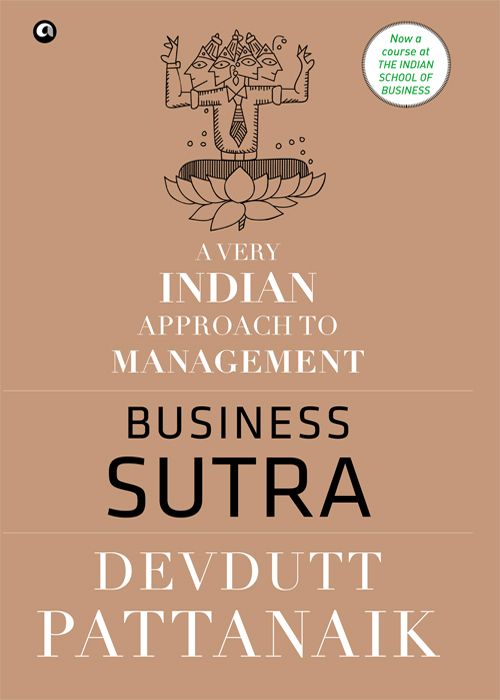
Business Sutra: A Management Framework from Indian Mythology
Business Sutra is an invitation to see business through a radically different lens. Devdutt Pattanaik, a mythologist who also spent years in the corporate world, offers a management approach rooted in Indian mythology, Hindu, Jain, and Buddhist traditions. This is a framework that challenges the fundamental assumptions of Western management science, going far beyond mere translation of Sanskrit terms into modern business language.
Pattanaik argues that modern management science, while appearing objective and universal, is actually a secular expression of Protestant beliefs, a fusion of Greek goal-oriented thinking and biblical compliance-based ethics. This approach emphasizes targets, processes, and measurement. It treats humans as resources that can be optimized like machines.
The Indian approach offered by Business Sutra is fundamentally different. It values gaze over goal, accommodation over alignment, nirguna (formless) over saguna (with form). It places belief, imagination, and subjectivity at the center, treating these as essential foundations to be embraced.
At the heart of this framework is yagna, the ritual of exchange described in the Rig Veda (one of the oldest Hindu scriptures). Business is yagna where the yajaman (initiator) makes an offering of svaha to the devata (the other), hoping to receive tathastu (a return offering) in exchange. The quality of this exchange is determined by bhaav (the feeling we bring), which is shaped by guna (personality), which is shaped by darshan (how we see the world).
Key Points
-
3B Framework: Belief → Behaviour → Business - Beliefs shape behavior, behavior shapes business. Modern management science ignores belief and focuses only on measurable behavior, creating inhuman corporations by ignoring the personal dimension.
-
Yagna: Business as Ritual Exchange - Business is bilateral exchange where everyone can be yajaman or devata depending on perspective. Exchange quality is determined by bhaav (feeling), which is shaped by guna (personality: tamas, rajas, or sattva).
-
Tri-Lakshmi: Three Types of Organizational Nourishment - Humans need Lakshmi (material wealth), Durga (power and social recognition), and Saraswati (knowledge and wisdom). Organizations that only focus on Lakshmi create shallow and inhuman cultures.
-
Varna as Consciousness Evolution Ladder - Varna is mindset based on consciousness expansion, distinct from the fixed caste of birth: shudra (dependent), vaishya (transactional), kshatriya (dominating), brahmana (unconditional leader). Hanuman rose from vaishya to brahmana; Ravana fell from kshatriya to vaishya.
-
Ranga-bhoomi vs Rana-bhoomi - Organizations can be playgrounds (ranga-bhoomi) where all parties thrive, or battlefields (rana-bhoomi) where there are only winners and losers. To create ranga-bhoomi, Lakshmi must serve as an indicator of personal growth, treated as a measure of inner expansion that goes far beyond a target to chase.
-
Ram, Krishna, and Ravana: Three Relationships with Rules - Ram is the rule-follower who enforces rules at the cost of humanity. Krishna is the rule-breaker with purpose who breaks old rules to create better ones. Ravana is the rule-breaker for ego who lives by his own rules.
-
Narayan vs Narayani - Modern organizations only value Narayani (the measurable: degrees, experience, skills) and ignore Narayan (potential, vision, character). The Pandavas chose Narayan (Krishna without weapons); the Kauravas chose Narayani Sena (measurable army).
-
"When the Mind Expands, Lakshmi Follows" - This is the antithesis of chase-Lakshmi mentality. When we expand consciousness and grow in wisdom, Lakshmi comes naturally. The rishis (ancient sages) designed yagna to force us to pay attention to others, the more dependable we become, the more Lakshmi flows.
The 3B Framework: Belief → Behaviour → Business
Belief is subjective truth, the lens we use to understand the world. The 3B framework states that belief shapes behavior, and behavior shapes business. As is belief, so is behaviour, so is business.
Modern management science tends to ignore belief and focus only on measurable behavior. The assumption is that certain behaviors reflect certain beliefs. This allows people to fake their way through corporations, as long as they are polite, follow protocols, and respect rules, no one cares what they actually think or feel.
Respect (formless belief) can manifest as politeness (tangible behavior). Politeness does not always reflect respect. By ignoring belief, corporations cancel out the personal, celebrate the professional, and create a separation between work and life. This is what makes corporations inhuman.
Belief and Imagination
Belief cannot be separated from imagination. Only humans have imagination, the ability to imagine future hunger, imagine food coming to us, imagine consuming without being consumed. This imagination is what makes us different from animals.
From imagination emerges subjectivity. Every human inhabits a customized and personalized subjective version of reality that no one else can access. From subjectivity comes belief. From belief comes culture. From culture comes humanity.
Every belief expresses itself in the stories we tell, the symbols we create, and the rituals we follow. The study of stories, symbols, and rituals to decode the beliefs they communicate is called mythology.
Management Science as Western Mythology
Pattanaik demonstrates that management science, which claims to be objective, is actually deeply embedded in Western beliefs. Its obsession with targets, milestones, and vision statements resonates with the Greek search for Elysium and the biblical quest for the Promised Land.
This is highly relevant for global business. Failure to recognize that modern management science is rooted in Western beliefs can lead to conflict and frustration when applied in different cultural contexts. An approach that works in North America may falter in India, China, or the Middle East. The cause lies in different beliefs about what matters, while the people themselves remain equally competent.
Key insight: If we want true transformation, we must work at the belief level, going deeper than behavior modification. Behavior change without belief change only creates superficial compliance.
Yagna: Business as Ritual Exchange
Business is yagna, a ritual described in the Rig Veda. The yajaman (initiator) makes an offering of svaha into the fire, hoping to please the devata (the other) who will then give him tathastu (a return offering).
Yagna can operate both downstream and upstream. So devata can be buyer or seller, investor or entrepreneur, boss or employee. In the cook's imagination, he is the yajaman and the boss is the devata. In the boss's imagination, he is the yajaman and the cook is the devata. Both perform svaha, which gives them satisfactory tathastu.
Lakshmi: Target or Indicator?
Yagna is declared successful only if it delivers wealth and prosperity, Lakshmi, the goddess of wealth. But the question is: is Lakshmi a target (laksh) or an indicator (lakshan)?
The answer depends on guna (personality):
- Those of tamas-guna will agree with what the majority says
- Those of rajas-guna will see Lakshmi as a target
- Those of sattva-guna will see Lakshmi as an indicator of personal growth
Guna is personality shaped by fear:
- Tamas-guna: Too afraid to have one's own opinion; follows the majority
- Rajas-guna: Too afraid to trust others' opinions; egotistical, territorial
- Sattva-guna: Trusts both others' opinions and one's own; introspective, sensitive
Bhaav: Feeling in Exchange
The quality of yagna is determined by bhaav, the feeling with which the yajaman offers svaha and receives tathastu. Bhaav determines the value he gives to the devata.
Pattanaik emphasizes that economic growth must be the result of intellectual and emotional growth, woven together into a single fabric. The rishis saw economic growth without personal growth as a recipe for disaster because then Lakshmi will come with her sister, Alakshmi (goddess of conflict), and create enough quarrels to ensure Lakshmi can slip from the unworthy yajaman's grasp.
If we only chase Lakshmi (revenue, profit) without attending to the personal growth of the team, we will create rana-bhoomi (battlefield) where everyone fights for their claim. If we make economic growth an indicator of personal growth, we create ranga-bhoomi (playground) where everyone can thrive.
Key insight: Yagna is truly successful only when the svaha helps both the devata and the yajaman outgrow dependency. Economic growth must be the result of intellectual and emotional growth.
Tri-Lakshmi: Three Types of Organizational Nourishment
Organizations need three types of nourishment, visualized as three goddesses:
- Lakshmi: Material wealth (nourishes sthula-sharira, the physical body)
- Durga: Power and social recognition (nourishes karana-sharira, the social body)
- Saraswati: Knowledge and wisdom (nourishes sukshma-sharira, the mental body)
These correspond to three levels of seeing:
- Drishti: Seeing Lakshmi, the measurable, objective, saguna (with form)
- Divya-drishti: Seeing Durga, power, status, hierarchy
- Darshan: Seeing Saraswati, wisdom, identity, why rules exist
Lakshmi: The Measurable
Lakshmi is the easiest to see. Everyone seeks material wealth, salary, revenue, profit. But if we only chase Lakshmi, we will create organizations that only care about numbers.
Durga: Recognition and Power
Durga is the search for social validation. When we are recognized, we feel powerful. When we are not recognized, we feel powerless. We seek aukaat (status and prestige) and izzat (respect). Only humans can validate another human's mental image. That is why we feel nervous around strangers until they are able to identify us.
Property is the physical manifestation of our mental body. A car is transportation, and at the same time a way to claim our place in the social hierarchy. A title is responsibility, and at the same time validation that we matter. When our car is scratched or our seat is given to someone else, our social body is damaged and this causes pain to the mental body, even though the physical body is perfectly fine.
Saraswati: Wisdom
Saraswati is the hardest to see. She transcends knowledge, she is wisdom, understanding why rules exist beneath the surface of what the rules are. Saraswati is fluid (saras), emerging from imagination, constantly changing form, with potential expanding toward infinity.
Maya vs Satya
Maya is truth based on comparison, allowing judgment because there is a reference scale. Satya is truth without comparison. In nature, everything is perfect at every moment. But in culture, measurement scales are designed to validate our mental images, to include and exclude, creating hierarchies.
Business is entirely built on maya, rankings, hierarchies, salary scales, performance reviews. All of these are measurements. But we forget that maya is delusion. Measurement is illusion. Satya is what is real.
Organizations that only focus on Lakshmi (numbers) will create shallow cultures. Organizations that value Durga without Saraswati will create politics and jockeying for position. Only organizations that value all three goddesses will create places where humans can thrive wholly.
Key insight: When we are recognized we feel powerful. When we are not recognized we feel powerless. Property is the physical manifestation of our mental body, what we have determines who we are.
Varna: The Consciousness Evolution Ladder
Varna is mindset based on consciousness expansion, distinct from caste (jati) which is based on birth. Varna can change, rise or fall, depending on how we transcend fear.
The four traditional varnas are stages of consciousness evolution:
-
Shudra-varna: Completely dependent on others (dependent). Has no opinion of their own. Follows the majority or authority without question.
-
Vaishya-varna: Starting to have one's own opinion but still conditional (transactional). Relationships are "I give X, you give Y."
-
Kshatriya-varna: Leader but still conditional (dominating). Will protect others as long as it benefits themselves. "I protect you, you follow me."
-
Brahmana-varna: Unconditional leader who is dependable (reliable). Protects and gives without expecting return. Understands others' fears and helps them grow.
Varna as Mindset, Not Profession
What distinguishes is mindset, deeper than profession or birth. A CEO can be shudra-varna if he only follows trends without thinking. An office assistant can be brahmana-varna if he is dependable and helps others grow unconditionally.
Hanuman: Evolution from Vaishya to Brahmana
Hanuman (the devoted monkey deity from the Ramayana epic) is the perfect example of varna evolution. He started serving Sugriva out of gratitude to his guru (vaishya-varna, conditional follower). He then served Ram without any hope or obligation (brahmana-varna, unconditional leader). Hanuman moved from pursuing things to pursuing thoughts. He does not care what Ram has or can give, he seeks to invoke Ram within himself.
Ravana: Descent from Kshatriya to Vaishya
Ravana (the antagonist king in the Ramayana), on the other hand, slipped from kshatriya-varna (leader of Lanka) to vaishya-varna (conditional follower of Shiva). He wanted to possess Shiva by bringing Mount Kailash to Lanka, while remaining unwilling to become like Shiva. He did not believe there was potential he needed to realize; he saw himself as perfect, requiring only more resources.
Signs of Varna Growth
Growth happens when:
- We prefer giving over taking
- More people can depend on us
- Even the insignificant become significant
- We include those we once excluded
- We stop seeing people as villains
- We strive to uplift the Other
The implications for talent management are profound. Modern organizations tend to see varna as fixed, they recruit "high potentials" and ignore the rest. But if varna can change, then everyone has potential to grow. The deeper question becomes "how do we create contexts that allow everyone to grow?", going beyond the simple question of "who has talent?"
Key insight: Hanuman does not care what Ram has, or can give him; he seeks to invoke Ram within him. Hanuman seeks to realize his potential, not increase his resources. Growth is about pursuing thoughts, not things.
Rules: Ram, Krishna, and Ravana
A person's relationship with rules reveals their varna. There are three main archetypes:
Ram: The Rule-Follower (Maryada Purushottam)
Ram enforces rules even at the cost of humanity. He exiles Sita even though he knows she is innocent, because the rules state a king cannot have a woman who is the subject of gossip as queen.
Rules were created to tame the animal-human, to remove jungle law from society. Rules can also be oppressive, creating underdogs and outsiders. Karna and Eklavya were denied the right to learn archery on the grounds of caste alone, despite having abundant talent, because they stood outside the kshatriya order. The social structure of the land was utterly unfair.
Krishna: The Rule-Breaker with Purpose (Leela Purushottam)
Krishna (the divine strategist in the Mahabharata epic) breaks old rules that no longer serve their purpose to create better rules. He breaks the rules of war to defeat Bhishma, Drona, and Karna, with the purpose of creating a society where jungle law cannot survive, his motive rooted in dharma.
Krishna can be described as an innovator, one who creates better rules by breaking and bending old rules that do not serve their purpose. He does so gently, with a smile, taking people into confidence.
Ravana: The Rule-Breaker for Ego
Ravana lives by his own rules. Does not care about anyone except what pleases him. He kicks out his brother Vibhishana, lets Lanka burn, sacrifices his sons, all because of ego.
Duryodhana: The Mimic Who Uses Rules for Domination
Duryodhana (the antagonist prince in the Mahabharata) is the fourth type, the mimic who follows rules but does not care about the purpose they serve. He did not break a single rule when inviting Yudhishthira to play dice or when disrobing Draupadi (infamous scenes from the epic). He used rules to control the world around him and get his way. When we celebrate professionalism without empathy, we celebrate Duryodhana.
Sita: Liberation from Rules
Sita's story is fascinating. She was twice banished to the forest by Ram. The first time voluntarily (as a dutiful wife). The second time involuntarily (because of gossip). Sita does not hate Ram. She understands his position, his responsibilities, his obligations to rules.
When Ram asks her to return, she refuses. As a forest dweller, she is no longer bound by city rules. She no longer needs the Durga offered by social rules. She has enough Shakti (internal strength) within herself to live without them. This is the highest liberation.
Modern organizations tend to celebrate Ram and Duryodhana, those who follow rules without questioning. This creates inhuman cultures. We need more Krishnas, those who question old rules and create better ones. And we need more Sitas, those who have internal Shakti to not depend on external validation.
Key insight: Krishna can be described as an innovator, one who creates better rules by breaking and bending old rules that do not serve their purpose. But he does so gently, with a smile, taking people into confidence.
Critical Assessment
Strengths
1. Framework that Challenges Fundamental Assumptions
Business Sutra demonstrates that modern management science, while claiming to be objective, is actually deeply embedded in Western beliefs. This is a perspective rarely discussed in mainstream management literature. Pattanaik provides vocabulary and framework to understand that there are other equally valid ways of seeing business.
2. Integration of Mythology with Practical Application
Pattanaik tells stories about Indian mythology while also extracting universal principles and showing concrete applications for modern business. Frameworks like yagna, Tri-Lakshmi, and varna provide new language for understanding organizational dynamics.
3. Values the Human Dimension in Business
In an era where corporations increasingly treat people as "human resources" to be optimized, Business Sutra reminds us that business is about humans with their beliefs, fears, and hungers. The Tri-Lakshmi framework (Lakshmi-Durga-Saraswati) provides language to understand that humans need more than just salary.
Limitations
1. Requires Understanding of Indian Mythology
This framework heavily depends on understanding Indian mythology, which may be foreign to many international readers. Concepts like rebirth, karma, and varna may feel too philosophical for practical business application for those unfamiliar with these traditions.
2. Less Concrete for Implementation
While the frameworks are conceptually interesting, the book sometimes lacks step-by-step guidance for implementation. How exactly does a CEO transform an organization from rana-bhoomi to ranga-bhoomi? What are concrete metrics for measuring varna growth? Many practical questions remain unanswered.
3. Generalizations about "West" and "India"
Pattanaik sometimes makes broad generalizations about "West" versus "India" that can be overly simplistic. Reality is more complex, there is great diversity within both Western and Indian traditions. This dichotomy, while useful for contrast, can obscure nuances.
Conclusion
Business Sutra is an invitation to see business, and life, through a different lens, going far beyond an ordinary management book. A lens that values subjectivity, diversity, and consciousness expansion.
The most valuable aspect of Business Sutra is the reminder that business is about humans. Numbers, processes, and systems are mere instruments; the substance is human. Humans with their beliefs, fears, and hungers. Humans who seek wealth, recognition, and meaning, woven together as a single hunger.
When we forget this, we create inhuman corporations. When we remember this, we create organizations where humans can thrive wholly, recognized as beings with unlimited potential, far beyond the narrow status of resources.
The essence of all of Business Sutra is the final sentence: "When the mind expands, Lakshmi follows." This is the antithesis of chase-Lakshmi mentality. When we expand consciousness, when we grow in wisdom, Lakshmi comes naturally. It does not need to be chased. It is attracted.
Recommendation: Highly recommended for entrepreneurs and business leaders seeking alternative perspectives from Western management. Best suited for those interested in traditional wisdom and philosophy, as well as those working in cross-cultural contexts. Rating: 4.5/5.
FAQ
Q: What is the main difference between Indian and Western management approaches according to Business Sutra? A: The Western approach emphasizes goal, alignment, and the measurable (saguna). The Indian approach values gaze, accommodation, and the formless (nirguna). The West treats humans as resources to be optimized; India sees business as yagna, an opportunity for mutual growth.
Q: What is yagna and how is it relevant for modern business? A: Yagna is a ritual of exchange where the yajaman (initiator) makes an offering of svaha to the devata (the other), hoping to receive tathastu (return offering). In business, everyone can be yajaman or devata depending on perspective. Exchange quality is determined by bhaav (feeling), which is shaped by guna (personality).
Q: Why do organizations need Tri-Lakshmi (Lakshmi, Durga, Saraswati)? A: Humans need Lakshmi (material wealth), Durga (social recognition), and Saraswati (wisdom). Organizations that only focus on Lakshmi (numbers) create shallow cultures. Those that only value Durga without Saraswati create internal politics. Only those that value all three goddesses create places where humans thrive wholly.
Q: What is varna and how is it different from caste? A: Varna is mindset based on consciousness expansion, distinct from fixed caste based on birth. Four varnas: shudra (dependent), vaishya (transactional), kshatriya (dominating), brahmana (unconditional leader). Varna can change, Hanuman rose from vaishya to brahmana; Ravana fell from kshatriya to vaishya.
Q: What is the difference between ranga-bhoomi and rana-bhoomi? A: Ranga-bhoomi is a playground where all parties can thrive. Rana-bhoomi is a battlefield where there are only winners and losers. Organizations that chase Lakshmi without personal growth create rana-bhoomi. Those that make Lakshmi an indicator of growth create ranga-bhoomi.
Q: Who should read Business Sutra? A: Business leaders and entrepreneurs who want alternative perspectives from Western management. Those working in cross-cultural contexts. Those interested in traditional wisdom for modern business. Those seeking frameworks to create more human organizations.
Q: What does "When the mind expands, Lakshmi follows" mean? A: This is the antithesis of chase-Lakshmi mentality. When we expand consciousness and grow in wisdom, wealth comes naturally. The rishis designed yagna to force us to pay attention to others, the more dependable we become, the more Lakshmi flows. Lakshmi flows because we become a refuge, drawing wealth toward us as a natural consequence of trustworthiness.
Q: How do Ram, Krishna, and Ravana differ in their relationship with rules? A: Ram is the rule-follower who enforces rules even at the cost of humanity. Krishna is the rule-breaker with purpose who breaks old rules to create better ones. Ravana is the rule-breaker for ego who lives by his own rules. Organizations need more Krishnas, innovators who create better rules.
Q: Does Business Sutra replace Western management science? A: No. Business Sutra is a supplement, an additional lens to see business more completely. In an increasingly connected and diverse world, understanding diverse perspectives is crucial. Indian and Western approaches can complement each other, working together as two views of the same business reality.
Q: What is meant by Narayan vs Narayani in the context of talent management? A: Narayani is the measurable (degrees, experience, skills). Narayan is potential, vision, character that cannot be measured. Modern organizations only value Narayani and ignore Narayan. The Pandavas chose Narayan (Krishna without weapons); the Kauravas chose Narayani Sena (measurable army). Result: Pandavas won.
Related Content
If you are interested in Business Sutra, also consider:
Related Books:
- Bhagavad Gita - Core philosophical text that is the foundation for many concepts in Business Sutra
- Narendra Jadhav: Alchemy of Management - Another Indian approach to management and leadership
- Simon Sinek: Leaders Eat Last - Western perspective on leadership that aligns with brahmana varna
Mental Models & Frameworks:
- First Principles Thinking - Questioning fundamental assumptions as Pattanaik does
- Perspective Taking - Understanding multiple perspectives like the gaze vs goal concept
- Systems Thinking - Understanding Tri-Lakshmi components and their interactions
Further Resources:
- Devdutt Pattanaik Official Website - Complete collection of works, videos, and insights
- Aleph Book Company - Official publisher of Business Sutra
- Podcasts & Video Seminars by Devdutt Pattanaik on Business Sutra and Indian Mythology
Exploration Topics:
- How the Yagna framework is applied in supply chain management
- Implementing Tri-Lakshmi in designing organizational benefits
- Varna Evolution as a framework for leadership development programs
- Creativity vs Compliance in organizations (Ram vs Krishna)