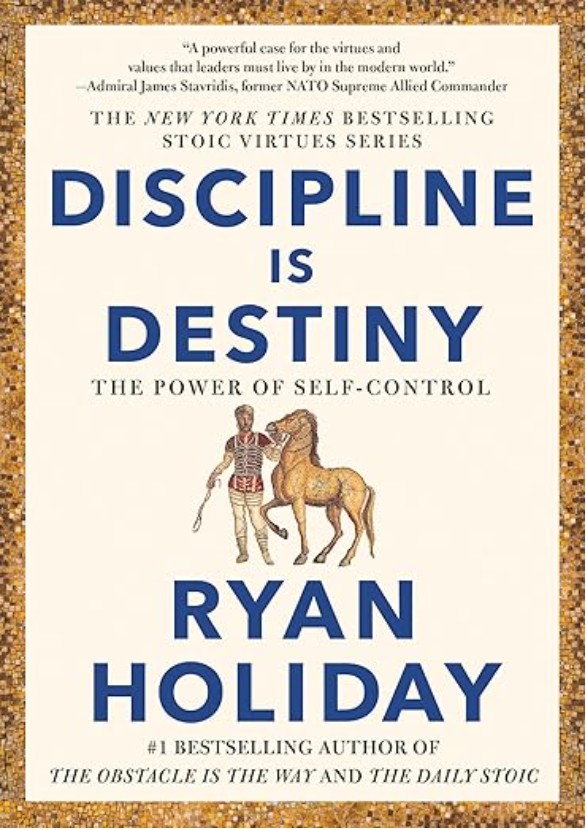
Why Read This
"Discipline Is Destiny" is a synthesis of dozens of biographies of masters throughout history: Lou Gehrig, Marcus Aurelius, Queen Elizabeth II, Churchill, and Cato. Holiday extracts the universal patterns of self-discipline.
This book breaks self-discipline into three domains: body (physical discipline), mind (mental temperament), and soul (magisterial mastery). This framework provides a practical blueprint for building an extraordinary life through consistent self-control.
Holiday shows that discipline isn't deprivation or punishment. Discipline is liberation and power. Those who master themselves have true freedom because they aren't controlled by impulses, addictions, or internal weaknesses.
This book is relevant for anyone who wants to build something that lasts. Entrepreneurs need consistency in execution, athletes pursue peak performance, and leaders must maintain composure under high-pressure situations.
Key Takeaways
-
Physical discipline is the foundation of all other discipline - Lou Gehrig played 2,130 consecutive games with 17 healed fractures in his hands. The body is the training ground for mind and soul.
-
Patience is the main ingredient of genius - Edison tested thousands of materials for the light bulb filament. Patience isn't passive waiting, it's active endurance with long-term focus.
-
Unchecked ambition is the most dangerous addiction - Napoleon wrote warnings about ambition at age 22, then his life was destroyed by the exact same pattern. Washington gave up power, Napoleon seized it until he was ruined.
-
Tolerant with others, strict with yourself - Marcus Aurelius gave Lucius Verus half the empire despite his half-brother not being as strict as him. Cato the Younger loved his hedonistic brother. High standards for yourself, compassion for others.
-
Discipline is contagious - Antoninus Pius never forced Marcus Aurelius to be disciplined. Marcus caught discipline from seeing Antoninus's living example every day. Leadership through example is the highest form of influence.
-
Calm under pressure results from years of practice - Queen Elizabeth sat alone at Prince Philip's funeral to honor pandemic protocol. Calm in critical moments comes from decades of daily discipline.
Core Ideas
1. Physical Discipline as Foundation
Physical discipline is the starting point of all self-mastery. The body is the first instrument that must be mastered before mind and soul.
Lou Gehrig transformed himself from a kid with "piano legs" into an elite athlete through fitness that was "almost like religion to him." He never drank alcohol, never used soft chairs because "I'm tired of sitting on cushions," and lived with his parents for ten seasons while taking the subway to the stadium. Living clean for him wasn't about vanity, it was stubborn ambition to be the best.
His main principle was clear: anything that interferes with ambition is poison to him.
Theodore Roosevelt was born weak with asthma attacks, poor eyesight, and fragile lungs. His father encouraged him to train so Roosevelt rebuilt his body and his life. As President, he always made time for several hours of afternoon exercise: walking, rowing, boxing, wrestling, hiking, hunting, and horseback riding.
In practice, the body is like a high-performance race car that needs the right fuel. Morning is the most powerful time for deep work because it's free from distractions. Use dawn before the world wakes up and demands come in. Toni Morrison wrote before her children woke up and before work demands came. The result: eleven novels and one Nobel Prize.
Physical discipline creates a willpower reserve that can be used for mental challenges. People who are consistent with morning routines, exercise, and sleep hygiene have a foundation for handling cognitive and emotional demands.
2. Patience and Long-Term Thinking
Patience is the main ingredient of genius. Even bursts of inspiration are worthless without the patience to polish, refine, and release.
Edison tested thousands of materials for light bulb filaments. He patiently ran repetitive tests, set aside experiments until he found better raw materials, and even designed ways to send electricity underground to the first block in New York City. His genius came from patient commitment to endless iteration.
Da Vinci wrote: "Patience serves as protection against wrongs as clothes do against cold. If you put on more clothes as the cold increases, it will have no power to hurt you. So in like manner you must grow in patience when you meet with great wrongs, and they will then be powerless to vex your mind."
Long patience is Shackleton-level patience. Keep the book in a drawer while it develops, sleep then come back tomorrow, let compound interest work, let investments appreciate, let plans run, and let people chase ideas that came too early.
Churchill held off the European invasion for a full 2 years despite intense pressure from allies. He knew one chance to land on the continent, couldn't fail. D-Day June 6, 1944 was the result of patience and preparation.
Practically, every significant project needs a maturation period. Let ideas ripen in the background while you work on other things. Build deep relationships through small consistent actions over years. Develop skills through daily practice that makes you 1% better.
3. Controlling Ambition and Releasing Power
Ambition is the most intoxicating and hardest addiction to control. Unlike drinking, society rewards ambition. We admire successful people without asking: what did it cost? how much did they suffer? how much did they make others suffer?
Napoleon at age 22 wrote a warning essay: "Ambition, which overthrows both governments and private fortunes, which feeds on blood and crime, is a hard and thoughtless fever which ceases only when life ceases." Adult Napoleon refused to accept this warning from his younger self. He threw the essay into the fire. A short time later he filled the continent with a generation of corpses and found himself exiled.
Alexander the Great showed that the whole world wasn't big enough to contain him; in the end only a coffin was enough. The same example appears in Pompey the Great: endless ambition made him ally with Caesar and begin the destruction of the Republic he once loved.
This condition contrasts with Washington. He defeated the British Empire, the continent lay before him as spoils. He instead stepped down from his commission, refused power, bowed, and surrendered his sword. King George III said, "If he does that, he will be the greatest man in the world."
Marcus Aurelius received absolute power and his first step was to give half of it to his half-brother, Lucius Verus. Their story refutes the belief that "absolute power corrupts absolutely".
Practically, ambition must be controlled. The best leaders don't chase power because they don't need it. After conquering lust and ego, they become stronger, more independent, less corrupt, calmer, and stay focused on what matters.
Use a simple test: can you delegate, step back, and give credit to others? People who can't refuse power are a danger to themselves and the organization. Those who need control and can't tolerate being anything but the main determiner aren't truly great despite achieving great things. They're addicts, and power controls them.
4. Tolerant with Others, Strict with Yourself
The highest standard for yourself, compassion and grace for others. This is the hardest balance to achieve.
Cato the Younger was as strict as his great-grandfather. Didn't care about wealth, wore ordinary clothes, walked around Rome barefoot. Slept on the ground with troops. Never lied, never went easy on himself. The saying in Rome: "We can't all be Cato."
His brother Caepio loved luxury, loved perfume, and hung out with people Cato would never allow for himself. Cato was humble enough to remember that this is called self-discipline for a reason. While we hold ourselves to the highest standards, we can't expect others to imitate the same pattern.
Marcus Aurelius and Lucius Verus couldn't be more different. Lucius wasn't that strict, wasn't known for ever picking up a philosophy book. Was Marcus convinced he was superior? From Meditations, all we hear: gratitude "that I have the kind of brother I have. One whose character challenges me to improve my own."
Marcus's true greatness is that his firmness was only directed at himself. He didn't "go around expecting Plato's Republic". People are people, he understood they're not perfect. Found ways to work with flawed people, positioned them to serve the good of the empire.
Practically, the burning question for high performers is why the team isn't enough and why they fail to do simple things correctly. The answer is simple: they're not us. Even if they're similar, is it fair to expect something they never signed up for?
Lincoln's secretary marveled: the president "never asked perfection from anyone, he didn't even insist, for others, on the high standard he set for himself."
Better to follow Marcus's model. Find things to love and appreciate in a different brother. Use the brother's flaws to improve yourself. Both are made better by being in each other's lives. This is a higher level: when self-discipline is coupled with compassion, kindness, understanding, love.
The fruit of temperance shouldn't be loneliness or isolation because that result would taste bitter. This journey is a process of self-actualization, so leave other people's mistakes to their makers. The better we are at this, the higher the standards we must live by and the more willing we are to see other approaches.
Critical Assessment
Strengths
The three-domain framework is very easy to apply. The separation into body, mind, and soul provides clear structure for approaching self-discipline systematically. You can identify the weakest domain and focus development there.
Case studies from various eras and fields. Holiday takes examples from athletes (Gehrig), emperors (Marcus Aurelius), queens (Elizabeth II), statesmen (Churchill, Washington), entrepreneurs. This diversity shows disciplinary principles are universal and timeless.
Balance between aspiration and realism. The book is honest about the difficulty of discipline. It acknowledges that everyone will fail, everyone will stumble. The question isn't whether you're perfect, the question is: can you get up again? Grace for yourself is as important as firmness.
Integration with Stoic philosophy. As a continuation of Courage Is Calling and Will Is Destiny, this book completes the virtue trilogy. The deep foundation in Stoic principles provides solid philosophical grounding.
Limitations
Minimal modern neuroscience and habit formation. The book focuses on historical examples and philosophical principles. Not much discussion of dopamine, prefrontal cortex, habit loops, or behavioral psychology that could strengthen arguments.
No discussion of systemic factors. Many examples in the book are people with privilege and resources. Washington owned slaves, Marcus was emperor, Churchill was from aristocratic family. Discussion of discipline needs to acknowledge structural advantages some people have.
Potential for toxic productivity mindset. The emphasis on daily discipline, showing up relentlessly, and always pushing yourself can easily turn into hustle culture or burnout. The book needs more explicit warnings about rest, recovery, and mental health.
Overlap with Holiday's previous books. If you've already read Ego Is the Enemy, Obstacle Is the Way, or Courage Is Calling, many themes and examples will be familiar. The core ideas remain valuable, execution is slightly repetitive.
FAQ
Q: Is discipline the same as willpower? A: No. Willpower is a depletable resource, discipline is a sustainable system. Discipline reduces the need for willpower by creating routines and habits.
Q: How to start building discipline if you've never been disciplined? A: Start with one small but consistent thing, like a morning routine or daily exercise. Discipline builds itself because small wins create momentum for bigger commitments.
Q: Must you be strict all the time or are there off days? A: Discipline isn't rigidity. Flexibility is strength. The key is intention, not perfection. Even Marcus Aurelius admitted he wasn't perfect, so the important question: can you get up again after stumbling?
Q: How to balance ambition with temperance? A: Ambition must be controlled by principles. Ask: for what is this achievement and at what cost? Napoleon chased glory until he was destroyed, Washington surrendered power and became great. Direction is more important than speed.
Q: Does discipline mean sacrificing all pleasure? A: No. Epicurus proved that true pleasure comes from moderation, not excess. Disciplined people enjoy things more because they appreciate them properly. Cato was strict yet cheerful, while Antoninus was moderate but not ascetic.
Q: How to be tolerant with others but strict with yourself? A: Remember that people aren't perfect, including you. High standards for yourself are personal choices, not obligations for others. Give credit for their efforts, forgive mistakes, and help when they're open to help.
Q: How long does it take to build real discipline? A: A lifetime. Discipline isn't a destination, it's a practice. Marcus Aurelius kept learning philosophy even as an old man. Queen Elizabeth maintained protocol until the end at age 95. The journey never ends, that's what makes it beautiful.
Q: What's the difference from popular motivational books? A: This book is rooted in Stoic philosophy and historical examples, not empty cliches. The focus is on principles and patterns instead of emotional pumping. The narrative is honest about difficulties and failures, not promises of instant transformation.
Favorite Quotes
"Persist and resist" - Epictetus
"Your best is good enough." - John Wooden
"Aequanimitas" (inner calm) - Antoninus Pius's last words
"Tolerant with others, strict with yourself." - Marcus Aurelius
"The impediment to action advances action. What stands in the way becomes the way." - Marcus Aurelius
Further Reading
If you resonate with this book, explore:
- Meditations by Marcus Aurelius - Direct source material from the philosopher-emperor
- Mastery by Robert Greene - Diving into deliberate practice and long-term skill development
- Atomic Habits by James Clear - Practical framework for building systems instead of just goals
- The Obstacle Is the Way by Ryan Holiday - Companion about resilience and difficulty
- Ego Is the Enemy by Ryan Holiday - About managing internal obstacles to growth
Rating: 5/5 - Essential reading for anyone serious about self-mastery and character development
Genre: Philosophy, Personal Development, Stoicism
Best for: Leaders, entrepreneurs, athletes, anyone building something that requires sustained discipline