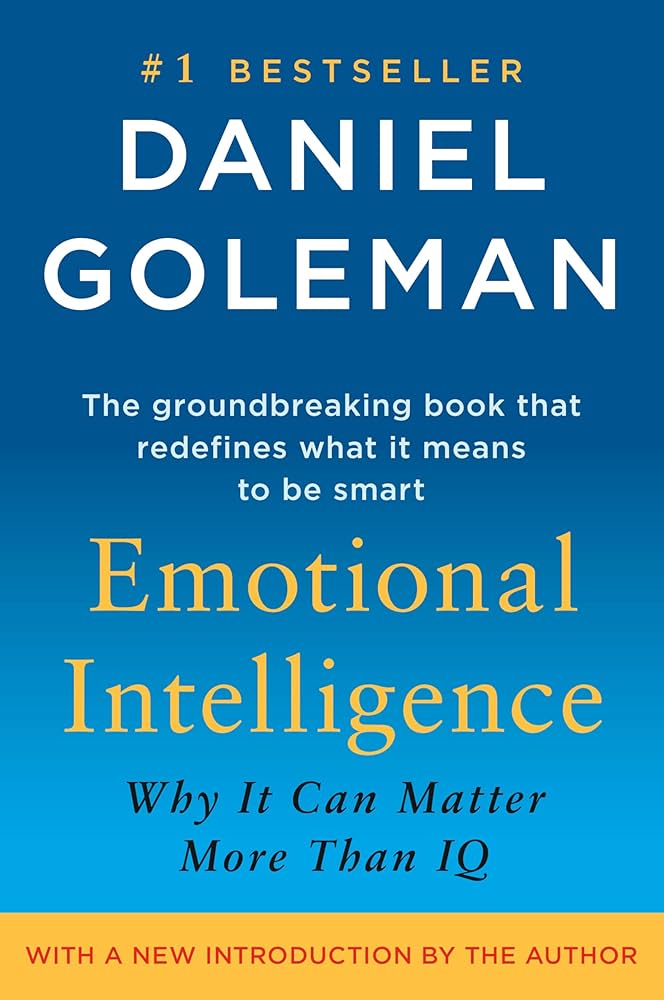
Emotional Intelligence
Author: Daniel Goleman Publisher: Bantam Books (1995) Pages: 352
Why Read This
Daniel Goleman demonstrates that IQ accounts for roughly 20% of what determines a person's fate. The remaining 80% depends on the ability to recognize and navigate one's own emotions and those of others.
This book grew from two anxieties that converged. Neuroscience and psychology data were growing increasingly clear that the human brain runs two systems simultaneously: a slow, deliberate thinking system and a fast emotional one. When the emotional system takes over too completely, even high intellectual intelligence becomes inaccessible. At the same time, surveys of parents and teachers across multiple countries showed that children growing up in the 1990s were lonelier, more anxious, more impulsive, and more aggressive than the generation before them.
Goleman answers both anxieties with a single argument built from the ground up: from the neurobiology of the amygdala, up through individual psychology, outward into marital and workplace dynamics, and finally arriving at a call for emotional education as an urgent social need. He shows that emotional intelligence is a cluster of capabilities that can be trained and shaped, from early childhood through adulthood.
This book rewards anyone who wants to understand why some people rise from failure while others stay submerged in it, and what is actually operating beneath that difference.
Core Idea 1: Two Minds, One Brain
The human brain carries two processing systems that operate at different speeds and according to different logics. The rational mind works through the neocortex: slow, reflective, capable of weighing long-term consequences. The emotional mind works through the amygdala and limbic system: fast and impulsive, sometimes seizing the whole brain before the rational mind has a chance to speak.
"In a very real sense we have two minds, one that thinks and one that feels."
The Amygdala as Emotional Sentinel
The amygdala, an almond-shaped structure at the base of the limbic system, scans every experience with the most primitive question available: is this dangerous? Researcher Joseph LeDoux discovered a direct neural pathway from the thalamus to the amygdala, bypassing the neocortex entirely. Through this pathway, the amygdala can trigger a response before conscious thought has finished processing what is happening.
Goleman calls this "emotional hijacking." The amygdala declares an emergency and recruits the entire brain for its urgent agenda. The result: a person reacts automatically to a situation that may require no such force of reaction, and regrets the action only afterward.
The Prefrontal Lobes as Counterweight
The prefrontal lobes, positioned just behind the forehead, allow for a more measured response. They evaluate signals from the amygdala and can dampen those signals when the situation is less urgent than it feels. When the connection between the two is healthy, a person can recognize that an initial reaction was disproportionate and adjust behavior in a meaningful way. When that connection has been weakened by chronic stress, trauma, or emotional neglect from childhood, the amygdala dominates with little resistance.
The most striking finding from this branch of neuroscience came from Antonio Damasio's research at the University of Iowa. Patients with damage to the prefrontal-amygdala circuit had completely intact intellectual intelligence, yet lost the ability to make decisions. Every choice felt neutral because there were no emotional signals to assign weight. Damasio concluded that emotions serve as guides for rational thought, pointing toward a direction long before formal logic begins to operate.
"Evidence like this leads Dr. Damasio to the counter-intuitive position that feelings are typically indispensable for rational decisions; they point us in the proper direction, where dry logic can then be of best use."
Core Idea 2: The Five Domains of Emotional Intelligence
Goleman organizes emotional intelligence into five domains that form a single hierarchical structure. Collapse the lower layers, and the ones above them begin to shift.
Domain 1: Self-Awareness
The ability to recognize a feeling at the moment it is occurring. The difference between "I am angry" and "I am experiencing anger" sounds small, but carries neurological weight: the shift signals that the neocortex has begun monitoring the amygdala, and monitoring is the first step toward regulation. A person who cannot name what they are feeling has no foundation on which to build any emotional capability whatsoever.
Domain 2: Managing Emotions
Goleman's aim here is balance: arranging the proportion of emotions, allowing them to be present in a measure that fits the moment. Research by Diane Tice produced findings that run against common assumption: catharsis, the open venting of anger, actually raises arousal in the emotional brain and leaves a person angrier. What works is reframing the situation. Chronic anxiety carries an addictive quality because verbal rumination on worry provides a slight dampening of the physical sensation, creating a false sense of relief that keeps the worry cycling.
Domain 3: Motivating Oneself
At the heart of this domain is the ability to delay impulse. Walter Mischel's marshmallow experiment with four-year-olds revealed its predictive power: children who waited for two marshmallows instead of taking one immediately showed, twelve to fourteen years later, greater social competence, higher frustration tolerance, and SAT scores averaging 210 points higher. At the peak of this domain sits the state Goleman calls flow: full absorption in a task, emotions aligned with the work, performance at its highest.
Domain 4: Empathy
The ability to read the feelings of others grows directly from the ability to read one's own feelings. Research by Robert Rosenthal of Harvard showed that more than ninety percent of emotional messages travel through facial expression, gesture, and tone of voice. Words carry less than ten percent of the emotional content in any given exchange. Burning anger leaves no room for empathy because intense emotion crowds out the receptive capacity needed to receive subtle signals from others.
Domain 5: Social Arts
Managing the feelings of others requires managing oneself first. From that foundation grows the ability to read situations, respond with precision, and influence the emotional state of others. Ulf Dimberg at the University of Uppsala found that when a person sees a smiling or angry face, their own facial muscles move in subtle imitation. Emotional contagion always follows one pattern: from the more expressive to the more passive, from the more powerful to the more deferential.
"Emotional entrainment is the heart of influence."
Core Idea 3: IQ as a Weak Predictor
A study of 95 Harvard graduates from the class of the 1940s found that those with the highest test scores in college were no more successful in career or life satisfaction than classmates with lower scores. A study tracking 450 boys in Somerville, Massachusetts from childhood to age 47 produced a similar result: IQ had almost no correlation with how well they navigated life. What made the actual difference was their childhood ability to manage frustration, regulate emotions, and get along with others.
"At best, IQ contributes about 20 percent to the factors that determine life success, which leaves 80 percent to other forces."
Emotional intelligence functions as a meta-ability: it sits above all other capabilities and determines how effectively each of them can be deployed. A person with strong analytical ability who cannot manage anxiety during a high-stakes exam finds that analytical ability inaccessible. A person with solid technical expertise who cannot function inside a team cannot translate that expertise into real contribution.
"Emotional aptitude is a meta-ability, determining how well we can use whatever other skills we have, including raw intellect."
Research by Jack Block of UC Berkeley draws the contrast sharply. Men with very high IQ but low emotional intelligence tend toward coldness, isolation, and ambition that fails to translate across the broader dimensions of life. Men high in emotional intelligence are socially fluid, cheerful, committed, empathic, and at ease with themselves and those around them.
Core Idea 4: Marriage as an Arena for Emotional Intelligence
Marriage is where emotional intelligence meets its most intimate and most vulnerable test. John Gottman of the University of Washington built the most detailed map of emotional dynamics in marriage available: with 94% accuracy, he could predict which couples would divorce within three years based on specific emotional patterns.
The four most destructive patterns are criticism that attacks character instead of specific actions, contempt, defensiveness, and stonewalling. Contempt is the most dangerous: when one partner displays contempt, the other experiences a rise in heart rate of two to three beats per minute within an exchange that goes unspoken. When a wife's face shows disgust four or more times in a fifteen-minute conversation, that is a silent signal that the couple will likely separate within four years.
Beneath the visible argument runs a second conversation inside each partner's mind: automatic thoughts shaping the perception of the other, far more powerful than any words spoken aloud. The condition Gottman calls "flooding," when a person is so overwhelmed by negativity that clear thought becomes impossible, is the point where a fight becomes unresolvable. Men, it turns out, are more susceptible to flooding at lower levels of negativity than women.
Three competencies separate the marriages that endure: the ability to calm oneself before continuing a difficult conversation, the ability to search for evidence that counters negative thoughts about a partner, and the ability to listen and speak with empathy toward the feelings behind the words.
Core Idea 5: The Workplace, Leadership, and Collective Intelligence
The 1978 plane crash in Portland, Oregon, which killed ten people, opens the chapter on work. The pilot, Melburn McBroom, was technically proficient. What failed was the social intelligence inside the cockpit: a copilot afraid of his anger did not dare speak up about the fuel steadily draining away.
"The cockpit is a microcosm of any working organization."
In an office, equivalent damage unfolds more quietly and more slowly: productivity falls, deadlines slip, the best people leave, and the root cause rarely surfaces. Emotional agitation disrupts cognitive function in measurable ways. A person gripped by anxiety, anger, or depression cannot remember, concentrate, learn, or make decisions with clarity.
The most decisive factor in group intelligence turns out to be social harmony, well above the average academic IQ of the members. Research by Robert Kelley and Janet Caplan at Bell Labs found that star engineers and average engineers carried equivalent intellectual ability. The real differentiator was interpersonal strategy: the stars built strong networks of relationships long before they needed them, so when a crisis arrived, the right people were already there and ready.
Unskilled criticism is the single largest source of conflict in the workplace, outranking personality clashes and disputes over power. Emotionally intelligent criticism is specific about the action, offers a solution, is delivered directly, and is sensitive to its effect on the person receiving it.
Core Idea 6: Mind, Body, Family, and Temperament
The Biological Bridge Between Emotion and Illness
Robert Ader's discovery at the University of Rochester in 1974 proved that the immune system can "learn": rats conditioned to associate the taste of saccharin with an immune-suppressing drug continued to experience a drop in T-cells even when given only saccharin, with no drug. The field that grew from that discovery, psychoneuroimmunology (PNI), opened a research pathway into how emotions affect physical health directly.
Anger is the emotion most damaging to the heart. Research by Dr. Redford Williams of Duke University found that physicians with the highest hostility scores in medical school were seven times more likely to die before age fifty than those with low scores. Social isolation raises the risk of death by a factor of 2.0, higher than smoking, which carries a factor of 1.6.
"Studies done over two decades involving more than thirty-seven thousand people show that social isolation... doubles the chances of sickness or death."
Dr. David Spiegel at Stanford found that women with metastatic breast cancer who attended a weekly support group lived an average of 37 months, while those who did not attend died an average of 19 months after diagnosis.
The Family as the First School of Emotion
The family is where the earliest and deepest emotional lessons take root, long before a child can read a single word. The first three or four years of life are a period when the infant brain grows to roughly two-thirds of its adult size and develops in complexity at a rate that will never be repeated.
Research by Carole Hooven and John Gottman identified the most effective parents as emotional coaches: they use the moments when a child is angry or sad as opportunities to draw close and guide. Those moments become doorways, chances to teach a child how to recognize and navigate feelings. Children raised by parents who take on this role grow up with lower levels of stress hormones, higher academic achievement, and stronger social skills, with equivalent IQ.
Temperament as a Starting Point That Can Be Shaped
Jerome Kagan of Harvard demonstrated that genuine variation in temperament exists from birth, linked to patterns of neural activity in the amygdala. About one-third of infants born with all the signs of a highly reactive amygdala had already lost their excessive fearfulness by the time they entered kindergarten. The key lies in how parents treat them. Parents who gently and consistently encourage these children to face things that feel uncomfortable, with steady and affectionate firmness, help genuinely fearful children grow measurably braver.
The frontal lobes, the region of the brain most decisive for emotional intelligence, continue developing through the end of adolescence, around ages sixteen to eighteen. All of childhood is an active window for shaping the emotional regulation circuitry: habits repeated hundreds of times during this period literally build synaptic connections in the frontal lobes.
Putting It to Work
Goleman spends more pages explaining mechanisms than offering prescriptions. The three practices below translate his findings into daily action.
Name the emotion when a hijacking begins to stir. When a reaction arrives faster than reflection, pause and name the feeling with precision: "I am embarrassed because I was corrected in front of the team," "I am anxious because the deadline is tomorrow." Specific naming shifts processing from the amygdala toward the neocortex and opens a window for choosing a response.
Practice delay in small doses. Choose one daily impulse that normally gets satisfied immediately, such as reaching for a phone while waiting. Delay it ten minutes, then observe whether the urge fades. Small, consistent practice carves the control circuitry in the prefrontal lobe, the same mechanism measured in the marshmallow experiment.
Take a break when flooding arrives in conflict. When a conversation feels too heated and the heart is racing, ask for a twenty-minute pause. During that pause, lower arousal through something that calms the body: a walk, steady breathing, or cold water on the face. A settled body restores access to the neocortex, and the conversation can resume with a clearer head.
Key Takeaways
-
The amygdala can seize the entire brain before conscious thought has a chance to respond. The direct neural pathway from the thalamus to the amygdala, discovered by Joseph LeDoux, bypasses the neocortex completely. A powerful emotional response can surface before a person "knows" what is happening. The prefrontal lobes are the natural counterweight, but that connection can be weakened by chronic stress, trauma, or emotional neglect from childhood. Understanding this mechanism shifts how we interpret "losing control": beneath it lies a circuit that has not yet been trained, and circuits can be trained.
-
The five domains of emotional intelligence form a single ascending staircase. Self-awareness makes emotional regulation possible. Stable emotional regulation opens the capacity for empathy. Developed empathy produces effective social capability. The whole structure sustains long-term motivation. Each domain can be trained separately, but the impact is greatest when all of them operate together.
-
Mischel's marshmallow experiment predicts success more reliably than IQ. Four-year-olds who could delay gratification showed SAT scores averaging 210 points higher a decade later.
-
Gottman predicted divorce with 94% accuracy from emotional patterns alone. The most dangerous signal is contempt. Couples who argue frequently without contempt have better odds of lasting than couples who rarely argue but occasionally demean each other. What matters is the quality of how partners treat each other during conflict, well above how often they disagree.
-
IQ accounts for roughly 20% of what determines a person's fate; the rest lies elsewhere. Decades of tracking 450 men in Somerville placed the ability to manage frustration and maintain relationships above IQ scores as predictors of how well a life goes.
-
Social isolation raises the risk of death by a factor of 2.0, higher than smoking. Data from more than 37,000 people across two decades places loneliness as a heavier health risk factor than cigarettes. Spiegel's Stanford study on breast cancer showed that a weekly support group doubled patient survival. Here Goleman closes the distance between emotional health and physical health: the two are linked through the immune system, stress hormones, and measurable changes in heart rate.
-
Temperament is a starting point that can be shaped. One-third of infants born with a highly reactive amygdala had already shed their excessive fearfulness before kindergarten, guided by parents who helped them face discomfort with gentle steadiness.
Critical Assessment
Strengths
1. A strong neuroscience foundation for a popular argument Goleman builds his case from primary research: LeDoux's findings on the amygdala, Damasio's studies of patients with prefrontal damage, Gottman's research involving thousands of couples over many years. The result is a synthesis of peer-reviewed science, translated into language accessible to anyone without a neuroscience background.
2. Exceptional breadth held together by a coherent argument From infant neurobiology to cockpit dynamics, from PTSD to effective managerial feedback, everything is bound by one central idea. This 352-page, 17-chapter book reads like a map of a single territory seen from varying altitudes, with each chapter deepening the understanding of one dimension of the same underlying idea.
3. A concrete and urgent policy argument Goleman closes the book with a vision for systematic emotional education in schools, supported by examples of programs already running, data on measurable outcomes, and an argument for why this deserves priority alongside reading and mathematics. This is where the book steps into public policy.
Limitations
1. The concept of "emotional intelligence" underwent meaning inflation after publication Goleman used the term coined by Salovey and Mayer but defined it far more broadly than the original technical definition. Researchers subsequently debated whether EI is a single measurable construct or a collection of distinct personality traits. The book does not warn readers about that limitation.
2. The oft-cited "80%" figure does not stand entirely on its own The 20% figure for IQ's contribution to life success is a rough estimate drawn from several studies with differing methodologies. Goleman presents it with slightly more certainty than the underlying data supports. Critical readers should treat the number as an estimate that no uniform body of scientific literature has yet established as a constant.
3. The practical sections are thinner than the theoretical ones The explanation of what happens in the brain during emotional hijacking is detailed and precise. The guidance on how to train self-awareness in daily life is considerably lighter. For step-by-step instruction, readers will need to complement this book with more practically oriented literature.
Conclusion
Emotional Intelligence is worth reading for anyone who wants to understand the mechanisms behind human emotional life. Goleman achieves something rare: he delivers a rigorous scientific argument in language that feels like a conversation about the most human things. The book is most useful as a map of territory, as an explanation of why emotional life works the way we experience it. From there, each reader can identify which regions are most relevant to them and seek more specific guidance onward.
Rating 4.5 out of 5: a book that changed how many people think about intelligence and success, with several claims best read with critical alertness.
Related Reading
- Thinking, Fast and Slow by Daniel Kahneman: the deepest available exploration of the two thinking systems that underpin Goleman's central argument about two minds.
- Behave by Robert Sapolsky: a more comprehensive and more current account of the neuroscience of human behavior, with broader evolutionary context.
- The Body Keeps the Score by Bessel van der Kolk: on how trauma is stored in the body and how it can be healed, extending the themes Goleman raises in his chapters on trauma.
- Nonviolent Communication by Marshall Rosenberg: a practical guide to empathic communication that bridges Goleman's theory of empathy and its everyday application.
FAQ
What is the difference between emotional intelligence and having a pleasant personality? A pleasant personality is a trait; emotional intelligence is a set of skills that can be trained. A person who is naturally quiet or introverted can carry high emotional intelligence, while someone who appears warm and agreeable on the surface may be genuinely poor at recognizing their own feelings or extending empathy to others. This distinction matters because emotional intelligence is developable, while personality is considerably more stable.
Is this book outdated? It was published in 1995, nearly three decades ago. Its neurological foundations remain solid. LeDoux's findings on the amygdala pathway, Damasio's research on prefrontal damage, and Gottman's marriage studies have all been replicated and extended by subsequent researchers. The broad direction holds. The details have been refined. Goleman later published follow-up books updating some claims, but for understanding the core framework, the original edition remains relevant.
Is Goleman too hard on IQ? There is reason to approach the way he presents the numbers with care. The claim that "80% is determined by factors other than IQ" is a rough estimate from studies with non-uniform methodologies. IQ remains a strong predictor of academic performance and of performance in certain technical fields. What Goleman demonstrates accurately is that IQ is a necessary condition for certain kinds of success, and emotional intelligence determines how far that condition can be activated in real situations.
How do you train self-awareness after reading this book? The simplest practice Goleman recommends is naming the emotion being felt with precision, moving past vague labels like "bad" or "stressed." More accurate words shift processing from the amygdala toward the neocortex and open space for a chosen response. This can begin small: whenever a strong emotional reaction arises, pause and ask, what exactly am I feeling and toward what.
Can this book directly help with anxiety or depression? The book explains the mechanisms behind anxiety and depression with considerable clarity, including why chronic worry has an addictive quality and why rumination deepens depression. It functions as a map of understanding. For someone actively struggling with clinical anxiety or depression, that map can bring relief, and professional support remains the most appropriate path forward.
Which Goleman book should be read first for leadership? For leadership specifically, Primal Leadership (2002), written with Richard Boyatzis and Annie McKee, is more focused and more operational. It builds directly on the foundation of Emotional Intelligence (1995) and applies it to organizational contexts in greater detail. For understanding the foundational argument about why emotions matter, the 1995 book remains the right starting point.
Are there serious scientific criticisms of the emotional intelligence concept? There are. Researchers such as Gerald Matthews have argued that EI as Goleman defines it overlaps too heavily with existing personality constructs, such as agreeableness and neuroticism in the Five Factor model. The question is whether EI actually measures something genuinely new, or simply gives a new name to traits that were already there. This debate continues among academic researchers. For general readers, that debate does not erase the practical usefulness of the framework Goleman offers.
What is the most surprising finding in this book? The data on social isolation: research involving more than 37,000 people across two decades shows that loneliness raises the risk of death by a factor of 2.0, higher than smoking at a factor of 1.6. Those numbers come from epidemiological studies with rigorous methodology and have been replicated. Spiegel's breast cancer study, which found that a weekly support group doubled patient survival, carries the same weight of surprise.