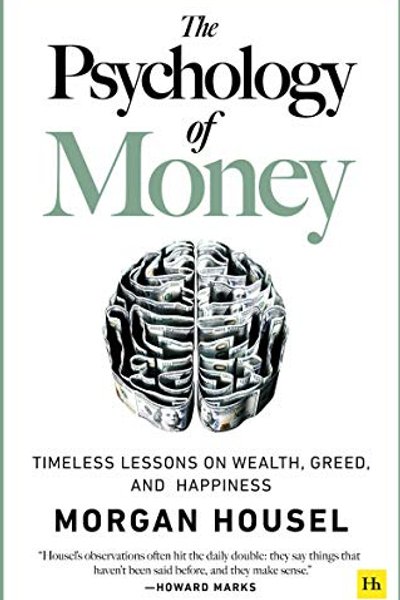
The Psychology of Money
Author: Morgan Housel Publisher: Harriman House (2020) Pages: 242
Key Points
-
Behavior Determines Outcomes - Ronald Read, a school janitor, accumulated $8 million by saving consistently and investing in blue-chip stocks over decades. Richard Fuscone, a Harvard-educated executive, went bankrupt due to high debt and an out-of-control lifestyle. Patience, humility, and self-control made the difference.
-
Luck and Risk Walk Together - Bill Gates attended one of the few high schools that had a computer in 1968. Kent Evans, Gates's close friend with similar talent, died in a mountaineering accident before graduation. The scale of opportunity was similar. The outcomes were vastly different. No one is truly crazy about money; everyone holds different cards.
-
Compound Interest Needs Long Time Horizons - Of Buffett's $84.5 billion net worth, approximately $81.5 billion was built after age 50. If he had started at 30 and stopped at 60 with the same returns, his wealth would be around $11.9 million. His primary advantage was time. The most powerful investing book should be titled "Shut Up and Wait."
-
Looking Rich vs. Being Rich - Looking rich shows in a $100,000 car. Being rich shows in the car not bought, the watch not worn, and the first-class upgrade declined. Wealth provides the option to buy something later. Savings rate has enormous influence on long-term financial strength.
-
Survival is the Prerequisite - Jesse Livermore made the equivalent of $3 billion in one day during the 1929 crash. Four years later he was bankrupt and committed suicide. Getting money requires courage, optimism, and risk-taking. Keeping money requires humility and frugal living. Michael Moritz of Sequoia said, "We always feel scared of going out of business. We assume tomorrow will be different from yesterday. We don't rest on our success."
-
Tail Events Determine Outcomes - 40% of Russell 3000 stocks lost 70% of their value and never recovered. Nearly all index returns came from 7% of companies that soared far. Warren Buffett owned hundreds of stocks and most of his money came from about 10 stocks.
-
Sustainable Strategy - Harry Markowitz chose a 50/50 allocation between bonds and stocks to minimize future regret. A strategy that feels comfortable to execute gives greater odds of survival. Long-term commitment is often the determining factor.
-
Stories Change How We Read Facts - Between 2007 and 2009, America's physical assets remained relatively the same. The story people believed about the economy changed. That narrative shift was enough to erase about $16 trillion in value. The stronger the desire for an outcome, the easier it is to believe stories that exaggerate its likelihood.
Why Read This
Morgan Housel emphasizes the behavior of money. Emotions, ego, and life experiences shape financial decisions every day.
The book opens with two stories. Ronald Read, a school janitor, died with $8 million. Richard Fuscone, a Harvard executive, went bankrupt. Read was patient and frugal. Fuscone was aggressive and overconfident. Two attitudes transformed their outcomes.
Housel connects many concepts: luck and risk, compound interest, hidden wealth, survival, tail events, and the power of economic narratives.
He weaves behavioral economics, history, evolutionary psychology, and personal experience into a coherent framework. This book provides mental models for everyday money decisions.
This book changed how I view financial success. I stopped chasing the highest returns. I focus on systems I can run for decades. I care more about survival and margin of safety.
Core Idea 1: Behavior Determines Outcomes
Financial Success is a Behavioral Skill
Financial success is a behavioral skill. Math helps, but emotional control matters far more. The world of money provides vast space for people without formal degrees to excel.
Ronald Read, a school janitor without formal education, accumulated $8 million by saving bit by bit and investing in blue-chip stocks over decades. Richard Fuscone, a Harvard graduate with an MBA and a Merrill Lynch executive, went bankrupt due to high debt and an out-of-control lifestyle after the 2008 crisis.
Read rarely read investing books. Fuscone was skilled in valuation, discounted cash flow (DCF) models, and portfolio theory. Patience, humility, and self-control made the difference.
Challenging Implications
This challenges assumptions about financial education. We spend billions teaching internal rate of return (IRR) and reading balance sheets. Training to manage emotions when portfolios drop 30% remains rare.
Financial success depends on behavior. Treat investing like a branch of psychology. The core skill is staying calm when markets panic and staying sane during euphoria.
Intelligence without emotional control opens enormous risk. Ordinary people with high discipline can achieve extraordinary results.
Core Idea 2: Luck, Risk, and Life Variation
Inseparable Twins
Luck and risk walk together. Bill Gates attended one of the few high schools that had a computer in 1968. Kent Evans, Gates's close friend with similar talent, died in a mountaineering accident before graduation.
The scale of opportunity was similar. The outcomes were vastly different.
No one is truly crazy about money. People who buy $400 lottery tickets are often buying hope in a world they see as closed off. People who grew up during high inflation will behave differently from those who grew up during stable prices.
Research by Ulrike Malmendier and Stefan Nagel shows that lifetime investment decisions are closely tied to experiences in early adulthood. Generational factors leave a large imprint.
An Antidote to Arrogance
Awareness of luck cultivates humility. The failures of others feel easier to understand.
This changes how we learn from role models. Imitating Warren Buffett is difficult because his time context was so unique. Focus on broad patterns: people who control their time tend to be happier.
This understanding also builds resilience. Defeat doesn't always mean error. Risk can topple the best strategies. The primary goal is to survive long enough for probabilities to work in your favor.
Core Idea 3: Compound Interest and Long Time Horizons
Time is the Primary Advantage
Of Buffett's net worth of $84.5 billion, approximately $81.5 billion was built after age 50. About $84.2 billion came after he qualified for U.S. Social Security in his mid-60s.
Buffett is an excellent investor. He has practiced his craft for three-quarters of a century. The combination of skill and time produces enormous effects.
Thought experiment: if Buffett started at age 30 with $25,000 and continued earning 22% per year but stopped at 60, his wealth today would be around $11.9 million. That figure is far from the actual result.
Jim Simons has earned 66% per year since 1988, triple Buffett's rate. His wealth is about $21 billion because he started at age 50. If Simons had 70 years like Buffett, his value could touch $63 quintillion. That figure shows the power of compound interest.
The Often-Missed Core
We often chase the highest returns. Returns that are good enough and consistent over long periods produce stable results.
The most powerful investing book should be titled "Shut Up and Wait." The content could be one page with a long-term chart of economic growth. The patience to not disturb investments for decades is a rare skill.
Charlie Munger calls it the first rule of compounding: don't interrupt it unnecessarily. Life desires change over time. The End of History Illusion makes us think major changes are finished.
Young adults pay to remove tattoos they got as teenagers. Middle-aged people divorce spouses they married when young.
Moderate Balance
Choose moderate balance at every life stage: moderate savings, moderate leisure time, moderate family time. This choice reduces future regret and keeps the compounding plan running.
Core Idea 4: Looking Rich vs. Being Rich
Looking Rich vs. Being Rich
Looking rich shows in income and symbols. A $100,000 car creates the impression of wealth. Being rich is often hidden.
Wealth shows in the car not bought, the watch not worn, and the first-class upgrade declined. Wealth provides the option to buy something later. Its value lies in flexibility.
We often see role models of looking rich. Role models of being rich are rarely visible because their results are hidden.
Savings rate has enormous influence on long-term financial strength. Investment returns also play a role. The habit of restraining spending maintains savings.
Ego Erodes Savings
Above the level of basic needs, much spending emerges from ego. Money is often used to display status. Basic needs are often already met.
The most powerful way to increase savings is to suppress ego. Humility makes spending more conscious.
The gap between income and ego determines savings size. Many people with decent income still save little due to the urge to show off.
People with lasting financial success often don't care much about others' judgment. This attitude protects savings.
Savings as Options
Saving doesn't require a specific goal. Savings are a hedge against life's surprises at the worst moments.
Savings without a spending plan provide choice, flexibility, and the ability to wait. This gives time to think and the opportunity to change direction.
Core Idea 5: Survival and Room for Error
Two Different Skills
Getting wealth and keeping wealth are two different skills. Getting money requires courage, optimism, and risk-taking. Keeping money requires humility, vigilance, and frugal living.
Jesse Livermore made the equivalent of $3 billion in one day during the 1929 crash. Four years later he was bankrupt and committed suicide. He was highly skilled at getting rich. He failed to keep his wealth.
Michael Moritz of Sequoia Capital was asked why Sequoia succeeded for four decades. He answered, "We always feel scared of going out of business. We assume tomorrow will be different from yesterday. We don't rest on our success."
Survival means lasting over long periods without being wiped out. This ability makes an enormous difference in financial outcomes.
Three Principles of Survival
- Financial survival is the top priority.
- Plan for the possibility that plans will fail.
- Barbell personality: optimistic about the future and paranoid about risks that could cut the journey short.
Room for error provides a safe way to navigate a world governed by probabilities. Blackjack card counters never bet all chips when odds are in their favor. Bill Gates always maintained enough cash to run Microsoft for a year without revenue.
Long-Term Optimism and Short-Term Paranoia
Benjamin Graham explained the function of margin of safety: it makes accuracy of forecast unnecessary. That simple sentence holds enormous power.
Over 170 years, American living standards increased 20-fold. Days full of reasons for pessimism were also abundant: 1.3 million people died in nine wars, 99.9% of all companies went bankrupt, four presidents were assassinated, 33 recessions, stock markets fell more than 10% at least 102 times.
Long-term growth still occurred. Short-term vigilance remains necessary. The road to the future is filled with unseen risks.
The biggest failure point in finance is single dependence on salary without savings. We can't prepare for every surprise. Redundancy provides protection.
Core Idea 6: Tail Events Determine Outcomes
7% Carry the Results
40% of Russell 3000 stocks lost at least 70% of their value and never recovered. Nearly all index returns came from about 7% of companies that soared far.
The Russell 3000 rose 73-fold since 1980. Forty percent of companies within it effectively failed. The small portion that excelled covered the rest.
Heinz Berggruen bought hundreds of artworks. Most were worthless. A few Picassos made all purchases worthwhile. Walt Disney produced hundreds of cartoons that lost money. 83 minutes of Snow White delivered the biggest business impact.
Peter Lynch said, "If you're terrific in this business, you're right six times out of ten." Warren Buffett has owned about 400-500 stocks throughout his life. Most of his money came from about 10 stocks.
Success Rate Isn't the Determinant
Tail events change how we judge success. Average daily success doesn't determine final outcomes. What matters is the size of the winners.
We can be wrong half the time and still become wealthy. This feels liberating. We only need to survive long enough and stay diversified enough for one or two big winners to emerge.
Most days run normally. Decisions on certain days have the biggest impact, often during only about 1% of the time, when everyone panics.
Defining Moments
If we saved $1 every month from 1900 to 2019, the result would be $435,551. If we sold during recessions and bought back after, the result would be $257,386. Staying calm during 22% of economic time in recession gives nearly three-quarters more money.
Investor success is determined by response during occasional moments of terror. Years running normally contribute little.
Core Idea 7: Sustainable Strategy
Harry Markowitz and Regret
Harry Markowitz won a Nobel Prize for researching mathematical trade-offs between risk and return. When asked how he invested his own money in the 1950s, he chose a 50/50 allocation between bonds and stocks.
"I visualized my regret if the stock market went way up and I wasn't in it. I also visualized my regret if the market tanked and I was fully in stocks. I chose a 50/50 composition to minimize future regret."
This argument is hard to prove on paper. It makes sense in real life. Investors who only follow numbers make different decisions from investors who think about social and family pressures.
The Price of Investment Success
Investment success has a price: volatility, fear, doubt, uncertainty, and regret.
The S&P 500 rose 119-fold in 50 years. The index was at least 5% below its all-time high on most days. Netflix rose 35,000%. Its stock traded below previous peaks 94% of the time.
That price doesn't appear like a label in a store. The bill arrives when markets shake. Many people interpret turbulence as punishment. This turbulence is actually the cost of long-term results.
Consider volatility as the fee for long-term returns. Don't interpret it as a penalty.
Executable Strategy
Investors who like their strategy tend to last longer. A strategy that feels comfortable gives greater odds of surviving difficult years.
Commitment to a strategy is often the variable most correlated with performance. Consistency maintains results.
Morgan Housel chose a house without a mortgage because it adds security. He keeps about 20% of assets in cash to maintain independence. He puts his entire portfolio in index funds.
Decisions that feel safe and consistent provide endurance. The measure is often hard to capture in numerical models.
Core Idea 8: Stories and Economic Narratives
The Power of Stories
Between 2007 and 2009, America had relatively the same buildings, factories, knowledge, and technology. The story people believed about the economy changed. That narrative shift was enough to erase about $16 trillion in value.
In 2007, many people believed in housing price stability and banking prudence. In 2009, that trust collapsed. The shift in belief had enormous impact.
History is the study of surprises. People often use it as a guide to the future. About 15 billion people were born in the 19th and 20th centuries. Imagine the global economy today if seven people never existed: Hitler, Stalin, Mao, Princip, Edison, Gates, MLK. Only 0.0000000004% of people influenced the world's direction on a large scale.
The main lesson is the world is full of surprises. Past surprises don't set definite limits for the next surprises.
Believing Stories We Want
The stronger the desire for an outcome, the easier it is to believe stories that exaggerate its likelihood.
Bernie Madoff collected billions from sophisticated investors. He told a captivating story. The stakes were high, so many people chose to believe.
Room for error, flexibility, and financial independence provide protection. The greater the distance between hopes and the need for adequate results, the greater the risk of being deceived by beautiful stories.
Playing Different Games
Bubbles emerge when long-term investors follow signals from day traders. Day traders only need prices to rise that day. Long-term investors who buy at the same price can be crushed.
Understanding your own time horizon is key. Keep distance from decisions of people playing with different horizons.
Pessimism often sounds smart. A Russian professor once predicted the U.S. would break into six parts and that news made the front page of the Wall Street Journal. A Japanese academic who predicted 15-fold growth after World War II would have been laughed at. Progress moves slowly. Disaster strikes quickly.
FAQ
Q: How long does it take for compound interest to work significantly?
A: Warren Buffett accumulated approximately $81.5 billion of his $84.5 billion total wealth after age 50. Compound interest requires decades, minimum 20-30 years, to produce major impact. Jim Simons with 66% annual returns has smaller wealth because of shorter time.
Q: What's the difference between looking rich and being rich?
A: Looking rich shows in high income and symbols like luxury cars or big houses. Being rich shows in assets not visible: income not spent, investments not flaunted, and choices deliberately postponed. Wealth provides flexibility.
Q: Why do smart people often fail with money?
A: Financial success is a behavioral skill. Intelligence without emotional control opens enormous risk. Richard Fuscone, a Harvard-educated executive with an MBA, went bankrupt due to debt and an out-of-control lifestyle. Ronald Read, a school janitor, accumulated $8 million with patience and humility.
Q: How do you build room for error in investing?
A: Assume future returns are about 1/3 lower than historical averages. Save more cash than spreadsheets deem optimal. Avoid excessive leverage. Maintain margin of safety as taught by Benjamin Graham. Bill Gates always maintained enough cash to run Microsoft for a year without revenue.
Q: Should investors always be rational?
A: Not always. A strategy that feels comfortable to execute gives greater odds of survival. Harry Markowitz split 50/50 between bonds and stocks to minimize future regret. The best strategy is one that lets you sleep soundly.
Q: What role does luck play in financial success?
A: Luck and risk walk together. Bill Gates attended one of the few high schools with a computer in 1968. Kent Evans, Gates's close friend with similar talent, died before graduation. Lifetime investment decisions are closely tied to generational experiences in early adulthood. Acknowledging luck's role makes us more humble.
Q: What matters more: savings rate or investment returns?
A: Savings rate has enormous influence on long-term results. Investment returns also play a role. Discipline in controlling spending makes savings grow.
Q: Why are tail events important in investing?
A: 40% of Russell 3000 stocks lost 70% of value and never recovered. Nearly all index returns came from 7% of companies that soared far. Warren Buffett owned hundreds of stocks and most of his money came from about 10 stocks. The size of winners determines outcomes.
Q: How do you survive high market volatility?
A: Consider volatility as the fee for long-term returns. The S&P 500 rose 119-fold in 50 years, yet often traded below all-time highs on most days. Investor success is determined by response during panic moments. Daily routines have small influence.
Q: Does saving need a specific goal?
A: No. Savings are a hedge against life's surprises at the worst moments. Savings without a spending plan provide choice, flexibility, and the ability to wait. This gives time to think and the opportunity to change direction.
Critical Assessment
Strengths
1. Transformative psychological framework
Housel places behavior and emotions at the center of discussion. This perspective rarely appears in traditional investing books that emphasize technical and fundamental analysis.
2. Concrete examples that stick
Every concept is reinforced with real examples: Ronald Read, Richard Fuscone, Warren Buffett, Jim Simons, Bill Gates, and Kent Evans. These stories make abstract principles feel close.
3. Honesty about uncertainty
Housel rejects promises of guaranteed formulas. He emphasizes a world of probabilities, margin of safety, room for error, and barbell personality.
4. Relevant for many levels
Principles in this book apply to anyone interacting with money, from $1,000 to $1 million. Focus on behavior, savings rate, time horizon, and emotional control feels universal.
Limitations
1. Discussion of concrete strategy remains thin
The book discusses little about technical investment strategy. Index fund recommendations appear without details on asset allocation, rebalancing, or tax optimization.
2. Early privilege under-discussed
Many example figures came from strong starting backgrounds. The book provides limited space for readers with zero or negative starting points, such as debt, medical bills, or structural barriers.
3. Compound interest discussed too smoothly
Discussion of compound interest under-highlights the need for sustained contributions and flat market phases. Japan 1990-2020 shows long periods without strong growth.
4. Dark side of wealth under-explored
The book focuses on accumulation and survival. Psychological impacts like fractured relationships, identity crisis after achieving financial independence, or guilt from privilege receive small portions.
Conclusion
"The Psychology of Money" deserves reading by anyone wanting to build a healthy relationship with money. Its strength lies in the psychological framework centered on behavior.
One concise sentence summarizing this book's content: financial success demands consistency and self-control over long periods for compound interest to work.
This book has limitations on technical strategy and discussion of privilege. Its core message remains strong and practical. I stopped chasing the highest returns. I built a system I can run for decades.
Rating: 5 out of 5. Read slowly, mark relevant sections, and re-read periodically when market volatility disturbs emotions.