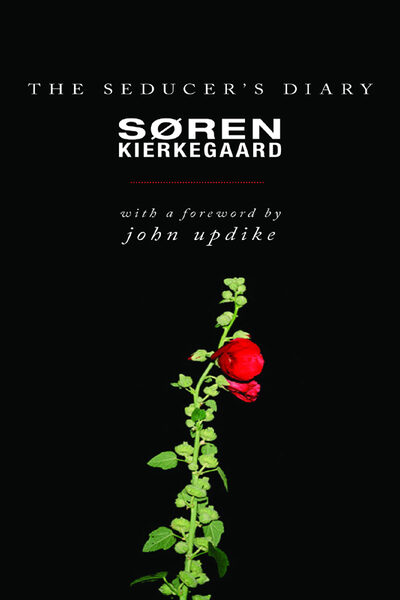
The Seducer's Diary
Author: Søren Kierkegaard Translator: Howard V. Hong & Edna H. Hong Publisher: Princeton University Press Pages: 166 (Princeton edition) Part of: Either/Or (Enten-Eller), 1843
Why Read This
Kierkegaard disguises existential philosophy as a seducer's journal, staging a critique of the aesthetic life that treats other people as raw material.
The Seducer's Diary is a manuscript inside a manuscript. It surfaces as part of Either/Or (1843), Kierkegaard's great work setting two ways of life in confrontation: the aesthetic and the ethical. Inside a pile of "aesthetic papers" edited by a figure called A, there is the diary of Johannes, a man who spent a year recording every step of his pursuit of a young woman named Cordelia Wahl. From the first glimpse beside a horse-drawn carriage in April, through careful surveillance, a engineered engagement, letters designed like slow-acting sedatives, to the night of conquest in September and Johannes's departure the following morning without a word.
The philosophical ambition of the book extends far beyond romantic narrative. Johannes represents what Kierkegaard called the "aesthetic stage" of existence: a way of life that treats beautiful experience and "the interesting" as the sole measure of value. When that way of life is followed to its limit, what remains is an emptiness with no name.
One small scene shows the mechanism at work. Johannes holds himself back from approaching Cordelia directly. Instead, he places a dull suitor named Edward in front of her, letting boredom grow, while he himself moves at the edges as a puzzle that resists reading. Every letter he sends builds longing; then he withdraws his presence so that longing can ripen on its own. Cordelia's feelings develop exactly according to the design, while she believes she is choosing freely. The same pattern is easy to recognize today in anyone who has mastered the art of shaping other people's desires, from marketing to politics, from boardrooms to phone screens.
This book matters for anyone who wants to understand Kierkegaard, the psychology of manipulation, or the deepest question about the human condition of choice: how far does a "free choice" remain free if the environment surrounding it was designed entirely by someone else?
Core Idea 1: Life as a Walking Poem
The Diary in the Subjunctive Mood
Johannes writes his diary with one purpose: to transform what happens into poetic material. The editor A explains to the reader:
"His life has been an attempt to accomplish the task of living poetically. With a sharply developed organ for discovering the interesting in life, he has known how to find it and after having found it has continually reproduced his experiences half poetically. Therefore, his diary is not historically accurate or strictly narrative; it is not indicative but subjunctive."
The indicative mood records facts: "This happened." The subjunctive lives in the territory of possibility: "If only." The entire diary of Johannes moves in that mood. He does not record reality; he refines it into a version more alive than the original.
The Double Pleasure
Behind this way of writing lies a structured mechanism. The first pleasure arrives when Johannes enters a real situation he has already designed and enjoys it directly. The second pleasure arrives when he writes about that experience and enjoys it a second time as a spectator of himself:
"The poetic was the plus he himself brought along. This plus was the poetic he enjoyed in the poetic situation of actuality; this he recaptured in the form of poetic reflection. This was the second enjoyment, and his whole life was intended for enjoyment."
This structure describes the entire aesthetic stage: life organized to be enjoyed again and again through reflection. The implication is serious. When life revolves entirely around this double aesthetic pleasure, other people inside it never become real subjects. They are extras in someone else's poem.
Core Idea 2: "The Interesting" as the Only Value
A Technical Concept in Kierkegaard's Philosophy
The sole value Johannes recognizes is the interesting, something that creates tension and possibility, something that has yet to settle into habit. When something stops being interesting, it loses all value entirely.
The entire pursuit of Johannes is organized around this principle. He chose Cordelia on purely aesthetic grounds, assessing her as an object that held sufficient aesthetic depth to become a satisfying project:
"it is dismaying that it is no art to seduce a girl but it is a stroke of good fortune to find one who is worth seducing."
That sentence lays bare Johannes's cold-blooded way of seeing. Seducing an ordinary girl is a matter of technique; there is no challenge there. What he seeks is a soul rich enough to reflect upon, a feminine quality strong enough to be bent toward higher tension.
A Strength Turned into a Sickness
The principle of "the interesting" carries profound existential consequences. A way of seeing that makes it the only value creates a difficulty impossible to resolve from within: it cannot stop, cannot find satisfaction, must keep hunting for fresh stimulation. A, the editor, frames Johannes's condition with precision:
"He suffered from an exacerbatio cerebri [exacerbation of the brain], for which actuality did not have enough stimulation, at most only momentarily. He did not overstrain himself on actuality, he was not too weak to bear it; no, he was too strong, but this strength was a sickness."
Excessive strength without an ethical channel becomes a sickness. This is the diagnosis Kierkegaard offers for the entire aesthetic way of life, and he delivers it through Johannes's own confession.
Core Idea 3: The Architecture of Patience
A Systematic Method of Surveillance
What is most impressive and most chilling about Johannes is his patience. He never rushes. He spends all of April and May observing Cordelia from a distance: learning her name, mapping her world, understanding the house and aunt she lives with, studying her daily schedule.
"No impatience, no greediness—everything will be relished in slow draughts; she is selected, she will be overtaken."
The foundational principle is that pleasure requires delay:
"One must limit oneself—that is the primary condition for all enjoyment."
Self-limitation is the primary discipline of the aesthetician. A process prolonged with patience is the most satisfying process, because anticipation is already part of the pleasure itself. In the hands of Johannes, a principle that sounds reasonable in many other contexts becomes an instrument for designing another person's soul with extraordinary precision.
Three Layers of Method
Johannes's method moves through several planned layers. First, he positions himself in Cordelia's orbit without drawing close, so that his presence is felt while his purpose remains unreadable:
"Presumably our repeated encounters are clearly noticeable to her; presumably she does perceive that on her horizon a new planet has loomed, which in its course has encroached disturbingly upon hers in a curiously undisturbing way, but she has no inkling of the law underlying this movement."
Second, he wins the trust of the aunt and uses Edward, another innocent suitor, as a mirror that shows Cordelia how shallow the world around her is. Third, the sharpest weapon he chooses is intellect and irony, a form of reasoning that enters from the direction least anticipated:
"What does a young girl fear? Intellect. Why? Because intellect constitutes the negation of her entire womanly existence... With these resources, one can make a girl blush, drop her eyes, but one can never generate the indescribable, captivating anxiety that makes her beauty interesting."
Core Idea 4: Letters as a Soul-Forming Machine
Imagination and Distance
One of the most sophisticated instruments Johannes uses is the letter. He understands that physical presence actually limits expression, while a letter grants Cordelia's imagination unlimited room to work, enlarging the image of Johannes beyond anything the actual man could sustain:
"If I am present only in a letter, then she can easily cope with me; to some extent, she mistakes me for a more universal creature who dwells in her love."
Planned Escalation
Every letter is designed to operate on a different layer of the soul. The early letters develop the mind, open intellectual horizons. Short notes strike the erotic point. As the relationship deepens, what Johannes writes grows shorter and more precise:
"My letters are not failing of their intention. They are developing her mentally, even though not erotically. For that purpose, letters cannot be used, but notes. The more the erotic emerges, the shorter they become, but all the more unerringly they seize the erotic point."
The final effect is:
"When she has received a letter, when its sweet poison has entered her blood, then a word is sufficient to make her love burst forth."
Johannes's insight about letters contains a truth about communication that outlasts his story. Distance creates space for imagination; presence sets real limits. A relationship conducted mostly through written text leaves more room for idealization than one conducted through direct presence. That mechanism operates regardless of intent.
Core Idea 5: The Engagement as an Instrument of Art
The Paradox of the Proposal
One of the great paradoxes in the diary is Johannes's decision to formally propose to Cordelia. He despises the institution of engagement:
"Of all ludicrous things an engagement is still the most ludicrous. There is at least meaning in a marriage, even if this meaning does not suit me. An engagement is a purely human invention and is no credit whatsoever to its inventor."
He enters it knowingly because the engagement gives him access, legitimacy, and time. More than that, he designs the proposal so that it feels to Cordelia like something that happened to her, something beyond anyone's control:
"The best thing to do is to transform the engagement from an act to an event, from something she does to something that happens to her, something about which she is compelled to say: God alone knows how it really came about."
Two Wars Inside One Engagement
Within the engagement, Johannes wages two wars in sequence. The first is a war of liberation: he retreats, allows Cordelia to feel she is winning, allows her erotic spirit to rise and bloom:
"So now begins the first war with Cordelia, in which I retreat and thereby teach her to be victorious as she pursues me. I continually fall back, and in this backward movement I teach her to know through me all the powers of erotic love, its turbulent thoughts, its passion, what longing is, and hope, and impatient expectancy."
The second war begins after the engagement breaks. And the engagement is designed to break on Cordelia's own initiative, from within:
"When I have brought her to the point where she has learned what it is to love and what it is to love me, then the engagement will break like a defective mold and she will belong to me."
Core Idea 6: Freedom as the Paradox of Mastery
Designed Freedom
Among the most complex concepts in the diary is the way Johannes understands freedom. He wants to possess Cordelia, and he refuses possession that feels like coercion. What he wants is a soul that chooses freely to come to him:
"She must owe me nothing, for she must be free. Only in freedom is there love; only in freedom are there diversion and everlasting amusement. Although I am making arrangements so that she will sink into my arms as if by a necessity of nature and am striving to make her gravitate toward me, the point nevertheless is that she should not fall like a heavy body but as mind should gravitate toward mind."
The "freedom" Johannes designs is one he controls entirely. He decides how free Cordelia feels. He designs the direction of that soul's gravity. He never resolves this paradox because he has no interest in resolving it: the most perfect mastery is the mastery the victim experiences as freedom.
When Cordelia finally breaks the engagement of her own will, Johannes records it with cold satisfaction:
"In me she is seeking her freedom, and the more firmly I encircle her, the better she will find it."
The question that remains from this paradox reaches far beyond the story of Cordelia and Johannes. How far does a "free choice" remain free if the environment surrounding it was designed entirely by someone else?
Core Idea 7: Woman as Being-for-Other
Philosophy at the End of the Diary
In the final section, Johannes steps out of narrative and begins philosophizing explicitly. He formulates what he calls the essential nature of woman through the concept of being-for-other:
"In which category is she to be placed? In the category of being-for-other... Not until she is touched by erotic love does she awaken; before that time she is a dream. But in this dream existence two stages can be distinguished: in the first, love dreams about her; in the second, she dreams about love."
Woman, according to Johannes, is a being who fully exists only when another touches her. Before that she exists in a state of dreaming, like a possibility not yet realized. Feminine innocence within this framework is an existential condition not yet real in itself:
"Feminine innocence has the same characteristic. Therefore, it can be said that woman in this state is invisible."
Johannes also formulates: "woman is substance, man is reflection." Behind the grandeur of that position lies an irony he relishes: a man who thinks cleverly knows how to frame the question so that only one answer is possible. He has spent months framing exactly that question for Cordelia.
This passage is important to read in context: it is Johannes's perspective, that of an aesthetician who constructs his entire philosophy to justify his predatory project. Kierkegaard himself, through the structure of Either/Or, places this perspective as one side of a dilemma that requires resolution.
Core Idea 8: The Bitterness at the End of the Moment
The Morning After
The shortest and coldest entry in the entire diary is the one dated September 25, the day after the night of conquest. Three words close a project months in the making: "now it is finished." Then an explanation that distills the entire aesthetic logic:
"When a girl has given away everything, she is weak, she has lost everything, for in a man innocence is a negative element, but in woman it is the substance of her being. Now all resistance is impossible, and to love is beautiful only as long as resistance is present; as soon as it ceases, to love is weakness and habit. I do not want to be reminded of my relationship with her; she has lost her fragrance."
"She has lost her fragrance" reads like a chemical report on a wilting flower. Cordelia has lost the quality that made her interesting: resistance and possibility. Once possibility becomes actuality, that actuality ceases to interest the aesthetician.
The Final Coldness
Johannes's last thoughts turn toward higher technique, a possibility even more refined than what he has just concluded:
"Yet it would really be worth knowing whether or not one could poetize oneself out of a girl in such a way as to make her so proud that she imagined it was she who was bored with the relationship. It could be a very interesting epilogue, which in and by itself could have psychological interest and besides that furnish one with many erotic observations."
This is the highest coldness: ruinous from Cordelia's perspective, and from Johannes's, the project has still not reached its aesthetic peak.
Relation to Either/Or and Kierkegaard's Thought
The Seducer's Diary is a complete demonstration of what Kierkegaard called the "aesthetic stage" of existence, one of three stages he described across his work: the aesthetic, the ethical, and the religious. The aesthetic stage is the stage where all value is organized around immediate experience, pleasure, and "the interesting." It holds no long-term commitment, no responsibility born from choice, no relationship that outlasts its aesthetic utility.
Johannes is the most consistent realization of this stage. He lives entirely inside the moment, managing every relationship as an aesthetic project with a beginning and an end determined from the start. The collapse within this way of life is embedded in its own structure: every fulfilled pleasure is the death of interest, so the pure aesthetician never arrives anywhere, always moving, always seeking, never finding rest.
A, the editor, shows this through the portrait in his preface: Johannes will gradually become lost inside the complexity of his own reflection, trapped in a labyrinth of consciousness that cannot stop.
The connections to other thought are also rich. Johannes's project touches modern psychology on manipulation and the dark triad (narcissism, Machiavellianism, psychopathy), and Kierkegaard is well ahead of that: he places this personality type within an ontological and existential framework, asking where that way of life ultimately leads. The theory of being-for-other also connects to Hegel's thought on the dialectic of self-consciousness, and later to Sartre's phenomenology of intersubjective relations.
Key Takeaways
-
The aesthetic stage as a way of life that is simultaneously coherent and self-destroying. Johannes is no half-hearted figure. He is the most consistent realization of one way of life: everything organized around "the interesting," aesthetic pleasure as the sole value, every relationship managed as a project with a predetermined beginning and end. Kierkegaard makes him coherent enough that readers must work hard to keep seeing Cordelia as a real human being. The collapse of this way of life is embedded in its own structure: every fulfilled pleasure is the death of interest, so the pure aesthetician never finds rest, always moving, always seeking.
-
The most effective manipulation operates as an architecture of freedom. Johannes never forces Cordelia anywhere. He designs the conditions so that Cordelia comes on her own, with a desire she believes was born from within. The most perfect mastery is the mastery the victim experiences as freedom. The question this raises reaches far beyond the diary: which environments in our own lives feel entirely like "free choice," yet were designed from outside?
-
Patience as an instrument of design. Johannes spends months only observing, mapping, and preparing before taking a single step. "One must limit oneself, that is the primary condition for all enjoyment." A principle of delay that sounds wise in other contexts becomes a precise instrument of control.
-
Letters create distance that produces idealization. Written communication gives the recipient's imagination room to work, enlarging the image of the sender. This mechanism operates regardless of intent. Johannes exploits it; the same dynamic lives in every relationship conducted more through text than through direct presence.
-
The diary in the subjunctive mood. Johannes does not record what happened; he transforms what happened into poetic material. First pleasure from direct experience, second pleasure from replaying it as a spectator of himself. This double structure means other people never become real subjects.
-
"She has lost her fragrance." Three words at the end of the diary. Cordelia has lost the quality that made her interesting: resistance and possibility. The sentence reads like a chemical report on a wilting flower, free of regret, free of guilt. This is the logical endpoint of the aesthetic life: emptiness arriving precisely at the moment of achievement.
-
Concealed critique through a layered structure. Kierkegaard never appears as the direct author. He hides behind A, who hides behind Johannes. The entire construction is designed so that readers discover for themselves what is missing from Johannes's perspective: Cordelia as a human being. Her letters returned by Johannes unopened stand as silent testimony to what a pure aesthetician does to the people around him.
Critical Assessment
Strengths
1. Uncomfortable honesty
The chief strength of this book lies in Johannes's honesty about himself. He conceals nothing from his own mind. He documents every tactic with a scientist's precision. Kierkegaard gives Johannes's perspective enough room to feel coherent, forcing readers to wrestle for themselves with what is wrong inside it.
2. Critique disguised as an aesthetic work
The entire structure of Either/Or is a philosophical argument hidden inside a literary architecture. Readers receive an authentic aesthetic experience while being pulled toward ethical questions they cannot avoid. This is among the most sophisticated rhetorical strategies in the history of philosophy.
3. Psychological relevance that endures
The dynamics Kierkegaard describes in 1843 feel fresh today: the architecture of false freedom, idealization through distance, intellect deployed as a weapon, coldness following achievement. This book anticipates a great deal of modern psychological insight on manipulation.
4. Prose that carries philosophical weight without feeling heavy
The Hong translation gives access to Kierkegaard's depth without sacrificing readability. John Updike's foreword orients readers who arrive without a background in philosophy.
Limitations
1. Cordelia has almost no voice
Cordelia appears almost entirely through Johannes's eyes. We do not know what she feels, thinks, or suffers beyond what Johannes permits us to see. This is a deliberate narrative strategy; the effect is that readers also tend to become trapped inside Johannes's perspective.
2. The context of Either/Or is absent here
The Seducer's Diary is published as a standalone text, separated from the ethical volume of Either/Or that contains Judge William's letters as a response to the aesthetic way of life. Reading it without that context means missing half of Kierkegaard's argument.
3. A philosophy of gender that invites debate
Johannes's theory of being-for-other as the essence of femininity is a view born from the context of his era and from the mouth of a character in the middle of justifying his predatory project. Readers need to maintain analytical distance from this view, something that is not always easy inside prose this persuasive.
Conclusion
The Seducer's Diary is the best entry point into Kierkegaard for readers who are more comfortable with narrative than with direct philosophical prose. It is also a text that grants no easy comfort: there is no cartoonish villain to dismiss, no passive victim, no tidy moral resolution.
"Their lives were not cracked or broken, as others' were, but were bent into themselves; lost to others, they futilely sought to find themselves."
The aesthetic life bends people inward, until they are lost inside a consciousness awakened by someone else and unable to find its way back. The book itself is a philosophical argument disguised as a diary. The argument: a way of life that makes aesthetic experience its sole value leads to an emptiness that must be perpetually refilled with fresh stimulation. And all along that road, the people passed through carry a weight that goes unseen and unrecorded.
My assessment: 5 out of 5, with the note that this is a book that cannot be finished in a single sitting. It asks for a reader willing to pause, to think, and to return.
Recognizing These Patterns in Life
This diary is valuable as a diagnostic mirror. A few questions help carry its lessons into everyday life.
Examine freedom that feels too smooth. When a choice arrives on its own and feels entirely like yours, there is value in asking who arranged the options surrounding it. Johannes proves that even the feeling of freedom can be engineered from outside.
Watch for deliberate distance. The pull-and-release of attention, present then absent, warm then cooling, is a mechanism that builds longing by design. Recognizing this rhythm protects a person from being governed by it.
Pay attention to people who treat relationships as projects. The signs are a calculated presence, a too-tidy charm, and interest that evaporates the moment something is achieved.
For anyone who works with influence, from leaders to marketers, this book offers an honest moral test. The question remains the same in every room: are the people across from us treated as ends in themselves, or as material for our design?
Related Reading
Readers who finish The Seducer's Diary will benefit from:
- Either/Or (Kierkegaard, complete) to read Judge William's ethical response to the aesthetic way of life Johannes demonstrates.
- Fear and Trembling (Kierkegaard) to understand the religious stage as the continuation of the dialectic.
- Being and Nothingness (Sartre) to pursue the question of intersubjective relations and being-for-other from a phenomenological direction.
- The Art of Seduction (Robert Greene) as a contemporary text treating similar mechanisms from an entirely different angle, without Kierkegaard's ethical framework.
On amhar.ma, several resources deepen adjacent themes:
- Beyond Good and Evil to see how Nietzsche dismantles the foundations of morality from a direction that complements Kierkegaard's critique of life without an ethical anchor.
- Thus Spoke Zarathustra for the question of values that must be created anew after old moorings collapse.
- The Denial of Death to trace how human beings flee from their finitude, parallel to Johannes's aesthetic escape.
- Second-Order Thinking to understand the layered thinking Johannes mastered to a dangerous degree.
- Narrative Audit as a tool for examining the stories others have planted inside our heads.
FAQ
Is it necessary to read the complete Either/Or first?
Highly recommended, though The Seducer's Diary stands on its own as a narrative text. It is designed as one side of an argument; the other half lives in Volume Two of Either/Or, where Judge William answers the aesthetic way of life with the ethical way of life. Reading only the diary means hearing one side speak.
Did Kierkegaard identify with Johannes?
The question is frequently asked and the answer is not simple. Kierkegaard had a severed relationship with Regine Olsen, his former beloved, whom many scholars regard as the shadow behind Cordelia. Kierkegaard built the entire architecture of Either/Or with deliberate authorial distance: he hides behind the pseudonym Victor Eremita, the editor A, who finds Johannes's manuscript. He is the architect of the building, standing outside it, watching from a distance.
What is the "aesthetic stage" and how does it relate to this book?
In Kierkegaard's thought, a person can live at one of three stages: the aesthetic, the ethical, or the religious. The aesthetic stage is the way of life that places pleasure and immediate experience as the highest value. Johannes is the most consistent representation of this stage. The entire diary is a demonstration of how that way of life operates all the way to its logical limit, and what is found there.
How difficult is this text philosophically?
Lighter than most of Kierkegaard's other works. It takes the form of narrative, with the flowing rhythm of fiction. The challenge lies in the deeper layers: readers need to see beyond the clarity of Johannes's narration to catch what Kierkegaard hides inside his structural choices. John Updike's foreword in the Princeton edition is very helpful for initial orientation.
Why is Johannes allowed to sound so coherent, even compelling?
This is Kierkegaard's boldest strategic choice. If Johannes sounded like a stock villain, readers would dismiss him easily and learn nothing. By making Johannes coherent and intelligent, Kierkegaard forces readers to actively wrestle with what is wrong in his way of seeing. A critique that demands active work from the reader reaches far deeper than one pre-packaged for easy consumption.
Is this relevant for understanding manipulation in real life?
Relevant, with reservations. Kierkegaard maps the mechanisms of manipulation: the architecture of false freedom, idealization through distance, intellect deployed as a weapon, planned stages of escalation. All of these exist in real relationships. This book is a work of philosophy and literature; its strength lies in its capacity to raise the right questions, questions that open awareness about the most hidden conditions of human choice.
Which edition is best for reading?
The Princeton University Press edition with the translation by Howard V. and Edna H. Hong is the academic standard. It includes useful footnotes and John Updike's foreword, which situates the text within a broader literary context. For philosophical study, this edition is the primary choice.
Does Cordelia have her own perspective in the text?
Almost none. We see Cordelia entirely through Johannes's eyes, and this is deliberate. Several scholars read this as Kierkegaard's implicit critique: the aesthetic way of seeing cannot perceive another person's subjectivity, so the text grants her none either. The single window into Cordelia's world that is unfiltered by Johannes is her letters returned to her unopened, which stand silent at the beginning of the book as testimony to what a pure aesthetician does to the people around him.