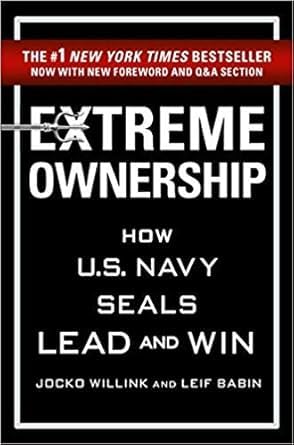
Extreme Ownership: How U.S. Navy SEALs Lead and Win
Authors: Jocko Willink & Leif Babin Publisher: St. Martin's Press (2015) Pages: 320
Main Lessons
- Extreme Ownership means total ownership. Leaders are responsible for every outcome, without excuses and without blaming others. Openly admitting mistakes builds team trust and opens space for improvement.
- There are no bad teams, only bad leaders. Leadership quality determines performance standards. When commanders rotated in BUD/S training, the worst-performing crew immediately became champions because of different leadership style.
- The Four Laws of Combat must be present daily. Cover and Move, Simple, Prioritize and Execute, and Decentralized Command form the foundation for coordination, execution, and effective delegation of authority.
- Thorough planning and decisive decision-making go hand in hand. Clear, concise plans understood by everyone facilitate execution. But leaders still must make quick decisions even when information isn't perfect.
- Discipline creates freedom. Consistent procedures give room to improvise because basic work is already controlled. Solid structure actually makes teams move more agilely.
- Leadership is a game of balance. The book closes with dichotomy: firm yet humble, aggressive yet cautious, close to the team yet objective. Finding the middle point is a leader's daily task.
Why You Should Read This
"Extreme Ownership" was born from Jocko and Leif's experience leading Task Unit Bruiser in Ramadi, Iraq, one of the most brutal urban operations in modern warfare. The principles they wrote aren't boardroom theory, but results of battlefield testing where the stakes were lives. When this framework was brought to companies, non-profits, and government units, the success pattern repeated.
This book is relevant because it places responsibility in the leader's hands. In the midst of blame culture, the total ownership approach feels radical yet refreshing: focus on what we can control. Combat narratives keep readers engaged, while business case studies provide practical examples in the real world.
Core Idea 1: Extreme Ownership as Foundation
Extreme Ownership demands leaders state, "If my team fails, it's my fault." When the Ramadi operation almost resulted in friendly fire between units, Jocko stood before senior commanders and stated all failures were his responsibility. By eliminating blame culture, the team could focus on improving procedures, communication, and discipline.
In business context, leaders who take full responsibility shift energy from seeking scapegoats to seeking improvements. The question changes from "Who's wrong?" to "What must I improve so the team succeeds?" This attitude is contagious: team members learn to take ownership of their respective tasks.
Strategies for Implementing Extreme Ownership
- Open the data as is. Present facts, don't wrap bad news. Transparency facilitates diagnosis.
- Change self-questioning. From "Why did they fail?" to "Which part of my direction wasn't clear?" or "What training haven't I provided?"
- Follow up quickly. Ownership without action is just a slogan. After admitting mistakes, set a concrete improvement plan.
Pitfalls to Avoid
- Bearing all the work yourself. Ownership doesn't mean taking over all tasks. A leader's job is ensuring the system works, not replacing the team.
- Using ownership as a shield. Saying "my fault" without changing processes only frustrates the team.
Core Idea 2: Bad Teams Come from Bad Leadership
During Hell Week, the last-place boat crew became champions once their leader was replaced. The main message: standards are set from the top. A leader who believes their team is capable will spread confidence, provide support, and raise expectations. A doubtful leader spreads fear, even unconsciously.
Practical Steps
- Set standards and communicate goals. Leaders explain what victory looks like, then accompany until the team understands how.
- Check yourself before blaming the team. When targets aren't met, evaluate direction, training, and resources provided.
- Build culture that persists without leader presence. The end goal is the team still maintaining standards even when the leader isn't in the room.
Two Common Pitfalls
- Replacing players before improving the leadership system. Often the problem is in the instructions, not the person.
- Allowing low performance without consequences. When tolerance for low standards is permitted, bad culture quickly becomes the norm.
Core Idea 3: Laws of Combat
The Four Laws of Combat are Task Unit Bruiser's operational framework.
- Cover and Move, Mutual Protection. Each element supports other elements. In business, this means departments shouldn't work in separate silos; sales, operations, and product must move as one unit.
- Simple, Simplify. Complex plans fall apart when situations change. Leaders must ensure plans can be understood by even the newest person.
- Prioritize and Execute, Determine Priority, Execute One by One. When pressure comes from all directions, choose the most critical threat, complete it, then move to the next priority.
- Decentralized Command, Distributed Authority. People closest to the problem must understand the big picture enough to make decisions without waiting for instructions.
Failure to follow one law quickly spreads to other laws. For example, when two sniper teams didn't cover each other's movements (Cover and Move), confusion emerged and almost caused friendly casualties.
Core Idea 4: Planning and Decisive Decisions
Good planning isn't bureaucracy, but a way to reduce risk. Jocko's process includes mission analysis, commander's intent statement, option exploration, delegation of planning to small units, intelligence gathering, and mitigation of controllable risks. After operations, the team conducts honest post-action reviews without ego.
However, planning doesn't eliminate uncertainty. Leaders must be comfortable making decisions with 60-70% complete information. The difference is whether the decision can be reversed. When Chris Kyle saw an armed figure, Leif chose to hold fire because the risk of wrong target was greater than waiting a few seconds. Decisiveness doesn't always mean acting fast; sometimes it means resisting pressure to act rashly.
Core Idea 5: Discipline Creates Freedom
In Baghdad, messy search procedures made the team slow, evidence was lost, and targets were missed. After the team standardized steps, who maps rooms, who labels evidence, how reporting is done, operation time dropped from 45 minutes to 10-20 minutes with higher quality. Because basics were handled, the team could attack more targets per night.
Discipline starts with oneself: wake when alarm rings, physical training, prepare equipment the night before. Personal discipline spreads to team discipline. However, discipline isn't the same as rigidity; rules should facilitate adaptation, not hinder it.
Core Idea 6: Dichotomy of Leadership
The final chapter discusses balance between two opposing sides: leading and following, brave and cautious, confident and humble, close to the team yet objective. Leaning too far to either side will damage the team. Leaders must constantly correct themselves to stay in the middle.
Critical Assessment
Book Strengths
- Battlefield validation. Principles born from life-or-death situations carry weight that's hard to match with classroom theory.
- Concise framework. The Four Laws of Combat are easy to remember, yet deep enough for years of practice.
- Dual case studies. War narratives paired with business examples make readers see principles work across contexts.
- Focus on personal responsibility. This book challenges blame culture and returns control to the leader's hands.
Book Limitations
- Less variation in context discussed. Application in startups, large companies, or government organizations requires more detailed adjustment than explained.
- Power dynamics from toxic bosses not explored deeply. The book touches on "leading up" but doesn't discuss much when bosses are the source of problems.
- Structural issues can be overlooked. Personal ownership isn't always enough when organizations have wrong incentives or very limited resources.
- Cultural prerequisites. An environment full of politics and blame might sacrifice leaders who try to take ownership.
Conclusion
"Extreme Ownership" is the main guide for anyone who wants to lead with full accountability. Its principles are simple but demand high discipline. Use this book as a compass: hold the general direction, then adjust the detailed map to the terrain you face. Personal rating: 5 out of 5, reread periodically so leadership reflection stays sharp.