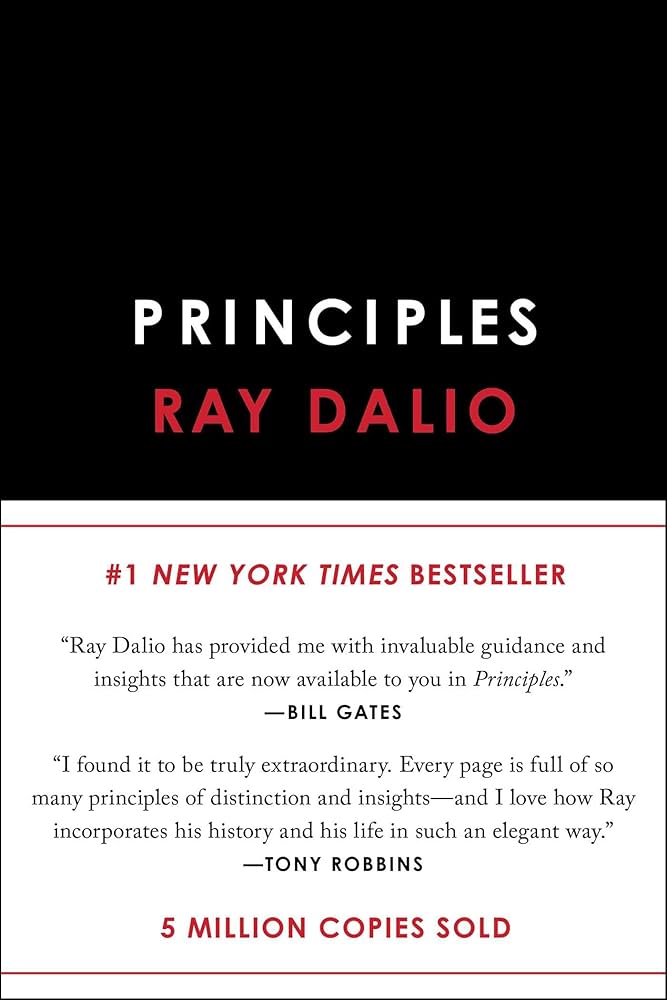
Principles: Life and Work
Author: Ray Dalio Publisher: Simon & Schuster (2017) Pages: 592
Core Takeaways
- Pain + Reflection = Progress. Bridgewater's crushing failure in 1982 confirmed Dalio's formula: every pain must be mapped, reflected upon, then coded into principles that guide collective learning.
- Five-Step Process. Clear goals, identified problems, understood root causes, designed solutions, and disciplined execution create a measurable cycle of repeated improvement.
- Credibility Weighting Beats Hierarchy. Decisions that weigh track record and reasoning quality are more accurate than egalitarian voting or boss decree without data.
- Organization as Machine. Every good or bad outcome is the output of a machine (combination of people and culture) that can be redesigned through directed iteration.
- Radical Transparency Accelerates Learning. Comprehensive documentation, meeting notes, and open feedback enable rapid correction though painful for new members.
- Uncorrelated Portfolio Dampens Risk. Fifteen to twenty truly independent outcome streams reduce risk drastically without sacrificing returns, the foundation of the All Weather Portfolio.
Why Important for Founders and Team Leaders
Bridgewater manages over $160 billion with full consistency over four decades. Dalio shows that thinking precision is what makes organizations withstand the hardest crises, with charisma serving only as an outer shell.
In Indonesian context, conflict-avoidant culture often lets problems fester until too late to handle. Dalio's principles provide a framework so founders can discuss hard facts without destroying team trust.
This book is also relevant for fast-growing organizations. The credibility weighting system, principle documentation, and collective diagnosis process help maintain standards when teams expand rapidly.
Core Idea 1: Pain + Reflection = Progress
Dalio went bankrupt emotionally and financially when his debt crisis prediction was wrong in 1982. The company nearly closed, he borrowed money from his father, and only one employee remained. From this destruction was born the habit of recording every decision, exposing mistakes, and turning them into written principles.
The formula is simple but brutal: pain sends signals, reflection deepens roots, principle notes ensure lessons aren't lost. Without documentation, the same wound will repeat; with documentation, organizations pound pain into structural advantage.
Use the calculator below to assess whether your last painful experience has transformed into a lesson that can be taught to the team.
Core Idea 2: Five-Step Process to Achieve Goals
The five-step framework forces teams to see goals as the distance between current reality and ideal conditions. Each step requires different competence so rarely is there an individual capable of doing all alone.
The first step demands vision clarity. The second step requires honesty facing facts. Diagnosis needs logical thinking and ability to see patterns. Design demands practical creativity. Execution requires discipline and tight coordination.
Dalio emphasizes cross-strength collaboration. If you're weak at diagnosis, partner with a colleague sharp at cause-effect thinking. If your execution is fragile, hire operators obsessive about detail. The goal is uniting team excellence above the same process, where each strength compensates for another's gap.
Core Idea 3: Radical Open-Mindedness and Courage to Test Ego
Every human has two layers of self: the rational layer that wants to find truth and the emotional layer that wants to defend self-worth. The radical open-mindedness principle teaches us to delay defensive reactions so facts lead the conversation.
Dalio practices thoughtful debate: explain reasoning, present data, listen to those with proven track records, summarize differences, then make decisions that favor the strongest logic. After decisions are set, everyone must support implementation despite initially disagreeing.
To enforce this culture, Bridgewater records each person's credibility per domain. These scores are built from real results, reasoning quality, and consistency. This system gives greater weight to people who've successfully solved similar problems before, so the best ideas win through evidence drawn from track record, with one's seat at the table mattering far less than one's history of correct calls.
Core Idea 4: Organization as Machine
Dalio views organizations as machines consisting of people and rules. Machines produce outputs; if results are bad, machine design is flawed. A leader's job is fixing the machine itself, treating fate as feedback to be engineered around.
Every problem becomes evaluation material: what should have happened, which part missed, who's responsible, and how to redesign so prevention mechanisms work faster. Machine improvement happens at design level (flow, roles, metrics) and human level (competence, value alignment).
This approach creates healthy emotional distance. Teams dissect causal structure then perfect the machine, so the same mistake becomes very unlikely to repeat and the search for scapegoats fades into the background.
Core Idea 5: Radical Transparency Accelerates Learning Cycle
At Bridgewater, meetings are recorded, notes opened to relevant people, and feedback given frankly. This practice is indeed heavy. About thirty to forty percent of new employees resign within the first eighteen months, but those who persist gain exponential learning pace.
Radical transparency reduces internal politics because facts are available to all. Mistake repetition drops drastically because analysis is published. People learn to rely on data first, with momentary intuition kept as a quieter second voice. The key is context: anyone giving feedback must bring concrete examples drawn from observable behavior, leaving personal attacks at the door.
Core Idea 6: Holy Grail of Diversification
Dalio discovered that portfolios with fifteen to twenty truly uncorrelated outcome streams can reduce risk up to eighty percent without reducing return expectations. This principle birthed the All Weather Portfolio that withstands across economic cycles.
This learning doesn't stop at investment. Founders can apply it to revenue sources, customer acquisition channels, even talent composition. As long as those streams don't fall simultaneously, organizations have enough cushion to experiment and withstand shocks.
How to Adapt to Indonesian Context
- Document important principles in the team's everyday language, then use during orientation.
- Apply gradual transparency: start from closed paired evaluations before bringing results to large forums.
- Use simple problem logs to track patterns, then schedule routine diagnosis sessions.
- Give decision weight based on performance data, with personal closeness held aside so the process feels fair to all. Share metrics openly to anchor that fairness.
- Ensure emotional recovery space exists. Honest culture still needs empathy, especially for new team members.
Critical Assessment
Book Strengths
Strength 1: Rarely Found Systematic Codification Dalio compresses forty years of decisions into operational principles that can be tested and adjusted. This detailed documentation turns tacit knowledge into inheritable assets.
Strength 2: Scalable Evidence-Based Culture The credibility scoring system, meeting recording, and tools like Dot Collector shift conversations from opinion to evidence. Even large organizations can practice measurable idea meritocracy.
Strength 3: Honesty About Psychological Costs Dalio writes with full disclosure. He acknowledges this culture is emotionally exhausting and makes many people resign. Transparency about consequences lets readers assess self-readiness before applying.
Book Limitations
Limitation 1: High Cultural Barriers Speaking bluntly and criticizing in public spaces feels foreign to many Asian teams that uphold harmony. Without adaptation, these principles could trigger resistance.
Limitation 2: Western Individualist Bias The emphasis on individuals speaking frankly and debating fiercely can weaken togetherness sense. The book leaves shallow ground around how to balance honesty with typical collectivist society respect.
Limitation 3: Excessive Focus on Rationality Emotions are sometimes viewed as disruptors. Yet intuition, empathy, and emotional motivation remain important elements in decision-making and talent retention, carrying weight that pure logic alone cannot supply.
Limitation 4: Implementation Complexity There are over five hundred principles. Without curation and prioritization, teams can be overwhelmed and run checklists without understanding essence.
Final Summary
Principles offers a complete operating system for thinking, making decisions, and building resilient organizations. Its main value lies in the habit of seeing reality as it is, extracting lessons, then copying them into testable procedures, a discipline that quietly outweighs any single trick.
Founders intending to adopt these principles need to prepare significant time and energy: minimum twelve to eighteen months to build documentation, train teams, and test feedback. The results justify the investment when organizations need consistent standards despite staff additions and rapid environment changes.
Rating and Reader Recommendations
Rating: 9.5/10. Nearly perfect in framework depth, field evidence, and practical guidance. Score reduced because cultural adaptation requires extra experimentation.
Highly recommended for: founders, function leaders, and senior managers ready to invest in data-based meritocracy systems and ready to accept open criticism for long-term performance.
Less suitable for: readers seeking light motivation or organizations unwilling to challenge their communication norms. Without full commitment, these principles dissolve into jargon.