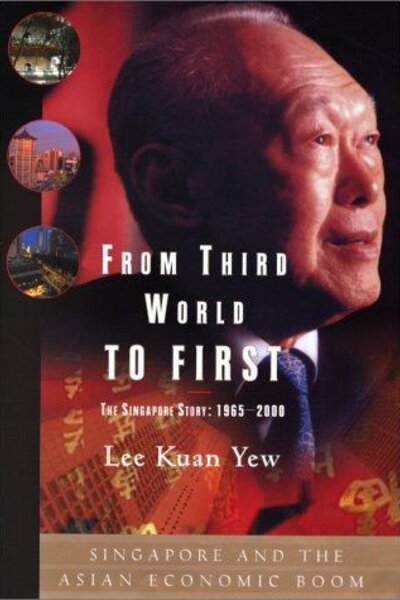
Why Read This
Lee Kuan Yew writes with unsparing honesty about Singapore's transformation from third-world to first-world status in one generation. This book doesn't offer a ready-made technical playbook. It presents a record of decisions, political dilemmas, and how a government closed vulnerability gaps through pragmatism.
The book provides insight into how a city-state with slim survival odds transformed itself from a trading post into a modern economic hub. Lee doesn't hide his fears at independence, acknowledges mistakes, and rejects romanticization. Its strength comes from a blunt voice, clear-eyed analysis without jargon, and the admission that success stems from hard work, pragmatism, and luck arriving at the right time.
The book demonstrates that debates between Asian and Western values have real implications for governance. Lee emphasizes designing institutions aligned with local context, preventing universal theories from being forced onto different conditions. Anyone seeking to understand how a small nation survives among larger neighbors will find essential lessons here.
Key Insights
-
Survival pragmatism: no room for hollow idealism - Singapore had to work better and cheaper than neighbors seeking to bypass them. Lee rejected the aid-dependency mentality, as he witnessed in Malta in 1967 when full-wage dockyard workers played water polo in dry docks filled with water because the Suez Canal was closed.
-
Meritocracy determines the fate of small nations - Talent is the scarcest asset. Lee saw Prince Sihanouk in Cambodia forced to be writer, director, actor, and producer due to a shortage of educated people. Singapore built a talent-search system using NASA-style psychological tests and Shell methods to assess big-picture thinking ability.
-
Trust is the highest currency - MAS (Monetary Authority of Singapore) rejected BCCI license applications in 1973, 1980, and 1982 despite the bank's backing from Arab royal families. When BCCI collapsed in 1991 with $11 billion in claims, Singapore remained safe. Long-term reputation investment yielded compound returns.
-
Grassroots work beats air campaigns - PAP (People's Action Party) won 10 consecutive elections since 1959 due to strong citizen-level organization. They built People's Association, community centers, citizens' consultative committees, and residents' committees connecting local leaders to the prime minister's office.
-
Confucian values have real-world applications - CPF (Central Provident Fund), home ownership, and meritocracy reflect principles where each generation bears its own costs and families care for members. Merit-based rewards, not inherited rights, create real stakes for citizens owning savings and assets.
-
Succession tests leadership - Lee stepped down in November 1990 when the economy and politics were stable. Hon Sui Sen reminded him in 1974 that investors assess who will replace aging ministers. Lee chose to pass the baton when the situation was still strong.
-
Timing determines major decisions - Lee knew when to step down, when to take risks (merger with Malaysia), and when to shift policy from import substitution to export-oriented industrialization. The Great Marriage Debate cost 12 percent of votes. He stood by data and long-term interests.
-
Transparency during crises strengthens trust - The 1997 Asian crisis tested everything. Many countries closed information; Singapore opened data as widely as possible. Banks in Singapore disclosed all regional loan exposure and added general provisions, strengthening trust.
Survival Pragmatism: No Room for Hollow Idealism
Singapore gained independence on August 9, 1965. Lee Kuan Yew was 42 years old and had to manage two million people without a roadmap. Foreign media predicted collapse. Denis Warner wrote in the Sydney Morning Herald that Singapore was deemed unable to survive. Richard Hughes in the London Sunday Times forecast economic collapse if the British base spending over 100 million pounds closed.
Lee acknowledged his fears. He struggled to sleep and his wife Choo asked the doctor to prescribe sedatives. He remained calm in public because a leader's duty during crisis is to provide hope.
Singapore was born as a man-made nation, a trading island without a land buffer. Indonesia confronted, Malaysia threatened to cut trade routes. Unemployment reached 14 percent and kept rising. The British military base prepared to leave, erasing about 20 percent of GDP and over 70,000 jobs.
Strategy to Leapfrog the Region
Lee's conclusion was simple: a city-state in Southeast Asia couldn't exist at average level. Singapore had to work better and cheaper than neighbors seeking to bypass them. They had to build a reputation as the most efficient hub.
The survival strategy stood on two principles. First, leapfrog the region like Israel. Because neighbors sought to reduce ties with Singapore, the city-state connected directly to America, Europe, and Japan. The government attracted multinational producers to manufacture in Singapore and export to developed markets.
Second, create a first-world oasis in a developing region. Standards for security, health, education, telecommunications, transportation, and services had to match developed cities. Singapore wanted to become a base for entrepreneurs and professionals working in Southeast Asia.
Rejecting Aid-Dependency Mentality
In 1967, Lee visited Malta to see the impact of British troop withdrawal. He saw full-wage dockyard workers playing water polo in dry docks filled with water because the Suez Canal was closed. The experience led him to reject aid-dependency mentality.
Lee said in parliament in September 1967: "There was a thriving Singapore before the bases were built. If we work it intelligently, there will be a larger and economically more virile Singapore after the bases are run down."
Lee's pragmatism rested on a simple principle: reality matters more than theory. Many development economists at the time viewed multinational corporations as neo-colonial exploiters. Lee and Goh Keng Swee chose to focus on real problems that needed solving.
The lesson for small nations is clear. When physical assets are limited, advantage comes from invisible factors like efficiency, reliability, government honesty, and speed of adaptation. Singapore had no oil like Indonesia or land buffer like Malaysia, so they had to intelligently leverage their strategic location as a trade hub.
Core lesson: Lee started from basic questions, or first principles thinking: what does Singapore actually have? Strategic location, world-class port, and hardworking people. What doesn't it have? Natural resources, large domestic market, and defense depth. From there he built a strategy rejecting standard developing-nation playbooks.
Meritocracy Without Compromise: Talent Determines Destiny
Lee reached a clear conclusion: talent is a small nation's most precious asset. The more talented the ministers, administrators, and professionals, the more effective the policies and the better the results.
This awareness didn't come from theory. Lee saw Prince Sihanouk in Cambodia forced to be writer, director, actor, and producer simultaneously because the country lacked educated people. That scarcity ended tragically when Pol Pot eliminated those who remained.
Talent-Search Mechanisms
The next biggest task was finding replacements for aging ministers. They prepared successors since the 1960s. They didn't find talent among typical political activists, so they sought PhD graduates, professionals, lawyers, doctors, and top-level administrators.
They quickly realized leadership was more than technical ability. Courage, determination, commitment, character, and the ability to make people want to follow became determinants. After many failures, Lee concluded character was harder to measure and far more important.
Lee adopted psychological testing after watching the Apollo 13 mission in 1970. Three astronauts remained calm during crisis and trusted their lives to ground control instructions. Lee saw evidence that NASA's psychological tests screened out panic-prone candidates, then applied it to PAP candidates.
Lee also adopted Shell's system to assess the ability to see facts in large context and identify critical details. The assessment examined strength of analysis, imagination, and sense of reality.
Global Recruitment: Additional Capacity for Small Nations
In Lee's first cabinet of ten people, only Lee was born and educated in Singapore. Goh Keng Swee and Toh Chin Chye were born in Malaya, S. Rajaratnam was born in Ceylon (now Sri Lanka). The Chief Justice at the time, Yong Pung How, came from Malaysia, as did Attorney General Chan Sek Keong. Thousands of engineers, managers, and professionals from abroad helped Singapore grow. They were like additional memory for a small nation's computer.
For SAF (Singapore Armed Forces), they selected the best officer cadets each year for overseas scholarships. Cadets received full lieutenant pay plus scholarships covering all costs. They signed an eight-year bond after graduation. During that period they were sent to America or Britain for two or three courses: specialist training, staff and command, then public administration or business at top universities like Harvard or Stanford.
By 1995, four former SAF scholars entered politics and became cabinet ministers: Lee Hsien Loong, George Yeo, Lim Hng Kiang, and Teo Chee Hean.
Core lesson: Talent investment is a long-term game with compound effects. One high-quality minister can make decisions affecting millions for decades. The SAF scholarship scheme shaped a leadership class understanding military discipline, strategy, and national interests before entering civilian government.
Trust as the Highest Capital
If Lee had to choose one word to explain why Singapore succeeded, that word would be "trust." This made foreign investors place their factories and refineries in Singapore. This trust was built inch by inch, through policy consistency, government honesty, and refusal to take short-term gains that damage long-term reputation.
Building Financial Credibility
In 1968, when Dr. Winsemius called his friend at Bank of America to start the Asian Dollar Market, Singapore was still a third-world country without international reputation. They had to struggle to build trust in their integrity, competence, and judgment.
Goh Keng Swee and Lee quickly decided Singapore should not have a central bank that could issue money without full backing. They maintained the Singapore dollar's value with a currency board that only issued money when backed by equivalent foreign reserves.
Strict regulatory standards became the long-term foundation. MAS rejected BCCI license applications in 1973, 1980, and 1982 despite the bank's backing from Arab royal families and Harold Wilson. When BCCI collapsed in 1991 with $11 billion in claims, Singapore remained safe.
MAS also rejected National Bank of Brunei's license run by Khoo Teck Puat. In 1986 the bank closed after massive deposit withdrawals and suspicions of S$1.3 billion (Singapore dollars) in problem loans. The decision to reject questionable banks became long-term reputation investment.
Crisis as Test: Maximum Transparency
The 1997 Asian financial crisis became the ultimate test. Investors panicked and withdrew funds from Asian markets. Many countries closed information to cover up problems. Singapore did the opposite: opened data as widely as possible.
Lee assessed that fund managers feared hidden traps, so hiding information wasn't smart. Banks in Singapore disclosed all regional loan exposure, all problem loans, and added general provisions earlier than waiting for non-performing loans.
The result: trust in Singapore strengthened during the crisis. No banks in Singapore faltered. Singapore became the only country in the region withstanding major capital outflows due to rule of law and solid banking supervision.
Long-Term Greed: Rejecting Opportunistic Gains
Lee's decision during the October 1973 oil crisis demonstrated this principle. Singapore could have blocked oil exports from their refineries and held a two-year stock. Lee chose to share cuts with other customers worldwide. This decision strengthened international trust that Singapore's government understood its long-term interests depended on being reliable.
Core lesson: Trust is an intangible asset built over decades and can collapse overnight. Short-term opportunistic decisions may yield quick profits. Long-term consequences are destructive. Second-order thinking forces us to see consequences of consequences.
Grassroots Organization: Ground Work Beats Air Campaigns
PAP won 10 consecutive elections since 1959. The secret was solid grassroots-level organization working every day. Lee learned from his toughest enemies, the communists. They didn't rely on spontaneous field visits. They built institutional networks to gather support.
Layered Organizational Structure
Lee formed People's Association, community centers, citizens' consultative committees, and residents' committees. This layered network connected local leaders directly to the prime minister's office:
- Residents' committees served one area of 6-10 apartment blocks
- Community centers organized recreational and educational activities
- Citizens' consultative committees ran local improvement projects and small public works
- People's Association housed all these organizations as corporate members
Opposition leaders conducting field visits crossed PAP-managed territory. There were swing voters and a hardcore of local leaders who knew PAP members of parliament, backed by government, would attend to citizens' needs during elections and between elections.
Facing Corruption Charges with Courts
Lee chose to directly confront corruption or abuse-of-power charges. In many developing countries, bribery charges emerged every election and were left alone because they were deemed too risky. Lee pursued legal action after seeking advice from counsel in Singapore and London. He was almost never counter-sued for defamation. He ensured he didn't make false slanderous accusations.
Western liberal critics felt Lee should ignore outrageous statements. Lee rejected that logic. Statements didn't automatically disappear just because vigorously denied. If Lee failed to sue, the public would assume the charges had foundation.
There was another more important reason. Since the 1950s, they built a political climate requiring politicians to defend every charge of wrongdoing. This rule applied to PAP and opposition. PAP ministers gained respect because they were willing to be examined and cross-examined in court.
Core lesson: Long-term political victory rests on consistent field work, networks working daily, and relationships built over years between elections. This creates a direct feedback loop between people and government.
Confucian Values in Practice: Beyond Asian Values Rhetoric
Singapore's relationship with America divided into two periods: during the Cold War and after. When the Soviet Union was a common threat, value differences weren't discussed confrontationally. After the Berlin Wall fell in 1989, human rights and democracy became America's main agenda, then differences with Asia sharpened.
Fundamental Value Conflict
Confucian society sees individuals within networks of family, extended family, friends, and community. Government cannot, and should not, take over family roles. Many in the West believe government can fulfill family obligations when families fail, for instance through single-mother support.
Singapore relied on family strength to maintain social order and preserve cultures of thrift, hard work, filial piety, and respect for scholarship. These values made people productive and helped economic growth.
Lee emphasized that freedom can only grow in an orderly state. Constant contention and anarchy destroy freedom. The primary goal of Eastern society is building order that enables everyone to enjoy maximum freedom.
Democracy Needs Foundation
Lee argued liberal democracy requires economic development, literacy, a growing middle class, and political institutions supporting free speech. Democracy also requires civil society based on shared values so people with different views will cooperate.
Europe and America developed democratic institutions over 200 years. More than 40 former British colonies and 25 former French colonies received democratic constitutions after independence, with disappointing results in both Asia and Africa.
In 1994, America tried bringing instant democracy to Haiti by reinstalling the ousted elected president. Five years later they quietly left the country and acknowledged failure. Bob Shacochis wrote that instant democratization was risky; Haiti's democracy was born premature and wouldn't survive without genuine multiparty systems, a secure middle class, and a viable economy.
CPF and Real Stakes
Singapore's CPF, home ownership, and meritocracy applied Confucian values: each generation pays for itself, families are responsible for their members, and rewards are merit-based, not inherited rights. This created a society different from European welfare states. People owning savings and substantial assets behave differently toward life, more aware of their power, and more responsible for themselves.
Core lesson: There's no universal recipe for nation-building. Institutions succeeding in one cultural context can fail totally in another. What matters are underlying principles like accountability, meritocracy, and rule of law, not specific forms. When each family owns real assets at stake, they have strong incentives for stability and growth.
Generational Transition: Legacy Through Succession
When reflecting on Suharto's 1998 fate, forced to resign and hand power to a vice president deemed inadequate, Lee felt grateful he had already stepped down in November 1990. He still held full control over political and economic situations running well. His physical condition was also still strong.
Right Time to Step Down
Hon Sui Sen said in 1974 that he wanted to retire at the next election. He was only 60 years old. That conversation had major impact on Lee. Sui Sen said investors saw aging ministers and asked who would replace them. They didn't see young ministers with potential to become finance minister.
Lee decided he must not fail. He had to place Singapore in competent hands before retiring. Stepping down at peak strength was a leader's final responsibility to the nation he led.
Building Successors: Collective Choice and Its Legitimacy
Lee decided 1988 would be the last election he led. After winning, he asked younger ministers to choose themselves whom they supported as prime minister. Lee saw Deng Xiaoping fail with people he appointed. He also remembered Anthony Eden, chosen by Churchill, who failed. The ministers chose Goh Chok Tong.
Chok Tong didn't grow up as a natural politician. He was tall, thin, and awkward, spoke English with a thick Hokkien accent. He had ability, dedication, and strong drive, plus interest in other people. Lee suggested he take lessons to improve speaking skills, and asked a Mandarin teacher to help him become a more effective communicator.
Facing Nepotism Charges
Many critics viewed Lee Hsien Loong's rise as smelling of nepotism. Lee answered firmly: precisely because Loong was his son, he didn't want Loong to replace him directly. Loong had to prove himself.
Loong got no special track. He entered parliament with high majority and was trusted to handle economic committees during the severe 1985 recession. Every position he held was tested with crises and real problems. After years watching Loong handle difficult problems in various ministries, criticism subsided because reality proved his capacity.
Core lesson: Generational transition tests political systems. By building deep and broad talent pipelines, Singapore created many options for the future. If one leader fails, another leader is ready to replace. The system doesn't depend on one figure. A leader's true legacy is seen in whether institutions he built survive and thrive after he leaves.
Related Content
Learn more about key concepts in this book:
- First Principles Thinking - Lee's approach to analyzing Singapore's problems from scratch
- Second-Order Thinking - Long-term perspective over immediate gains
- Meritocracy - Singapore's talent selection system
- Long-Term Thinking - Principle of long-term reputation investment
- Opportunity Cost - Trade-offs between freedom and stability in Singapore's context
Practical Applications
How to Apply Lessons from This Book
1. Survival Pragmatism for Your Business:
- Identify your unique competitive advantage like Singapore's strategic location
- Focus on being better and cheaper than competitors in specific areas
- Reject dependency mentality like subsidies or special preferences, then build financial independence
- Test every strategy: "Does this actually work in my real conditions?"
2. Meritocracy in Organizations:
- Create objective systems to identify talent like aptitude tests, simulations, and observation under pressure
- Invest in developing top talent; returns are compounding
- Value character and mental resilience equal to technical ability
- Recruit from anywhere, internal or external, because talent is the most precious asset
3. Building Long-Term Trust:
- Open information during crises, don't hide
- Reject opportunistic gains damaging reputation. Compare short-term benefits with long-term costs
- Maintain policy consistency over years to build credibility
- Test every decision: "Does this strengthen or damage long-term trust?"
4. Grassroots Work in Leadership:
- Build layered networks of local leaders and regular meetings, don't just rely on top-down announcements
- Create direct feedback loops between you and team or customers, listen to complaints before they become crises
- Solid grassroots organization beats big temporary campaigns
5. Succession as Final Responsibility:
- Start identifying successors 5-10 years before you're ready to step down
- Let them choose the next leader so legitimacy grows from within
- Step down at peak strength and don't wait until weakened
- Measure leadership success by whether the organization thrives after you leave
6. Decision-Making from First Principles:
- Start with fundamental questions: "What do we have? What don't we have?"
- Don't follow standard playbooks if your context is unique
- Ask: "Is this decision right for the long term, even if difficult short-term?"
- Prioritize data over dogma and abstract theory
Further Reading
To deepen your understanding of leadership, nation-building, and strategic thinking:
Related Books:
- "Lee Kuan Yew: The Grand Master's Insights on China, the United States, and the World" - Lee's interviews on geopolitics
- "The Singapore Economy: Past Performance, Current State and Future Prospects" - In-depth analysis of Singapore's economy
- "Thinking, Fast and Slow" by Daniel Kahneman - Cognitive foundations of rational decision-making like Lee's
Articles & Research:
- Goodreads: Reader discussions of this book
- Amazon: Reader reviews & different perspectives
FAQ
What made Singapore successfully transform from third-world to first-world status in one generation?
A combination of survival pragmatism, uncompromising meritocracy, and trust built inch by inch. Lee rejected standard developing-nation playbooks and built strategy based on Singapore's reality: a city-state without resources that had to be better than neighbors to survive.
Why did Lee Kuan Yew emphasize meritocracy as the key to Singapore's success?
Lee saw firsthand in Cambodia how talent shortage destroyed a nation. Prince Sihanouk had to be everything because there were no other talented people. For small nations like Singapore, one high-quality minister can make decisions affecting millions for decades. Talent is the biggest leverage.
How did Singapore build international trust as a third-world country without reputation?
MAS rejected questionable banks like BCCI despite strong backing from Arab royal families. When the 1997 Asian financial crisis hit, Singapore opened maximum information while other countries closed up problems. Banks in Singapore disclosed all loan exposure and added provisions early. This consistency built decades of reputation.
What's the difference between Confucian values and Western welfare states according to Lee?
Confucian society believes individuals exist within family context and government should not take over family roles. CPF and home ownership ensure each generation pays for itself. This creates real stakes: people with substantial assets behave differently and are more responsible for themselves.
How did PAP win 10 consecutive elections since 1959?
Solid grassroots work. Lee formed People's Association, community centers, citizens' consultative committees, and residents' committees creating layered networks connecting local leaders to the prime minister's office. These networks worked daily between elections and created direct feedback loops between people and government.
Why did Lee Kuan Yew step down in 1990 when still strong?
Hon Sui Sen said in 1974 that investors saw aging ministers and looked for replacements. Lee decided he had to place Singapore in competent hands before retiring. Stepping down at peak strength was a leader's final responsibility. True legacy is measured by whether institutions survive after the leader leaves.
How did Lee Kuan Yew handle nepotism charges against Lee Hsien Loong?
Precisely because Loong was his son, Lee didn't want him to replace directly. Loong had to prove himself. He entered parliament with high majority, was trusted to handle economic committees during the severe 1985 recession, and every position was tested with crises and real problems. Reality proved capacity.
What's the most important lesson from the 1997 Asian financial crisis for Singapore?
Transparency during crisis strengthens trust. While other countries closed information, Singapore opened maximum disclosure about regional loan exposure and problem loans. Result: trust in Singapore strengthened during the crisis. No banks in Singapore faltered.
Why did Lee reject universal blueprints for democracy and development?
Lee saw over 40 former British colonies and 25 former French colonies receive democratic constitutions after independence. Results were disappointing in both Asia and Africa. Haiti became a dramatic example: instant democracy without middle class or viable economy failed totally. Institutions must be adapted to local context, not forced based on universal theory.
What differentiated Singapore's succession approach from Deng Xiaoping's failures?
Lee let colleagues choose their own leader, not appointed from above. Appointed leaders often fail because they lack organic team support. Goh had strong internal legitimacy because he was chosen by peers. Talent pipeline was built decades earlier.
Critical Assessment
Strengths
1. Brutal honesty without romanticization
Lee writes with the same direct voice as the way he governed. He doesn't try to make himself look better than he was. He acknowledges fears (sleepless nights after independence), mistakes (delayed Chinese education policy), and doesn't claim successes not his own (15-fold growth was from global technological advancement).
2. Focus on first principles, not abstract theory
What guided Lee was reason and reality. The acid test he applied: does this work? If not, don't waste time and resources on it. This makes the book powerful as a record of how a leader thinks when facing problems without precedent.
3. Concrete data and specific examples
Lee writes with detail: BCCI collapsed with $11 billion in claims, the British base spent over 100 million pounds and eliminated 20 percent of GDP, four former SAF scholars became cabinet ministers in 1995. This gives empirical weight to every claim and makes lessons easier to apply.
Limitations
1. Singapore's unique context is hard to replicate
A city-state without land buffer, strategic location as a trade hub, and existential threats creating a sense of urgency. Not all countries have this combination of factors. Lee himself acknowledged much success was a combination of hard work and luck arriving at the right time.
2. Questions about freedom-stability trade-offs
Critics will say Lee was authoritarian, suppressed press freedom, and detained political opponents without trial. Lee doesn't deny. He explains with data why detention without trial was necessary. The more important question is: do you understand those trade-offs in the same context?
3. One leader's perspective may miss team contributions
As a personal memoir, this book is written from Lee's perspective. Although he praises Goh Keng Swee, S. Rajaratnam, Hon Sui Sen, and others, their perspectives on critical decisions might differ. Singapore's complete history needs to involve more leaders' voices.
Conclusion
This book is an essential document for anyone seeking to understand how a small nation can survive and thrive among large hostile neighbors. Singapore grew 15-fold from $3 billion GDP in 1965 to $46 billion in 1997. This came from uncompromising pragmatism, consistent meritocracy, and trust built inch by inch.
Lee's legacy is fundamental principles applicable anywhere. His specific political system may not be exportable. His lessons remain universal: intellectual honesty in facing reality, pragmatism faithful to core principles, willingness to pay political price for correct decisions, and understanding that trust is the highest currency in leadership.
Singapore today is living proof that small nations can survive and even thrive if led with wisdom, integrity, and relentless commitment to long-term interests. Can this be replicated? Maybe not exactly. The lessons are universal: talent determines, trust compounds, timing matters, and true legacy is measured by whether institutions survive after the leader leaves.
Rating: 5/5 - One of the most important political memoirs of the 20th century. Must-read for anyone interested in leadership, nation-building, or how principle-guided pragmatism can transform a nation's fate.