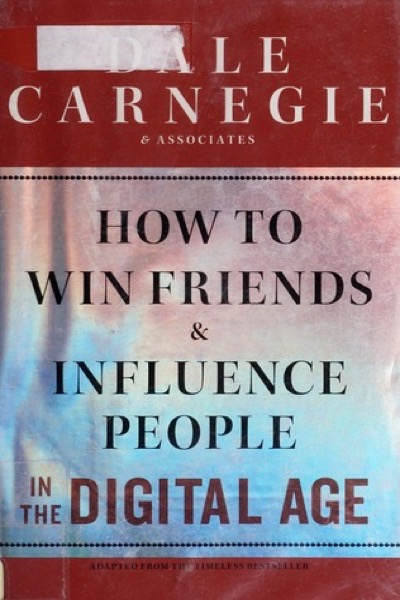
Why This Book
An update of Dale Carnegie's principles for the digital era: true influence comes from generosity, authenticity, and genuine care for others in digital communication.
In 1936, Dale Carnegie wrote a statement that remains relevant today: "Dealing with people is probably the biggest problem you face." Seventy-five years later, this statement hasn't just remained true, it's become more urgent. In the digital age, every word we type, every email we send, every tweet we post is an opportunity to win a friend or alienate someone.
This book updates Carnegie's principles for the digital age. The core principles haven't changed: true influence comes from generosity, authenticity, and genuine care for others. What has changed is the medium. We now communicate through email, text, blogs, Twitter, and Facebook. Human nature remains the same. People still want to feel valued. They still want to be heard. They're still interested in those who are interested in their lives.
The paradox of the digital age is this: we're more connected than ever, yet lonelier than ever. We have 600 Facebook friends, send 25 emails a day, but the number of people we actually talk to about important things keeps shrinking. Studies show that Americans had an average of two close friends in 2004, down from three in 1985. Technology gives us the tools to connect. Technology doesn't teach us how to use those tools wisely. This is why Carnegie's principles have become more relevant in the digital era.
In the midst of digital noise, the ability to truly listen, to truly care, to truly be present is a rare competitive advantage.
Who This Book Is For
This book is for you if:
- Professionals who communicate digitally every day and want to build long-term influence through email, chat, and social media
- Leaders and managers who want to build team trust in an era of remote work and virtual communication
- Entrepreneurs and business owners who want to build loyal customer relationships amid digital competition
- Anyone who feels isolated despite having hundreds of online connections and wants to build more meaningful relationships
- Communicators and marketers who want to understand the psychology of influence in the era of social media and digital marketing
This book is highly relevant if you feel your digital communications aren't producing the connections you hope for, or if you want to understand how timeless principles about human relationships apply in the technology era.
Key Points
-
No exchange is neutral - Every interaction with another person is a scale: you leave someone slightly better or slightly worse. In the digital era, this effect is amplified because every communication is permanently recorded.
-
Criticism works like a boomerang - United Airlines lost 180 million dollars in market capitalization because they didn't listen to one customer's complaint about a broken guitar. In the digital world, the criticism boomerang comes back faster and harder.
-
Affirmation creates reality - When we treat people according to their best potential, we help them become what they should be. Lionel Logue saw courage in Prince Albert that others missed.
-
Connect with core desires before logical arguments - Steve Jobs offered a better life through Apple's "digital hub" strategy, with technical specifications serving the vision. Result: stock price rose 4,856 percent in one decade.
-
Genuine interest creates influence - Andrew Sullivan increased Atlantic Monthly's site traffic 30 percent with the "View from Your Window" feature that showed genuine interest in readers.
-
Smiles spread up to three degrees - Research by Christakis and Fowler shows happiness spreads up to three degrees of separation in social networks. Each additional happy friend increases our likelihood of happiness by 9 percent.
-
Names are personal logos - Dave Munson of Saddleback Leather hugged Mexican workers and called them by name. One person teared up. This approach made Saddleback grow into a multimillion-dollar business.
-
Listening builds long-term trust - John, a political writer, never failed a job interview because of one principle: "Every interview is an opportunity to learn something new about a person I've never met."
Key Concepts
No Exchange Is Neutral
Every interaction with another person is a scale. You leave someone slightly better or slightly worse. Nothing is neutral. Every nod, every inflection, every digital interface creates an impact. The best among us leave others slightly better with each interaction.
Communication creates a cumulative effect: every conversation builds or erodes relationships. The scales of justice measure everything: there are no idle arguments or irrelevant facts. In the digital era, this effect is amplified: one tweet, one email, one careless comment all count and are permanent.
Emerson once wrote: "Every person deserves to be judged by their best moments." This book extends this principle by showing that we're entitled to be judged by our best moments, and equally responsible for creating the best moments for others. Lincoln understood this when he wrote an angry letter to General Meade, then stored it and never sent it. He knew that factually correct words could be strategically wrong.
This is a principle about compound interest in human relationships. Just as compound interest works in financial investments, consistently positive small interactions create exponential results over time. Conversely, small negative interactions also erode relationships exponentially.
In the digital era, we often forget that every email we write hastily, every reply we type while distracted, is an investment or divestment in our relationships. If you want long-term influence, focus on the quality of each interaction over occasional grand gestures.
Key insight: There's no such thing as a neutral exchange. Every interaction leaves others slightly better or slightly worse. We choose which with every word, every nod, every silence.
Bury Your Boomerangs: The Danger of Criticism in the Digital Era
Criticism works like a boomerang: it comes back to hit the thrower. In the digital era, that boomerang comes back faster and harder. What used to be just a private complaint in the living room can now become viral news that damages reputation forever.
People instinctively defend themselves against threats to their pride. Criticism makes people defensive and closed to change. In the digital world, every public criticism is recorded forever and can spread uncontrollably. True influence begins with improving ourselves first, then extends outward to others.
The case of Dave Carroll and United Airlines is a perfect example. A musician lost a $3,500 guitar due to airline employee negligence. He tried to complain for a full year. No one would listen. Frustrated, Dave wrote the song "United Breaks Guitars" and uploaded it to YouTube. Within two weeks, the video was watched four million times. United Airlines stock fell 10 percent, costing shareholders 180 million dollars.
Another example: Dr. Patrick Michael Nesbitt was fined $40,000 for posting "cruel" comments about his daughter's mother on Facebook. Ryan Babel, Liverpool striker, was fined $16,000 for a tweet mocking a referee.
This is an application of the second-order thinking principle: we must think through the direct effects of our actions, then the second, third effects, and so on. When we criticize someone publicly, the direct effect may satisfy our ego. The second effect is that person becomes defensive. The third effect is the relationship is damaged. The fourth effect is our reputation is tarnished. The fifth effect is others fear working with us.
Lincoln understood this. He knew that being factually right isn't always strategically right. He chose long-term influence over short-term satisfaction. In a world where sarcasm and anger have become the norm, grace and humility are rare and valuable differentiators.
Key insight: Criticism acts like a boomerang. It comes back to hit us with multiplied force. In the digital era, that boomerang comes back faster and harder than before.
Affirm the Good: The Power of Seeing Potential
Affirmation differs from empty praise because it's rooted in genuine care and deep observation of a person. When we treat someone according to their best potential, we help them become what they should be.
Every person deserves to be judged by their best moments, with their darkest records held lightly in the background. Affirmation creates reality: people tend to become what we see in them. Disappointment and betrayal actually provide rare opportunities to make a deep impression by showing undeserved grace. In the digital era, affirmation can be extended through email, social media, and text messages while remaining personal and genuine.
The film The King's Speech illustrates this perfectly. Lionel Logue, a speech therapist from Australia, saw something in Prince Albert that others missed. When the prince felt afraid to fail, Logue said: "Bertie, you're the bravest man I know." Those words changed everything because someone saw the fundamental goodness obscured by deficiencies.
Abraham Lincoln demonstrated this principle on a national scale. In his inaugural address, when seven states had already seceded and war was approaching, he said: "We are not enemies, but friends. We must not be enemies." How brave this was. He saw beyond the obvious and saw what might be.
This is a principle about shaping reality through perspective. In psychology, this is called the Pygmalion effect or self-fulfilling prophecy: our expectations of others tend to become reality because they respond to those expectations. When we see someone as a failure, we treat them accordingly, and they respond by fulfilling our low expectations. When we see their potential and treat them according to that potential, we give them room to grow.
In a digital era where criticism and condemnation are so easily hurled, the ability to see and affirm the good is a rare superpower.
Key insight: When we treat people as they are, we make them worse than they should be. When we treat them as if they already are what they potentially could be, we make them become what they should be.
Connect with Core Desires: Dialogue vs Monologue
To influence people to act, you must connect with their core desires first. Influence is about how deeply we understand what others truly want, with the cleverness of our arguments serving that understanding.
Intuition is more important than intellect in influencing people. Dialogue builds trust, monologue builds tension. True change begins at the spiritual level of the individual, then radiates outward through organizational campaigns. People only move toward what moves them.
The story of Emerson and his house servant illustrates this perfectly. Emerson, a brilliant philosopher, failed to get a calf into the barn by pushing and pulling. The humble house servant? He put his finger in the calf's mouth, let it suck, and gently guided the cow in. The servant knew something the philosopher forgot: the calf wants to eat. Once he leveraged that desire, the cow willingly followed.
Steve Jobs understood this when launching Apple's "digital hub" strategy in 2002. He offered a better life, with technical specifications serving that promise. While competitors mocked his products as "ridiculous," the public embraced that vision. Result: Apple stock price rose 4,856 percent in the next decade.
This is an application of the incentives principle: people respond first to incentives, and arguments only land when they ride on those incentives. The most powerful incentives are emotional and psychological: the desire to be valued, to feel competent, to contribute to something meaningful. When we try to influence people with logical arguments alone, we ignore 90 percent of what actually drives human behavior.
Todd Duncan in his book Killing the Sale explains this fatal mistake: we assume communication is about how well we deliver, when true communication is about how well we understand what others need. The paradox: the best way to get what we want is by helping others get what they want.
Key insight: Action arises from what we fundamentally want. The best advice that can be given to those who want to persuade is: First, arouse a great desire in the other person.
Be Interested in Others' Interests: The Gravity of Self-Interest
The fastest way to gain friends is by becoming genuinely interested in them. Self-interest is gravity we can't fight. What we can choose is its direction: toward isolation or toward connection.
Dogs understand this instinctively: they are simply there for us, present and devoted. Self-interest is a reality like gravity. A self-centered life is the most problematic life. Genuine interest creates closeness, and closeness creates influence. In the digital era, we have unlimited opportunities to show interest through five minutes a day reading profiles, blogs, or updates of others.
Andrew Sullivan, one of the world's top political bloggers, understands this. After leaving his position as the youngest editor of The New Republic, he created the "View from Your Window" feature where he asked readers to send photos of the world outside their homes. He explained: "I wanted to see their world. I give all these people all access to my world, one-way interaction ultimately gets boring." After this feature was introduced, Atlantic Monthly's site traffic increased 30 percent.
Steve Beecham, a mortgage business owner, learned this the hard way. He failed in two previous ventures. His third business almost went bankrupt until he met a celebrity who taught him the deep value of being interested in others' interests. From that day on, he committed to asking wise questions to every new person he met. Within months, his business turned around and took off. His business was 100 percent referral-based for a decade.
This is the opposite of zero-sum thinking. Most people assume attention is a zero-sum game: if I give attention to you, I lose attention for myself. The reality is positive-sum: when I give genuine attention to you, you tend to reciprocate with attention to me. This creates a virtuous cycle that enriches both parties.
Alfred Adler explained that "the person who is not interested in their fellow human beings has the greatest difficulties in life and provides the greatest injury to others." In the digital era, the paradox is we have more ways to show interest with less time to be truly interested. We scroll without really seeing. We like without really caring. In a world full of shallow attention, deep interest is the rarest and most valuable differentiator.
Key insight: All things being equal, people do business with people they like. All things being unequal, they still do business.
Smile: The Universal Contagious Language
A smile is the universal language that unites humanity across cultures. In the digital era, smiles are translated through tone of writing, word choice, and voice inflection. Happiness shown through smiles spreads up to three degrees of friendship in social networks.
As many as 99.7 percent of adults believe a smile is an important social asset. Research by Christakis and Fowler shows happiness spreads up to three degrees of separation. Each additional happy friend increases our likelihood of happiness by about 9 percent. Compared to an additional $5,000 income which only increases it by 2 percent. In the digital world, smiles must be manifested through written words and voice.
A Facebook study by Christakis and Fowler of 1,700 college students showed a clear pattern: people who smile in their photos tend to be at the center of social networks, have more friends, and are surrounded by other happy people. The group of smiling people was much larger and more crowded than the group of frowning people. Those who frown tend to be on the periphery of networks.
Research also shows that the physical act of smiling, even when on a phone call, actually improves our voice tone. Speaking, singing, and broadcasting coaches all emphasize that the voice sounds more pleasant when we smile, even though the person on the other end can't see our face.
This is a classic example of network effects in an emotional context. Just as products become more valuable when more people use them, happiness becomes stronger when more people around us are happy. We are active producers of happiness as well as consumers of it. Every smile we give is an investment in a happiness network that will return to us in amplified form.
In the digital era, the challenge is that our physical smile isn't visible in most communications. The solution lies deeper than emoticons or emojis. The solution is learning to smile through our words: diction choices, sentence structure, overall message tone.
Key insight: A smile costs nothing. A smile enriches those who receive it without impoverishing those who give it. It takes but a moment. The memory of it can last forever.
Be Powerful with Names: Personal Logos in the Digital Era
A person's name is the first gift after life itself and becomes their personal trademark. Remembering and using people's names is a small investment that brings great impact. In a digital era full of distractions, the ability to remember names becomes a rare competitive advantage.
A name is a verbal symbol of someone's identity, character, and existence. In the digital era, a name is like a company logo that represents who we are and what we stand for. Remembering a name says "You're important enough to me that I remember you." Forgetting a name means losing an opportunity to build meaningful connections.
Dave Munson, founder of Saddleback Leather Company, often takes customer calls from his cell phone and goes to Mexico several times a year to stay connected with the leather craftsmen. "I hug the workers and ask how I can pray for them. When I first made the trip, I remember how shocked these people were that I called them by name and then sat down to talk to them about their personal lives. One person teared up. Then so did I." This approach helped Saddleback survive and grow into a multimillion-dollar business.
Mr. Bates from Georgia always returned to Bone's restaurant because of a server named James. When Mr. Bates came for the second time after six months, James approached and said: "Hello, Mr. Bates. Thank you for choosing Bone's. Nice to see you back." That small gesture made Mr. Bates feel like a regular customer, even though he'd only eaten there once before.
This is an application of the personal touch in scalable systems principle. Many businesses assume scale requires sacrificing personality. The reality is the opposite: the bigger you grow, the more important it is to maintain personal touch. A name is the smallest unit of personality.
Napoleon III claimed he could remember the name of every person he met. His technique: repeat the name several times, associate it with physical features, write it on paper, look at it, concentrate, then tear up the paper. The challenge in the digital era is our brains are being trained to forget. Nicholas Carr shows that the internet changes our brain structure: when we're online, we enter an environment that encourages skimming, hurried and distracted thinking, and superficial learning.
In a world that trains us to forget, the ability to remember names is a superpower. And for businesses: technology makes it easy to store names in CRM or databases, technology doesn't replace authenticity in using that name.
Key insight: We should always be aware of the magic contained in a person's name and realize that this word is wholly and completely owned by the person we're dealing with, and by no one else.
Listen Longer: The Power of Full Presence
Listening is the power to change hearts and minds. In a hyper-connected digital era, people actually feel more isolated because no one is really listening to the important things in their lives. Full presence is the main principle of listening: wherever you are, be fully there.
The inability to listen can cost millions of dollars. The United Airlines case losing 180 million dollars in market capitalization proves this. The number of close friends we can talk to has dropped drastically: from 3 people in 1985 to 2 people in 2004. Listening builds long-term trust that's far more valuable than advertising campaigns. The fifteen questions a day technique: 5 for family, 5 for coworkers, 5 for digital interactions.
Dave Carroll and United Airlines is the perfect example of the cost of not listening. For a full year, not a single employee would stop for a moment to listen to his complaint about the broken guitar. Result: the viral "United Breaks Guitars" video and a loss of 180 million dollars in market capitalization. One five-minute conversation could have saved millions of dollars.
Sigmund Freud was a master of listening. A man who once met him described: "Never have I seen such concentrated attention. His eyes were mild and friendly. His voice was low and kind. His gestures were few. The attention he paid me was extraordinary. You don't know what it means to be listened to like that."
John, a political writer, never failed a job interview. His secret: "Every interview is an opportunity to learn something new about a person I've never met. People want to be heard and they want people around them who will listen. So I listen."
This is an application of the scarcity value principle: in a world full of noise, attention becomes the rarest and most valuable commodity. The paradox: we all want attention, we don't want to give it. Loïc Le Meur, founder of Seesmic, says online advertising campaigns are already outdated. The key to success is long-term engagement programs that facilitate listening to customers.
Why don't campaigns work? Because campaigns generate impressions, while trust grows from a different soil entirely. Trust can only be built through consistent listening. Just as compound interest works in investments, consistent listening creates trust that grows exponentially over time.
When people most need listeners, listeners become rarest. This is the greatest opportunity for differentiation. Anyone who masters the art of listening in the digital era will have disproportionate influence.
Key insight: Wherever you are, be all there.
Book Structure
This book consists of 28 chapters organized into four main parts:
Part 1: The Essence of Engagement Fundamental principles about how every interaction shapes relationships. Includes: bury your boomerangs (criticism), affirm the good, connect with core desires, be interested in others' interests, smile, be powerful with names, listen longer, discuss what's important to them, and leave others slightly better.
Part 2: How to Win Others to Your Way of Thinking Strategies for changing minds without creating resistance. Includes: avoid arguments, never say "you're wrong," admit mistakes quickly, begin in a friendly way, access agreement from "yes," surrender credit, engage with empathy, appeal to noble motives, share your journey, and throw down a challenge.
Part 3: How to Lead Change Without Resistance or Resentment Leadership techniques for driving change. Includes: begin on a positive note, acknowledge your burden, show mistakes calmly, ask instead of command, minimize mistakes, amplify improvements, give a good reputation to uphold, and stay connected at common ground.
Part 4: Digital Applications Every principle exemplified with real cases from the digital era: email, social media, blogs, viral videos, and other virtual communications.
Strengths
Practical relevance for the digital era. Every timeless Carnegie principle is exemplified with real cases from the digital world: United Airlines and YouTube, Andrew Sullivan and blogging, Steve Jobs and Apple, Dave Munson and e-commerce. This is a practical guide that can be applied today in email, chat, and social media, grounded in concrete cases throughout.
Strong empirical evidence. The Christakis and Fowler study on the spread of happiness in social networks. Research on the decline in the number of close friends from 3 to 2 people. Data on United Airlines' 180 million dollar loss. These numbers provide weight to the claims made.
Counter-intuitive principles. The best way to get what we want is by helping others get what they want. The best way to look great is by making others look great. The best way to be heard is by listening. These principles go against our selfish instincts, which makes them powerful when applied.
Connection to fundamental mental models. Compound interest in relationships. Network effects in happiness. Second-order thinking in criticism. Reciprocity in attention. Scarcity value in listening. This book provides frameworks for thinking, with tactics emerging from those frameworks.
Deep paradox of the digital era. The observation that technology makes us more quantitatively connected yet more qualitatively lonely is a profound insight. And the solution lies in using technology with timeless human relationship principles, embracing the medium while honoring the message.
Limitations
Lack of analysis on the dark side. This book focuses on the positive aspects of Carnegie's principles with little discussion of how the same principles could be misused for manipulation. In an era of misinformation and digital propaganda, understanding ethical boundaries is important.
Assumptions about authenticity. These principles only work if applied authentically. People can sense the difference between genuine interest and strategic interest. The book doesn't adequately explore how to build that authenticity itself if someone fundamentally doesn't care about others.
Limited cultural context. Most examples come from American and Western contexts. Relationship dynamics in collectivist cultures like Asia or the Middle East may have different nuances not fully covered.
Limitations in structural conflicts. These principles are highly effective for interpersonal relationships, less applicable to conflicts rooted in systemic structures. Not all problems can be solved by listening better or smiling more.
Lack of discussion on boundaries. The focus on making others feel good could potentially blur the importance of setting healthy boundaries. Not all relationships are worth maintaining. Not all people deserve our limited time and energy.
Conclusion
Dale Carnegie's principles from 1936 haven't become obsolete in the digital era. Quite the opposite. In a world where every word can go viral, every criticism can be recorded forever, and every interaction can be seen by thousands of people, our communication responsibility becomes greater. This book teaches that relational success in the digital era requires three things: authenticity, consistency, and care for others.
There are no shortcuts. No manipulative tricks that last. What endures is fundamental principles: treat people with respect, listen earnestly, affirm the good, and focus on what's important to them before what's important to you.
What makes this book profound is its paradox: in an era where technology allows us to scale communication to millions of people, the most effective principles are the most personal and hardest to scale. You can't scale authenticity. You can't scale full presence. You can't scale the ability to truly listen.
This is the greatest competitive moat in the digital era. The more people try to scale with automation, AI, and mass communication, the rarer genuine personal touch becomes. And what's rare is valuable.
Technology is an amplifier of who we already are. Technology amplifies who we are, good or bad. If we're selfish, technology amplifies our selfishness and makes us more isolated. If we're caring, technology amplifies our care and makes us more influential.
The choice is in our hands. Every email we write, every tweet we post, every comment we leave is a choice: will we leave others slightly better or slightly worse? In the digital era, that choice is amplified. The consequences are greater. The opportunities are also greater.
FAQ
Are Carnegie's principles still relevant in the era of social media and digital communication?
More relevant than ever. In an era where we communicate through email, chat, and social media, every word is permanently recorded and can go viral. Our communication responsibility becomes greater. The ability to truly listen and care amid digital noise is a rare competitive advantage.
How do you smile in digital communication that doesn't show faces?
Smiles in digital communication are manifested through tone of writing, word choice, and sentence structure. Research shows that even when speaking on the phone, the physical act of smiling actually improves our voice tone. In email or chat, use positive diction, avoid stiff or defensive language, and show genuine interest in others.
What's the difference between genuine affirmation and empty praise?
Affirmation is rooted in deep observation of a person and seeing their best potential. Empty praise is generic and transactional. Example: "You're the bravest man I know" from Lionel Logue to Prince Albert is affirmation because it sees fundamental qualities obscured by deficiencies. While "Good job" without context is empty praise.
How to apply listening principles in a digital era full of distractions?
Use the fifteen questions a day technique: 5 for family, 5 for coworkers, 5 for digital interactions. When talking to someone, close all other tabs, turn off notifications, and give full attention. Wherever you are, be fully there. One five-minute conversation with full presence is more valuable than five conversations with divided attention.
Does focusing on others mean ignoring your own needs?
No. This is a positive-sum game where both parties grow together. When you give genuine attention to others, they tend to reciprocate with attention to you. This creates a virtuous cycle that enriches both parties. The reciprocity principle works: humans have a strong tendency to return kindness, as long as your intentions are genuine.
How to remember names in the digital era with thousands of connections?
Use technology as an enabler: CRM, contact management, notes on phone. Napoleon III used the technique: repeat the name several times, associate it with physical features, write on paper, focus, then tear it up. In the digital era: when meeting someone virtually, add notes about the meeting context and personal details. Review before the next interaction.
Do these principles apply in conflicts rooted in fundamental value differences?
These principles are highly effective for interpersonal relationships, less applicable to structural conflicts. Not all differences can be resolved by listening better. Some conflicts require systemic change beyond communication change. It's important to recognize the difference between conflicts that can be overcome with empathy and conflicts that require structural action.
How to avoid manipulation when applying these persuasion principles?
The key is authenticity. People can sense the difference between genuine interest and strategic interest. These principles only work long-term if applied with the right intention: to truly add value to others, not to manipulate them for personal gain. If your intention is transactional, people will sense it and trust will be damaged.
How many meaningful relationships can we maintain in the digital era?
Dunbar's research shows the human brain can only manage about 150 meaningful relationships. In the digital era where we have hundreds or thousands of connections, it's important to choose wisely. Quality beats quantity. Better to have 10 deep relationships than 1000 shallow connections.
What's the biggest consequence of not listening in the digital era?
United Airlines lost 180 million dollars in market capitalization because they didn't listen to one customer's complaint about a broken guitar. The "United Breaks Guitars" video went viral and damaged their reputation. In the digital era, one unheard customer can become a PR crisis seen by millions. The cost of not listening becomes exponentially greater.