Why Read This
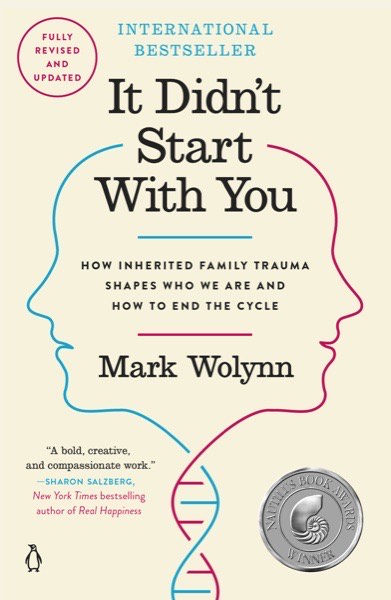
Mark Wolynn reveals that our fears, anxieties, and behavioral patterns often originate from trauma passed down across generations through epigenetics and family dynamics. This book integrates neuroscience research, epigenetics, and family systems therapy with the Core Language Approach, a practical method for identifying and releasing inherited trauma patterns by listening to the specific words we use.
Have you ever felt you carry inexplicable fears? Anxieties that feel so familiar, as if you were born carrying them? Wolynn shows that many of these patterns are inheritances from unresolved trauma in our family history, transmitted through biological mechanisms, neural pathways, and family dynamics, even when they feel deeply our own.
Groundbreaking research by Rachel Yehuda demonstrates that children of Holocaust survivors are born with cortisol levels similar to their parents. This isn't learned behavior, it's epigenetic changes at the DNA level. A woman who is claustrophobic and feels she "can't breathe" may be carrying the terror of grandparents who suffocated in gas chambers. A man with severe insomnia may be reliving the fear of an uncle who froze to death.
What's most liberating about this approach is how it frees us from self-blame. When we understand that we may be carrying "traveling sentences" seeking resolution across generations, we can begin to see ourselves with more compassion. True healing doesn't require explicitly remembering trauma, it requires listening to the specific words we use and finding their source in family history.
This book is for those who: experience fears or anxieties that seem disproportionate to their life experiences, are curious about the deep roots of recurring behavioral patterns, want practical self-healing tools without expensive therapy, or are interested in integrating science (epigenetics, neuroplasticity) with more holistic healing. Wolynn's approach opens the possibility that healing trauma reaches our entire family lineage, with our own healing flowing outward through generations.
Key Insights
-
Trauma can be inherited biologically - Rachel Yehuda's research shows that children of Holocaust survivors are born with low cortisol levels similar to their parents, the result of epigenetic changes to DNA that travel beyond ordinary learned behavior.
-
Core Language reveals trauma sources - The specific words we use to describe our deepest fears are often clues to unresolved trauma in family history, like "I can't breathe" connected to a suffocation death.
-
Family consciousness binds us across generations - Bert Hellinger teaches that we share family consciousness with biological members who came before us, and unconscious loyalty to this system can be stronger than conscious desires for happiness.
-
Four unconscious themes block life - Merging with parental pain, rejecting parents, interrupted bond with mother, and identification with other family members create unnecessary suffering.
-
Healing sentences create new neural pathways - Norman Doidge proved that neuroplasticity allows us to change our brain simply by imagining, and the right healing sentences can release unconscious family ties.
-
The first nine months are a critical period - Neural circuitry formed in the womb and the first nine months of life becomes the blueprint for managing emotions, thoughts, and behavior throughout life.
-
Parental rejection creates stronger bonds - Paradoxically, the more we try to distance ourselves from parental patterns, the more bound we are to them because we cannot expel our parents from ourselves.
-
Epigenetic changes are reversible - Dawson Church shows that visualization, meditation, and focus on positive thoughts can positively activate genes, proving we're not locked into genetic fate.
Inherited Family Trauma: When Pain Doesn't Dissolve on Its Own
Inherited family trauma is a phenomenon where the effects of trauma can transfer from one generation to the next. Wolynn teaches that pain doesn't always dissolve on its own or diminish over time. When someone in the family experiences trauma too overwhelming to bear, those extraordinary feelings and sensations can become buried and then resurface in the next generation as symptoms difficult to explain.
Wolynn explains three main mechanisms of trauma transmission: biological inheritance through epigenetic changes to DNA that occur in egg or sperm cells, neural circuitry formed in the womb and the first nine months of life, and relational patterns where disrupted mother-child bonding dynamics are passed to the next generation.
Rachel Yehuda's research on children of Holocaust survivors shows they were born with low cortisol levels similar to their parents, predisposing them to relive PTSD symptoms from the previous generation. This is real biological change at the cellular level, reaching well beyond learned behavior.
Jesse's Case: Insomnia Inheriting the Fear of Death
Jesse, a 20-year-old man, experienced severe insomnia starting at age 19. He felt extremely cold on the first night insomnia appeared and was shrouded in fear that if he fell asleep, he would never wake up.
Upon exploration, it turned out that his father's uncle, Colin, died freezing to death at age 19 while checking power lines in a snowstorm. The family never spoke of Colin's death again. Three decades later, Jesse unknowingly relived aspects of Colin's death, specifically the terror of releasing into unconsciousness. When Jesse understood this connection and spoke healing sentences for his uncle, his insomnia completely disappeared.
Implications for Understanding Suffering
This concept transforms how we understand suffering. Until now, we may have been seeking answers in our own personal history, spending years in therapy to find the root cause of our anxiety. Wolynn shows that the answer may lie one, two, or even three generations back.
This explains why some people experience fears that seem disproportionate to their life experiences. A client terrified of enclosed spaces may be carrying the terror of grandparents who suffocated in gas chambers. A woman who can't sleep may be carrying the vigilance of a grandmother who had to stay alert to protect her children during war.
What's more profound is how this concept changes our relationship with family. Family trauma becomes an invitation for deeper healing, reaching our entire lineage even as we begin with ourselves.
Core Language Approach: Listening to the Words of Fear
The Core Language Approach is a method that combines understanding of inherited family trauma with the crucial role of language in healing. Wolynn teaches that the specific words we use to describe our fears are often clues to unresolved trauma in family history.
Core language consists of emotionally charged words that appear repeatedly in our complaints. They are the "missing language" of trauma that couldn't be integrated when it occurred. By following these words, we can trace them back to their source and begin the healing process.
Core Language Map Framework
The Core Language Map consists of four elements: Core Complaint is the deepest complaint with strong emotional resonance, Core Descriptors are adjectives and phrases describing parents and relationships, Core Sentence is a short 3-6 word sentence summarizing our worst fear, and Core Trauma is the traumatic event in family history that is the source.
Wolynn teaches that we must "trust the words implicitly" but "don't always trust the context." The words of the core complaint are generally true for someone, not always for us.
Sandy's Case: Claustrophobia from the Holocaust
Sandy, a child of Holocaust survivors, described her fear with very specific words: "not death itself, but knowing that I'm going to die and I can't do anything to stop it." She also had paralyzing fear of enclosed spaces: "I can't breathe. I can't get out."
Sandy was 19 when the claustrophobia and feeling of not being able to breathe began. Her father was also 19 when both his parents and his younger sister suffocated in the gas chambers at Auschwitz. Sandy was carrying the panic terror of grandparents and an aunt she never knew.
When Sandy understood that the words "I can't breathe, I can't get out" weren't really hers, but rather a traveling sentence from those who died in gas chambers, she could begin to release that burden. Core sentences function like "traveling salesmen who knock on door after door until someone lets them in," seeking resolution across generations.
Carole's Case: Obesity Carrying the Word "Suffocated"
Carole, a 38-year-old woman weighing 300 pounds, had a core complaint: "I feel smothered and suffocated by all this weight." Upon exploration, it turned out that Carole's grandmother had two sons who suffocated in the birth canal due to severe oxygen deprivation. The words "smothered and suffocated" were the unspoken words of her family's trauma.
This approach transforms how we listen to ourselves. Words that recur in our complaints become breadcrumbs leading to buried treasure, far more than passing feelings to dismiss.
What's most liberating is the understanding that we don't need to explicitly remember trauma to heal it. Even if we don't have access to complete family history, our own core language can direct us toward healing. The words we use carry the wisdom of the body that knows what needs to be released.
Epigenetic Inheritance: The Biology of Inherited Trauma
Wolynn presents groundbreaking research in epigenetics showing how trauma can leave biological traces that are inherited. Epigenetics is the study of how life experiences can alter gene expression without changing the DNA sequence itself. These changes can be passed to the next generation.
Rachel Yehuda from Mount Sinai School of Medicine found that children of Holocaust survivors with PTSD were born with low cortisol levels similar to their parents. This is biological change at the cellular level, deeper than any learned behavior.
Three Generations in One Biological Environment
Wolynn explains a remarkable phenomenon: when your grandmother was five months pregnant with your mother, the precursor cells for the egg you developed from were already present in your mother's ovaries. In other words, you already shared a cellular environment with your mother and grandmother before you were conceived.
During pregnancy, nutrients in the mother's blood feed the fetus through the placental wall. Along with nutrients, she also releases hormones and information signals generated by the emotions she experiences. These chemical signals activate specific receptor proteins in cells, triggering a cascade of physiological changes in both the mother's and fetus's body.
Mouse Study: Inherited Trauma Memory
A mouse study at Emory University School of Medicine (2013) showed how traumatic memories can be inherited through epigenetic changes. Mice in one generation were trained to fear the scent of cherry blossoms (acetophenone) by delivering electric shocks whenever exposed to that smell.
Remarkably, the children and grandchildren of these mice, despite never experiencing electric shocks, became anxious and avoided the flower scent when exposed. They also showed the same brain changes: a larger number of scent receptors and larger brain areas dedicated to those receptors.
Another study from University of Lethbridge (2014) found that stress in pregnant mothers causes premature births, and this effect worsens with each subsequent generation. The third generation experienced even shorter pregnancies than previous generations.
Hopeful Implication: Reversibility
Epigenetics research provides scientific validation for experiences long observed in clinical practice. What's most hopeful about these findings is that epigenetic changes are reversible. Dawson Church in his book "The Genie in Your Genes" describes how visualization, meditation, and focus on positive thoughts and emotions can positively activate genes and affect our health. We are not locked into our genetic fate.
This also explains why early trauma, especially in the womb and the first nine months of life, has such profound impact. The neural circuitry formed during this critical period becomes the blueprint for managing emotions, thoughts, and behavior throughout life.
Family Consciousness and Entanglement
Wolynn integrates the concept of "family consciousness" from Bert Hellinger, a German psychotherapist who has studied families for over fifty years. Hellinger teaches that we share family consciousness with biological family members who came before us.
Everyone has an equal right to belong in the family system, and no one can be excluded for any reason. This includes alcoholic grandfathers, stillborn siblings, aborted children, and even people who harmed our family members.
When someone is rejected or excluded from the family system, that person can be represented by a later member of the system. Hellinger uses the term "entanglement" to describe this suffering. When entangled, you unconsciously carry the feelings, symptoms, behaviors, or difficulties of earlier family members as if they were your own.
John's Case: Paying for His Father's Crime
John came to see Wolynn after being released from prison. He had served three years for embezzlement, a crime he claimed he didn't commit. Upon exploration, it was revealed that one generation earlier, his father was accused of murdering his business partner but was acquitted on a technicality. Everyone in the family knew his father was guilty, but never spoke of it. John was the same age as his father when he went to trial. Justice was finally served, but the wrong person paid the price.
Zach's Case: "I Was Born to Die"
Zach was 24 years old and had made several suicide attempts, all with the same theme: he wanted to be shot dead by someone defending their country. His core sentence: "I was born to die."
It turned out that Zach's maternal grandfather was a high official in Mussolini's cabinet responsible for decisions that led to many deaths. When the war ended, he managed to escape to America. His colleagues who remained were rounded up and shot by firing squad. Zach had been trying to pay for his grandfather's crimes with his own life without awareness.
Unconscious Loyalty Stronger Than Conscious Desire
This concept of family consciousness is profound because it shows that we don't live in isolation, but as part of a larger system that spans generations. Our unconscious loyalty to this system can be stronger than our conscious desire for happiness or success.
What's most powerful about this concept is that healing doesn't require us to judge or blame anyone in the family system. Even people who committed crimes or hurt others have the right to belong. By acknowledging them with respect instead of pushing them away, we free the next generation from having to represent them.
Four Unconscious Themes That Block Life
Wolynn identifies four unconscious themes that can disrupt our life flow and create unnecessary suffering: merging with parental pain by unconsciously taking on parents' suffering as if we had magical power to lighten their burden, rejecting parents by blaming or judging them which ironically binds us more tightly to their patterns, interrupted bond with mother which creates a blueprint for difficulties in intimacy and trust, and identification with other family members that relives trauma that isn't ours.
Gavin's Case: Merging with Father's Failure
Gavin was 34 years old when he made a series of reckless financial decisions that cost his entire family savings. Without realizing it, he was repeating the experience of his "loser" father who also lost family savings at the racetrack when he was in his mid-thirties.
By not sharing a conscious connection with his father, Gavin had forged an unconscious connection by repeating his father's failure. Wolynn explains: "The last thing parents would want to see is their child suffering on their behalf. It is arrogant and inflated to think that we, as children, are better equipped to handle our parents' suffering than they are."
Megan's Case: Identifying with Grandmother's Loss
Megan married Dean at age 19 and felt their relationship would last forever. Then one day, when Megan turned 25, she stared at him across the kitchen table and felt numb. Her feelings for Dean had disappeared.
It turned out that Megan's grandmother was only 25 when her husband, the love of her life, drowned while fishing at sea. As soon as Megan realized she was reliving her grandmother's story, her feelings for Dean began to return.
The Paradox of Parental Rejection
What's most paradoxical is parental rejection: the more we try to distance ourselves from them, the more bound we are to their patterns. Wolynn teaches that "the family story is our story. Like it or not, it resides within us." We cannot expel or erase our parents from ourselves. Rejecting them only distances us further from ourselves and creates more suffering.
Interrupted bond with mother is especially significant because mother is "our entire world" in early years. When this bond is disrupted, a dark cloud of fear, scarcity, and distrust can become our default. This explains many patterns in adult relationships, from attachment anxiety to inability to receive love.
Healing Sentences and Neuroplasticity
Wolynn teaches that the right words have the power to release us from unconscious family ties and loyalties. Healing sentences are reconciliation or resolution statements that produce new images and feelings of wellbeing.
Norman Doidge revolutionized our understanding of the brain with the concept of neuroplasticity: the brain is flexible and capable of change. New experiences can create new neural pathways. What's more interesting, Doidge says we can change our brain simply by imagining. Visualization activates the primary visual cortex the same way as if we were actually performing the action.
Structure of Healing Sentences
Healing sentences typically contain three elements: acknowledgment that recognizes what happened to the family member, honoring that respects their suffering, and release that returns the burden to its original owner.
Simple rituals like placing family photos, lighting candles, writing letters, or developing supportive images can strengthen healing sentences. Each time we repeat this practice, we reinforce new neural pathways.
Jesse's Case: Healing from Insomnia
Jesse with insomnia was invited to visualize his uncle Colin who froze to death in a snowstorm and speak directly to him: "Uncle Colin, I can see now that I've been carrying your fear of dying. I've been cold and afraid to fall asleep, just like you. I know this is not what you want for me. From now on, I will sleep peacefully through the night, knowing that you are at rest."
When Jesse spoke these words, tears began to flow, his breathing deepened, his jaw relaxed, and his shoulders dropped. After that session, Jesse reported he could sleep through the night without disturbance.
Though this conversation was only in imagination, brain research shows that Jesse activated the same neurons and brain regions as if he had actually experienced this conversation directly.
Healing Sentence Templates
For someone who realizes they share their grandfather's loneliness from rejection: "I have been isolated and alone just like you. I can see that this doesn't even belong to me. I know this is not what you want for me. From now on, I will live my life connected to the people around me."
For a woman who understands she shares her mother's relationship failure: "Mom, please bless me to be happy with my husband, even when you couldn't be happy with Dad."
The concept of neuroplasticity provides scientific basis for healing practices that may seem too simple. Our brain continues to change throughout life, and we have agency in this change process. We don't need to wait for our parents to change, or even to still be alive, to heal our relationship with them. Healing happens at the level of inner image and inner experience.
Practical Applications
For Personal Life
Audit Core Language: Make a list of recurring complaints you have. Listen to the specific words you use. Are there phrases that appear repeatedly like "I feel trapped," "I can't breathe," "I'll end up alone," or "I'm not good enough"? Ask yourself: "Who in the family might feel the same way?"
Create Family Genogram: Draw a family tree three or four generations back. Next to each family member, write the traumas and difficult fates they experienced. Who died young? Who was abandoned? Who committed suicide or killed someone? Who benefited from others' loss? See what patterns emerge. Often, trauma in one generation will repeat in different form in the next generation.
Reconnect with Parents: If you've distanced yourself from parents, either physically or emotionally, consider reconnecting. The work is changing your inner image of them, set aside from the question of forgiving abuse or forgetting wounds. You can start with small steps: looking at their photos with compassion, visualizing them as vulnerable children, or writing a letter you don't have to send.
Practice Healing Sentences: After you identify the connection between your symptoms and family trauma, create personal healing sentences. Speak them aloud, feel the sensations in your body, and repeat regularly. Template: "I can see now that I've been carrying [feeling/behavior] that belongs to [family member]. This is not mine. I honor you and all that happened to you. From now on, I will [new behavior/feeling]."
For Therapy and Helping Professionals
Expand Timeline Exploration: Don't just focus on the client's childhood. Ask about family history three generations back. Seemingly unexplainable trauma may have clear roots when we look at family history.
Listen for Core Language: Pay attention to the specific words clients use repeatedly. Don't interpret or reframe too quickly. Trust the words. They often carry clues to the trauma source.
Use Bridging Questions: When clients express fears or symptoms, ask: "Who in the family might feel the same way?" or "What event in family history matches this feeling?"
Facilitate Acknowledgment: Many unresolved family traumas exist because they were never acknowledged. Facilitating acknowledgment rituals, even simple ones like lighting candles or placing photos, can bring profound relief.
For Parenting
Heal Your Own Trauma: What's unresolved in you will tend to be passed to your children. Prioritize your own healing, knowing that the benefit reaches generations to come.
Talk About Family History: Don't keep family trauma secret from children. Remaining silent doesn't protect them; conversely, unspoken trauma often emerges as symptoms in children.
Protect the Mother-Child Bond: Nine months in the womb and the first nine months outside are critical periods. Protect this bond as much as possible. If separation or disruption occurs, work to reestablish the bond as quickly as possible.
Don't Make Children Emotional Caretakers: Don't burden your children with your emotional problems. They will try to carry your burden, and this will affect their ability to thrive.
For Relationships
Understand Partner as Mirror: Your partner likely triggers unhealed wounds. This is an opportunity for healing, beyond mere coincidence or poor choice. Instead of blaming your partner, ask: "What's unresolved in me that's being mirrored here?"
Identify Inherited Patterns: Your complaints about your partner may be echoes of unfinished business with your parents. If you feel you "don't get enough attention" from your partner, ask if this is a pattern you also experienced with your mother or father.
Release Unconscious Loyalty: If your parents weren't happy in their marriage, you may unconsciously limit your own happiness out of loyalty. Acknowledge this and give yourself permission to have more than they had.
Connections to Mental Models
This book has deep connections to several mental models:
Second-order thinking: Trauma doesn't just affect direct victims, but also has ripple effects to the next generation who weren't directly exposed.
Systems thinking: Family is an interconnected system where trauma in one part affects the whole. Healing one individual can free the entire lineage.
Inversion: Instead of asking "What's wrong with me?", ask "What happened to my family?" Instead of "How can I fix myself?", ask "Who do I need to acknowledge and honor in family history?"
First principles thinking: Return to root causes by asking "Who first felt this?" Don't accept the assumption that all problems originate from our own childhood.
Circle of competence: We often assume we understand ourselves well, when many of our patterns lie outside the circle of competence of our awareness. Acknowledging this opens the door to deeper learning.
FAQ
Q: How can I know if my fear is inherited trauma or personal experience? A: Pay attention to specific words that recur in your complaints. If the fear seems disproportionate to your life experience or started at the same age as family trauma, it may be inherited. Ask: "Who in the family might feel the same way?"
Q: Do I need to know my entire family history to heal? A: No. Your own core language can direct you to healing even without complete access to family history. The words you use carry the wisdom of the body that knows what needs to be released.
Q: How long does it take to heal from inherited trauma? A: It varies for each person. Some clients like Jesse experience significant relief after one healing sentence session. What's important is consistency in practice and willingness to reconnect with family history.
Q: Are healing sentences really effective if they're only in imagination? A: Yes. Neuroplasticity research by Norman Doidge shows that visualization activates the same neurons and brain regions as real experience. The brain doesn't differentiate between actual and vividly imagined experiences.
Q: What if my parents are still alive but toxic or abusive? A: Healing is internal work, not an external project. You don't need to change them or repair the external relationship. Focus on changing your inner image of them, seeing them as wounded children, and releasing expectations that they must change.
Q: Are epigenetic changes permanent? A: No. Epigenetic changes are reversible. Dawson Church shows that visualization, meditation, and focus on positive thoughts can positively activate genes. You're not locked into genetic fate.
Q: How can I stop trauma patterns from being passed to my children? A: Prioritize healing your own trauma. Talk about family history with children appropriately. Protect the mother-child bond during pregnancy and the first nine months. Don't make children emotional caretakers for your problems.
Q: What's the difference between merging and identifying with family members? A: Merging is taking on your own parents' suffering as if you could lighten their burden. Identification is reliving the trauma of other family members like grandparents or siblings, usually people who were excluded from the system.
Q: Can the Core Language Approach be used alone or does it need a therapist? A: It can be used alone for self-exploration, but a trained therapist can help identify connections you might miss and facilitate more effective healing sentences.
Q: Why does rejecting my parents make me more like them? A: This is the paradox of parental rejection. The family story is your story. Rejecting them means rejecting parts of yourself, which actually binds you more tightly to their patterns. Acceptance is the path to freedom.
Further Reading & Resources
To deepen your understanding of inherited trauma and healing, consider these resources:
Related Books:
- "The Body Keeps the Score" by Bessel van der Kolk - In-depth exploration of how trauma is stored in the body and the neurobiology of PTSD
- "It's Not Your Fault (But It Is Your Responsibility)" by Bob Scheinfeld - Alternative perspective on personal responsibility vs inherited patterns
- "What Happened to You?" by James P. Gilligan & Bruce D. Perry - Trauma-informed framework for understanding destructive behavior
Research Sources:
- Rachel Yehuda's research (Mount Sinai School of Medicine) on epigenetic inheritance in Holocaust survivors
- Emory University study (2013) on transgenerational transmission of trauma through epigenetic modification
- Bert Hellinger's work on Family Constellation Therapy and systemic entanglement
Additional Resources on Our Platform:
- Mental model Systems thinking for understanding family as a system
- Mental model Second-order thinking for seeing long-term consequences of trauma
- Mental model Inversion for changing perspective on personal problems
Critical Assessment
Strengths
Multidisciplinary Research Integration: Wolynn successfully integrates neuroscience, epigenetics, family systems therapy, and spirituality into a coherent and applicable framework. Rachel Yehuda's research on epigenetics in Holocaust survivors provides strong scientific validation.
Accessible Practical Method: The Core Language Approach provides concrete tools that can be immediately practiced. Clinical cases like Jesse, Sandy, and Zach powerfully illustrate applications and make abstract concepts relatable.
Liberating Perspective Shift: Understanding that many of our fears aren't truly ours frees us from self-blame and opens pathways for deeper compassion toward ourselves and our families.
Limitations
Verification Difficulty: Some connections between symptoms and family trauma appear speculative. Not all correlation is causation, and there's risk of confirmation bias where we see connections that may not exist.
Implementation Complexity: While healing sentences seem simple, identifying the right connection between symptoms and family trauma requires deep skill and insight. Not everyone has access to complete family history information.
Clinical Case Limitations: The book relies heavily on individual clinical cases. There's no data on success rates, long-term outcomes, or how this approach compares to traditional therapy in controlled studies.
Conclusion
"It Didn't Start with You" is a valuable contribution to our understanding of trauma and healing. This approach is best suited for readers open to integrative perspectives combining science and spirituality, who have symptoms or patterns seemingly unexplainable by personal history, and who are interested in exploring family dynamics and inherited patterns.
This book is recommended with a 4.5/5 rating for its unique combination of scientific research and healing practice, accessibility for general readers, and potential for profound transformation, though with attention to verification limitations and implementation complexity.