Why Read This
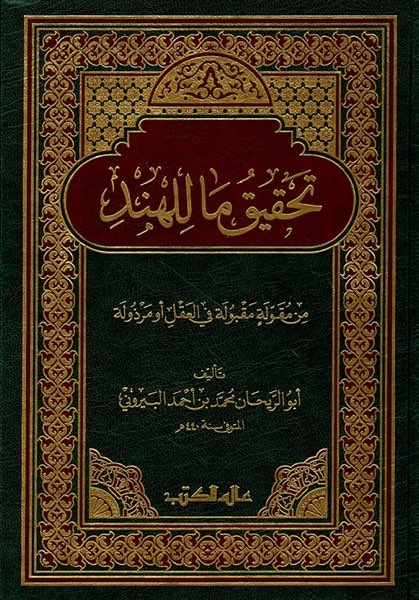
Al-Biruni spent 13 years in medieval India (1017-1030 CE) to write the first objective study of Hindu civilization: theology, astronomy, mathematics, and culture. This work is a masterpiece of comparative religion before the term even existed, written with extraordinary intellectual honesty in an era when religious bias dominated scholarship across all civilizations.
As a Persian polymath who mastered Sanskrit, Al-Biruni immersed himself in the culture, reading original Hindu texts like the Bhagavad Gita, Patanjali's Yoga Sutras, and the Siddhantas (astronomical treatises). He engaged in deep dialogue with Brahmin scholars. He compared Hindu theology with Islamic monotheism and Greek philosophy without any apologetic agenda.
What makes Kitab al-Hind revolutionary is its methodology: Al-Biruni separated observation from judgment, presented Hindu beliefs as they are before analyzing them, and acknowledged the limitations of his own knowledge. This is the prototype of the scientific method in humanities, 600 years before the European Renaissance.
This book is essential reading for anyone interested in interfaith dialogue, the history of Islamic science, or understanding how intellectual curiosity can transcend cultural and religious boundaries. Al-Biruni demonstrated that rigorous scholarship and deep faith can strengthen each other when held by the same hand.
Key Points
-
Pioneering Objective Methodology - Al-Biruni used an empirical approach: learning Sanskrit, reading primary texts, dialoguing with Hindu scholars, and separating description from evaluation. This is the blueprint for modern comparative religion.
-
Comparative Theology Without Agenda - He presented Hindu concepts of Brahman, reincarnation, and moksha fairly before comparing them with Islamic monotheism. Al-Biruni wrote: "I shall not produce the arguments of our antagonists in order to refute them, but I shall simply quote them."
-
Documentation of Indian Sciences - Al-Biruni translated and analyzed the Siddhantas (Hindu astronomical treatises), explained the Indian decimal number system (what we now call "Arabic numerals"), and documented advanced trigonometric calculation methods. He acknowledged the superiority of certain Indian mathematical techniques over contemporary Greek and Persian methods.
-
Cultural Anthropology Avant la Lettre - From the caste system to religious festivals, from the geography of the Ganges River to trade routes, Al-Biruni documented 11th-century India with ethnographic detail rarely found in the medieval era.
-
Intellectual Humility Amid Expertise - Despite mastering mathematics, astronomy, and theology, Al-Biruni consistently acknowledged his limitations: "I can only say what I have learnt from them, and I shall not add to it anything of my own." This is the posture of a scholar who walks with an open hand, ready to receive what he does not yet know.
-
Bridge Between Civilizations - This work became a crucial knowledge bridge between the Islamic world, India, and later Europe (via Edward Sachau's landmark 1887 English translation). Al-Biruni proved that meaningful knowledge transfer across civilizations is essential for human progress, a current that carries every civilization forward when allowed to flow.
Al-Biruni's Objective Methodology
Al-Biruni began Kitab al-Hind with reflections on epistemology: the difference between firsthand observation and hearsay. He wrote that "seeing is not like hearing" because eyewitness accounts have temporal and spatial dimensions that rumor lacks. This awareness drove him to settle in India for 13 years, sharing its seasons, its language, and its scholarly company.
Linguistic Approach
The first barrier he identified was language. Al-Biruni noted that Sanskrit has its own complexity: one word can have many meanings, and one concept can be expressed with many synonyms. This made translation a major challenge.
His solution: master Sanskrit through intensive study, collaborate with pandits (Hindu scholars and learned priests), and compare multiple sources to verify understanding. Al-Biruni became a skilled translator himself, working directly with the original tongue.
He even acknowledged technical difficulties: the Devanagari script (used for Sanskrit) couldn't be perfectly represented with Arabic letters, so he developed a specialized diacritical system for accurate transcription of Sanskrit terms and proper names. This is a concrete example of methodological rigor.
Principle of Fair Representation
In chapters on Hindu theology, Al-Biruni consistently quoted original texts before offering commentary. When explaining the concept of Brahman (the ultimate reality in Vedanta philosophy), he quoted directly from the Upanishads and Bhagavad Gita.
The format he used: "They say..." (direct quotation), then "This is their belief..." (neutral paraphrase), and only then "From a rational perspective..." (critical analysis). This structure maintains intellectual honesty.
Al-Biruni's critical eye turned both ways: he scrutinized Hindu beliefs that contradicted Islam, and he scrutinized Muslim scholars who misunderstood India due to bias or ignorance. His objectivity favored no one except truth.
Admission of Limitations
Unlike other medieval scholars who often wrote with overconfidence, Al-Biruni was transparent about what he didn't know. When discussing complex topics like cosmic cycles in Hindu cosmology, he wrote: "This requires further verification, as I have not found complete agreement among my sources."
When he couldn't access certain texts or regions in India, he stated this explicitly. This humility is the very thing that strengthens the trust readers place in his work.
Hindu Theology According to Al-Biruni
One of Kitab al-Hind's greatest contributions is its systematic documentation of Hindu theology for a Muslim audience. Before Al-Biruni, Muslim scholars only had stereotypes or fragmentary knowledge about India.
Concept of Divinity
Al-Biruni explained that Hindu theology has layers: there are popular beliefs (with a pantheon of deities like Vishnu, Shiva, Brahma) and there are philosophical elite beliefs (which teach abstract monotheism about Brahman).
He quoted from Patanjali's Yoga Sutras the definition of God: "The All-Knowing without need to learn, for His knowledge is eternal. He is not bound by time or place. He is the Teacher of all teachers, even the ancient masters."
Al-Biruni noted the similarity of this concept with the Islamic conception of Allah: eternal, beyond time and space, all-knowing. This is a powerful moment in interfaith understanding, where the scholar pauses on common ground and lets the resemblance speak for itself.
Reincarnation and Liberation
On reincarnation (samsara), Al-Biruni accurately presented Hindu doctrine: the soul (atman) migrates from one body to another based on karma (accumulated actions). This cycle continues until reaching moksha (liberation), where atman merges with Brahman.
He then compared it with Islamic belief about resurrection and the afterlife. The difference: Islam teaches one-time judgment, while Hinduism teaches a cyclical process. Al-Biruni laid out the logical structure of each system and let the reader weigh them.
What he critiqued was inconsistency in practice: if Hindus believe the soul can reincarnate as animals, why do they still consume certain animals? This is a philosophical critique within the bounds of reason, raised in the spirit of inquiry.
Caste System
Al-Biruni documented the varna system (Brahmins, Kshatriyas, Vaishyas, Shudras) with anthropological detail. He explained its theological basis: that caste is determined by birth as a consequence of karma from previous lives.
He also critiqued it from a social justice perspective. Al-Biruni compared the caste system with Islamic egalitarianism, which teaches "there is no superiority of Arab over non-Arab except in piety." This is one of the sections where Al-Biruni's values as a Muslim are clearly visible.
He acknowledged that although Islam teaches equality, in practice there is also social stratification. This self-awareness makes his critique more nuanced.
Indian Astronomy and Mathematics
As a mathematician and astronomer, Al-Biruni was deeply interested in India's scientific achievements. He translated several Siddhantas (astronomical treatises) and compared them with Ptolemaic astronomy, which was dominant in the Islamic world.
The Five Siddhantas
Al-Biruni identified five major Siddhantas circulating in India:
- Surya Siddhanta (attributed to the Sun god) - the most popular
- Brahma Siddhanta (attributed to Brahma)
- Pulisa Siddhanta (influenced by Paulus Alexandrinus, a Greek astronomer)
- Vashishta Siddhanta
- Paitamaha Siddhanta
He noted that although linked to deities, these Siddhantas are mathematical texts with sophisticated trigonometry, planetary calculations, and eclipse predictions.
Indian Numerals
Al-Biruni explained the Indian number system, which uses place-value notation and zero as a placeholder. He acknowledged that this system is superior to Roman numerals or Greek alphabetic numerals used in Byzantium.
Ironically, the Indian decimal system entered Europe via the Islamic world and became known as "Arabic numerals," even though Al-Biruni himself explicitly acknowledged its Indian origin. This is a classic example of how knowledge attribution can become distorted through cross-cultural transmission.
Trigonometric Calculations
Al-Biruni compared Indian trigonometry methods (using sine functions) with Ptolemy's methods (using chords). He found that the Indian approach is more efficient for certain calculations.
He also documented Indian astronomers' methods for calculating Earth's circumference. Al-Biruni himself had independently performed similar calculations using mountain altitude observations (a technique he pioneered), and he compared his results with Indian estimates for verification.
Planetary Motions
In discussions about planetary periods and mean motions, Al-Biruni presented tables from Surya Siddhanta and compared them with Ptolemaic values. He noted areas of agreement and discrepancies, then rendered judgment based on the observational evidence he had.
Al-Biruni performed his own verification calculations on the data he gathered. This is scientific rigor rare in the 11th century.
Geography and Culture of India
The ethnographic sections of Kitab al-Hind provide a window into 11th-century India unavailable in other sources. Al-Biruni wrote like a modern anthropologist, documenting everything from sacred rivers to marriage customs.
Physical Geography
Al-Biruni described India's major rivers: the Ganga (Ganges), Yamuna, Sindhu (Indus), and others. He explained the religious significance of the Ganga and why Hindu pilgrims flocked to cities like Varanasi (Benares) and Prayaga (Allahabad).
Regarding the Himalayas (the world's highest mountain range), he noted that these mountains are the sources of major rivers and hold deep religious significance in Hindu cosmology. Al-Biruni compared elevations and climate zones with regions he knew in Persia and Central Asia.
Cities and Trade Routes
He documented important cities: Kanauj (capital of the Pratiharas), Multan, Kashmir, and others. Al-Biruni explained trade networks connecting India with Central Asia, Persia, and the Arab world.
He noted that Indian merchants rarely traveled outside India, unlike Arab or Persian traders who were mobile. This is an acute sociological observation.
Festivals and Rituals
Al-Biruni described Hindu festivals like Diwali (festival of lights), Holi, and others. He explained the mythological origins of these festivals based on stories from the Puranas.
Regarding purification rituals in rivers, cremation ceremonies, and pilgrimage practices, Al-Biruni wrote with the kind of detail that comes only from a witness standing on the riverbank with his own eyes open.
Social Customs
From marriage ceremonies to dietary restrictions, from clothing styles to the education system, Al-Biruni documented Indian social life with thoroughness. He noted that Hindu widows weren't allowed to remarry, and in some cases, the practice of sati (widow burning) occurred, though it was controversial.
He also explained the gurukula system, where students lived with their guru (teacher) for years to learn the Vedas, philosophy, or sciences through oral transmission and practice. Al-Biruni compared it with the madrasah system in the Islamic world, noting both similarities and differences in pedagogical approaches.
Intellectual Honesty and Self-Critique
What distinguished Al-Biruni from other scholars of his time was his willingness to acknowledge mistakes and biases. His critical eye turned in both directions, weighing Hindu beliefs and Muslim misconceptions about India with the same scales.
Critique of Muslim Biases
Al-Biruni wrote that many Muslim scholars misunderstood India because they refused to learn Sanskrit or engage with Hindu texts. They relied on stereotypes or information from low-quality informants.
He also criticized Muslim invaders who destroyed temples and libraries, as such actions annihilated irreplaceable repositories of knowledge. Al-Biruni, though working for Sultan Mahmud of Ghazni (infamous for his destructive raids on India), wasn't afraid to voice this principled criticism, a remarkable act of intellectual courage.
Acknowledgment of Complexity
Al-Biruni repeatedly acknowledged that Hindu thought is extremely complex and has multiple schools with different doctrines. He didn't simplify "Hinduism" into a monolithic entity.
Example: when discussing the concept of liberation (moksha), he noted that the Samkhya school has a different interpretation from the Vedanta school, and the Yoga school has a different approach from both. This nuance is rare in medieval scholarship.
Limitations of His Knowledge
Al-Biruni acknowledged that he couldn't access Southern India due to travel limitations, so his information focused more on Northern India. He also acknowledged difficulty understanding certain obscure Tantric practices due to their esoteric nature.
This transparency about limitations makes his work more credible. Al-Biruni wrote for posterity, with truth as his only audience.
Practical Applications
1. For Interfaith & Diplomatic Work
Concrete steps:
- Learn the native language of the community you want to understand (literal or metaphorical)
- Read their primary texts firsthand, going beyond secondary commentaries
- Build an "observe-describe-analyze" framework before critique
- Acknowledge complexity and diversity within traditions, avoid stereotyping
Example: Diplomats or interfaith workers can adapt Al-Biruni's structure (quotation → neutral paraphrase → analysis) for reports about other communities.
2. For Academic Research & Scholarship
Concrete steps:
- Start with epistemological questions: "How do I know what I claim?"
- Separate evidence from interpretation
- Document your research limitations explicitly
- Cross-verify with multiple sources before conclusions
- Acknowledge potential biases embedded in your worldview
Example: Students writing about topics outside their cultural background can adopt Al-Biruni's principle: invest time in language/context, consult practitioners, and be transparent about what you cannot access.
3. For Leadership & Decision-Making
Concrete steps:
- Before making decisions about other groups, understand their worldview from within
- Don't trust information from a single source or outsider perspective
- Acknowledge trade-offs: the Hindu caste system has logic (karma doctrine) even though it's ethically problematic
- Humble inquiry is more powerful than confident judgment
Example: Managers wanting to understand team culture from different backgrounds can adopt a curiosity-first approach: ask clarifying questions, read relevant texts/articles, consult with insiders.
4. For Personal Intellectual Development
Concrete steps:
- Choose ONE culture/tradition different from yours for deep study
- Invest 3-6 months in intensive learning (language, history, philosophy, current issues)
- Keep a journal about assumptions you uncover about yourself
- Share learning with others, noting what surprised you
Example: Digital nomads or global citizens can choose a country/culture for "Al-Biruni study": live 1-2 months, read locally-authored books, interview locals, document your evolution of understanding.
Historical Significance and Legacy
Kitab al-Hind is a landmark in the history of intellectual exchange between Islam and India. This work proves that scholarly objectivity is possible even in contexts of religious difference and political tension.
Impact in the Islamic World
After Al-Biruni, Muslim scholars writing about India used Kitab al-Hind as a reference. This work became a standard text for understanding Hindu philosophy and Indian sciences.
Due to its complexity and length, Kitab al-Hind wasn't as popular as Al-Biruni's other works like Al-Qanun al-Mas'udi (astronomy) or Al-Athar al-Baqiya (chronology). Only serious scholars truly studied this work in depth.
Rediscovery in Europe
When Edward Sachau translated Kitab al-Hind into English in 1887, European scholars were astonished by its level of sophistication and objectivity. This was the height of colonial-era Orientalism (later critiqued by Edward Said), when many European scholars wrote about Asia with patronizing attitudes and cultural superiority.
Al-Biruni's approach was counterfactual: an "Eastern" scholar writing about another "Eastern" civilization with methodology more rigorous than many "Western" scholars.
Relevance for Modern Interfaith Dialogue
In an era when religious polarization remains an issue, Al-Biruni's example shows that intellectual curiosity and deep faith can coexist. He didn't need to abandon Islamic beliefs to appreciate Hindu philosophy, and he didn't need to demonize Hinduism to affirm Islam.
This model is relevant for contemporary interfaith efforts: engage with other traditions seriously, learn their language (literal and metaphorical), and present their beliefs fairly before critique.
Model for Comparative Religion
Renowned historian Annemarie Schimmel called Kitab al-Hind "the first objective book on the history of religion." While this claim may be debatable, there's no doubt that Al-Biruni was pioneering in developing systematic comparative religious methodology.
His principles: learn the source language, read primary texts, consult with practitioners, separate description from evaluation, acknowledge complexity and diversity within traditions. This is a blueprint still valid for religious studies today.
FAQ
Q: Did Al-Biruni convert to Hinduism after writing this book? A: No. Al-Biruni remained Muslim until his death. Objectivity in scholarship is not the same as religious relativism. He could appreciate Hindu philosophy while maintaining Islamic faith.
Q: How long did Al-Biruni stay in India? A: About 13 years (1017-1030 CE), as part of Sultan Mahmud of Ghazni's entourage. Unlike the Sultan who focused on military conquests, Al-Biruni focused on intellectual pursuits.
Q: Did Hindu scholars of the time appreciate Al-Biruni's work? A: There's no record of Hindu response to Kitab al-Hind in the 11th century, as the work was written in Arabic which Hindu pandits didn't read. Modern Indian scholars value it as an invaluable historical source.
Q: Why didn't Al-Biruni write in Persian or Sanskrit? A: Al-Biruni wrote most of his works in Arabic because it was the lingua franca of the Islamic scientific world. Writing in Arabic maximized readership among scholars from Baghdad to Córdoba (al-Andalus, Islamic Spain).
Q: Is there bias in Kitab al-Hind? A: Of course. Al-Biruni was still an 11th-century man with an Islamic worldview. What's impressive is his awareness of potential bias and his effort to minimize it through rigorous methodology.
Q: How did Al-Biruni conduct research without the internet or modern libraries? A: He worked with Brahmin scholars who had access to manuscripts, borrowed and copied texts himself, conducted interviews with pandits, and observed rituals directly. Labor-intensive but thorough.
Q: Was there a contradiction between science and religion in Al-Biruni's thought? A: Al-Biruni separated empirical knowledge (science) from revealed knowledge (religion). He believed reason and revelation work as two complementary sources of light, each illuminating its proper domain.
Q: Why isn't this work as popular as the travels of Marco Polo or Ibn Battuta? A: Marco Polo and Ibn Battuta wrote accessible and entertaining travelogues. Kitab al-Hind is a dense and technical scholarly treatise written for serious scholars, not general readers.
Q: Did Al-Biruni speak Sanskrit fluently? A: Most likely yes, at least with high reading proficiency. He translated texts from Sanskrit to Arabic and vice versa. However, his spoken fluency isn't clearly documented.
Q: What's the biggest lesson from Kitab al-Hind for modern readers? A: That intellectual humility, curiosity, and objectivity can transcend barriers of culture and religion. When we approach "the Other" with genuine desire to understand, well beyond any agenda to conquer or convert, transformative learning occurs.
Further Reading & Related Resources
Primary Sources
- Edward Sachau (Translator). 1887. The Alberuni's India: An Account of the Religion, Philosophy, Literature, Geography, Chronology, Astronomy, Etc. of India. London: Trübner & Co. (Standard English translation)
- Qeyamuddin Ahmad (Editor). 1983. Al-Biruni's India: With introduction and notes. National Book Trust India.
Related Resources on Platform
To deepen understanding of mental models central to Al-Biruni's work:
- Intellectual Humility: Mental model about acknowledging limitations (core principle of Al-Biruni)
- Comparative Thinking: Framework for understanding multiple perspectives simultaneously (applicable to interfaith dialogue)
- First Principles Thinking: Al-Biruni's methodology in beginning research (methodological blueprint)
- Systems Thinking: Al-Biruni's integral approach to India as a complex system
Related Essays
- "Interfaith Dialogue in the Context of Islamic Science": Exploring Al-Biruni's legacy in contemporary religious studies
- "Comparative Religion Methodology: Lessons from Islam's Golden Age": Critique and development of Al-Biruni's approach
Critical Assessment
Strengths
1. Pioneering Methodology in Comparative Studies
Kitab al-Hind is a prototype for modern ethnographic research. Al-Biruni's insistence on learning source languages, consulting primary texts, and separating observation from judgment are principles that only became standard in anthropology in the 20th century. Nine centuries before anthropologist Clifford Geertz wrote about "thick description," Al-Biruni was already practicing it.
2. Rare Intellectual Honesty
In an era when religious triumphalism dominated scholarship, Al-Biruni's willingness to acknowledge complexity, admit ignorance, and critique his own community is refreshing. He wrote: "I can only say what I have learnt, I shall not add anything of my own." This commitment to truth over ego is the hallmark of great scholarship.
3. Bridge Between Civilizations
This work is a monument to intellectual exchange. Al-Biruni proved that knowledge knows no religious or cultural boundaries. By translating Siddhantas, documenting Indian numerals, and explaining Hindu theology, he facilitated knowledge transfer whose impact is felt to this day.
4. Scientific Rigor
In sections on astronomy and mathematics, Al-Biruni went further than reporting data, verifying calculations, comparing multiple sources, and identifying errors. This level of rigor is comparable to modern peer-reviewed scholarship.
Limitations
1. Geographic Limitations
Al-Biruni primarily focused on Northern India, with limited knowledge about South India, Bengal, or other regions he didn't visit. This makes his generalizations about "India" sometimes incomplete.
2. Elite Bias
His informants were primarily Brahmin scholars. He had less access to perspectives from lower castes or non-Hindu communities in India (Buddhists, Jains). This makes his portrayal of "Hindu beliefs" biased toward high-caste orthodoxy.
3. Complexity for General Readers
Kitab al-Hind is a dense academic work. Chapters on astronomy are full of technical terms and calculations meaningful only to specialists. The lack of narrative structure makes this work challenging to read cover-to-cover.
4. Limited Impact on Hindu-Muslim Relations
Although Al-Biruni wrote with objectivity, his work wasn't widely read in India and didn't prevent conflicts between Hindu-Muslim communities in subsequent centuries. Scholarly exchange doesn't automatically translate to social harmony.
Conclusion
Kitab al-Hind is a masterpiece that transcends its historical context. For scholars of Islamic intellectual history, this is proof that Islam's Golden Age extended well beyond preserving Greek knowledge, into active engagement with other civilizations.
For students of comparative religion, Al-Biruni is a model of how to approach "the Other" with respect and rigor. For anyone interested in interfaith dialogue, this work is a reminder that intellectual curiosity and deep faith can coexist.
Recommendation: Essential reading for anyone serious about Islamic science history, comparative religion, or medieval India. Requires patience due to its dense and technical nature. Start with the introduction by Qeyamuddin Ahmad or Edward Sachau for context before diving into detailed chapters.
Rating: 5/5 - Monumental work that remains relevant after 1000 years.