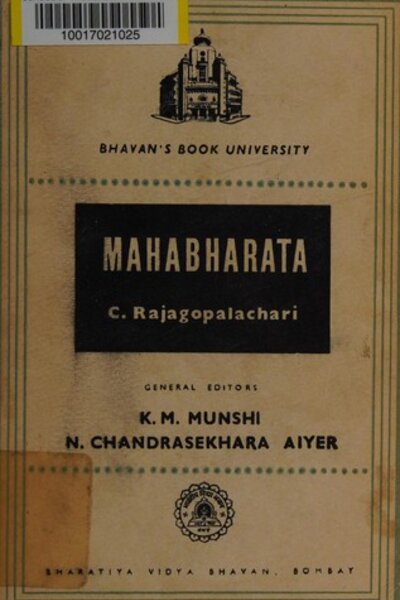
Mahabharata: Rajagopalachari's Retelling of Dharma
Why Read This
Rajagopalachari condenses the Mahabharata into 106 chapters, tracing dharma as a living compass, anger that devours its owner, and Yudhishthira's final test at heaven's gate.
C. Rajagopalachari was a statesman, teacher, and writer who lived the wisdom of this epic long before he set it down in prose. The result is an English prose retelling carrying the authority of someone who understood every moral dilemma in this story from the inside. Rajagopalachari read the Mahabharata as a timeless moral map, equally valid for twentieth-century readers navigating governance, family, loyalty, anger, and death as it was for the characters within it.
"The Mahabharata is in fact a veritable ocean containing countless pearls and gems. It is, with the Ramayana, a living fountain of the ethics and culture of our Motherland."
This book is for readers who want to understand dharma as a living inner compass demanding careful situational judgment; who want to trace decision-making patterns in situations where two equally legitimate duties collide; and who want to read the greatest epic in the Indian tradition with a guide who was also a statesman.
Key Points
-
Dharma lives within situations, woven into every decision - Drona, Bhishma, Karna, and Balarama each face a collision between two equally valid obligations. How they choose reveals that dharma demands careful situational reading, and there is no wholly clean answer.
-
Anger erodes even the most steadfast moral code - Rajagopalachari writes a law that feels like a law of nature: "Evil flourishes on retaliation." From Satyaki's attack comes Aswatthama's revenge, and every transgression opens the door to the next.
-
Knowledge and virtue are two distinct things - Yavakrida mastered the Vedas through Indra's gift, yet the pride that grew alongside his learning killed him. Kausika, who had memorized every mantra, had to sit at the feet of a butcher who cared for his parents with devotion every single day.
-
The Yaksha-prashna holds questions that transcend every era - When the Yaksha asks "What is the greatest wonder in the world?", Yudhishthira answers: every day people witness death, then go on behaving as though death is someone else's concern. That self-chosen blindness is the most astonishing thing of all.
-
The Bhagavad Gita was born at a man's lowest point - Arjuna, the greatest warrior alive, stood in his chariot and his bow slipped from his hands. From that paralysis, Krishna taught that the soul is imperishable, and a kshatriya is called to perform his duty while releasing all attachment to its outcome.
-
Great evil rarely announces itself openly - The palace built to kill the Pandavas was named "Sivam," meaning prosperity. Yudhishthira's genuine goodwill toward family unity became the opening that Sakuni exploited with precision.
-
The victory at Kurukshetra was not clean - Drona fell because of Yudhishthira's half-truth. Karna was struck while his chariot wheel was buried and he stood defenseless. Yudhishthira looked across the battlefield afterward and said: "At the very moment of victory, we have been totally defeated."
-
Dharma is the one companion that never leaves - Yudhishthira refused to enter heaven without the faithful dog that had traveled beside him. The dog was Yama, the god of dharma, in disguise. Loyalty maintained toward the most humble creature was the final and most human test of all.
The Epic in Outline: 106 Chapters from Oath to Heaven
The Mahabharata in Rajagopalachari's retelling moves from the narrative frame of Ganapati writing down the story at Vyasa's dictation, through the births of the Pandavas and Kauravas, the conflict that slowly expands, the dice game that changes everything, thirteen years of exile, the eighteen-day Kurukshetra War, Yudhishthira's reign, and the final ascent to the Himalayas.
Rajagopalachari treats these episodes not as a collection of heroic tales. Each one arrives with a lesson he draws to the surface before closing the chapter, in the voice of a teacher who knows this story is still in effect.
"The Mahabharata is a great and wonderful story. The sorrows of human life are painted with sublime beauty and rolled out in a grand panorama. Behind the story of errors and sorrows the poet enables us to have a vision of the Transcendent Reality."
When Rajagopalachari places Drupada's plan alongside the Pearl Harbour attack of December 1941, or notes that a "walk-out" from an assembly was no modern invention since Sisupala had done it thousands of years earlier, he is affirming one principle: human nature does not change, and the lessons of this epic remain in force.
Dharma as a Living Compass
Across 106 chapters, the word "dharma" appears hundreds of times. Rajagopalachari shows that dharma is an inner compass demanding situational judgment, something far more alive and weightier than a set of rules one can memorize. Every major figure in the epic confronts a moment where two equally legitimate obligations point in opposite directions, and there is no fully clean answer available.
Three Figures at the Crossroads
Drona fought for the Kauravas because of an obligation to the king who had employed him for decades, an obligation binding more strongly than his own moral assessment.
"I am under inescapable obligations to the Kauravas, O son of Dharma. Our vested interests enslave us and become our masters. Thus have I become bound to the Kauravas. I shall fight on their side. But yours will be the victory."
Karna refused to join his own brothers because he had eaten Duryodhana's salt.
"I have eaten the salt of Dhritarashtra's sons, won their confidence as their champion and enjoyed all the consideration and kindness they showed me; and now you want me-when the battle is about to be joined-to be untrue to my salt and go over to the Pandavas. The sons of Dhritarashtra look on me as the ark which will enable them to cross the deluge of war. I have myself urged them into this war. How can I now desert them? Could there be blacker treachery and baser ingratitude? What in life, or beyond it, would be worth a price like that?"
Balarama went on pilgrimage and refused to fight because two men he loved with equal measure, Bhima and Duryodhana, stood in opposing camps.
"This episode of Balarama's keeping out of the Mahabharata war is illustrative of the perplexing situations in which good and honest men often find themselves. Compelled to choose between two equally justifiable, but contrary, courses of action, the unhappy individual is caught on the horns of a dilemma."
Rajagopalachari writes this to show that moral dilemma is a sign of deep concern. Precisely because Balarama was selfless, he experienced a dilemma never felt by someone choosing purely from self-interest.
The Deepest Lesson
The epic teaches something more seasoned than "do what is right." It teaches that two right paths sometimes point in opposite directions, and it is in those moments that a person's true character becomes visible. How someone bears a difficult choice is the most honest mirror they have.
Anger and Hatred: The Fire That Consumes Its Owner
From the first chapter, Rajagopalachari places the theme of anger as the most recurring moral thread. The story of Sukracharya teaching his daughter Devayani, and through her every reader, delivers the lesson plainly:
"He conquers the world, who patiently puts up with the abuse of his neighbours. He who controls his anger, as a horseman breaks an unruly horse, is indeed a charioteer and not he who merely holds the reins, but lets the horse go whither it would. He who sheds his anger just as a snake its slough, is a real hero. He who is not moved despite the greatest torments inflicted by others, will realise his aim. He who never gets angry is superior to the ritualist who faithfully performs for a hundred years the sacrifices ordained by scripture. Servants, friends, brothers, wife, children, virtue and truth abandon the man who gives way to anger. The wise will not take to heart the words of boys and girls."
When Duryodhana travels to Dvaitavana to display his wealth before the exiled Pandavas, Rajagopalachari produces one of the most concentrated sentences in the entire retelling:
"A heart full of hate can know no contentment. Hate is a cruel fire which extorts the fuel on which it lives and grows."
Duryodhana's hatred already possessed a kingdom, victory, and Draupadi's humiliation. His heart found no peace. Victory did not extinguish that fire; it only fed it. What hatred demands is always more, always a closer view of the suffering it has caused.
The epic also shows that anger breaks the most steadfast moral codes. In one movement no one could stop, Satyaki decapitated Bhurisravas while he sat in meditation. From that act of evil, the next was born: Aswatthama retaliated by slaughtering men in their sleep. Rajagopalachari closes the cycle with a line that carries the weight of natural law:
"Thus does evil grow! One transgression begets the next and thus evil grows from evil submerging righteousness. Evil flourishes on retaliation."
Knowledge and Virtue: Two Distinct Things
This theme runs through the forest tales during the Pandavas' years of exile:
"Learning is one thing and virtue is quite another. It is true that one should know the difference between good and evil, if one is to seek good and shun evil, but this knowledge should soak into every thought and influence every act in one's life. Then indeed knowledge becomes virtue. The knowledge, that is merely so much undigested information crammed into the mind, cannot instil virtue. It is just an outward show like our clothes and is no real part of us."
Yavakrida mastered the Vedas through Indra's gift, without a teacher's guidance. That learning stayed in his head, never descending into his conduct, and he died from the pride that grew alongside it. Kausika, a brahmin who had memorized the Vedas, had to learn dharma from a butcher who knew no mantra at all yet cared for his parents with wholehearted devotion every day.
The story of Ashtavakra overturns every assumption about where wisdom resides. A twelve-year-old boy with eight curves in his body defeated the most celebrated scholar at court. When the gatekeeper refused him entry for being too young, he answered:
"Gate-keeper, grey hairs do not prove the ripeness of the soul. The really mature man is the one who has learnt the Vedas and the Vedangas, mastered their gist and realised their essence."
King Janaka offered his own verdict on the true measure of a person:
"What this brahmana stripling says is true. Fire is fire whether it is tiny or big and it has the power to burn."
This lesson carries particular weight in an age when accumulating information has become easier than ever before. Knowledge that stops in the head, without becoming part of how one lives, is like clothing that can be removed at any moment. Genuine virtue forms when knowledge has soaked into every action.
Yaksha-Prashna: Questions That Transcend Every Era
The chapter of the Enchanted Lake is among the richest passages in this retelling. The Yaksha, who turns out to be Yama himself, poses a series of questions to Yudhishthira about the highest truths of human life. Yudhishthira's answers reveal a king whose mind has been forged through years of exile.
"By the study of which science does man become wise?" "Not by studying any sastra does man become wise. It is by association with the great in wisdom that he gets wisdom."
"Who accompanies a man in death?" "Dharma. That alone accompanies the soul in its solitary journey after death."
"What is happiness?" "Happiness is the result of good conduct."
"What is the greatest wonder in the world?" "Every day, men see creatures depart to Yama's abode and yet, those who remain, seek to live for ever. This verily is the greatest wonder."
Rajagopalachari lets that final question and answer stand without comment. People witness death every day, bury those they love, then go on behaving as though death has no claim on them. That self-chosen blindness, because the full weight of it is too much to hold, is the most astonishing thing in the world.
Yudhishthira's Choice
When the Yaksha offered to restore one life, Yudhishthira passed over Bhima, who had the strength of sixteen thousand elephants, and Arjuna, who held the Gandiva bow. He chose Nakula, then explained:
"O yaksha, dharma is the only shield of man and not Bhima or Arjuna. If dharma is set at naught, man will be ruined. Kunti and Madri were the two wives of my father. I am surviving, a son of Kunti, and so, she is not completely bereaved. In order that the scales of justice may be even, I ask that Madri's son Nakula may revive."
He chose on the principle of equal justice for both mothers left behind by their husband. Yama, who was his own father in disguise, embraced him and restored all his brothers.
The Bhagavad Gita: Words Born at a Man's Lowest Point
Rajagopalachari introduces the Bhagavad Gita to his readers through the fully human context that produced it. Arjuna, the greatest warrior the world had seen, stood in his chariot and looked across at the faces on the other side: Bhishma, the grandfather who raised him; Drona, the teacher who taught him archery; cousins, uncles, friends. The bow slipped from his hands. From that paralysis, Krishna began to teach.
"Krishna's exhortation to Arjuna at this juncture is the Bhagavad Gita which is enshrined in millions of hearts as the Word of God, and is acknowledged by all as one of the supreme treasures of human literature. Its gospel of devotion to duty, without attachment or desire of reward, has shown the way of life for all men, rich or poor, learned or ignorant, who have sought for light in the dark problems of life."
The core of the teaching rests on a single idea: the soul does not die; only the body is mortal. Those who appear about to be killed cannot in truth be destroyed. Arjuna mourned deaths that had not yet occurred, and that grief was born from a confusion between the eternal and the temporary. A kshatriya is called to perform his duty, releasing all attachment to its outcome.
Rajagopalachari shows that the Gita was born at a man's lowest point. The deepest wisdom often surfaces precisely at the moment when someone stands bewildered, with no clear step forward. Arjuna in his confusion represents anyone who has ever stood before a genuinely hard choice.
How Evil Works: From the Lac Palace to the Dice Hall
Rajagopalachari shows that great evil rarely announces itself openly. The palace built to kill the Pandavas was named "Sivam," meaning prosperity.
"It was named 'Sivam' which means prosperity, and that was the name which, in ghastly irony, was given to the deathtrap."
The dice game drew Yudhishthira in through three forces working simultaneously: a genuine addiction, a tradition that made refusing a challenge at dice a matter of public shame, and a sincere desire to preserve family goodwill. Rajagopalachari notes:
"Out of his very anxiety to foster goodwill, he laid open the field for the poisonous seed of hatred and death."
Goodwill unguarded by vigilance is the most dangerous opening of all. Sakuni understood this and used it with precision.
Behind all of it stood a father who knew his son was wrong, yet could never restrain his love:
"For his children's sake the worse became the better reason, and he would sometimes even knowingly follow the wrong path."
Dhritarashtra is a portrait of love that was never examined or disciplined. He loved Duryodhana in a way that ultimately destroyed the son he loved.
Draupadi's Question and the Silence of the Hall
The scene in the Dice Hall is among the darkest in the history of epic literature. When Draupadi was dragged before the assembly, she posed a question no one present could answer:
"How could you consent to my being staked by the king who was himself trapped into the game and cheated by wicked persons, expert in the art? Since he was no longer a free man, how could he stake anything at all? If you have loved and revered the mothers who bore you and gave you suck, if the honour of wife or sister or daughter has been dear to you, if you believe in God and dharma, forsake me not in this horror more cruel than death!"
Her question worked on two levels. The first was a precise legal argument: a man who had already lost his own freedom had no right to stake anything further. The second was a moral call reaching into the depths of every person present. The elders bowed their heads in grief and shame. Only a young man named Vikarna, a son of Dhritarashtra himself, rose and said aloud what everyone else was afraid to speak.
Bhishma: Oath, Duty, and the Bed of Arrows
Bhishma is the figure who receives the most sustained honor from Rajagopalachari. He surrendered the throne and renounced all progeny for life to give happiness to his father, and he kept that oath to his final day.
"I shall never marry and I dedicate myself to a life of unbroken chastity."
When "Bhishma" was spoken by the gods from the sky, the word meant: one who has made a terrible vow and kept it.
On the tenth day of battle, Bhishma fell from his chariot, his body filled with Arjuna's arrows. The arrows that pierced him from every side held him suspended. There he lay, waiting for the sun to turn northward, and from that bed of arrows he continued to teach. To Duryodhana who came to him, he said:
"Duryodhana, may you be wise! Did you see how Arjuna brought me water to quench my thirst? Who else in this world can do such a deed? Make peace with him without further delay. May the war cease with my exit. Listen to me, son, make peace with the Pandavas."
Rajagopalachari closes Bhishma's death with an elegy that gathers his entire life:
"Thus fell the great and good Bhishma, the son of Ganga- Ganga, who came on earth to hallow it and all it bears. The blameless hero who, unasked made the great renunciation to give joy to his father, the undefeated bowman who had humbled the pride of Rama of the axe, the selfless worker for righteousness sake, thus repaid his debt to Duryodhana, and lay wounded to death sanctifying with his life-blood the battlefield. As the grandsire fell, the hearts of the Kauravas also fell along with him."
The Impure Victory and the Final Test
The Lessons of Kurukshetra
Drona fell because of Yudhishthira's half-truth. Karna was struck while his chariot wheel was buried and he stood defenseless. As Karna's wheel sank into the earth, he called out to Arjuna about the rules of fair combat and the code of chivalry. Krishna cut in with a rebuke that carried the full record:
"Ha, Karna! It is well that you too remember that there are things like fairplay and chivalry! Now that you are in difficulty, you remember them indeed, but when you and Duryodhana and Duhsasana and Sakuni dragged Draupadi to the Hall of Assembly and insulted her, how was it you forgot them utterly?"
Rajagopalachari draws the heaviest moral conclusion in the entire epic:
"The lesson is that it is vanity to hope, through physical violence and war, to put down wrong. The battle for right, conducted through physical force leads to numerous wrongs and, in the net result, adharma increases."
Victory was achieved. Oaths were fulfilled. When Yudhishthira looked across the battlefield after the war, he said:
"At the very moment of victory, we have been totally defeated. The vanquished have indeed triumphed."
The Dog at Heaven's Gate
After years of rule, after his brothers and Draupadi fell one by one on the ascent of the Himalayas, Yudhishthira arrived at the summit with only a dog beside him. Indra descended and offered a chariot to heaven. The dog was told it could not come. Yudhishthira stopped.
"Then there is no room for me either," said Yudhishthira, and refused to enter the heavenly chariot if he had to leave his faithful companion behind.
Indra urged him with every argument. Yudhishthira did not move. He would not abandon the creature that had stayed faithful when everyone else was gone. Then the truth was revealed: the dog was Yama, the god of dharma, his own father in disguise.
"The lesson enforced by the poet in this episode of the dog is that dharma is the only constant companion in life's journey. It was dharma who, in the shape of the dog, followed Yudhishthira up the wearisome mountain path, when his brothers and wife had gone leaving him alone."
In heaven, Yudhishthira found Duryodhana enthroned in glory and could not find his own brothers anywhere. He refused to remain without them. The celestials led him to a dark place, foul-smelling, filled with bones and worms. From the darkness, voices called out: the voices of Karna, Bhima, Arjuna, Draupadi, Nakula, Sahadeva. They asked him to stay a little longer, because his presence brought a measure of relief.
Yudhishthira chose to remain with them. At precisely that moment Yama appeared, the darkness lifted, and it was revealed that the entire vision had been an illusion, one final test.
"Wisest of men, this is the third time I have tested you. You chose to remain in hell for the sake of your brothers. It is inevitable that kings and rulers must go through hell if only for a while."
Patterns Running Through the Entire Epic
Three large patterns are visible across the full narrative arc of Rajagopalachari's retelling.
The first pattern: virtue exploited. Bhishma surrendered the throne out of love for his father, and that vacancy opened space for all the conflict that followed. Yudhishthira could not refuse the dice invitation because his genuine desire to protect family unity made refusal impossible. Karna could not betray Duryodhana because his loyalty ran too deep. Rajagopalachari shows that the real world often turns virtue into an opening, without that fact making the virtue wrong.
The second pattern: competing obligations. Bhishma, Drona, and Salya fought for a side they knew was not entirely right. Obligations rooted over many years became chains stronger than moral judgment. They were caught between two duties, each genuinely real. The author presents this complexity as part of the human condition, clearly and without condemnation.
The third pattern: evil begetting evil. From the plan to burn the lac palace came the dice game. From the dice game came Draupadi's humiliation. From that humiliation came the Kurukshetra War. From the war came Abhimanyu's death, then Aswatthama's night attack. Every transgression opened the door to the next.
Relevance for Decision-Making Frameworks
Second-order thinking. Dhritarashtra permitted the dice game because he saw Duryodhana's short-term pleasure. He did not see the layered consequences that followed. Vidura saw much further, which is precisely why his counsel was always correct and always ignored.
Skin in the game. Bhishma fought for the Kauravas even knowing the truth lay with the Pandavas, because the salt he had eaten bound him more powerfully than any moral argument. Karna refused to join his own brothers because Duryodhana's trust was the price of his own self-respect.
Incentive-caused bias. Duryodhana cited legitimate texts of statecraft to justify his envy. Rajagopalachari records this as "making the worse appear the better reason." A clever argument drawing on respected sources is not automatically correct when the motivation behind it has already been distorted.
Critical Assessment
Strengths
1. The authority of a narrator who lived this epic Rajagopalachari writes as a statesman who once governed, who faced firsthand the dilemmas of duty and loyalty in public life. Every moral lesson he draws from the epic carries vitality because that authority flows through every page.
2. Moral lessons present without ever becoming lectures Rajagopalachari never stops mid-story to deliver a long sermon. He draws the lesson to the surface in a compact and precise sentence, then lets the story move on. Readers absorb these values through narrative experience, through emotional engagement with characters who bear the consequences.
3. Cross-century relevance that feels organic When Rajagopalachari mentions Pearl Harbour or a "walk-out" from an assembly as phenomena already present in the Mahabharata thousands of years earlier, he shows that patterns of human behavior do not change. The connection feels organic because it grows from deep understanding of both worlds.
4. Respect for moral complexity The epic does not divide its characters into clean heroes and villains. Drona, Karna, and Bhishma are simultaneously wrong in one dimension and right in another. Rajagopalachari honors this complexity without reaching for easy resolution.
Limitations
1. Speed that sometimes sacrifices depth With 106 chapters covering all eighteen parvas, some of the richest episodes must be condensed into a page or two. Readers who want to go deep into one particular episode, such as the full Udyoga Parva or Shanti Parva, will need to continue into fuller sources.
2. Many sub-stories are absent This retelling selects the major episodes and passes over many mythological sub-stories present in the complete Mahabharata. The result is a cleaner narrative, with the consequence that the seventy-eighth layer of richness from the original tradition is not fully available here.
3. The narrator's perspective comes from one reading tradition Rajagopalachari reads the Mahabharata from a Vaishnava perspective shaped strongly by the South Indian interpretive tradition. Readers who want to explore other readings, such as a Dalit perspective on Ekalavya's story, or a feminist reading of Draupadi, will need to supplement from other sources.
Conclusion
Rajagopalachari's Mahabharata merits reading by anyone who wants to understand dharma as a living compass demanding situational judgment; who wants to trace decision-making patterns in situations where no choice is entirely clean; and who wants to read the greatest Indian epic with a guide who was also a statesman. The rating of 4.5/5 reflects the rare authority of the narrator and the unstudied moral relevance throughout, with the note that readers seeking the full depth will need to continue into more complete sources.
FAQ
Is this book a translation or a retelling?
This is an English prose retelling written by C. Rajagopalachari from a deep understanding of Vyasa's original Sanskrit text. Rajagopalachari did not translate word for word; he selected the major episodes, condensed them, and drew the moral lessons to the surface in his own authoritative voice as a narrator.
How long is this version of the Mahabharata?
Rajagopalachari's retelling consists of 106 short chapters covering all eighteen parvas of the original epic, from the narrative frame of Ganapati writing the story at Vyasa's dictation through the Pandavas' final ascent of the Himalayas and Yudhishthira's test at heaven's gate. The modern Bharatiya Vidya Bhavan edition runs to 483 pages.
What is the Yaksha-prashna?
The Yaksha-prashna is the episode in which Yudhishthira faces a series of questions about the highest truths of human life from a Yaksha at the edge of a lake. The Yaksha is ultimately revealed as Yama, the god of dharma and Yudhishthira's own father. The questions cover the nature of happiness, what accompanies a person after death, and what the greatest wonder in the world is.
Why did Yudhishthira choose Nakula in the Enchanted Lake episode?
When the Yaksha offered to restore one brother's life, Yudhishthira chose Nakula on the principle of equal justice. He, as Kunti's son, was still alive. Madri, his father's second wife, had lost both her sons. To treat both mothers with equal measure, Yudhishthira chose Nakula, Madri's son. The choice shows him placing the principle of justice above personal affection.
What is the central lesson from Karna's story?
Karna teaches two things simultaneously. First, loyalty to those who have trusted us is a value that surpasses any calculation of advantage. Karna refused to join his own brothers because he had eaten Duryodhana's salt, and he would not become a traitor. Second, loyalty held without examining whether the cause one serves is just can become the very chain that leads to destruction.
What is the message of the dog at heaven's gate?
This episode is Yudhishthira's final test. He refused to enter heaven if it meant leaving behind the dog that had faithfully accompanied him through the entire ascent. The dog was revealed as Yama in disguise. The lesson Rajagopalachari draws: dharma is the one companion that never abandons a person on life's journey. Loyalty maintained even toward the most humble creature is the purest expression of dharma.
Why does Yudhishthira himself call the Kurukshetra victory a defeat?
The Kurukshetra War claimed the people most loved by both sides. The Pandava victory was won through means that were not entirely clean: the half-truth that brought down Drona, the attack on Karna while he stood defenseless. When Yudhishthira looked across the battlefield and said that "the vanquished have truly triumphed," he was stating that victory through physical violence always leaves wounds no crown can heal.
Is the Mahabharata relevant for modern decision-making?
The epic contains patterns of enduring relevance. Dhritarashtra is a case study in incentive-caused bias: he knew his son was wrong, yet his love distorted his judgment. Vidura is a model of second-order thinking: he saw the layered consequences that everyone else ignored. Balarama is an example of someone who chose abstention when two equally legitimate obligations conflicted, a choice that remains valid in genuine conflicts of interest.
Where is the best place to start reading the Mahabharata?
Rajagopalachari's retelling is the most efficient entry point for readers new to the epic. After finishing it, readers can continue to the Bhagavad Gita as a standalone text to explore Krishna's teaching in depth, or to a fuller Mahabharata such as Kisari Mohan Ganguli's translation to recover the depth of the episodes condensed here.
Who was C. Rajagopalachari?
C. Rajagopalachari, widely known as Rajaji, was an Indian statesman, writer, and independence leader who lived from 1878 to 1972. He served as the last Governor-General of India before the republic was proclaimed, as Governor of West Bengal, and as Chief Minister of Madras. Beyond his political career, he wrote prose retellings of both the Ramayana and the Mahabharata that continue to be reprinted and widely read today.
Further Reading
To deepen understanding of dharma, Indian epic literature, and wisdom philosophy:
- Bhagavad Gita - The text born from the Mahabharata, containing Krishna's teaching to Arjuna on duty, the soul, and non-attachment. Available in many translations; Eknath Easwaran's version is strongly recommended for first-time readers.
- Ramayana (Rajagopalachari's retelling) - Rajagopalachari also wrote a prose retelling of the Ramayana in the same style, a natural companion to this volume.
- Arthashastra (Kautilya) - The classical Indian treatise on statecraft, governance, and political strategy, sharing thematic ground with the leadership dimensions of the Mahabharata.
- Mental model: Second-order thinking - The thinking framework that explains why Vidura's counsel always reached further than every other adviser's.
- Mental model: Skin in the game - The concept that explains why Karna and Bhishma fought for a side they knew was not entirely right.