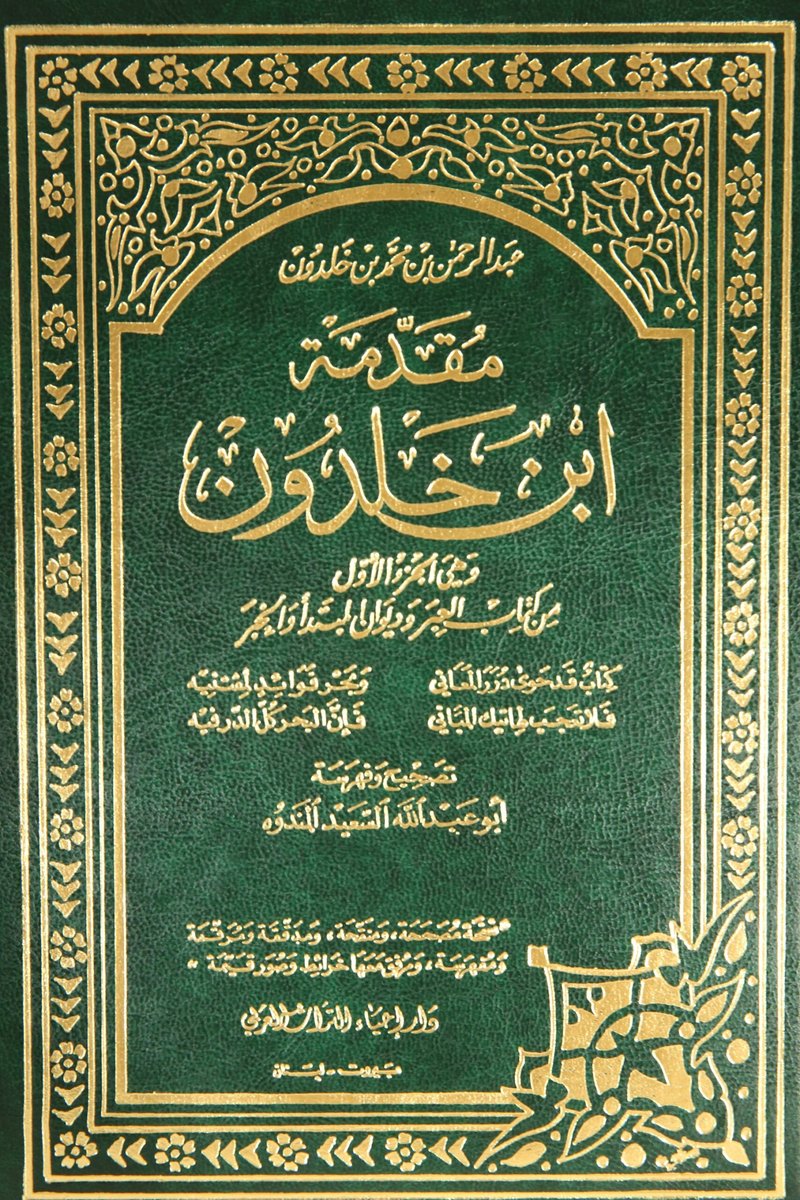
Why Read This
Ibn Khaldun built the science of civilization in the 14th century: the theory of asabiyyah (social solidarity), dynastic cycles, the Laffer Curve avant la lettre, labor theory of value, centuries before modern sociology existed.
The Muqaddimah is an attempt to build a new science about human civilization ('ilm al-'umran, the science of social organization), reaching far beyond a historical chronicle. Ibn Khaldun searched for universal laws governing the rise and fall of civilizations, going far beyond the chronicling of events. Why do great dynasties collapse within a few generations? What enables nomadic peoples to conquer advanced cities? How are economics, culture, and politics interconnected in shaping societies?
What makes the Muqaddimah extraordinary is Ibn Khaldun's empirical method, field observation, causal analysis, rejection of myths without evidence. This is the scientific method avant la lettre, centuries before Francis Bacon. Even more remarkable, many of his theories anticipate modern economics: labor theory of value, supply-demand, Laffer Curve, comparative advantage.
Reading the Muqaddimah today is like discovering an intellectual treasure hidden for centuries. Ibn Khaldun is a bridge between the classical and modern worlds, between Arab-Islamic philosophy and Western sociology. This book is essential for anyone wanting to understand how civilizations work, why they rise, why they fall, and what we can learn from patterns that repeat throughout history.
Key Points
-
Asabiyyah is the foundation of power - Group solidarity is more important than resources. Muslim Arabs conquered Persia and Byzantium despite being fewer and poorer because their asabiyyah was extremely high. Mongols conquered nearly all of Asia through strong tribal solidarity. Nomadic peoples with strong asabiyyah always defeat city-dwellers with weak asabiyyah.
-
Dynastic cycles take three to four generations - The first generation conquers through strong asabiyyah. The second generation consolidates power. The third generation reaches peak luxury. The fourth generation weakens due to loss of asabiyyah. The fifth generation collapses, conquered by a new group with strong asabiyyah. This pattern repeats throughout history in 120-150 year cycles.
-
Luxury weakens subsequent generations - People accustomed to soft beds cannot sleep on hard ground. People used to fine food cannot eat dry bread. Dependence on luxury is a structural weakness that makes dynasties vulnerable when crisis comes. Hard times create strong men, strong men create good times, good times create weak men, weak men create hard times.
-
Low taxes generate higher state revenue - At the dynasty's beginning, taxes are low but revenue is high because the economy grows rapidly. At the dynasty's end, taxes are high but revenue is low because the economy dies. There's an optimal taxation point where state revenue is maximized, below it yields less, above it also yields less. Arthur Laffer formulated the same principle 600 years later.
-
Labor is the true source of all economic value - Gold, silver, land have no value without the labor that processes them. Value comes from work that transforms raw materials into something useful. Division of labor and specialization create the surplus that enables civilization to flourish. Adam Smith and Karl Marx arrived at this insight 400-500 years after Ibn Khaldun.
-
Economic surplus is the foundation of civilization - Without surplus, there's no specialization. Without specialization, there are no cities. Without cities, there's no art, science, or philosophy. Islamic civilization at its peak (8th-13th centuries) excelled because the large economic surplus from Baghdad, Cairo, and Cordoba could support thousands of scholars. After the Mongol invasions and Black Death destroyed the economy, intellectual life collapsed.
-
Geography is a starting point that shapes destiny - Differences between nations originate from structural inequalities tied to geography, far removed from any claim of inherent racial inferiority. Nations in temperate climates have easier access to surplus. With modern technology (irrigation, transportation), extreme climates can be overcome, though geographic advantages still provide a significant head start.
Asabiyyah: Solidarity as the Foundation of Power
Asabiyyah (العصبية) is Ibn Khaldun's most famous concept. It is group solidarity, the emotional, social, even biological bonds that make group members feel that the group's honor is personal honor. Asabiyyah is not mere loyalty. It is a collective force that enables a small nomadic group to defeat a larger and wealthier city army.
Ibn Khaldun observed a recurring pattern in history: small groups with strong asabiyyah always defeat large groups with weak asabiyyah. Muslim Arabs conquered Persia and Byzantium despite being fewer and poorer, because their asabiyyah was extremely high. Mongols conquered nearly all of Asia through strong tribal solidarity. The Almoravid dynasty from the Sahara desert conquered the wealthy and cultured Andalusia, because nomadic asabiyyah was stronger than the already weakened asabiyyah of city-dwellers.
Why Nomads Are Stronger
Asabiyyah is strongest among nomadic peoples (badawa) because harsh living conditions force them to depend on each other for survival. In the desert, without the group, the individual dies. In the city (hadara), individuals can live independently without needing the group, solidarity weakens.
This is the paradox of civilization: poor and rough nomadic peoples can conquer wealthy and civilized city-dwellers because cohesion is more important than resources. A solid army of 10,000 soldiers can defeat a divided army of 50,000. The decisive question is whether each soldier believes the soldier beside them will fight to the death for them, while technology and strategy play a smaller role.
Modern Relevance
Ibn Khaldun's asabiyyah theory anticipates 20th-century social capital theory. Robert Putnam in Bowling Alone shows that declining civic engagement in America weakens social cohesion, exactly as Ibn Khaldun predicted about urban civilizations.
In modern contexts, startups with solid teams can defeat large bureaucratic corporations. Nations with strong national identity are more stable than wealthy nations fractured by ethnicity. Social movements with strong solidarity can overthrow regimes, the Arab Spring is an example.
In our hyper-individualistic modern era, we're losing asabiyyah. We're taught to "be yourself," "chase your own dreams," "you don't need anyone." Ibn Khaldun reminds us: without solidarity, there is no power. The completely individualistic human is a weak human.
Key insight: The paradox that's difficult to solve is how to maintain solidarity after success. Almost all organizations experience the same cycle, high solidarity at the start, weakening after success. This question remains open today.
Dynastic Cycles: Five Generations to Destruction
Ibn Khaldun formulated a predictable theory of dynastic cycles. Every dynasty experiences five phases: (1) Conquest through strong asabiyyah, (2) Consolidation of power under one leader, (3) Peak of luxury and culture, (4) Satisfaction and conservatism, (5) Waste and destruction. This process takes three to four generations, approximately 120-150 years.
Generational Dynamics
The first generation lives hard in the desert, accustomed to difficulty, possesses strong asabiyyah, they can conquer. The second generation is born in the desert but matures in the city, still has memories of hardship, asabiyyah is still strong enough. The third generation is born and raised in palaces, never knows hardship, begins forgetting that power comes from asabiyyah, asabiyyah weakens.
The fourth and fifth generations are completely alienated from nomadic roots, live in extreme luxury, asabiyyah is nearly gone, vulnerable to conquest by a new group with strong asabiyyah.
Luxury as Structural Weakness
The mechanism of asabiyyah weakening is luxury (taraf). After winning, the dynasty accumulates great wealth, wealth is used for comfortable living, comfort makes the new generation physically and mentally weak.
People accustomed to soft beds cannot sleep on hard ground. People used to fine food cannot eat dry bread. Dependence on luxury is a weakness, when luxury disappears, they cannot survive.
Patterns in Business and Family
This theory anticipates Arnold Toynbee's challenge and response: civilizations grow from challenges, collapse when challenges no longer exist. Joseph Tainter's diminishing returns on complexity: civilizations collapse when the costs of complexity exceed its benefits. Peter Turchin's cliodynamics: history follows predictable mathematical patterns. Ibn Khaldun did this 600 years earlier.
In business, the same pattern appears: "shirtsleeves to shirtsleeves in three generations." The first generation builds wealth, the second maintains it, the third spends it. Statistics show 70% of family businesses fail in the second generation, 90% fail in the third.
A popular modern quote perfectly summarizes Ibn Khaldun's theory: "Hard times create strong men. Strong men create good times. Good times create weak men. Weak men create hard times."
Key insight: The big question is whether the West is in the luxury-weakening phase? Are "hungry" nations like China in the strong badawa phase? Or has technology and modern institutions changed the game so this cycle no longer applies? We don't know the answer yet, but Ibn Khaldun's framework provides a lens for analysis.
Badawa and Hadara: The Inevitable Transition
Ibn Khaldun distinguishes two modes of life: badawa (nomadic) and hadara (urban). Badawa live in deserts or steppes, economy based on pastoralism, high mobility, very strong asabiyyah, but poor culture. Hadara live in cities, economy based on trade and crafts, weak asabiyyah, but rich culture and technology.
The Paradox of Civilization
The paradox of civilization is that nomadic peoples with high asabiyyah can conquer cities, but after controlling the city, they begin living in luxury, asabiyyah weakens. Within a few generations, they become like the city-dwellers they conquered, then a new nomadic wave arrives, the cycle repeats.
The transition from badawa to hadara is nearly unavoidable. After conquering vast territories, dynasties must administer, they need cities as control centers. Wealth from taxes and war spoils is used to build palaces, mosques, infrastructure, all of which can only be obtained in cities. The new generation born after victory never experiences badawa hardship; city life is normal to them.
Frontier Thesis Avant la Lettre
Frederick Jackson Turner's frontier thesis (1893) argued that the "frontier spirit" made America strong, when the frontier closed, there was risk of decline. This is exactly Ibn Khaldun's theory 500 years earlier. The frontier is badawa (harsh, independent, brave), the eastern cities are hadara (luxurious, dependent, soft).
In modern global politics: is the West in the hadara phase (luxurious, weak)? Modern generations grew up in unprecedented prosperity, they never experienced major war or famine. The "resilient" mentality is declining, anxiety and depression are increasing despite the best material conditions in history. System dependence is high, most people couldn't survive a week without supermarkets, electricity, or internet.
Startup vs Corporation
In business: startups are badawa (hungry, agile, willing to take risks), large corporations are hadara (bureaucratic, risk-averse, comfortable). This is why startups often overthrow large corporations, they have stronger asabiyyah.
Key insight: The open question is whether modern technology (global communication, digital economy) can break this cycle? Or accelerate it? So far, the same pattern is still visible at all scales, from nations to companies, from cultures to social movements.
Economics and Taxation: The 14th-Century Laffer Curve
Ibn Khaldun observed a paradoxical economic pattern in dynasties: at the dynasty's beginning, taxes are low but state revenue is high. At the dynasty's end, taxes are high but state revenue is low, and this accelerates destruction.
Incentive Mechanism
The mechanism is clear: low taxes provide high economic incentives. Farmers know that if they work hard and harvest well, most of the yield is theirs, so they're motivated. The economy grows rapidly, total state revenue is large despite low tax rates.
High taxes kill incentives, "why work hard if almost everything is taken by taxes?" Productivity collapses: farmers stop cultivating land, merchants stop trading, artisans close businesses. The economy shrinks, total state revenue falls despite very high tax rates.
Negative Spiral
Greedy governments raise taxes to cover deficits, but this only worsens the problem. The economy becomes more sluggish, revenue falls further, the government raises taxes again, a negative spiral until the economy collapses completely.
Ibn Khaldun formulated a principle that 600 years later was called the Laffer Curve: there's an optimal taxation point where state revenue is maximized. Below it revenue is less, above it revenue is also less because the economy dies.
Relevance to Supply-Side Economics
Arthur Laffer (1974) drew a curve showing the relationship between tax rates and state revenue, becoming the basis for supply-side economics in the Reagan and Thatcher eras. Ibn Khaldun explained the same principle 600 years earlier, with richer explanation of socio-economic mechanisms.
Modern economics shows that incentives are key to growth. High taxes reduce incentives, this is consensus among economists. What's interesting: what matters is how taxes are used, well beyond the simple question of high or low. Scandinavian countries have high taxes (50-60%) but high per capita income, because taxes are used for productive investment (education, health, infrastructure) that increases productivity, while elite luxury is kept aside.
Developing countries with high taxes plus corruption are exactly like late dynasties in Ibn Khaldun's theory: high taxes but corrupted, the economy doesn't grow, negative spiral. Venezuela, Zimbabwe, modern examples of Ibn Khaldun's theory about excessive taxation killing the economy.
Labor as the Source of Value
Ibn Khaldun argued that labor (al-'amal) is the true source of all economic value. Gold, silver, land, all are worthless without the labor that processes them. Fertile land without farmers is just land. Raw gold without a goldsmith is just yellow rock. Value comes from work that transforms raw materials into something useful.
Differences in Labor Value
Ibn Khaldun distinguishes two types of labor: simple (doesn't require special skills, easily replaceable, low wages) and skilled (requires years of training, hard to replace, high wages). The value difference rises from scarcity, well beyond any claim that one is "better" as a human. Doctors are paid highly because doctors are scarce and laborers are abundant, set apart from any judgment about human nobility.
Division of Labor and Surplus
Division of labor and specialization create surplus. A human alone can hardly survive, must find food, make clothing, build shelter, make tools. A hundred people with division of labor can live abundantly: 50 become farmers, 20 become weavers, 10 become carpenters, 10 become blacksmiths. Each person specializes in one field, becomes highly productive, produces surplus exchanged in the market.
Anticipating Adam Smith and Karl Marx
Adam Smith (1776) and Karl Marx (1867) developed the labor theory of value, Ibn Khaldun arrived at this insight 400-500 years earlier, without Marx's political agenda. David Ricardo (1817) formulated comparative advantage, Ibn Khaldun explained the same principle: trade benefits all parties because specialization increases total productivity.
Ibn Khaldun's theory explains why countries focused on specialization (Taiwan for chips, Germany for cars) are wealthier than countries trying to produce everything themselves.
Key insight: In the era of AI and automation, this theory needs updating: if robots can do all physical work, where does value come from? Perhaps creativity, empathy, wisdom, things that can only come from humans. The essence remains the same: value comes from what we contribute, with ownership playing only a supporting role.
Knowledge: Transmitted vs Rational Sciences
Ibn Khaldun distinguishes two types of knowledge: 'ulum naqliyyah (transmitted sciences) sourced from revelation and tradition, and 'ulum 'aqliyyah (rational sciences) obtained through reason and observation of nature.
Transmitted sciences regulate morals and relationship with God (tafsir, hadith, fiqh, kalam). Rational sciences regulate understanding of nature and society (mathematics, logic, physics, medicine, philosophy).
Different Domains
Both are important and don't conflict as long as each doesn't exceed its domain. The Quran was not revealed to teach astronomy or medicine, that's not its purpose. The Quran teaches morals and relationship with God. To understand nature, God gave us reason, and we must use it.
Economic Surplus and Intellectual Life
Ibn Khaldun observed that Islamic civilization at its peak (8th-13th centuries) excelled in both types of knowledge. Large economic surplus from Baghdad, Cairo, and Cordoba could support thousands of scholars. Intellectual tolerance, open debate was permitted. Patronage from caliphs and sultans built libraries and observatories.
After the 13th century, decline: Mongol invasions and the Black Death destroyed the economy, there was no longer surplus to support scholars who weren't immediately productive. Theoretical sciences were abandoned, only practical sciences survived.
Relevance to Science-Religion Debate
Ibn Khaldun shows that intellectual life requires material surplus, this remains valid today. Wealthy nations can support more basic research that isn't immediately profitable. Poor nations tend to focus on applied research that's directly productive.
In the modern West, there's a perceived conflict between religion and science. Ibn Khaldun's view: conflict only occurs if each exceeds its domain. Religion shouldn't regulate science, science shouldn't regulate morals.
Key insight: In the future, we need to return to Ibn Khaldun's balance: excellence in STEM for material progress, excellence in humanities for wisdom and moral guidance. Civilizations with only one without the other will be crippled.
Geography and Climate: Environmental Determinism
Ibn Khaldun observed that geography and climate are not mere historical background, both are active factors shaping the character of nations and the types of civilization that emerge. He divided the earth into seven climates based on latitude.
Temperate vs Extreme Climates
Temperate climates (middle zones) are most conducive to civilization development, high agricultural productivity, good health, energy not drained for survival. Extreme climates (too hot or cold) limit productivity and intellectual development.
Differences between nations originate from structural inequalities tied to geography, far removed from any claim of inherent racial inferiority. Nations in temperate climates carry geographic advantages, with genetics playing no role. Economic surplus is the foundation of civilization, without surplus, everyone is busy finding food, no time for art, science, or philosophy.
Anticipating Jared Diamond
Ibn Khaldun's theory anticipates Jared Diamond's Guns, Germs, and Steel: differences in power between civilizations begin with a geographic lottery, who happens to be born on fertile land, near trade routes. Skin color is adaptation to sunlight, with no bearing on human value.
Ibn Khaldun rejects overly rigid determinism, with technology (irrigation, greenhouses, modern transportation), extreme climates can be overcome. But geographic advantages still provide a significant head start.
Key insight: What remains relevant is that cultural differences often root in material differences, well beyond cliches about "hard-working culture" or "lazy culture." Environmental explanation carries the day, supported by modern science, while genetic explanation falls short. Civilization is a product of opportunity and environment, far removed from any claim of inherent superiority.
Integration: Surplus as the Foundation of Civilization
All of Ibn Khaldun's theories are rooted in one principle: economic surplus is the foundation of civilization. Without surplus, there's no specialization. Without specialization, there are no cities. Without cities, there's no art, science, or philosophy.
Asabiyyah is the social mechanism that enables groups to create surplus (through conquest or trade). Dynastic cycles are the process by which that surplus is produced, accumulated, then consumed. The badawa-hadara transition is the journey from survival mode (all energy for eating) to civilization mode (time to think).
Connection to Mental Models
Taxation and labor explain the economic mechanisms behind surplus. Knowledge (both transmitted and rational) is a product of surplus, only prosperous societies can support thousands of scholars. Geography determines who has easier access to surplus, but it's not destiny, just a starting point.
Ibn Khaldun sees civilization as a complex system (systems thinking) where economics, politics, culture, and geography interact with each other. Luxury seems positive (reward for success), but its second-order effect is negative (weakens asabiyyah, makes the new generation weak).
Low taxes provide incentives to be productive. High taxes kill incentives. Nations accustomed to hardship (badawa) are more antifragile, they grow strong from pressure. Nations too comfortable (hadara) are fragile, they collapse when pressure comes.
Cyclical Patterns
History moves in cycles, far from any straight line of linear progress. Rise and fall, construction and destruction, badawa and hadara. These cycles are driven by predictable mechanisms: asabiyyah rises → conquest → surplus → luxury → asabiyyah falls → conquered → cycle repeats.
No dynasty, company, or civilization can avoid this cycle forever. The big question is whether we can slow the cycle or even break it, or whether this is a social law of nature that cannot be opposed.
Practical Implications
For Business
Maintain asabiyyah in your team, solidarity is the most valuable asset. Beware of "luxury" after success, don't let the team become complacent. Excessive taxation (regulatory burden) kills productivity, fight for a low-friction environment. Specialization is key to efficiency, but don't over-specialize until you lose the big picture.
For Personal Life
Build asabiyyah in family and community, solidarity is the best safety net. Don't get too comfortable, seek discomfort to maintain mental resilience. Focus on scarce skills (skilled labor), not those anyone can replace. Understand that surplus (time, energy, money) is what enables us to pursue meaningful things, without surplus, we're stuck in survival mode.
For Decision-Making
Verify claims with empirical evidence, don't accept stories at face value (Ibn Khaldun's principle in historian critique). Understand context and material conditions before judging cultural differences. Be wary of cycles, if an organization or nation is already in the luxury phase, prepare for the decline phase. Investment in intellectual capital requires surplus, prioritize creating surplus first before pursuing long-term projects.
Critical Assessment
Strengths
1. Revolutionary Empirical Method
Ibn Khaldun used field observation, causal analysis, and rejection of myths without evidence, this is the scientific method avant la lettre, centuries before Francis Bacon. He didn't just theorize, he observed actual patterns in history and sought universal laws explaining those patterns.
2. Theories Anticipating Modern Economics
Labor theory of value, Laffer Curve, comparative advantage, supply-demand, economic incentives, all explained by Ibn Khaldun 400-600 years before modern economists. This is genuine insight that endures across time, well beyond coincidence or post-hoc rationalization.
3. Framework Applicable Across Scales
Ibn Khaldun's theories work at the level of nations, companies, families, even social movements. The same cycles appear at all scales, from medieval Islamic dynasties to Silicon Valley startups today. This is a sign of a robust theory.
Limitations
1. Overly Strong Determinism
Ibn Khaldun is sometimes too deterministic, as if dynastic cycles are unavoidable. In reality, there are many variables that can slow or even break the cycle. Democratic institutions, rule of law, meritocracy, all of these can reduce the impact of luxury on subsequent generations.
2. Bias Toward Islamic Civilization
Though Ibn Khaldun tried to be objective, his analysis remains centered on the Islamic world and its surroundings. He didn't analyze China, India, or Mesoamerican civilizations, yet they have different patterns. Over-generalization from a limited sample is a methodological risk.
3. Ignoring Technology as a Game Changer
Ibn Khaldun lived before the industrial revolution, before exponential technology changed fundamental economics. With automation and AI, does the labor theory of value still apply? With global communication and digital economy, do dynastic cycles still apply? These questions require updating the theory.
Conclusion
Ibn Khaldun built a science of civilization that is empirical, systematic, and verifiable. He identified social laws operating across time and place: asabiyyah as the foundation of power, predictable dynastic cycles, the inevitable badawa-hadara transition, taxation as a double-edged sword, labor as the source of value, geography as a determinant factor but not destiny. All of this is rooted in one principle: economic surplus is the foundation of civilization.
What makes the Muqaddimah timeless is its relevance across ages. Asabiyyah theory explains why solid startups can beat large corporations. Dynastic cycles explain "shirtsleeves to shirtsleeves in three generations." The badawa-hadara transition explains why frontier spirit disappears after the frontier closes. The Laffer Curve explains why excessive taxation kills the economy. Labor theory of value is still debated today.
Ibn Khaldun is a bridge between the classical and modern worlds. He used empirical methods before the scientific method was formulated. He formulated economic theory before Adam Smith. He built sociology before Auguste Comte. He conducted cyclical historical analysis before Toynbee and Turchin.
Reading the Muqaddimah today is discovering that the big questions about civilization, why nations rise, why they fall, what makes societies cohesive, how economies work, were already brilliantly answered 700 years ago.
Most importantly: Ibn Khaldun teaches us not to accept narratives at face value. Verify with reason and empirical evidence. Understand the mechanisms behind events. See patterns that repeat. Don't be surprised when the decline phase comes, because cycles are a social law of nature. And don't be too arrogant in the rise phase, because luxury is the beginning of destruction.
Rating: 5/5 - An intellectual masterpiece that must be read by anyone serious about understanding how civilizations work. Relevant for historians, economists, sociologists, entrepreneurs, policymakers, and anyone wanting to understand the patterns behind the rise and fall of nations and organizations.
FAQ
Q: Do Ibn Khaldun's dynastic cycles still apply in the modern era?
A: Yes, the same pattern appears in family businesses (70% fail in the second generation), startups that become complacent after success, even nations that lose "hunger" after prosperity. Modern technology and institutions might slow the cycle, but haven't fully broken it.
Q: How can we maintain asabiyyah after success?
A: This is a paradox not yet fully solved. Some strategies: keep a shared mission larger than profit, rotate teams out of comfort zones, hire hungry people, avoid excessive luxury that makes you complacent. But it's difficult, almost all organizations eventually lose asabiyyah.
Q: Does Ibn Khaldun's theory about taxes mean taxes should always be low?
A: It's not that simple. Ibn Khaldun talks about optimal taxation, there's a sweet spot where state revenue is maximized. The deeper issue is how taxes are used, well beyond the tax rate alone. High taxes invested productively (education, infrastructure) can be sustainable. High taxes that are corrupted or for elite luxury will kill the economy.
Q: Is the labor theory of value still relevant in the era of AI and automation?
A: The theory needs updating. If robots can do all physical work, value might come from creativity, empathy, wisdom, things that can only come from humans. The essence remains the same: value comes from what we contribute (even if that contribution changes form), with ownership playing only a supporting role.
Q: Why did Islamic civilization experience scientific decline after the 13th century?
A: According to Ibn Khaldun: Mongol invasions and the Black Death destroyed the economy, there was no longer surplus to support research that wasn't immediately productive. Additional modern factors: closing of the gates of ijtihad (religious dogmatism), prolonged political instability, European colonialism. A combination of economic, political, and cultural factors.
Q: Do differences between nations stem from culture or geography?
A: Ibn Khaldun: more from geography than inherent culture. Nations in temperate climates have easier access to surplus, not because they're "more diligent." With modern technology, extreme climates can be overcome, but geographic advantages still provide a head start. This is an environmental explanation, not genetic or cultural superiority.
Q: How long does a dynastic cycle typically last according to Ibn Khaldun?
A: Three to four generations, approximately 120-150 years. The first generation conquers, the second consolidates, the third reaches peak luxury, the fourth and fifth collapse. This pattern is seen in Islamic dynasties (Umayyad, Abbasid, Fatimid) and continues into modern times (wealthy families, family businesses).
Q: Did Ibn Khaldun believe religion and science are in conflict?
A: No. Ibn Khaldun distinguished domains: transmitted sciences (morals, relationship with God) and rational sciences (understanding nature). Both are important and don't conflict as long as each doesn't exceed its domain. Conflict occurs if religion tries to regulate science or science tries to regulate morals.
Q: What is Ibn Khaldun's greatest contribution to modern thought?
A: Empirical method in social sciences, asabiyyah theory (social capital), dynastic cycles (rise and fall of civilizations), Laffer Curve (optimal taxation), labor theory of value, and the understanding that history follows predictable patterns. He is the founding father of sociology, Islamic economics, and philosophy of history, 600 years before these disciplines formally existed.
Q: Is the Muqaddimah difficult to read?
A: It depends on the edition and translation. Franz Rosenthal's edition (Princeton) is the most comprehensive but academic. Abridged editions are more accessible for general readers. The 14th-century context and references to Arab-Islamic historical events require background knowledge, but the core ideas can be understood without being an expert in Islamic history.