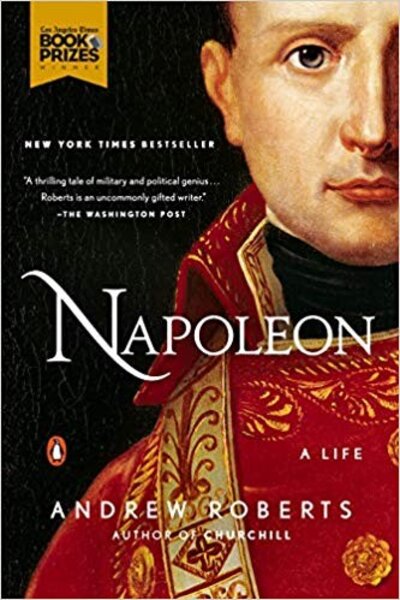
Napoleon: A Life - The Definitive Biography of the Emperor Who Changed Europe
Why Read This
Andrew Roberts' comprehensive biography of Napoleon Bonaparte draws on 33,000 original letters to reveal the complex figure behind the myth: from a poor Corsican child to the French Emperor who built institutions that have endured for 200 years.
This book is essential because Roberts had access to 33,000 of Napoleon's original letters newly published by the Fondation Napoléon since 2004, primary sources that reveal a figure far more nuanced than popular mythology suggests. Roberts successfully separates Napoleon from Hitler's shadow, which has unfairly distorted his reputation since 1940. He also dismantles fraudulent memoirs written by ghostwriters serving the Bourbon regime's political interests.
What makes Napoleon relevant today is not his military victories. He won 53 out of 60 battles. All those victories vanished. What endures are institutions: the Napoleonic Code became the legal foundation in 40 countries, his educational system still operates, the Légion d'Honneur remains prestigious more than two centuries later. The true legacy lies in institutions that transformed the daily lives of millions, far beyond any battlefield victory.
This book is for anyone who wants to understand transformative leadership, strategies for building enduring institutions, and the limits of human ambition. Roberts presents a humane Napoleon: a leader with a sharp sense of humor, an extraordinary ability to compartmentalize his mind, and obsessive micromanagement that transformed Europe while remembering the name of a deputy's child he met ten years earlier.
Key Insights
-
Institutions Outlast Conquests - Napoleon won 53 of 60 battles; all victories lost. His legal code is still used by 40 countries, his education system still stands, the Légion d'Honneur is still valued 200+ years later. The true legacy lies in institutions that transformed millions of lives.
-
Crisis Creates Opportunity for the Bold - The French Revolution destroyed the old military hierarchy. Thousands of aristocratic officers fled. Napoleon, a poor child without connections, saw opportunity. He rose from second lieutenant to brigadier general in 6 years. When the old order collapses, real achievement finally becomes more valuable than birth.
-
Speed Defeats Size - Napoleon mastered the observe-decide-execute cycle with unmatched speed. The strategy of central position allowed him to strike divided enemies one by one before they could unite. At Austerlitz, he defeated larger combined Austro-Russian forces by concentrating strength at the decisive point.
-
Meritocracy Must Be Renewed Each Generation - Napoleon created a new nobility system: 59% military, 22% civil servants, 17% notable figures. Titles had to be renewed each generation with real achievement. If the next generation did nothing worthy, the title was lost. This is equality before the law, distinct from equality of outcome.
-
Small Details and Grand Vision Are Not Contradictions - Napoleon could plan a battle in the morning and write regulations for girls' schools in the afternoon. His attention to detail was meticulous: ration prices, fence construction, exact amounts of gunpowder. Obsessive micromanagement did not hinder radical transformation. Detail is what makes vision reality.
-
Unlimited Ambition Destroys Itself - After Tilsit in 1807, Napoleon controlled almost all of continental Europe. He could have consolidated power and enjoyed peace. Instead, he kept expanding: Spain, Russia, total destruction. The inability to know when to stop turned Europe's most powerful ruler into a prisoner on a remote island.
-
Small Mistakes Accumulate Into Great Disasters - Waterloo: five hours of delay, decisions half an hour too late, troops in the wrong place. Each small by itself. Together they turned near-certain victory into decisive defeat. Fatigue erodes the ability to make sharp decisions. No brilliant strategy defeats an exhausted mind.
From Poor Corsican Child to Emperor of Europe
Napoleon Bonaparte was born on August 15, 1769, in Ajaccio, Corsica, only 15 months after France purchased the island from Genoa. The Bonaparte family was minor Italian-Corsican nobility, far from wealthy. His father Carlo was a clever yet profligate lawyer. His mother Letizia was a strong woman with extraordinary practical acumen. Napoleon always said he owed everything to his mother.
Napoleon's childhood was shaped by profound identity tension. Corsica had just lost its independence after Pasquale Paoli's heroic resistance. Carlo switched from independence fighter to French collaborator for the family's survival. This pragmatic decision opened the path for Napoleon to receive a military education scholarship.
At age nine, Napoleon left Corsica for the École Militaire at Brienne. He would not see his native island again for nearly eight years. At military school, he was endlessly mocked for his thick Corsican accent, relative poverty, and nationalist pride. Instead of playing with peers, he spent time reading ancient history: Alexander the Great, Julius Caesar, Hannibal. These books planted a deep conviction that he could stand equal to history's greatest figures.
Split Identity Creates Extraordinary Ambition
Napoleon was neither fully Corsican nor fully French. He was an outsider who saw the world more sharply because he was not bound by old traditions. This sense of alienation gave him unique perspective and freedom to reimagine everything. The mockery he received in youth did not destroy him. It became fuel for ambition that drove him to prove he was greater than all insults heaped upon him.
The French Revolution: Opportunity in Chaos
The French Revolution erupted on July 14, 1789. For Napoleon, this was a hidden blessing. As a young man from minor nobility without money or connections, he previously had no path to rise in France's rigid military hierarchy. The Revolution changed the game. Thousands of aristocratic officers fled or were executed. Vacancies appeared everywhere.
Napoleon saw this pattern clearly: amid chaos, real ability is more valuable than family name. When his peers from the École Militaire flocked to oppose Louis XVI's overthrow, Napoleon joined the local Jacobin club instead. This choice was risky. It was also highly strategic.
Toulon: Birth of a General
The climax came at Toulon in 1793. This strategic Mediterranean port fell to rebels who invited British forces. Napoleon, only 24, was appointed to command artillery. He sent dozens of letters demanding cannons, gunpowder, horses, sandbags. He lobbied directly to the Committee of Public Safety, bypassing his superiors. The result was a powerful artillery train, assembled in record time.
Napoleon's strategy for Toulon was simple and brilliant: seize L'Eguillette, the high promontory dominating the harbor. In the early hours of December 17, amid heavy rain and lightning, Napoleon led the assault. His horse was shot. He was stabbed in the thigh with a pike. The fort fell. Napoleon immediately poured hot cannonballs into Royal Navy ships. The Allies evacuated Toulon the next day.
On December 22, Napoleon was promoted to brigadier general at age 24. He had spent five and a half years as a second lieutenant, one year as a lieutenant, sixteen months as a captain, only three months as a major, and none at all as a colonel. The Revolution created unprecedented promotion velocity.
The Italian Campaign: Birth of a Legend
When Napoleon arrived in Nice on March 26, 1796, to command the Army of Italy, he faced skepticism from five divisional commanders all far more experienced. Sérurier had 34 years of military experience. Augereau was a rough mercenary who had killed three men in duels. Masséna was a former smuggler who rose through battlefields. They viewed this thin 26-year-old general with suspicion.
What changed everything was the energy Napoleon radiated, his obsessive desire for information, and his clear plan, far beyond what any rank or formal authority could grant him. In the first meeting, he showed maps, explained three valleys that could carry them to the Lombardy plains, and laid out concrete strategy to separate Austria from Piedmont.
Strategy of Central Position
Napoleon faced 60,000 Austrian and Piedmontese troops with only 40,000 starving French soldiers. Conventional strategy would suggest retreat or reinforcements. Napoleon chose another path: position himself between two enemies and attack one by one before they could unite.
This became known as the strategy of central position. At Montenotte, he tied down Austria in front while sending Masséna to envelop their right wing in heavy rain at 1 a.m. Austria lost 2,500 men. France lost 800. In three days, three victories. In three weeks, Piedmont requested armistice.
The Battle of Lodi Bridge on May 10, 1796, became central to Napoleon's legend. A wooden bridge 200 yards long and 10 yards wide was defended by Austrian artillery with grapeshot. Napoleon placed 30 cannons, then sent 3,500 men in a nearly suicidal charge. With extraordinary courage, the bridge was taken. From the Battle of Lodi, his men gave him the nickname "le petit caporal" (the little corporal).
Napoleon later said: "I no longer considered myself a simple general, but a man called to decide the fate of nations. At that moment was born the first spark of high ambition."
Egypt and Acre: The Limits of Ambition
After brilliant victories in Italy, Napoleon was tasked with leading the invasion of Egypt in 1798. The objectives were ambitious: disrupt British trade, open Asian markets for France, and build a base to attack India. He brought 38,000 troops, 13,000 sailors, and 167 scientists to make this more than mere military conquest.
The reality in Egypt was far from romantic. The army hated the desert with its torturous heat, throat-tearing thirst, and no wine or beautiful women like in Italy. The Mamluks were easily defeated at the Battle of the Pyramids through solid square formations. Napoleon entered Cairo and immediately began reforms: postal system, street lighting, Egypt's first printed books.
Disaster came in August 1798 when Admiral Nelson destroyed the French fleet at Aboukir Bay. Napoleon was trapped in Egypt. Rebellion erupted in Cairo in October. Napoleon crushed the rebellion with terrible brutality: thousands of executions, heads dumped into the Nile, bodies piled in squares.
Failure at Acre
The Syrian campaign in 1799 ended with failure at Acre. Despite winning the Battle of Mount Tabor against far larger Ottoman forces, the nine-week siege of Acre failed. British Commodore Sidney Smith and military engineer Phélippeaux successfully defended the city. Having lost heavy weaponry seized by the British fleet, Napoleon finally lifted the siege.
Most controversial was the Jaffa massacre, where 2,000 to 3,500 prisoners of war who violated capitulation terms were taken to the beach and slaughtered in cold blood. Napoleon justified this with harsh war logic: they were "devils too dangerous to release a second time."
In August 1799, after crushing the second Ottoman invasion at Aboukir, Napoleon quickly left Egypt and sailed back to France, leaving Kléber to command the stranded forces.
Grand ambition unsupported by resources is fantasy in military uniform. Napoleon dreamed of conquering Asia with 13,000 troops. Logistical reality always defeats grandiose imagination.
The Coup of Brumaire: Seizing Power
Napoleon returned to Paris in October 1799 as a hero. France was in critical condition: the Directory failed to manage the economy, wars raged on multiple fronts, and inflation ran rampant. The existing government was so weak that a coup became inevitable.
Napoleon joined a conspiracy led by Abbé Sieyès to overthrow the Directory. The coup known as 18 Brumaire proceeded in two stages: first, moving the legislative session to Saint-Cloud under security pretenses; second, dissolving the legislature and forming a new government called the Consulate consisting of three members.
This seemingly neat plan nearly failed when assembly members fiercely resisted Napoleon's presence and almost declared him an outlaw. Napoleon, brave on the battlefield, turned nervous and awkward when facing angry politicians in the chamber. Some deputies descended from their seats and began pushing, shaking, even slapping Napoleon.
What saved the coup was his brother Lucien, who jumped on a horse, drew his sword, pointed the tip at Napoleon's chest, and shouted: "I swear that I will stab my own brother to the heart if he ever attempts anything against the liberty of the French people." This promise was as insincere as it was theatrical. It worked.
Murat then led troops to storm the chamber and empty the Orangery. Surprisingly, there was no resistance whatsoever from the Paris populace. The Directory fell without a single barricade built or bullet fired in its defense.
Power does not wait for formal legitimacy. Power flows to those bold enough to fill it when others hesitate. Institutions are only as strong as the trust people place in them. When that trust is completely lost, even written constitutions cannot save them.
First Consul: Building Foundations That Endure
As First Consul, Napoleon immediately demonstrated his administrative genius. He created the Bank of France to stabilize currency. He formed the Conseil d'État, which still meets every Wednesday to this day to review legislation. He established the prefect system that governed departments with extraordinary efficiency.
The Napoleonic Code: A 200-Year Legal Legacy
Most monumental was the Napoleonic Code, completed in 1804. This legal codification abolished feudal privileges, established equality before the law, protected property rights, and ensured religious tolerance. The Napoleonic Code became the legal foundation in 40 countries and is still used today.
Napoleon also created the Légion d'Honneur to replace feudal privileges. This honor was awarded based on merit, not birth. France's best secondary schools, many founded by Napoleon, provided high-quality education. He built bridges, reservoirs, canals, and drainage systems throughout France that are still in use.
Institutions outlast conquests. Napoleon won 53 of 60 battles, all victories now gone. His legal code is used by 40 countries. His education system still stands. The honors he created remain valued. The true legacy lives in institutions that transformed millions of daily lives, far beyond any battlefield triumph.
Emperor: Creating a Dynasty
On December 2, 1804, Napoleon was crowned Emperor at Notre-Dame Cathedral. He took the crown from Pope Pius VII's hands and crowned himself. The symbolism was clear: he owed his throne to no one except his own will and the will of the French people.
Meritocracy Renewed Each Generation
Napoleon created a new nobility system based on merit that had to be renewed each generation. Twenty percent came from the working class. Fifty-eight percent from the middle class. If the next generation did nothing worthy, the title was lost. Of 3,263 nobles he created, 59 percent were military, 22 percent civil servants, and 17 percent notable figures.
This system created the "granite mass" he needed: high military officers, ministers, and state officials at the top; more than 30,000 members of the Légion d'Honneur in the middle; about 100,000 sub-prefects, mayors, education and judicial officials at the base. This was the social foundation of the Empire.
Napoleon understood that the French Revolution contained fundamental contradictions. Liberty, equality, and fraternity are mutually exclusive. A society can be built on two of the three. Never all three simultaneously. He chose to discard equality of outcome and replace it with equality before the law. This new nobility system rewarded merit, with birth no longer counting. Each generation had to prove itself anew.
Military Dominance: Austerlitz to Tilsit
On December 2, 1805, one year after his coronation, Napoleon achieved his most brilliant victory at Austerlitz. Facing larger combined Austrian and Russian forces, he deliberately weakened his right wing to tempt the enemy to attack. When they took the bait, he smashed through their weakened center with the Reserve. The result was a crushing victory that forced Austria out of the war.
Austerlitz proved Napoleon's tactical genius: the ability to read terrain, understand enemy psychology, and execute complex plans with perfect timing. He called Austerlitz his "finest battle."
Victory at Jena-Auerstedt in 1806 destroyed Prussia within weeks. Victory at Friedland in 1807 forced Tsar Alexander to negotiate. The resulting Treaty of Tilsit gave Napoleon dominance over almost all of continental Europe.
Speed defeats size. An army that can decide faster, move faster, and adapt faster will defeat a larger enemy that moves slowly. Napoleon mastered the observe-decide-execute cycle with speed his enemies could not match.
Spain: The Ulcer That Never Healed
Intervention in Spain began from sound strategic calculation: close Portugal to Britain and secure the southern border. Its execution revealed fatal weaknesses in Napoleon's system.
Spain's dysfunctional royal family provided a seemingly easy opportunity. Napoleon engineered an extraordinary construction where Ferdinand surrendered the crown back to his father Charles IV, who then handed it to Napoleon, who then passed it to his brother Joseph.
The Dos de Mayo uprising in Madrid on May 2, 1808, triggered guerrilla warfare that would drain 300,000 to 400,000 French troops over six years. General Dupont's defeat at Bailén shattered the myth of French invincibility. What Napoleon expected as quick modernization turned into the "Spanish ulcer" that never healed.
Guerrilla Warfare Changes the Strategic Equation
Guerrilla warfare in Spain changed the strategic equation. Trained conventional forces became ineffective when the enemy refused to fight conventionally. Every village became a battlefield. Every supply convoy required hundreds of guards. Spanish and Portuguese guerrillas killed more Frenchmen than combined British, Portuguese, and Spanish regular armies.
The most expensive mistakes often come from previous success. Napoleon applied formulas that worked in Italy and the Netherlands to Spain, without realizing the context was completely different. Spain was still deeply rural, illiterate, economically backward, and ultra-Catholic. The modernization formula that worked elsewhere failed here. Nationalism and religion, when combined, created a force that could not be conquered by military might alone.
Russia 1812: Fatal Hubris
The Russian campaign of 1812 was Napoleon's greatest strategic error. With 600,000 troops, he invaded Russia to force them to comply with the Continental System. Russia's strategy was simple: retreat continuously while burning everything the French could use.
The Battle of Borodino on September 7, 1812, was the bloodiest battle in the Napoleonic Wars. Over 70,000 casualties in a single day. Napoleon won the field but did not destroy the Russian army as he hoped.
Napoleon entered burning Moscow on September 14. He waited for Tsar Alexander to offer peace. The offer never came. On October 19, with winter approaching and supplies exhausted, Napoleon began the terrible retreat. Of 600,000 who crossed the Niemen River in June, fewer than 100,000 returned in fighting condition.
Not every battle must be taken. Attacking on terrain chosen by the enemy, with supply lines too long, against an enemy refusing decisive battle, is taking unnecessary risk. Napoleon violated his own fundamental principles in Russia. The result was a catastrophe that ended his dominance over Europe.
The 1814 Campaign: Genius Without Support
Facing a combined Allied invasion of nearly one million troops with only 70,000 soldiers, Napoleon conducted a brilliant military campaign. In 65 days, he won a series of battles through rapid maneuver and use of interior lines. Wellington himself commented that the 1814 campaign gave him "a greater idea of his genius than any other campaign."
Napoleon's tactical genius could not compensate for a more fundamental fact: the French people were exhausted from war. After 22 consecutive years of conflict, they craved peace even at the price of surrender. No guerrilla movement emerged when enemies invaded. Cities surrendered without resistance.
More painful was betrayal by those closest. Murat joined Austria. Talleyrand formed a provisional government and restored the Bourbons. Marmont surrendered his entire corps to the Allies. When Paris fell on March 30, 1814, it was not from failed defense, but from lost will to fight.
Trust is more fragile than we think. It takes years to build. Only a few bad decisions to destroy completely. Genius without support is a monologue without listeners. Exhaustion is the invisible enemy.
Waterloo: Accumulated Mistakes
Napoleon returned from exile in Elba in March 1815. Within three months, he rebuilt government and rallied troops. All these efforts culminated in a single battle in Belgium on June 18, 1815.
The campaign began brilliantly. Napoleon succeeded in splitting Allied forces and defeating Prussia at Ligny. That victory should have been crushing. Instead, imprecise decisions turned it into wasted opportunity.
Napoleon waited too long on the morning after victory. He sent one-third of his forces to pursue the Prussians instead of concentrating strength. He attacked Wellington on terrain chosen by the enemy. He launched cavalry charges without infantry or artillery support. He hesitated at the crucial moment after La Haie Sainte fell.
When the Imperial Guard retreated at 7 p.m., the cry "La Garde recule!" ("The Guard retreats!") echoed for the first time since 1799. This signaled general disintegration of the French army across the entire front. Napoleon lost. Wellington and Blücher deserved to win. Napoleon richly deserved to lose.
Small mistakes have a way of accumulating into great disasters. Five hours of delay. Decisions half an hour too late. Troops in the wrong place. All appear small individually. Together, they turned near-certain victory into decisive defeat. Fatigue erodes our ability to make sharp decisions. No brilliant strategy can defeat an exhausted mind.
Enduring Leadership Lessons
What Made Napoleon Extraordinary
Napoleon was one of history's most complex leaders. He combined military genius with extraordinary administrative ability. He could plan battles in the morning and write regulations for girls' schools in the afternoon. The ability to separate various life compartments is an attribute required for every great statesman.
His attention to detail was meticulous. Nothing escaped his attention: ration prices, proper fence construction, exact amounts of gunpowder needed. Small details and grand vision are not contradictions. Obsessive micromanagement did not hinder radical transformation. Attention to detail is what makes grand vision reality.
Napoleon also understood human psychology deeply. He knew soldiers fight for identity and pride, with money playing only a supporting role. He gave regiments nicknames: "Les Braves," "Les Incomparables," "Un Contre Dix" (One Against Ten). Every soldier knew he was part of something greater than a number on a roster. Morale is everything.
Fatal Mistakes That Destroyed
Napoleon's greatest mistake was underestimating the power of nationalism and religious sentiment in mobilizing popular resistance. The modernization formula that worked in Italy, Belgium, and the Netherlands failed in Spain and Russia. He did not understand that people defend identity, beliefs, and way of life along with their land.
The second mistake was his inability to know when to stop. After Tilsit in 1807, Napoleon controlled almost all of continental Europe. He could have consolidated power and enjoyed peace. Instead, he kept expanding: Spain, Russia, and ultimately total destruction. Uncontrolled ambition turned Europe's most powerful ruler into a prisoner on a remote island.
The third mistake was a system overly dependent on one person. Napoleon created an efficient government machine, but the machine could not function without him. He did not train his generals to operate effectively without his direct instruction. When he could not be physically present, the system collapsed.
A Legacy That Endures 200 Years
Despite losing in war, Napoleon won in institutions. The Napoleonic Code remains the legal foundation in 40 countries. His education system still stands. The bridges, reservoirs, canals he built are still used. The Légion d'Honneur is still highly valued more than two centuries later.
Most importantly, Napoleon personified the best aspects of the French Revolution and discarded the worst. He saved the ideas of meritocracy, equality before the law, property rights, religious tolerance, and modern secular education. He discarded the Terror, absurd calendar, and Directory corruption. We live in a world shaped by those choices.
Napoleon also proved that background is not destiny. A poor child from a remote island could change the world through a combination of talent, hard work, and right timing. He showed that greatness is not a birthright privilege. Greatness is something achievable through will, courage, and action.
Related Content
If you're interested in leadership and strategy as demonstrated by Napoleon, here are other relevant resources:
- Mental Model: First Principles - Understanding how Napoleon broke complex problems into fundamental elements
- Mental Model: Feedback Loops - Learning how Napoleon used battlefield feedback to adjust strategy
- Mental Model: Leverage - Exploring the concept of how Napoleon achieved maximum results with limited resources through concentration of force
Favorite Quotes
On Ambition and Leadership:
"I will defend it, for I am the Revolution."
"From the sublime to the ridiculous there is only one step."
"In this age, in past ages, in any age, Napoleon." (Duke of Wellington on Napoleon)
"Sixty thousand and me, together one hundred thousand."
"I sought a glorious death disputing foot by foot the soil of the country."
On War and Strategy:
"In war, moral factors account for three-quarters of the whole; relative material strength accounts for only one-quarter."
"There is only one step from victory to defeat. I have seen, in the most critical circumstances, that a few small things have always decided great events."
"The strength of an army, like the power in mechanics, is the product of the mass and the velocity."
"To lead an army, you must be constantly concerned for it, thinking ahead of the news, providing for everything."
"One must speak to the soul; it's the only way to electrify people."
On Institutions and Reform:
"We have done with the romance of the Revolution, we must now commence its history."
"The French people fought for only one thing: equality in the eyes of the law."
"Public opinion is an invisible, mysterious, irresistible power."
On Mistakes and Reflection:
"That unfortunate war destroyed me; it divided my forces, multiplied my obligations, undermined morale."
"I embarked pretty badly on this affair, I admit it; the immorality showed too obviously, the injustice was too cynical."
"Had I arrived sooner, all would have been saved."
"An incomprehensible day. I don't fully understand the battle."
On Character and Personality:
"What a novel my life has been!"
"To my mother, I owe my fortune and all I have done that is worthwhile."
"Who knows, one day I may have to beg for bread for all the kings I have given birth to." (Letizia Bonaparte)
"I have tasted authority and I will not give it up."
On Life and Destiny:
"Europe is but a molehill; all the great reputations have come from Asia."
"I felt that Fortune was leaving me. I no longer had in me the feeling of ultimate success."
"The men at the head of affairs have never succeeded by winning over the powerful, but always by stirring up the masses."
"A nation is always what you have the intelligence to make it."
On Learning:
"Reading history quickly made me feel that I was capable of achieving as much as the men who had been placed in the highest ranks of our history." (Napoleon to Caulaincourt)
"I prefer to speak to soldiers rather than lawyers. I am not used to assemblies; perhaps the time will come."
Final Reflections:
"All the world calls me the most fortunate of mothers, yet my life has been a series of grief and torment." (Letizia Bonaparte in her final years)
"Now I can say I am the most successful general alive." (Duke of Wellington after Napoleon's death)
FAQ
Q: Why is Napoleon considered one of the greatest military leaders in history? A: Napoleon won 53 of 60 battles he commanded through a combination of tactical genius, speed of decision-making, and deep understanding of enemy psychology. The strategy of central position he developed allowed him to defeat larger enemies by striking them one by one before they could unite. Victories like Austerlitz demonstrated his ability to read terrain, manipulate enemies, and execute complex plans with perfect timing.
Q: What is Napoleon's greatest legacy that endures to this day? A: The Napoleonic Code became the legal foundation in 40 countries and is still used today. The education system he built, the Légion d'Honneur he created, the bridges, reservoirs, and canals he constructed still function. Most importantly, he saved the best aspects of the French Revolution: meritocracy, equality before the law, property rights, religious tolerance, and modern secular education. These institutions transformed millions of lives more than any military victory.
Q: How did Napoleon rise from a poor Corsican child to Emperor of France? A: Napoleon exploited the chaos of the French Revolution. When thousands of aristocratic officers fled, he saw opportunity to rise based on achievement, not birth. Victory at Toulon at age 24 made him a brigadier general. The brilliant Italian campaign turned him into a national hero. The coup of Brumaire gave him political power. He rose through a combination of military talent, obsessive hard work, and ability to see opportunity when others saw only chaos.
Q: Why did Napoleon fail in Russia in 1812? A: Napoleon invaded Russia with 600,000 troops, supply lines too long, on terrain chosen by the enemy. Russia applied a scorched-earth strategy: retreat continuously while burning everything. Napoleon won the Battle of Borodino but did not destroy the Russian army. He entered burning Moscow, waiting for peace that never came. Winter, starvation, and guerrilla attacks destroyed his forces. Of 600,000 who entered, fewer than 100,000 returned. He violated his own fundamental principles: don't attack on enemy terrain with overstretched supplies.
Q: What was Napoleon's greatest mistake? A: His inability to know when to stop. After Tilsit in 1807, he controlled almost all of continental Europe. He could have consolidated power and enjoyed peace. Instead, he kept expanding: Spain, Russia, total destruction. Uncontrolled ambition turned Europe's most powerful ruler into a prisoner on a remote island. His second mistake was underestimating nationalism and religion in mobilizing popular resistance in Spain and Russia.
Q: How could Napoleon manage so many things simultaneously? A: Napoleon had an extraordinary ability to compartmentalize his mind. He could plan battles in the morning and write regulations for girls' schools in the afternoon. His attention to detail was meticulous: ration prices, fence construction, amounts of gunpowder. Small details and grand vision are not contradictions. Obsessive micromanagement did not hinder radical transformation. Detail is what makes vision reality.
Q: Was Napoleon a tyrant or a hero? A: Napoleon is a complex figure who cannot be simply categorized. He saved the best aspects of the French Revolution (meritocracy, legal equality, religious tolerance) while creating an authoritarian regime. He built institutions that transformed millions of lives while sacrificing hundreds of thousands in wars. He was a child of the Revolution who became emperor, a defender of equality who created a dynasty, a brilliant general who made fatal strategic errors. We can learn as much from his victories as from his defeats.
Q: Why was Waterloo a decisive defeat? A: Waterloo was an accumulation of small mistakes that piled into disaster: five hours of morning delay, sending one-third of forces to chase Prussians instead of concentrating strength, attacking on terrain chosen by Wellington, launching cavalry charges without infantry support, hesitating at crucial moments. Fatigue eroded sharp decision-making ability. When the Imperial Guard retreated, it signaled general disintegration. Small mistakes, individually minor. Together, they turned near-certain victory into decisive defeat.
Q: What is the greatest lesson from Napoleon's life? A: Institutions outlast conquests. Napoleon won 53 of 60 battles, all victories now lost. His legal code is used by 40 countries, his education system still stands, the honors he created remain valued 200+ years later. The true legacy lives in institutions that transformed millions of lives, far beyond any battlefield triumph. Unlimited ambition destroys itself. Genius without support is a monologue without listeners.
Who Should Read This
This book is for anyone who wants to understand transformative leadership, strategies for building enduring institutions, and the limits of human ambition. It's essential for:
Leaders and Entrepreneurs who want to understand how to build institutions that outlast founders. Napoleon shows that small details and grand vision are not contradictions. Obsessive micromanagement does not hinder radical transformation.
Strategists who want to learn how speed defeats size, how concentration of force at the decisive point beats security in all directions, and how the strategy of central position works in practice.
History Students who want to understand Napoleon as a complex figure, not a caricature. Roberts uses 33,000 original letters to reveal the human behind the myth: intelligent, funny, obsessive, brilliant, and ultimately tragic.
Anyone Who Wants to Understand how background is not destiny, how a poor child from a remote island could change the world, and how greatness can be achieved through will, courage, and action.
This book reaches beyond biography. It is a study of ambition, leadership, institutions, and legacy that endures far beyond one person's lifetime.
Conclusion
Napoleon Bonaparte was one of history's most complex leaders. He combined military genius with extraordinary administrative ability. He won 53 of 60 battles through a combination of speed, strategy of central position, and deep understanding of enemy psychology. He built institutions that transformed Europe and still function 200 years later.
The Napoleonic Code became the legal foundation in 40 countries. The education system he created still stands. The Légion d'Honneur remains valued. The bridges, reservoirs, and canals he built are still in use. The true legacy lives in institutions that transformed millions of daily lives, far beyond any battlefield triumph.
His mistakes teach equally important lessons. Unlimited ambition destroys itself. The inability to know when to stop turned Europe's most powerful ruler into a prisoner on a remote island. Small mistakes accumulate into great disasters. Fatigue erodes the ability to make sharp decisions.
Andrew Roberts presents a humane Napoleon based on 33,000 original letters: a leader with sharp humor, ability to compartmentalize his mind, and obsessive micromanagement that transformed Europe while remembering the name of a deputy's child he met ten years earlier.
This book reaches beyond biography. It is a study of leadership, institutions, ambition, and legacy that endures far beyond one person's lifetime. We can learn as much from his victories as from his defeats.
Rating: 5/5 - The definitive biography of Napoleon that reveals the complex figure behind the myth. Essential reading for anyone who wants to understand transformative leadership and institutional legacy that transcends time.
Want to read this book? Buy on Amazon or see on Goodreads for other reader reviews.
Share these insights with colleagues interested in leadership and strategy. Lessons from Napoleon remain relevant for modern leaders wherever they are.