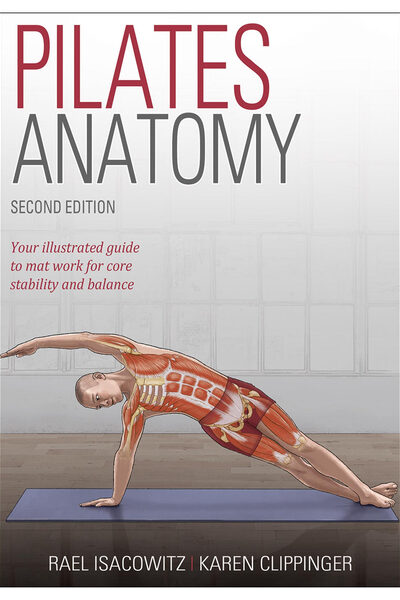
Pilates Anatomy
Author: Rael Isacowitz & Karen Clippinger Publisher: Human Kinetics (2011) Pages: 240
Why Read This
Rael Isacowitz and Karen Clippinger dissect the anatomy of every mat Pilates exercise, from powerhouse engagement to vertebra-by-vertebra spinal articulation. Isacowitz brings over thirty years of teaching experience, including a lineage that traces directly to Joseph Pilates' first generation of students. Clippinger adds three decades of teaching kinesiology and directing Pilates-based rehabilitation programs at academic institutions. Together they wrote this book as a sustained conversation between the art of movement and the science of anatomy.
The thesis the book builds is clear and deep: Pilates is a mind-body exercise system that yields its full benefit only to those who understand its anatomical underpinning. A practitioner doing a Chest Lift with full awareness of how the transversus abdominis and rectus abdominis cooperate is engaged in something neurologically distinct from someone merely copying the external shape. Every repetition, when accompanied by that understanding, becomes an active dialogue between mind and body.
The relevance extends well beyond the Pilates studio. In an era when hours of sitting in front of screens have produced waves of back pain and increasingly rounded posture, the understanding of the spine, the powerhouse, and functional movement patterns that this book offers becomes foundational knowledge with applications far beyond the mat.
Target reader: Pilates instructors who want to deepen the anatomical foundation of their teaching; practitioners already training regularly who want to understand the mechanics behind the technical cues they receive; athletes from any sport building core stability with greater intelligence; and anyone managing chronic low back pain who wants to understand the scientific basis before starting a program.
Core Idea 1: Six Principles as the Foundation of Movement
From Contrology to Living Movement
Before discussing a single muscle, Isacowitz and Clippinger ask the reader to understand that Joseph Pilates named his method contrology: the science of mastering the body through the mind. That name tells us something important about how the method operates. The six principles built upon it form both a philosophical and technical architecture that governs how every movement is performed and inhabited.
Breath. Pilates elevates breath from an automatic function to an active instrument. Ron Fletcher, one of the first-generation Pilates students, put it this way:
"The breath shapes the movement and defines its dynamic."
Three modes of breath management appear in Pilates. Lateral breathing expands the ribcage sideways on the inhale while the deep abdominal muscles remain engaged. Structured breath patterns per exercise prevent the Valsalva maneuver and facilitate proper muscle activation. Active breath, as in the Hundred, makes breathing a rhythmic and purposeful action.
Concentration. The demand is for deliberate attention directed to every detail of execution: bone position, muscle recruitment sequence, depth of contraction, breath. The standard aimed at is the practitioner's best effort from their current capacity, fully conscious and present on every repetition.
Center. The center operates at three layers: the body's physical center of gravity, located slightly in front of the second sacral vertebra; the powerhouse or core as the active region from which all movement originates; and in Joseph Pilates' vision, the source of energy that flows movement outward through the entire body. Romana Kryzanowska, one of the method's inheritors, described it as "flowing motion outward from a strong center."
Control. Mature control shows in movement that can be repeated with increasing accuracy, less effort, and lower muscle tension over time. This is the sign that the nervous system has learned the movement pattern efficiently.
Precision. A movement that resembles a regular sit-up becomes something distinct when performed with Pilates precision: which muscles are activated, at which phase of movement, with what spinal orientation. Precision encompasses two capacities working together: isolation of specific muscles, and integration of the right muscles in the right sequence.
Flow. Flow is the result of all six principles working in mature concert. The authors reference psychologist Mihaly Csikszentmihalyi: total involvement, energized focus, and success in the process itself. In movement, flow arises when all elements have ripened enough and nothing interrupts the current.
What binds all six is a single common denominator: every principle carries both a physical and a mental component, inseparable from each other.
Core Idea 2: The Spine and the Powerhouse
The Architecture of the Body's Center
The spine is a column of 33 segments that, viewed from the side, forms four alternating curves: the cervical and lumbar curve concave to the back, the thoracic and sacral concave to the front. This design is structural engineering built to absorb impact and support a wide range of motion. Between each pair of vertebrae sits an intervertebral disc with a fluid-filled core (nucleus pulposus) that serves as a living cushion. Facet joints at the back determine the available direction of movement: the thoracic region tends to support rotation, the lumbar restricts it. Understanding this becomes a key technical point in practice, because rotational movements in Pilates must come primarily from the upper back.
The Pilates goal for the spine is stated with specificity by the authors:
"One of the goals of Pilates is to help fully utilize the potential range in each segment of the spine in a symmetrical manner."
Most people, due to strength imbalances, postural habits, and injury history, have spinal segments that move too little in one place and too much in another. Pilates works to restore that balance.
The Four Layers of the Powerhouse
The powerhouse is the heart of the entire system:
"The powerhouse, or core, can be described as the area from the bottom of the rib cage to a line across the hip joints in the front and to the base of the buttocks in the back."
Four muscle layers form it. The transversus abdominis is the deepest abdominal muscle, with fibers running nearly horizontal, acting like a natural corset. It is the primary stabilizing muscle, and in a healthy body it fires automatically ahead of any arm or leg movement. The cue "scoop" or "draw the navel to the spine" is specifically designed to recruit this muscle. The rectus abdominis is the primary mover for spinal flexion, running straight from sternum to pubis. The external and internal obliques are the primary producers of rotation and lateral flexion, with paired fiber directions running diagonally from opposite angles. The spinal extensors (erector spinae, multifidus, semispinalis) hold the spine upright and generate extension. The multifidus in particular handles segmental stabilization: it moves one vertebra against its neighbor, the very capacity that underlies vertebra-by-vertebra spinal articulation.
The pelvic floor muscles (levator ani, coccygeus) complete the powerhouse from below. Research shows that contracting the pelvic floor drives activation of the transversus abdominis, and the relationship holds in reverse as well.
Core stability is the ability to maintain the desired pelvic and spinal position while the limbs are moving, without distortion or compensation. This is the most practical measure of powerhouse function.
Cocontraction. One of the most important principles in Pilates is the demand that mechanically opposing muscle groups work simultaneously. The abdominals and spinal extensors do not take turns; in many exercises, both must be active at once, each contributing differently to position and safety.
Core Idea 3: The Anatomy of Movement and How to Read an Exercise
An Analytical Vocabulary
The book builds an analytical vocabulary that makes every exercise readable in a meaningful way. Three types of muscle contraction form the foundation.
Concentric contraction occurs when a muscle shortens against gravity, as when lifting the torso in a Chest Lift. Eccentric contraction occurs when a muscle is active but lengthening, controlling movement in the direction of gravity, as when lowering the torso back to the mat after a Chest Lift. Isometric contraction occurs with no visible change in muscle length, maintaining a position such as holding a straight body line in a Push-Up. All three types appear in every Pilates session, often within a single exercise.
Torque and the Decision of Leg Height
One of the most important safety principles in Pilates mat work:
"The weight of the limbs is the same, but moving them closer or farther away from the trunk markedly affects the torque they exert and the amount of muscle force that must be generated."
The lower the legs from vertical, the greater the torque the abdominals must resist. If the abdominals are insufficient, the iliopsoas contracting hard to hold the legs will pull the lower back into hyperextension. Choosing the right leg height is a safety decision with direct consequences for spinal health, and it is one of the most consistently overlooked considerations among beginners.
Force Couples
The abdominals and hamstrings are the primary force couple in Pilates. Although located on opposite sides of the pelvis, both can work together to produce a posterior pelvic tilt, resisting the anterior tilt tendency that threatens the lower back. Understanding this relationship explains why the cues "draw in the belly" and "lengthen the tailbone" so often appear together in a single instruction.
The rule of gravitational analysis built on this is straightforward: movement against gravity is produced by the muscle group whose action matches the direction of movement (concentric contraction). Movement with gravity is controlled by the muscle group whose action opposes it (eccentric contraction). With this rule in hand, a practitioner can anticipate which muscles are working at every phase of any exercise without needing to memorize each one separately.
Core Idea 4: Six Exercise Groups by Spinal Function
The Anatomical Logic Behind the Sequence
The book organizes over fifty mat exercises into six groups, each training a distinct spinal function, with anatomical logic supporting the sequence.
Foundation. Seven opening movements. Pelvic Curl trains vertebra-by-vertebra articulation and activates the hamstring-abdominals force couple. Chest Lift builds the correct C-curve. Leg Lift Supine and Side develop isolation of limb movement over a still trunk. Spine Twist Supine and Chest Lift With Rotation introduce rotation through the obliques. Back Extension Prone closes the foundation with controlled extension using cocontraction.
Abdominal Work. Nine exercises forming a skill ladder from pelvic control through One-Leg Circle up to the total synthesis of the Teaser. Roll-Up and Neck Pull train articulation with straight legs. Hundred demands core stability while the arms pump. One-Leg Stretch and its variations train stabilization as limbs alternate movement. Crisscross adds the rotational dimension. Teaser sits at the summit because it synthesizes all the skills: refined spinal articulation, both legs straight and lifted, and active balance between hip flexors and abdominals.
Fine Articulation. This group trains one specific capacity: each vertebra moving in sequence, like a pianist sounding every note separately. Spine Stretch, Rolling Back, Seal, Rocker With Open Legs, Rollover, Boomerang, Control Balance, and Jackknife form a spectrum from gradual curving through vertical dimensions. The authors state plainly that several exercises in this group load the neck and require medical clearance for certain populations.
Bridging. These six exercises shift the focus from flexion to stability in neutral or slightly hyperextended positions, with the pelvis lifted from the mat. The key concept here is bracing: cocontraction of abdominals and spinal extensors to stabilize the spine from both sides, distinct from the scooping that dominates flexion work. Shoulder Bridge, Scissors, Bicycle, Leg Pull, Leg Pull Front, and Push-Up form a gradient of difficulty with one constant principle: the pelvis is what is kept stable.
Side Body. Eight exercises place the obliques as the primary subject through lateral flexion and rotation, the two planes that load the obliques most directly. Side Kick builds lateral stability, Side Bend elevates the lateral flexors to prime mover, Spine Twist and Saw train rotation from the center in an upright position.
Back Extension. This group balances all the flexion that dominates Pilates. Cat Stretch introduces the basic coordination, One-Leg Kick and Double Kick build spinal extensor strength progressively, Swimming trains rotational stability through a contralateral pattern, Rocking and Swan Dive take the body to a full arc. The rationale: good spinal extensor endurance is associated with reduced risk of low back injury and osteoporosis.
Core Idea 5: Building a Program That Lasts
Principles for Designing a Personal Program
The final chapter provides a framework for designing a personal program. Every body requires a different approach. Body type, injury history, medical conditions, age, fitness level, and movement skill all affect which exercises are appropriate. A good program is adjusted continuously as the body changes.
Muscular balance is the primary argument for exercise sequencing. Because flexion dominates Pilates, extension, side work, and bridging must be present as counterweights in every program. Joseph Pilates understood this intuitively: the constant alternation between flexion and extension is a hallmark of his original program.
Progression in Pilates operates by a logic distinct from most other training systems:
"In Pilates, making an exercise more difficult often does not equate to greater strength demands (increased resistance) but instead relates more closely to neuromuscular coordination and timing."
The same movement becomes far more demanding when performed with full precision, accurate timing, and all six principles active simultaneously. A practitioner doing a Chest Lift with full concentration on every repetition is building a motor program distinct from someone working through it mechanically while the mind wanders.
Modification is its own art. The authors encourage every practitioner to understand the anatomical purpose behind each movement, so that any modification made still serves that purpose even as the form changes. Creative modification grows from deep anatomical understanding.
The most frequently quoted Joseph Pilates legacy:
"If your spine is inflexible at 30, you are old; if it is completely flexible at 60, you are young."
Key Takeaways
-
The transversus abdominis is the body's natural corset, and it is the first muscle that must be active before any limb moves. In a healthy body, this muscle fires automatically ahead of arm or leg movement, a stabilization reflex that often weakens in people with chronic low back pain. Research consistently shows delayed transversus abdominis activation as a finding in this population. The cues "scoop" and "draw the navel to the spine," which sound simple, carry a very specific anatomical mechanism: both are designed to recruit the transversus abdominis, the deepest layer that cannot be accessed without the right cue. Contracting the pelvic floor triggers transversus abdominis activation, and the relationship holds in reverse; this reciprocal connection explains why Pilates manages the pelvic floor and core as one system. This is the muscle at the center of the entire book.
-
Leg height determines torque on the spine, and mismanaged torque is the most common injury mechanism in mat work. The lower the legs from vertical, the greater the torque the abdominals must resist. If the abdominals are insufficient, the iliopsoas pulls the spine into hyperextension. Choosing the right leg height is a safety decision with direct implications for spinal health, and it is the consideration most consistently overlooked by beginners.
-
The six Pilates principles each carry a physical and a mental component, inseparable from one another. Breath, concentration, center, control, precision, and flow are the architecture for thinking about movement, and the technical guide for every repetition. Movement performed with all six principles active simultaneously builds a motor program that differs neurologically from movement done mechanically.
-
Progression in Pilates moves through neuromuscular coordination and precise timing, two capacities that grow from conscious precision. The same movement becomes far more challenging with full precision and accurate timing. This understanding transforms the way a practitioner approaches seemingly simple foundation exercises.
-
Back extension belongs in every Pilates program as a counterweight to flexion. Weak spinal extensors are a risk factor for osteoporosis and low back injury. Cat Stretch through Swan Dive, chosen according to current capacity, is a long-term preventive investment.
-
Vertebra-by-vertebra spinal articulation is a capacity that can be trained and recovered. Rolling movements that feel difficult today can become accessible within months. This capacity grows through repeated practice with conscious precision, and it continues to develop as long as the practitioner tends to it.
Critical Assessment
Strengths
1. Two complementary perspectives in one volume
The Isacowitz and Clippinger collaboration produces something uncommon: the practical depth of a master teacher meeting the anatomical depth of an academic kinesiologist. Books on Pilates typically favor one direction; the technically rich ones are often anatomically shallow, the anatomically rich ones often feel sterile in practice. Here both arrive with equal weight.
2. Highly specific muscle illustrations
Every exercise comes with a diagram showing the primary and stabilizing muscles involved, clearly differentiated. This transforms verbal instructions that can sometimes feel abstract into a visual reference that can be consulted directly during practice.
3. Honest about risks and population limitations
The authors do not romanticize every exercise. For the movements in the Fine Articulation group that load the neck, they explicitly name the populations requiring medical clearance. This honesty strengthens trust in the entire book.
Limitations
1. A firm orientation toward mat work
The book focuses on mat exercises. Practitioners who also train with the reformer, Cadillac, or other apparatus in the Pilates system will find no equivalent guide for repertoire outside the mat. This is a deliberate choice and worth knowing before purchase.
2. Designed for practitioners with prior experience
Someone with no prior Pilates experience will find this book difficult without classes or hands-on guidance first. Its primary function is to deepen understanding of what is already being practiced, and it rewards readers who already have direct experience on the mat.
3. Thinner physiological depth in the program design section
The chapter on personal program design, while useful as a framework, feels lighter than the anatomy chapters that precede it. Discussion of periodization, optimal volume, and long-term adaptation receives less proportional space compared to the rigor applied to individual movement analysis.
Verdict
Pilates Anatomy is the most technically comprehensive reference for mat Pilates available in a single volume. For instructors who want to explain why each technical cue works, and for practitioners who want to understand the mechanics behind exercises they already perform, this book earns a permanent place on the working desk. It asks readers who are willing to think, and it gives generously to those who are willing to be patient. Rating: 4.5 out of 5.
Related Reading
Complementary Books
- The Anatomy of Movement by Blandine Calais-Germain (1993). The standard anatomical movement reference that underlies the practice of many movement instructors across Pilates, yoga, and dance.
- Movement: Functional Movement Systems by Gray Cook (2010). A systematic approach to functional movement patterns and mobility screening, a useful complement for understanding why Pilates foundations matter before advancing.
- Why We Get Sick by Benjamin Bikman (2020). Broad metabolic context for understanding why movement health and spinal stability connect to systemic health.
- Body by Science by Doug McGuff & John Little (2009). A different perspective on training efficiency, useful as a comparative lens for locating Pilates within the wider spectrum of exercise approaches.
- Anatomy Trains by Thomas Myers (2001). Myofascial theory that extends understanding of how the muscles discussed in Pilates Anatomy connect as functional chains across the whole body.
Note: Explore this site for articles on mind-body practice, movement anatomy, and principle-based training programs.
FAQ
Q: Is this book appropriate for someone who has never done Pilates before? A: It works better as a second book than a first. The book is designed for people who already know the Pilates basics and want to understand the anatomical mechanics behind what they are already doing. Someone entirely new to Pilates would benefit from taking a few classes with an instructor first, then using this book as a deeper reference.
Q: Is there a fundamental difference between mat Pilates and Pilates with the reformer? A: The principles are the same. The reformer adds a resistance variable through adjustable springs. Mat work relies on body weight and gravity as the sole resistance. Some movements that are difficult to perform safely on the mat can be modified more easily on the reformer due to its physical support. This book is specifically about mat work and does not cover the apparatus repertoire.
Q: I have chronic low back pain. Is it safe to start training from this book on my own? A: Consult a doctor or physiotherapist before starting any program for a back condition. For context, the book addresses with care the mechanism by which transversus abdominis weakness relates to chronic low back pain, and foundation exercises like Pelvic Curl, performed correctly, can serve as a safe starting point under professional guidance. Reading the anatomy chapters before attempting any movement is the recommended first step.
Q: Isacowitz founded BASI Pilates, one of many certification bodies. Does this book carry the perspective of one particular lineage? A: There is nuance here. Isacowitz brings a perspective rooted in the lineage of Joseph Pilates' first-generation students, and he acknowledges that the method has evolved into several legitimate lines. The book leans anatomical-universal over doctrinal; the explanations of muscles, the spine, and movement mechanics hold across teaching lineages. Practitioners from the Romana, Stott, or Classical Pilates schools will find the anatomical foundation relevant, though some differences may exist in specific technical cues.
Q: Which sections are most useful for an instructor looking to improve teaching quality? A: The movement analysis chapter and the per-group exercise breakdowns. There, Isacowitz and Clippinger detail the primary and stabilizing muscles for every movement, along with notes on common errors and modifications. An instructor who understands why each technical cue works anatomically will be able to explain it to students with far greater clarity and conviction.
Q: Pilates is often associated with women and upscale studios. Is it relevant for male athletes from other sports? A: The relevance is concrete. The rotational strength built through side body exercises, particularly Spine Twist, Saw, and Crisscross, transfers directly to sports involving rotation: golf, tennis, rowing, and swimming. The pelvic stability built through Hundred, One-Leg Circle, and bridging is the foundation for safe explosive movement, both in power sports like athletics and in technical sports like swimming. A number of professional sports teams, including football and rugby clubs in Europe, have incorporated Pilates-based core training into their conditioning programs.
Q: There are many Pilates books available. What distinguishes this one? A: The combination of anatomical depth and practical orientation. Most popular Pilates books teach what to do; this book explains why each movement works mechanically. The per-exercise muscle diagrams are a feature rarely found in comparable books, and that is what turns this volume into a reference consulted years after purchase.
Sources
- Rael Isacowitz and Karen Clippinger, Pilates Anatomy (Champaign, IL: Human Kinetics, 2011), 240 pages, ISBN 978-0736092197.
- The chapters this page draws on: "Six Key Principles of Pilates"; "Spine, Core, and Body Alignment"; "Muscles, Movement Analysis, and Mat Work"; "Foundation for a Mat Session"; "Abdominal Work for Movement and Stabilization"; "Fine Articulation for a Flexible Spine"; "Bridging for a Functional Spine"; "Side Exercises for an Effective Core"; "Extensions for a Strong Back"; and "Customizing Your Pilates Program".