Why Read This
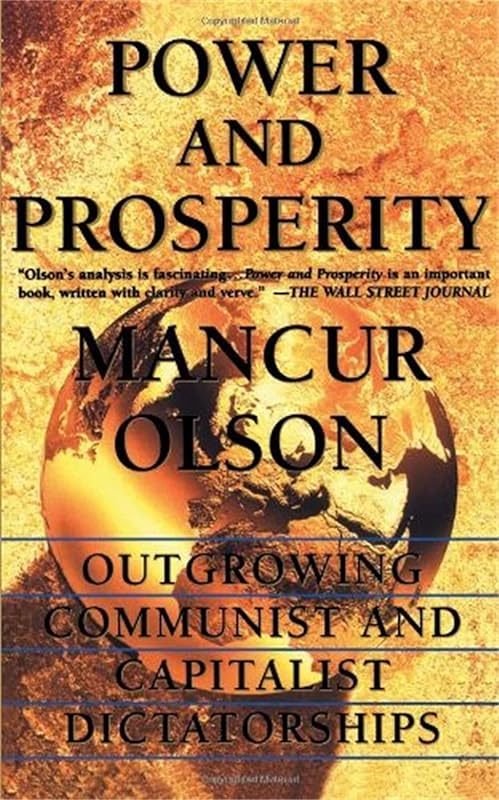
Mancur Olson poses a fundamental question: why are some nations wealthy while others remain poor? He locates the answer in political power structures and institutional design that shape economic incentives.
This book offers a framework for understanding how power distribution shapes policy: credible property rights protection, public goods provision, and constraints on arbitrary action. Prosperity rests on political foundations that protect contracts and open space for investment.
Olson's analysis views the emergence of the state as an evolution from organized banditry. He explains the logic of the second invisible hand: rulers with long time horizons choose pro-growth policies to expand their tax base, driven by long-term self-interest that operates well beyond altruism.
This framework resolves various historical puzzles: some autocracies achieve rapid growth (Singapore, early South Korea) while many stagnate. Democracy provides more consistent property rights protection, the sequence of reforms determines outcomes, and special interest groups gradually capture the political process.
This book is valuable for academics, policymakers, founders, and investors seeking to assess institutional quality as a determinant of economic futures. Olson expands the lens of collective action and links it to the political foundations of prosperity.
Key Points
- Stationary Bandit Logic - States emerge when roving bandits settle down and begin thinking about the future. Rulers who plan to stay choose optimal tax rates to keep the economy alive and generate recurring revenue.
- Second Invisible Hand - Beyond voluntary exchange, there's a mechanism in the realm of power: rulers with long horizons provide pro-growth policies in their own interest, generating social benefits.
- Encompassing Interests Determine Policy - Policy quality depends on how broad the interests of those in power are. Democratic majorities bear the widest costs and benefits, so they tend to choose pro-growth policies.
- Democracy Enables Credible Commitment - Sustainable democracy creates credible commitment to property rights through independent courts, separation of powers, and constitutional limits that make arbitrary expropriation costly.
- Markets Need Government Foundations - Free markets only function atop an institutional framework enforced by government. Contract enforcement, property rights protection, and public goods are prerequisites for transactions.
- Time Horizons Drive Investment - Long time horizons encourage investment and public goods provision. Short horizons encourage maximum extraction and destruction of the tax base.
- Special Interest Capture Inevitable - In democracies, narrowly focused organized groups are more effective than dispersed majorities, so privileges tend to accumulate.
- Sequence of Reforms Matters - The order of reforms determines outcomes: build institutions and legal certainty first, then gradual liberalization and democratization.
Stationary Bandit vs Roving Bandit
Olson opens with a thought experiment: a roving bandit takes everything from a village, while a stationary bandit thinks about future income. When bandits stop moving, they have reason to preserve productive capacity.
A ruler planning to govern long-term avoids 100% taxation because he knows GDP will collapse. He seeks the rate that maximizes revenue over time, far below total extraction.
Time Horizon Mechanism
A roving bandit discounts the future to zero, so the optimal strategy is quick pillage. A stationary bandit sees GDP fall as rates rise, then chooses the sweet spot that maintains economic activity.
Long horizons also encourage provision of public goods like security, contract enforcement, and infrastructure. These raise regional productivity, expanding the tax base. The motivation remains self-interest extended through time.
Historical Evidence
The transition from anarchy to monarchy displays this pattern. After one ruler monopolizes violence, he begins protecting some productive capacity and providing basic services.
Chinese warlords, medieval European kings, and some modern autocrats follow similar patterns: monopolizing violence opens the path to limited protection and public goods.
Key insight: The seeds of civilization emerge from organized predation constrained by long-term self-interest.
Practical implication: stability matters because it extends horizons and enables long-term commitment. Regime uncertainty kills investment.
The Second Invisible Hand
Adam Smith explained the first invisible hand in voluntary exchange. Olson adds a second invisible hand in the realm of coercion: rulers with long horizons choose policies that also benefit society because they want to maximize long-term revenue.
The logic is simple: optimal tax rates, public goods, and property rights protection expand the future tax base.
Creating Virtuous Cycles
Positive cycles emerge when stable governments invest in infrastructure. Productivity rises, GDP grows, the tax base widens, then further public investment becomes more feasible.
Unlike the first invisible hand, this mechanism operates in asymmetric power relations. Pro-social outcomes only emerge when horizons are sufficiently long and the ruler's position is secure.
Limits of Enlightened Autocracy
The same logic explains why public goods provision in autocracies is often insufficient. The ruler only counts the portion of benefits he can capture through taxation, so service levels always fall below the social optimum.
Singapore under Lee Kuan Yew and some Chinese dynasties demonstrate autocracies providing substantial public goods because rulers aligned private interests with regional prosperity.
The limitation is clear: rulers never capture all social benefits, so underprovision persists.
Encompassing Interests
The key variable lies in how broad the interests of those in power are, well beyond the surface label of any regime. The broader, the more aligned with economic welfare.
A roving bandit has almost no encompassing interest. A stationary bandit has some because his income depends on the local economy. A democratic majority has the broadest interest because they are both taxpayers and public goods recipients.
Mathematical Logic
An interest group representing 1% of society only feels 1% of the policy impact on society, but receives all special benefits. Their incentive tilts toward extraction.
An autocrat with monopoly power bears a larger portion of bad policy costs than a narrow group, but still smaller than a democratic majority.
A democratic majority bears direct costs when GDP falls, so they tend to choose pro-growth policies.
Comparative Evidence
Democracies tend to set tax rates below the revenue-maximizing point for autocracies because voters directly feel the impact on their income.
They also push for broader public goods. Absolute monarchies, constitutional monarchies, and democracies show gradations of increasingly broad interests and increasingly strong economic performance.
Key insight: Pro-market policies emerge from government controlled by broad interests, growing within institutional foundations that the absence of government can never provide.
This explanation also illuminates the success of certain autocracies like Singapore or South Korea under Park: rulers equated private interests with national economic success, broadening their encompassing interest despite lacking democratic accountability.
Democracy and Property Rights Protection
Checks and balances in democracy serve dual functions: preventing consolidation of tyranny and protecting property rights and contracts. Olson argues only sustainable democracy provides reliable property rights protection.
Institutional constraints that preserve democracy also block arbitrary expropriation. Independent courts, separation of powers, and electoral accountability maintain stability of economic rights.
Credible Commitment Mechanism
Democratic leaders need support from a majority of asset owners. Policies that expropriate property trigger electoral punishment.
Multiple veto points make sudden policy changes difficult, providing predictability for long-term investment.
In autocracy, rulers struggle to build credible commitment because there are no institutional barriers for successors or for themselves when circumstances become desperate. Dynastic succession extends horizons but remains fragile.
Historical Case: England's Glorious Revolution
England's Glorious Revolution provides an example: parliament constrained royal power so property rights were respected and investment surged toward the Industrial Revolution.
Olson doesn't claim every democracy automatically protects property rights. Fragile democracies with weak institutions can fall into expropriatory populism. Institutional strength determines outcomes.
Market-Augmenting Government
Olson rejects the market versus state dichotomy. Markets need states to enforce property rights, contracts, and public goods.
The paradox: states must be strong enough to enforce law yet limited enough not to abuse power.
Institutional Framework for Markets
Government provides definition of property rights, courts for contract enforcement, police, standards, and infrastructure. All of these lower transaction costs.
Without government enforcement, long-term transactions with strangers become impossible. Free rider problems make public goods insufficient when relying only on voluntary participation.
Lessons from Failed Transitions
Russia in the 1990s demonstrates that rapid privatization without legal enforcement creates chaos. Many Washington Consensus prescriptions failed because they assumed self-regulating markets.
Better strategy: build state capacity to enforce property rights and contracts, establish legal frameworks, provide priority public goods, then liberalize.
South Korea, Taiwan, and Singapore succeeded with combinations of strong government, property rights protection, and strategic public goods provision.
Time Horizons and Credible Commitment
Time horizons determine government behavior. Long horizons encourage investment and public services. Short horizons encourage extraction.
With high discount rates, rulers focus on current revenue. With low discount rates, they value future revenue streams.
Solving Credibility Problems
Investors ask whether protection promises will endure. Without enforcement, promises are empty.
Autocracies rely on reputation and dynastic succession to extend horizons across generations, but these mechanisms are fragile.
Democracies use constitutional constraints, independent courts, and separation of powers to make policy reversals costly, so promises become more credible.
The Aging Dictator Problem
When dictators age or fall ill, horizons shrink. Rational behavior shifts toward quick plunder and asset securing.
Revolutions also face credibility problems: new regimes reject old commitments, so investment waits until new credibility forms.
Key insight: Democracy provides credible commitment through structure; autocracy relies on reputation that easily collapses.
Special Interest Groups in Democracy
Olson shows democracies are vulnerable to capture by narrow interest groups because their benefits are concentrated while costs are dispersed.
Small groups bear large per-member benefits, so they're motivated to organize. Majorities bear small per-person costs, so they rarely mobilize.
Collective Action Asymmetry
Consequence: professional licenses, sectoral subsidies, trade protection, and targeted tax breaks accumulate. Each seems small; total impact is large.
Politicians respond to organized pressure, not vague majority preferences. Electoral competition doesn't eliminate this bias.
Evidence from Institutional Sclerosis
Long-stable democracies tend to be laden with interest groups and rent-seeking policies. Germany and Japan surged after the war partly because rent-seeking networks were destroyed.
Partial solutions: sunset clauses, lobbying transparency, constitutional limits on narrow redistribution, and anti-rent norms.
Young democracies or post-crisis ones have momentum because they're free from accumulated privileges, but need institutional design to avoid repeating the cycle.
Framework Integration
Olson's framework interconnects: stationary bandits explain the emergence of order, encompassing interests explain policy variation, time horizons determine credibility, democracy provides institutional solutions while bringing special interest challenges.
The central theme: incentive structures determine outcomes. Institutions matter because of the incentives they create.
Developmental Logic
Anarchy → stationary predation → autocracy with long horizons → democracy with constraints → mature democracy with special interest burdens.
Connections to Mental Models
Second-Order Thinking: Olson calculates the effect of falling GDP when taxes rise. Rational rulers weigh downstream impacts alongside direct revenue.
Incentives Outweigh Intentions: Institutional design that aligns private interests with social welfare matters more than assumptions of ruler virtue.
Systems Thinking: Political economy is an interconnected system. Single changes like privatization without legal enforcement damage the whole.
Principal-Agent Problem: Democracy shrinks the principal-agent gap because citizens are both voters and public goods recipients. Autocracy widens that gap.
Practical Implications
For Developing Countries
Initial priority: establish order and monopoly on violence. Anarchy is the worst scenario.
After stabilization, build credible property rights protection institutions. Regime form can vary as long as function is achieved.
Avoid hasty democratization without rule of law. Start with capable state, then expand participation.
Reform sequence: stabilize → establish property rights → build legal framework → provide public goods → market liberalization → gradual democratization.
For Transition Economies
Post-communist transitions show rapid privatization without legal frameworks triggers oligarchy and fragile property rights.
Better to transition more slowly with robust property rights protection than rapid privatization without enforcement.
Build broad coalitions so reforms endure.
For Mature Democracies
Monitor special interest capture through lobbying transparency, constitutional limits, and anti-rent norms.
Use sunset clauses and periodic review so rent-seeking policies don't become permanent. Make costs clear to the public.
Balance stability for credibility and renewal to avoid sclerosis.
For International Development
Aid conditions should focus on institutional quality: property rights, rule of law, corruption oversight.
Consider trade-offs between promoting democracy and stability. Sometimes supporting stable regimes with decent institutions is safer than chaos.
Regional integration and trade create competitive pressure that restrains rent-seeking.
Critical Assessment
Strengths
1. Analytical Clarity
Olson's framework illuminates political economy incentive structures with precision. Mechanisms are explained operationally so hypotheses can be tested and policy relevance is clear.
2. Empirical Support
Historical and cross-national comparative evidence consistently supports theoretical predictions. Institutional variation explains differences in economic performance.
3. Policy Relevance
The framework guides institutional design, development policy, and constitutional reform. Not mere academic abstraction.
Limitations
1. Rationality Assumptions
The model assumes highly rational actors. Culture, ideology, and legitimacy-seeking sometimes override incentive calculations.
2. Transition Dynamics
Dynamics of institutional change aren't detailed. Triggers for shifts from autocracy to democracy still need elaboration.
3. Measurement Challenges
Concepts like encompassing interests or time horizons are difficult to measure. Many predictions are qualitative.
Needed Elaborations
Contemporary challenges demand framework expansion: environmental externalities, global governance without single authority, technology transforming property rights, and income inequality dynamics.
Conclusion
Mancur Olson provides a powerful framework for understanding the relationship between power and prosperity. Prosperity emerges from political institutions that create appropriate incentives.
Core insight: power distribution determines adopted policies. Narrow interests produce extraction and service shortfalls. Broad interests align private motives with social welfare. Time horizons determine whether rulers invest or plunder. Institutional constraints enable the credible commitment that investment requires.
This framework dissolves the market versus government dichotomy. Prosperity requires government capable of enforcing rights yet limited enough not to abuse power, controlled by broad interests with long horizons.
Enduring Lessons
Incentives determine outcomes. Institutional design determines incentives.
Power distribution is critical. Who holds power affects policy.
Time horizons matter. Long horizons enable investment and credible commitment.
Credibility is costly. Promises have value only with enforcement.
Sequence matters. Build institutions before full liberalization and democratization.
Lasting Value
Olson shows prosperity is possible but not automatic. It requires conscious institutional design to create broad interests, long horizons, and credible commitment. Development is a political problem about power distribution and institutional architecture.
This framework remains relevant for policymakers, institutional reformers, and political economy analysts. It helps decode why some nations advance while others stagnate and how to improve the political foundations of prosperity.
FAQ
Q: What's the main difference between roving and stationary bandits?
A: Roving bandits move around and take everything without thinking about the future. Stationary bandits protect territory, choose optimal tax rates, and provide public goods to expand the tax base.
Q: Why is democracy better for property rights protection?
A: Democracy creates institutional constraints like independent courts, separation of powers, and constitutional limits that make arbitrary expropriation costly and politically risky.
Q: What are encompassing interests?
A: Encompassing interests describe how much stake rulers have in overall economic performance versus narrow extraction. Democratic majorities are most encompassing because they're both taxpayers and public goods recipients.
Q: Why do some autocracies succeed economically?
A: Authoritarians like Lee Kuan Yew in Singapore or Park Chung-hee in South Korea equated private interests with national prosperity, extended time horizons, and maintained stability so investment grew.
Q: What's the second invisible hand?
A: Beyond voluntary exchange, there's a mechanism in the realm of power: rulers thinking about the future provide pro-growth policies to expand their own revenue, generating social benefits.
Q: Why do markets need government?
A: Property rights and contracts don't enforce themselves. Government provides enforcement, public goods, and infrastructure that make transactions possible.
Q: What's the problem with special interest groups in democracy?
A: Small groups with large per-member benefits organize more easily and lobby effectively, while costs spread to majorities that struggle to mobilize. This bias drives rent-seeking policies that harm efficiency.
Q: Why are time horizons important for economic development?
A: Long horizons encourage investment and public goods provision because rulers value future revenue. Short horizons produce extraction and asset plundering.
Q: What's the right sequence for development reforms?
A: Stabilize security → establish property rights → build legal framework → provide public goods → market liberalization → gradual democratization.
Q: Why did some Washington Consensus prescriptions fail in the 1990s?
A: Those prescriptions assumed self-regulating markets and pushed rapid privatization without institutional foundations. Without property rights and contract enforcement, the result was chaos and rent-seeking.
Sources and References:
- Olson, Mancur. Power and Prosperity: Outgrowing Communist and Capitalist Dictatorships. Basic Books, 2000. 272 pages. ISBN: 978-0465051960.
- Related Olson works: The Logic of Collective Action (1965), The Rise and Decline of Nations (1982)
- Complementary frameworks: Douglass North (institutional economics), Elinor Ostrom (collective action), Daron Acemoglu & James Robinson (Why Nations Fail)