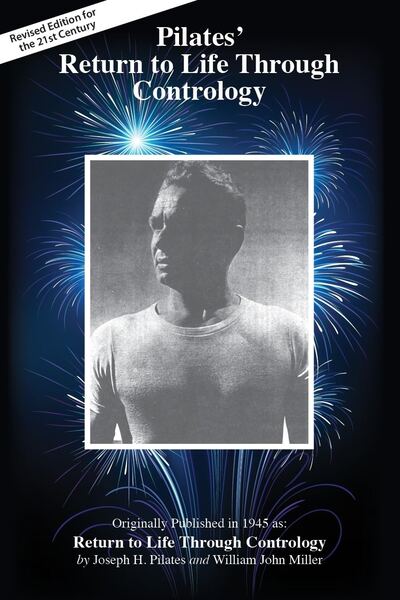
Return to Life Through Contrology
Author: Joseph H. Pilates Publisher: Presentation Dynamics (1945, revised edition for the 21st century, 2012) Pages: approximately 139
Why Read This
Joseph Pilates formulated Contrology in 1945: a system for coordinating body, mind, and spirit that established physical fitness as the foundation of happiness. In one slim volume written in his own hand, Pilates delivers a complete diagnosis of the human body damaged by modern civilization, followed by a program of 34 mat exercises he developed over more than forty-three years at his New York studio.
The book's relevance has only sharpened in the twenty-first century. Pilates' complaints about desk work that cripples the spine, economic pressure that strains the nerves, and urban noise that produces chronic tension read as a report from today's world, written eighty years ago. The program he offers requires no equipment, no gym membership, and no supplements. A mat, four sessions per week, and a mind fully present in every movement.
Return to Life is the source text for the entire world of Pilates. What thousands of instructors teach in thousands of studios around the world today began on these pages. Reading Pilates in his own voice gives readers something often missing in modern classes: the philosophy behind the method, the reasoning behind each instruction, and the moral contract between teacher and student that forms the heart of the whole system.
Intended readers: Anyone who practices Pilates and wants to understand its philosophical foundations. Someone wrestling with chronic back pain, poor posture, or the fatigue that comes from a sedentary lifestyle. Knowledge workers seeking an evidence-grounded argument for why investing in physical fitness is an investment in mental clarity. Readers drawn to the history of ideas about the relationship between body and mind.
Core Idea 1: Physical Fitness as the First Condition of Happiness
An Axiom That Admits No Exceptions
Pilates opens his entire system with a single claim, stated with the authority of a natural law.
"Physical fitness is the first requisite of happiness."
He then spells out what he means by fitness: a body developed evenly in every part, joined to a sound mind, able to carry out the many tasks of an ordinary day naturally and easily, with spontaneous zest and pleasure.
Notice how Pilates defines "physical fitness." True fitness is a uniformly developed body, a sound mind, and the capacity to move through each day with "spontaneous zest and pleasure," vitality that arises from within. Muscle size and running times are goals Pilates never mentions. What he describes is a body light and ready, fully present for every demand of daily life.
From that axiom, Pilates extends a moral contract to his readers.
His argument runs like this: whatever a person hopes to reach in any walk of life, the highest version of it depends on first building a strong, healthy body and developing the mind as far as it will go.
The highest achievement in any field rests on this foundation. Over decades in his studio, Pilates watched restored bodies carry sharper minds and better decisions in their wake.
Then he closes every last excuse with one short sentence.
"Physical fitness can neither be acquired by wishful thinking nor by outright purchase."
The two routes most commonly taken, empty hope and the purchase of shortcuts, are both sealed off. The one path that remains is real work, done with the right method, practiced with regularity. In an era when the fitness industry earns billions selling hope, this warning arrives like a splash of cold water.
Core Idea 2: The Diagnosis of Civilization
The Enemy That Goes Unseen
One of Pilates' most original contributions is his diagnosis of why modern people lose their fitness. He points to the structure of modern life itself as the culprit. Individual laziness is only a symptom; the causes are deeper and more systemic.
He names the culprits directly: the telephone, the automobile, and economic pressure. Together, he writes, they produce so much physical letdown and mental strain that hardly a household of his day was free of someone suffering from nervous tension.
Pilates wrote this in 1945. Replace "telephones" with "smartphones" and "automobiles" with ride-hailing apps, and the sentence becomes a current dispatch from any city in the world. The small threats that seem trivial in isolation, noise, dirty air, economic pressure, packed schedules, accumulate quietly over years and leave the body quietly knotted.
The Hidden Imbalance
Pilates also identifies a more specific form of damage: adults tend to exercise only their favorite muscle groups while neglecting the vast remainder of the body. The result he describes plainly, with no softening.
The bodies he describes are slumped, the shoulders stooped, the eyes hollow, the muscles slack, and the vitality drained low or gone altogether.
Four signs: slumped torso, drooping shoulders, hollow eyes, slack muscles. A portrait drawn from decades of his own observation, working with bodies worn down by modern ways of living. Pilates' diagnosis anticipated the conclusions of ergonomics and occupational medicine by nearly eighty years. Current research on the health risks of sedentary living confirms, in detail, what Pilates already warned about in 1945.
More importantly, the solution he offers demands no expensive infrastructure. The full 34-exercise program runs on a mat at home, four sessions per week, over three months.
Core Idea 3: Contrology, the Complete Coordination of Three Domains
A Definition That Gets Oversimplified
Pilates' definition of his own system is the passage most often quoted and most often stripped of its actual meaning.
In his own definition, Contrology is the complete coordination of body, mind, and spirit. The student first gains deliberate control of the body, and then, through correct repetition, slowly acquires the natural rhythm and coordination that belong to everything the body does without thinking. Pilates adds that this rhythm can be seen in pets and wild animals alike, with no exception he knew of.
Follow the sequence carefully. First comes deliberate, purposeful practice: conscious control of the body, one movement, one position, one breath. Then, through correct repetition, that conscious control seeps into deeper layers and becomes the rhythm and coordination that operates automatically. Pilates points to animals as evidence: that natural rhythm and coordination are real and measurable in creatures undistorted by bad habits.
The five outcomes he promises are compressed into one dense sentence.
"Contrology develops the body uniformly, corrects wrong postures, restores physical vitality, invigorates the mind, and elevates the spirit."
Five effects at once, across three distinct domains. Each one is bound to the others. A uniformly developed body carries a fresher mind; corrected posture lifts the spirit; restored vitality engages all three simultaneously. Contrology works as a system, because a human being is a system that cannot be divided into separate parts.
Core Idea 4: Six Guiding Principles
The Backbone of the Practice
From Pilates' writings, generations of instructors who studied him have distilled six core principles that form the backbone of the entire Contrology practice. All six are interdependent, each one reinforcing the rest.
Breathing is first and most fundamental.
"Breathing is the first act of life, and the last."
Since life itself depends on it, Pilates finds it tragically deplorable that millions of people never learn to breathe correctly.
Pilates chose the phrase "tragically deplorable" to describe incorrect breathing. Shallow breathing leaves stale air pooling at the base of the lungs. Contrology demands complete breathing: fill the lungs entirely, then empty them to something close to a vacuum. That is what pumps blood, cleanses tissue, and powers the muscles.
Centering is the physical and mental focus on the body's core, the area between the lower ribs and the hips that modern instructors call the powerhouse. Every movement in Contrology originates from this center.
Concentration is full presence throughout the exercise. Pilates has no tolerance for mechanical movement with a wandering mind.
His instruction is to concentrate on the correct movement each time you exercise, because a movement done carelessly forfeits the benefit it was meant to bring. Once the exercises are mastered to the point of reflex, he promises, the same grace and balance show up in ordinary daily activity.
In the original, "EACH TIME" is set in full capitals. The teacher's voice rises. Students who have memorized the movements tend to perform them mechanically, and that is precisely where the value of practice disappears.
Control is the principle most directly reflected in the system's name.
"IDEALLY, OUR MUSCLES SHOULD OBEY OUR WILL. REASONABLY, OUR WILL SHOULD NOT BE DOMINATED BY THE REFLEX ACTIONS OF OUR MUSCLES."
This is written entirely in capitals because it is the core of his entire philosophy. The ideal human moves with conscious intention in every movement. Muscles serve the will; will precedes movement.
Flow is how energy travels evenly and smoothly from one part of the body to another. No movement in Contrology is isolated; every limb works within one connected current.
Precision is the requirement that every movement has a very specific placement, alignment, and trajectory. Precise movement builds correct layers of capacity; careless movement rehearses the wrong patterns.
A Foundation in Neuroscience
Mapped against modern learning theory, these six principles create the optimal conditions for motor learning: focused attention, rich internal feedback, meaningful repetition, and transfer to automatic behavior. What Pilates discovered intuitively from decades of observation now has grounding in movement neuroscience. The brain learns movement most efficiently when mind and body move as one unit.
Core Idea 5: The Spine and the "Internal Shower"
The Only True Measure of Age
No claim Pilates makes is more provocative, or more measurable, than his claim about the spine.
Pilates turns the old saying "you're only as old as you feel" on its head. Feeling, in his view, is an unreliable witness. The reliable one is the spine: how naturally and fully it still flexes tells your true age. His formula is blunt. A spine stiff at thirty belongs to an old person; a spine fully flexible at sixty belongs to a young one.
Feelings can deceive. The spine is harder to fool. Spinal condition is something that can be observed and measured directly, without a laboratory or medical equipment. Pilates needed only to watch a person move.
His argument rests on physiological observation: 95 percent of the population suffers varying degrees of spinal curvature from poor posture. The back of a newborn is naturally straight. Adults lose that alignment gradually through hours of sitting, asymmetrical movement, and the neglect of whole regions of the body. Contrology is designed to return the spine, vertebra by vertebra, to the condition it held at birth.
Nearly every exercise in the sequence of 34 movements articulates the spine directly: rolling through each segment, rotating, lengthening, or bending it under full control.
Cleansing from Within
Pilates reaches for the most physically immediate image he can find to explain what Contrology exercises do physiologically.
He calls the effect an "internal shower" and compares it to spring floodwater: rain and melting mountain snow swell the rivers until they rush toward the sea, and in the same way, he says, faithful practice sends the blood through the body with new force.
A sluggish river suddenly swollen by snowmelt. That is what happens to blood circulation when Contrology is performed correctly. The body holds billions of capillaries that are rarely fully stimulated after adulthood. Exercises that move the entire body uniformly force the heart to pump hard enough for blood to reach back to the outermost edges.
Breathing is the primary mechanism.
Lazy breathing, he warns, turns the lungs into something like a cemetery for diseased and dying germs, and a comfortable breeding ground for new ones.
Lungs as a cemetery. Pilates chose this harsh image deliberately so readers would stop treating breathing as something that runs on its own, requiring no attention. His remedy is equally forceful.
His remedy is to squeeze every atom of air out of the lungs until they are almost a vacuum, then stand upright again and watch them refill with fresh air on their own.
Empty them to near vacuum, then let the lungs fill themselves automatically. That is an accurate mechanical description of how the lungs work: when internal pressure falls below external pressure, air flows in.
Core Idea 6: The Program of 34 Mat Exercises
The Logic of a Sequence
The 34-exercise Contrology sequence is a program assembled with a logic that becomes readable once a person pays attention to its order.
The program opens with The Hundred, the gateway into the entire system. One hundred counted arm beats, divided into structured breathing cycles, build core strength and discipline the respiratory system at the same time. Pilates instructs beginners to start with twenty beats only, adding five per session. The limit of one hundred is absolute: never go beyond it.
Pilates expects beginners to fall short of the poses in the photographs at first, and he reads that shortfall as the proof that the exercises are needed. With patience and perseverance, he writes, the student will eventually reach the positions shown, and normal health comes with them.
Inability on the first day is an honest diagnosis and a map of the journey ahead.
Spinal Articulation as the Central Theme
The opening movements (The Roll Up, The Roll-Over, Rolling Back) all train the same capacity: spinal articulation, the ability to move through the spine segment by segment from base to crown. Every time Pilates writes the word "rolling," it is a specific instruction. The back curves like a wheel in motion, one vertebra following the one before it, sequential and wave-like.
The middle movements (One Leg Stretch, Double Leg Stretch, Spine Stretch, Rocker with Open Legs, Cork-Screw) introduce more complex arm-and-leg coordination while continuing to develop spinal mobility. Rotation and lateral stretching are layered onto increasingly deep core work.
The next group of movements reverses the body's orientation. The One Leg Kick and The Double Leg Kick are performed prone, training the posterior chain (lower back, hamstrings, gluteals) that goes neglected in a seated life. The Shoulder Bridge brings the spine to full extension from a supine position. This is the principle of uniform development that Pilates holds throughout the program: every side receives its portion, flexion is balanced by extension, the front body is balanced by the back body.
The Closing That Gathers Everything
The program closes with The Push Up, a movement that draws together everything trained before it: spinal flexibility as the practitioner "walks" on their hands from standing to plank position, core strength to maintain full-body rigidity, strict breath discipline, and complete mental control over all the muscles working together.
For Pilates, good posture comes only when the whole mechanism of the body is under control, and graceful carriage then follows by itself. He compares the trained body to a well-built automobile engine whose parts are assembled correctly, so that it runs smoothly on little fuel and with little wear. The exercises, practiced in their order, are meant to produce that same harmonious structure, a coordinated unity of body, mind, and spirit.
An engine assembled correctly runs smoothly on minimum fuel. That is the body Contrology produces: a body that conserves energy, moves with minimum effort and maximum enjoyment, ready to meet daily demands with a full reserve still in hand.
The Philosophy of Small Repetitions
One philosophy permeates the entire program without Pilates ever stating it as a separate principle: a small number of movements done correctly is worth far more than a large number done halfway. The repetitions within each exercise are always small: three times, five times, six times. Pilates never asks for twelve repetitions when six done with precision already deliver the full benefit.
His closing advice names patience and persistence as the qualities every worthwhile effort depends on, and asks the student to practice with a fixed determination that nothing will be allowed to break that faith with oneself.
In the original, both words are set in full capitals. Progress is work that accumulates slowly, day by day.
Key Takeaways
-
Physical fitness is the foundation of every achievement, and the only path to that foundation runs through real work done with the right method. Pilates defines fitness as a uniformly developed body, a sound mind, and the capacity to move through each day with vitality arising from within. He seals off the two shortcuts most commonly attempted: hope without action and the purchase of instant solutions. What remains is practice done seriously, four times per week, over three months. Pilates watched this work on actual bodies for more than four decades before he wrote it down.
-
Contrology coordinates three domains at once: body, mind, and spirit. The control built through deliberate repetition gradually descends into the subconscious and becomes natural rhythm.
-
The spine is the one measure of age that cannot be deceived. A stiff back at thirty signals old age; a flexible back at sixty signals youth. Pilates required no laboratory to assess a person's health. Nearly every exercise in the 34-movement mat sequence directly trains vertebral articulation, because the entire program aims to return the spine to the condition it held at birth.
-
Full breathing is the "internal shower" that cleanses the body from within. Shallow breathing leaves stale air pooling at the base of the lungs. Contrology demands emptying the lungs to near vacuum so fresh air flows in on its own. Pilates called incorrect breathing "tragically deplorable" because millions of people have never learned to master the art of correct breathing, though breathing is the first act of life.
-
A small number of precise movements outperforms a large number of careless ones. Contrology repetitions are always few: three, five, six, each one a complete unit of full attention. This principle meets Anders Ericsson's findings on deliberate practice at the same point.
-
A trained body carries a sharper mind. Pilates cited psychologist G. Stanley Hall: "The culture of muscles is brain-building." Modern neuroscience has identified the mechanism through BDNF, the neurotrophin released during exercise that drives the growth of new nerve cells. Pilates witnessed this effect thousands of times in his studio, long before there was any scientific vocabulary to explain it.
Critical Assessment
Strengths
1. Pilates wrote from four decades of fieldwork
More than four decades at his New York studio, working with bodies worn down by modern living, gave Pilates an empirical authority that is difficult to match. Every instruction in this book is a distillation of thousands of hours of direct observation. Pilates writes as a trainer who watched bodies change in front of him, hundreds into thousands of bodies, before he condensed his findings onto the page.
2. A diagnosis of civilization that anticipated its era
Pilates identified "sitting disease" and the risks of sedentary living in 1945, nearly eighty years before those terms appeared in the occupational medicine literature. His argument about how the pressures of civilization damage the body systemically, through the accumulation of small harms joining together over years, remains relevant and feels urgent.
3. A program that runs on its own, at no cost
Pilates explicitly rejected the myth that fitness requires expensive infrastructure. The full 34-exercise program runs on a mat at home. His instructions are complete enough for a serious beginner, though a live instructor remains ideal for finer technical corrections.
4. Philosophy that holds the technical instructions together
Pilates does not teach movements in isolation from philosophy. Every technical command is tied to a physiological explanation and a mental principle. This way of teaching makes the instructions easier to remember and easier to understand in terms of why each movement matters.
Limitations
1. Written before modern rehabilitation research existed
Some of Pilates' instructions on spinal positions and breathing technique have been revised by modern instructors such as Moira Stott, who integrated findings from current orthopedic rehabilitation. Beginners with injuries or specific medical conditions need guidance from a certified instructor, as following this book literally carries real risk for those bodies.
2. The authoritative tone of a twentieth-century teacher
Pilates writes with a confidence that leaves little room for questions. This was the pedagogical style of his time. Modern readers accustomed to more inclusive, consensus-based approaches to fitness may need to adjust their expectations.
3. Exercise photographs that lack sufficient detail for all movements
Several advanced movements require more visual guidance than black-and-white photographs can offer. The 1998 edition added helpful modern editorial material, but for exercises like The Control Balance or The Boomerang, a live instructor remains strongly recommended.
Conclusion
Return to Life Through Contrology continues to be read and taught eight decades after first publication, across thousands of studios worldwide, though it remains largely unknown outside the Pilates community. Its philosophy of coordinating body, mind, and spirit anticipated a great deal of what movement neuroscience, sports psychology, and somatic education have since developed. Readers who approach this book with an open mind will find a training guide and a way of seeing that changes how they understand the relationship between physical condition and the quality of thought. Rating: 4 out of 5.
Related Reading
Complementary Books
- Your Body, Your Yoga by Bernie Clark (2016). A modern, functional-anatomy approach to movement and flexibility that complements Contrology's principles with current movement science.
- The Brain That Changes Itself by Norman Doidge (2007). Neuroplasticity and how deliberate physical practice reshapes brain structure, providing a scientific foundation for Pilates' claims about the connection between muscles and brain cells.
- The Body Keeps the Score by Bessel van der Kolk (2014). How the body stores experience and how physical interventions affect mental states, relevant to the dimension of spirit in Contrology.
- Move Your DNA by Katy Bowman (2014). The argument for why movement variety across the whole day matters more than a single intensive session, complementary to Pilates' principle of uniform development.
- Awareness Through Movement by Moshe Feldenkrais (1972). A somatic education system that runs parallel to Contrology: using conscious movement to retrain inefficient neuromuscular patterns.
- The Mindbody Prescription by John Sarno (1998). The relationship between psychological tension and physical pain, particularly back pain, deepening the understanding of why the Pilates program works at a level beyond the muscular.
Note: On this site, see also the articles on deliberate practice, somatic education, and the body-mind relationship in the mental models collection.
FAQ
Q: Is Pilates suitable for complete beginners who have never exercised? A: Yes, with one important condition. Pilates designed this program for anyone willing to learn, and he himself advised beginners to start with the simpler version: The Hundred beginning at twenty counts only, with five counts added per session. The more critical point is following the breathing instructions and resisting the urge to force movements that are not yet available. Pilates wrote plainly that inability on the first day is an honest diagnosis and a map of the journey ahead.
Q: Can I learn from this book alone, without an instructor? A: For foundational movements such as The Hundred, The Roll Up, and The Spine Stretch, the book is a solid starting guide. For advanced movements such as The Control Balance or The Boomerang, a live instructor is strongly recommended because subtle technical corrections are difficult to self-apply. The 1998 edition with Judd Robbins' editorial material adds helpful modern context. The general principle: start with what is accessible, study the philosophy first, then find an instructor to refine technique.
Q: Is Pilates safe for someone with chronic back pain? A: This question belongs first to a doctor or physiotherapist. The Contrology program was designed to strengthen and mobilize the spine, and many modern Pilates instructors work in orthopedic rehabilitation contexts. A certified instructor can adapt movements for specific conditions. One thing to note: several of Pilates' original instructions about spinal positioning have been revised based on modern rehabilitation research, so following the 1945 text literally for certain injury conditions can be counterproductive.
Q: How long before results are felt? A: Pilates himself gave a very specific promise: four times per week over three months. After three months, a practitioner "will find your body development approaching the ideal, accompanied by renewed mental vigor and spiritual enhancement." That is a realistic timeframe for felt change. Some people report improvements in posture and mental clarity sooner, particularly those who were very sedentary before. Three months is the benchmark Pilates gave, drawn from decades of observation.
Q: What is the difference between modern studio Pilates and the original Contrology in this book? A: The differences are significant. Modern Pilates, particularly the lineage developed by Moira Stott and contemporary streams, has integrated current spinal rehabilitation findings, including the importance of maintaining natural lumbar curvature (neutral spine) for many movements, which diverges from Pilates' original instructions that often emphasized imprinting or flattening the lower back to the floor. This book is the primary source that provides philosophical context; modern classes provide technical corrections that are safer for contemporary bodies.
Q: Can Contrology replace cardio training? A: Pilates did not design Contrology as cardiovascular training in the modern sense. He designed it as a comprehensive body development system, including circulatory stimulation through breathing and full-body movement. The Hundred, performed with tightly controlled breathing, does elevate heart rate. For someone whose specific goal is cardiovascular health, Contrology serves as a foundation and complement to aerobic training, with its greatest strength in uniform body development and movement quality.
Q: This book was published in 1945. Has the science behind it aged out? A: The core principles, coordination of body and mind, full breathing, spinal articulation, and uniform body development, align with findings in movement neuroscience and modern somatic education. What has changed are certain technical details (particularly around spinal positioning) and the understanding of who should avoid specific movements. The central philosophy of full attentiveness in movement and the relationship between physical condition and mental quality has received confirmation from directions Pilates himself never imagined.
Q: Joseph Pilates writes with a very authoritative tone and includes almost no scientific references. Should I trust him? A: That is exactly the right question to ask. Pilates wrote from a very long empirical experience. Some of his claims, such as the figure of 95 percent of the population suffering spinal curvature, are rough estimates based on studio observation without controlled epidemiological data behind them. The value of this book lies in its philosophy and the practical program, tested by millions of practitioners across eight decades. Read it with appreciation for the depth of his experience, while keeping a critical stance toward claims that sound absolute.
Sources
- Joseph H. Pilates and William John Miller, Return to Life Through Contrology (first published 1945; revised edition edited by Judd Robbins and Lin Van Heuit-Robbins, Incline Village, NV: Presentation Dynamics, 2012), 139 pages, ISBN 978-1928564904.
- The sections this page draws on: Pilates' own introduction; "Civilization Impairs Physical Fitness"; "Contrology Restores Physical Fitness"; "Guiding Principles of Contrology"; "Bodily House-Cleaning with Blood Circulation"; "Results of Contrology"; and the 34 mat exercises, from The Hundred to The Push Up.