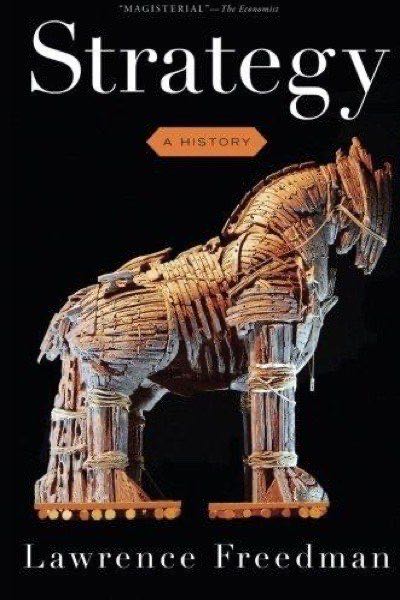
Strategy: A History - 2,500 Years of Strategic Thought Evolution
Why Read This
Lawrence Freedman chronicles 2,500 years of strategic thinking from primate behavior to modern business strategy, revealing that strategy is always about uncertainty, social context, and adaptability.
His central thesis: strategy is improvisation in the face of constantly changing reality, with rational planning serving only as the opening sketch. This book traces the evolution of strategic thought through war, politics, and business, shattering the illusion that strategy can be predicted or formulated with certainty.
What makes this book extraordinary is how Freedman reveals recurring patterns: every generation seeks a magic formula for victory through decisive battle, nuclear deterrence, or business frameworks. Reality proves there are no shortcuts. The best strategy stays flexible and responsive, breathing with the situation as it unfolds.
This book is relevant for anyone making decisions under uncertainty, reminding us that effective strategy keeps adapting across many scenarios, like a river that finds its way through every terrain. Freedman connects classical military strategy with modern decision-making in business, politics, and personal life.
Why This Book Matters
Freedman dismantles major myths about strategy that have persisted for centuries. He demonstrates that strategy is an art requiring judgment, wisdom, and adaptability, far beyond the realm of exact science. In an era where Big Data and AI promise to "solve everything," this book is a powerful antidote to the cult of optimization and illusory certainty.
Each chapter presents case studies from various contexts (military, business, politics) showing that the same principles apply everywhere. This provides a framework for understanding why many strategies fail and what makes some endure. More importantly, the book teaches that the most important strategic skill is the ability to improvise and adjust when reality deviates from the plan.
Key Points
-
The Dichotomy of Biē vs Mētis - Ancient Greek tradition distinguished biē (direct force) from mētis (indirect cunning). Cunning Odysseus defeated mighty Ajax. In the long run, mētis tends to outlast biē because cleverness and adaptability are more sustainable than physical strength.
-
Fog of War is the Essence of Strategy - Clausewitz introduced the concept of fog of war: structural uncertainty in conflict. Napoleon understood this well and didn't try to eliminate it, but used it. Battles like Verdun and Somme in World War I demonstrated the fatal failure of assuming war could be fully predicted.
-
Decisive Battle is an Illusion - After Napoleon, many military thinkers became obsessed with decisive battle that totally destroys the enemy. However, Ulysses Grant understood that the American Civil War would not be won with one great battle, but through attrition: gradual erosion of enemy strength that couldn't be replaced.
-
Strategy as Narrative - Martin Luther King Jr. was a master strategist because he built a powerful narrative about nonviolent resistance against brutal oppression, far beyond any military plan. Every time police attacked peaceful demonstrators, King's narrative was reinforced.
-
Guerrilla Warfare for the Weak - Mao Zedong divided guerrilla war into three phases: strategic defensive, strategic stalemate, and strategic offensive. Vietnam proved that the Viet Cong made occupation costs so high that US public support evaporated. The 1968 Tet Offensive was a military defeat but a strategic victory.
-
Nuclear Strategy and the Paradox of Deterrence - Mutually Assured Destruction transformed strategy from "how to win war" to "how to prevent war." The Cuban Missile Crisis showed how Kennedy and Khrushchev used signaling and backchannels to retreat without total humiliation, creating stability through credible threats.
-
Business Strategy Has Limits - Henry Mintzberg critiqued deliberate strategy and proposed emergent strategy: strategy formed through trial and error. Amazon, Apple, and Google stay flexible in execution while keeping very clear principles like customer obsession and innovation.
-
Bounded Rationality and Cognitive Biases - Kahneman and Tversky showed that expert forecasters are no more accurate than random chance. The Vietnam War exemplified overconfidence: US planners believed that superior firepower would inevitably win, ignoring evidence that guerrilla warfare and political will could defeat military might.
The Dichotomy of Biē vs Mētis: Direct Force vs Indirect Cunning
Ancient Greek tradition introduced two fundamental approaches in strategy. Biē is direct, brutal, frontal force that crushes opponents with physical superiority. Mētis is sly cunning, deception, and indirect approach using trickery to overcome superior strength.
Biē: Direct Force in the Hoplite Tradition
Ancient Greece glorified biē in the context of hoplite warfare, where phalanx formations faced each other in open fields. Courage and physical strength were honored as the highest virtues. However, this approach had limitations: direct confrontation required massive resources and produced high casualties.
In the Peloponnesian War, Sparta relied on biē as a rigid, frontal land force. Their strategy was direct invasion of Attica every year to force Athens to fight on land. This strategy failed in practice because Athens avoided direct battle.
Mētis: Cunning in Mythology and Strategy
In Greek mythology and literature, mētis often won. Cunning Odysseus defeated mighty Ajax. The Trojan Horse is the perfect example: disguising as a gift to infiltrate enemy fortifications. Athena, goddess of wisdom, reached for stratagem first, leaving violence as a last resort.
Athens in the Peloponnesian War relied on naval dominance and indirect strategy. Pericles developed a strategy of avoiding land battles and relying on naval power to attack Sparta's weak points. This strategy succeeded until Athens was tempted to use biē in the Sicilian Expedition, which ended in total disaster.
Key insight: In the long run, mētis tends to be more sustainable than biē. Physical strength declines, but cunning and adaptability endure. This explains why many great empires dependent on biē eventually collapsed, while cultures that valued mētis like Athens in its Golden Age left a stronger intellectual legacy.
Modern Application: Startup vs Incumbent
This dichotomy reaches far beyond ancient history, standing as an enduring framework for understanding strategic conflict. In business, startups rely on mētis to fight incumbents who possess biē in the form of resources and market share. Startups carve their path through disruptive innovation, slipping past head-to-head competition with the larger player.
In negotiation, the weaker party uses framing and timing to overcome their opponent's strength. They sidestep the domain of strength altogether, opening a new domain where cunning becomes the more valuable currency.
Fog of War: Uncertainty as the Essence of Strategy
Clausewitz introduced the concept of fog of war: structural uncertainty in conflict where information is incomplete, situations change rapidly, and decisions must be made without perfect data. This is the normal condition of every strategic conflict, far from being an anomaly.
Friction: The Gap Between Plans and Reality
Friction is the difference between plans on paper and execution in the field. Bad weather, broken communications, exhausted troops, all create unpredictable obstacles. Napoleon understood friction very well and turned it into an advantage, well beyond any effort to eliminate it.
Napoleon moved quickly to create uncertainty for the enemy, while building better communication systems to reduce uncertainty on his side. Speed and flexibility were Napoleon's ways of exploiting the fog of war.
The Failure of Prediction in World War I
Many 19th-century generals believed that science and technology could eliminate the fog of war. They made detailed, rigid plans, then failed when reality didn't match expectations. Battles like Verdun and Somme demonstrated the fatal failure of assuming war could be fully predicted and controlled.
Germany's Schlieffen Plan for World War I was designed for a decisive victory in six weeks through a lightning attack on France. The plan was highly detailed and precise, but failed because Belgium resisted longer than expected, Russia mobilized faster than predicted, and France didn't collapse as hoped.
Modern Technology and the Information Paradox
Modern technology like satellites, drones, and AI reduces the fog of war in some aspects, but creates new uncertainty in others. We have more data, but it's harder to separate signal from noise. We can see the enemy in real-time, but don't know their intentions.
This paradox is highly relevant in today's information age. Businesses have access to massive data analytics, yet still can't predict how competitors will react or how consumer behavior will change. Politics has sophisticated polling, yet still fails to predict election results.
Key insight: Good strategy must build optionality and resilience alongside efficiency. Plans that are too detailed and rigid will collapse when the first assumption is violated. Better to have flexible guiding principles and the ability to adapt quickly.
Decisive Battle vs Attrition: The Illusion of Total Victory
After Napoleon, many military thinkers became obsessed with the concept of decisive battle: one great battle that totally destroys the enemy and ends the war quickly. However, history shows that true victory more often comes from attrition: gradual erosion of enemy strength through a series of small battles and economic pressure.
The Myth of Decisive Battle in Military Planning
The myth of decisive battle dominated military thinking in the 19th and early 20th centuries. Germany's Schlieffen Plan for World War I was designed for a decisive victory in six weeks through a lightning attack on France, imitating Napoleon's victory at Austerlitz. The plan failed, and the war became four years of attrition.
The obsession with decisive battle reflects a human cognitive bias: we want quick, total solutions. We grow weary of the slow, grinding process of attrition. But in practice, most complex conflicts are won through persistent effort spread across many seasons, with the single breakthrough proving rare.
Ulysses Grant and the Strategy of Attrition
Ulysses Grant understood that the American Civil War would not be won with one great battle. He used attrition: continuously attacking Lee, grinding down Confederate troops that couldn't be replaced, cutting supply lines, and finally forcing surrender through exhaustion, with annihilation never as the aim.
Grant was criticized for high casualties, but he understood the fundamental math: the Union had more men and resources than the Confederacy. In a war of attrition, the side with greater resources wins if they're willing to sustain the cost.
Application in Modern Business
In business, startups chasing viral moments or killer features often fail. Winners are those who consistently improve products, build their customer base, and grind through years of incremental progress. Amazon won with 20 years of attrition against traditional retail, far beyond any single innovation.
Modern technology makes decisive battle increasingly difficult. Nuclear weapons created Mutually Assured Destruction, eliminating the possibility of decisive victory. Cyber warfare is pure attrition: continuous breach and patch, with no clear end.
Key insight: Most complex conflicts are won through persistent effort, not a single breakthrough. Focus on process, not outcome. Build capacity to sustain long-term effort.
Strategy as Narrative: The Power of Story in Social Conflict
Freedman argues that strategy is fundamentally a narrative: the story we tell ourselves and others about what's happening, why, and what should be done. This narrative shapes perception, motivates action, and creates coalitions. Winning strategies are often those with the most powerful narratives, far beyond what pure logic alone would predict.
Martin Luther King Jr. and Nonviolent Resistance
Martin Luther King Jr. was a master strategist because he built an extremely powerful narrative: nonviolent resistance against brutal oppression, far beyond any military plan. Every time police attacked peaceful demonstrators, King's narrative was reinforced.
King understood that the civil rights movement wouldn't win through physical confrontation. He used framing: demonstrators were moral heroes, police were brutal villains. This narrative resonated with American values of freedom and justice, creating political pressure that couldn't be ignored.
Steve Jobs and the "Think Different" Narrative
In business, Steve Jobs built the "Think Different" narrative for Apple. This was about identity: Apple users are rebels, innovators, and creative thinkers, reaching far beyond technical product specifications. This narrative created brand loyalty far stronger than rational advertising about product features.
Apple didn't compete in the domain of technical specifications with PCs. They created a new domain: identity and lifestyle. A powerful narrative made people willing to pay a premium for Apple products because they were buying into a story, and with it a device.
The Danger of Narrative Trap
Freedman also warns that narrative can become a trap. When we're too committed to one story, we ignore contradictory evidence. This happened with the Bush administration's "WMD in Iraq" narrative: they were too invested in that story to back down when evidence didn't support it.
An effective narrative must balance compelling storytelling with factual accuracy. If a narrative strays too far from reality, it will collapse when evidence emerges. Credibility is a strategic asset that's hard to build but easy to destroy.
Key insight: Before making strategic plans, ask "what story do we want to tell?" alongside "what is our goal?" A powerful narrative makes people willing to sacrifice, work harder, and stay committed when initial plans don't go as expected.
Guerrilla Warfare: Strategy of the Weak Against the Strong
Guerrilla warfare is an asymmetric strategy where the militarily weaker side avoids direct battle and uses hit-and-run tactics, blending with civilian populations, and gradually eroding enemy strength. The key to success lies in making the cost of occupation too high for the stronger side, far beyond winning conventional battles.
Mao Zedong's Three Phases of Guerrilla War
Mao Zedong developed a theory of guerrilla warfare that became the template for revolutionary movements worldwide. Mao divided guerrilla war into three phases:
-
Strategic Defensive - The weak side defends, avoids major battles, builds base areas. Focus on survival and recruitment, not victory.
-
Strategic Stalemate - Guerrilla tactics increase, the enemy becomes frustrated, popular support grows. This is the longest and most critical phase.
-
Strategic Offensive - When strong enough, transition to conventional warfare. This is the riskiest phase because it exposes forces to open battle.
Vietnam War as Case Study
Vietnam is the perfect case study for guerrilla warfare. The Viet Cong and North Vietnamese Army couldn't defeat the US military in open battle. But they made occupation costs so high in blood and money that US public support evaporated.
The 1968 Tet Offensive was a military defeat for North Vietnam. They lost thousands of fighters and failed to spark an uprising in South Vietnam. But Tet was a strategic victory because it changed the narrative in America: if the enemy could launch a major offensive after years of "winning," it meant the war would never end.
Application in Business and Politics
Guerrilla warfare isn't just military tactics, but a mental model applicable in many contexts. In business, startups use guerrilla marketing: low budget, high creativity, targeting niches ignored by incumbents. They create a beachhead in small segments and then expand, sidestepping head-to-head competition.
In politics, social movements use guerrilla tactics: protests, civil disobedience, viral campaigns. They lack formal power, but can make the status quo politically untenable.
Limitations of Guerrilla Strategy
Guerrilla warfare has limitations. It can't work against brutal regimes that don't care about civilian casualties, like Russia in Chechnya. It's also hard to sustain without external support in the form of weapons, funding, and safe havens. And the transition from guerrilla to conventional force is very difficult and often fails.
Key insight: Guerrilla strategy is about time arbitrage. The weak side bets that time is on their side. They don't need to win, they just need to not lose until the strong side gives up.
Nuclear Strategy and Game Theory: The Paradox of Deterrence
Nuclear weapons fundamentally changed the nature of strategy by creating the condition of Mutually Assured Destruction. In the nuclear world, traditional military victory became impossible. Strategy shifted from "how to win war" to "how to prevent war" through deterrence. This gave birth to the application of game theory in strategic thinking.
Bernard Brodie and the Logic of Deterrence
Bernard Brodie was one of the first thinkers to understand the revolutionary implications of nuclear weapons. He realized that nukes couldn't be used to win wars, but only to prevent wars. The military objective changed from winning wars to preventing wars.
Deterrence works by making the cost of attack too high to contemplate. If you attack, we both perish. But for deterrence to work, the threat must be credible. If the enemy doesn't believe you'll retaliate, deterrence fails.
Thomas Schelling and "The Threat That Leaves Something to Chance"
Thomas Schelling developed the concept of brinkmanship: you don't need to commit to suicidal retaliation, you just need to make the enemy fear there's a risk of uncontrolled escalation. This is the strategy of "the threat that leaves something to chance."
Schelling showed that in a game of chicken, the winner is the one who can credibly signal they can't back down. But if both sides can't back down, a crash is inevitable. The solution is maintaining communication channels to de-escalate before it's too late.
Cuban Missile Crisis: The Ultimate Test Case
The Cuban Missile Crisis was the ultimate test case for nuclear deterrence. Kennedy and Khrushchev played chicken: who would back down first? Kennedy used a blockade instead of an invasion to give Khrushchev room to retreat without total humiliation.
Backchannels between Robert Kennedy and the Soviet Ambassador enabled a deal: the USSR withdrew missiles from Cuba, the US withdrew missiles from Turkey quietly. Both sides could claim victory. This demonstrated the importance of face-saving in strategic interaction.
Application in Negotiation and Business
Nuclear strategy teaches us about the importance of signaling and credibility in strategic interactions. In negotiation, if you threaten to walk away but never actually do, your threat becomes non-credible. Conversely, if you occasionally walk away from bad deals, future threats become more believable.
Deterrence has a paradox: the more effective the deterrence, the less likely it is to be used, which makes people doubt its credibility. This is the stability-instability paradox: stability at the nuclear level creates space for conventional conflict and proxy wars.
Key insight: The most effective weapon is one that is never used. The art of nuclear strategy is the art of making threats credible without ever having to carry them out.
Business Strategy: From Military Analogy to Corporate Reality
In the 1960s, the concept of strategy was imported from the military world to the business world. Peter Drucker, Alfred Chandler, and Igor Ansoff were pioneers who built the field of business strategy. They believed that principles of military strategy could be adapted for corporate context. However, Freedman shows that this analogy has limits.
Alfred Chandler: Structure Follows Strategy
Alfred Chandler studied the evolution of American corporations and found that organizational structure follows strategic goals. Companies that expand to multiple products or geographies need to change structure from functional to divisional. This is a fundamental insight about alignment between strategy and organization.
Chandler showed that many companies fail because structure doesn't support strategy, far more often than because of bad strategy itself. Organizational inertia is the greatest obstacle to strategic change.
Igor Ansoff and Corporate Planning
Igor Ansoff developed the highly influential growth matrix: market penetration, market development, product development, and diversification. This framework provided structure for strategic choice. But Ansoff was too optimistic about the capability of rational planning.
Ansoff believed that with enough analysis, companies could predict the future and design optimal strategy. His models were highly detailed and quantitative, as if business were an exact science. Reality shows that business, like war, is filled with uncertainty and friction.
Henry Mintzberg: Emergent Strategy
Henry Mintzberg critiqued deliberate strategy and proposed emergent strategy: strategy formed through trial and error, not top-down planning. Mintzberg showed that realized strategy is often very different from intended strategy.
Successful companies like Amazon, Apple, and Google stay flexible in execution while keeping very clear principles. Amazon focuses on customer obsession. Apple focuses on design excellence. Google focuses on organizing information. These principles guide decision-making in various situations.
Limits of Military Analogy
Military metaphors in business, like war, battle, and killing the competition, can be misleading. In war, the goal is to destroy the enemy. In business, the goal is to create value. Sometimes collaboration is more profitable than competition through ecosystems, platforms, and partnerships.
Competitive advantage is not static. Porter's framework is useful for snapshot analysis, but less useful for dynamic environments where rules constantly change. Disruption often comes from outside the industry, with existing competitors caught off guard.
Key insight: Business strategy is not about making perfect five-year plans, but about creating organizational capability to adapt and learn. Principles are more important than plans.
Behavioral Economics and Bounded Rationality: Limits of Rational Strategy
The basic premise of much strategic theory is that actors behave rationally: they have clear objectives, evaluate options objectively, and choose what maximizes utility. However, behavioral economics shows that humans are systematically irrational. We have cognitive biases that make our strategic decisions often suboptimal.
Kahneman and Tversky: Systematic Irrationality
Daniel Kahneman and Amos Tversky showed that expert forecasters are no more accurate than random chance in predictions. Yet they're highly confident about their predictions. Overconfidence is one of the most dangerous biases in strategic decision making.
Prospect theory shows that we fear losses more than we value gains. Loss aversion makes us too risk-averse in the domain of gains and too risk-seeking in the domain of losses. We evaluate outcomes relative to a reference point, with absolute terms slipping out of view.
Vietnam War and Overconfidence
In the context of military strategy, overconfidence caused many disasters. The Vietnam War is a classic example: US planners believed that superior firepower and technology would inevitably win. They ignored evidence that guerrilla warfare and political will could defeat military might.
Sunk cost fallacy made the US continue investing in a failing war because they didn't want to "admit defeat." Each escalation was justified by the investment already made. This is a textbook example of throwing good money after bad.
New Coke and Sunk Cost Fallacy
In business, sunk cost fallacy makes companies continue investing in failing projects. New Coke is a classic example: Coca-Cola invested heavily in reformulation, then wouldn't back down despite strong consumer backlash. They were too committed to the decision to admit the mistake.
Confirmation bias makes decision makers seek evidence that supports their strategy and ignore contradictions. Availability heuristic makes us overweight recent or vivid examples in strategic thinking. Planning fallacy makes us underestimate time and resources needed to execute strategy.
Mitigating Cognitive Biases
Awareness of biases isn't enough to eliminate them. Even experts who know about biases remain victims of them. More effective is changing the decision-making environment:
-
Pre-mortem - Before executing strategy, imagine the strategy has already failed. What might have caused the failure? This is a forcing function to identify blind spots.
-
Red Team - Assign people to actively challenge strategic assumptions and argue against proposed strategy. This prevents groupthink and surfaces weak points.
-
Incremental Commitment - Don't go all-in on one strategy. Test with small bets, learn, then scale. This limits the downside of being wrong.
Key insight: Rationality is not the natural state of strategic decision-making. It is an achievement that requires discipline, humility, and constant vigilance against our cognitive limitations.
Playwright vs Strategist: Improvisation in Uncertainty
Freedman ends the book with a powerful metaphor: strategists are more like playwrights than engineers. Playwrights write scripts, but can't control how actors will perform, how audiences will react, or how external events will disrupt the show. Similarly, strategists can make plans, but can't control how those plans will unfold in chaotic reality.
Script as Framework, Not Instruction Manual
Strategic plans are scripts that provide direction, but not rigid instruction manuals. Actors must improvise when reality deviates from the script. Effective strategy can adjust based on feedback from the environment.
Germany's Schlieffen Plan for World War I was highly detailed and precise. But when Belgium resisted longer than expected, when Russia mobilized faster than predicted, and when France didn't collapse as hoped, the entire plan unraveled. Germany had no contingency because planners believed precision planning could eliminate uncertainty.
Napoleon, Lincoln, Churchill: Masters of Improvisation
Successful strategists like Napoleon, Lincoln, and Churchill were masters of improvisation. They had clear principles but were highly flexible in tactics. Napoleon focused on speed and concentration of force. Lincoln focused on preserving the Union. Churchill focused on never surrendering.
These principles guided decision-making in various situations without dictating specific actions. When circumstances changed, principles remained relevant but tactics could be adjusted. This is the balance between consistency and flexibility.
Jazz Improvisation as Analogy
Jazz musicians improvise, but they have a deep understanding of music theory and years of practice. Similarly, strategic improvisation requires deep knowledge, experience, and judgment. Improvisation isn't the same as having no plan or making it up as you go.
Effective improvisation requires:
- Deep Knowledge - Understanding of context, history, and patterns
- Clear Principles - Framework to evaluate options quickly
- Tight Feedback Loops - Ability to rapidly detect when assumptions are wrong
- Optionality - Always have Plan B and C and D
Key insight: Good strategy is not the most detailed or most clever, but the most adaptive. In an uncertain and complex world, the ability to improvise and adjust is more valuable than the ability to plan perfectly.
Conclusion and Reflection
Lawrence Freedman has written a definitive history of strategy spanning 2,500 years from Greek hoplites to modern corporate boardrooms. His central thesis is that strategy is always about navigating uncertainty, adapting to changing circumstances, and influencing the behavior of actors you can't control.
There's no magic formula for successful strategy. What exists are principles that can guide thinking, and skills to improvise when reality deviates from the plan. Every generation believes they've discovered the formula to eliminate uncertainty: decisive battle, superior firepower, nuclear deterrence, business frameworks. All have proven too optimistic.
What endures are strategists who are humble about the limitations of prediction, who maintain flexibility in execution, and who deeply understand that strategy is fundamentally about human behavior, with mechanical optimization playing only a supporting role.
Universal Principles from the History of Strategy
Freedman identifies recurring patterns throughout history:
- Accept Uncertainty as a Fundamental Condition - Fog of war can't be eliminated, only managed
- Focus on Adaptability over Optimization - Systems too optimized for one scenario will be fragile
- Build a Compelling Narrative - Strong stories align stakeholders and create momentum
- Use Asymmetric Approaches When the Underdog - Mētis defeats biē in the long run
- Learn to Improvise in Real-Time - Principles are more important than detailed plans
- Understand Biases That Distort Judgment - Build processes to counteract cognitive limitations
- Maintain Optionality and Avoid All-In Bets - Preserve flexibility to pivot when circumstances change
Relevance for Modern Life
This book is a powerful antidote to the cult of planning and optimization that dominates modern culture. We live in an era where data analytics, AI, and predictive models promise to eliminate uncertainty. Freedman reminds us that uncertainty is a feature, not a bug, of the strategic environment.
Whether you're a startup founder, corporate executive, political activist, or someone who wants to make better decisions, the same principles apply. Strategy is an art, not a science. You can't reduce it to formulas or frameworks. You need judgment, experience, and wisdom to navigate the complexity of strategic challenges.
But by understanding the history of strategic thought, you can avoid repeating past mistakes and build on insights that have been proven over centuries. This is a book that should be reread every few years. Each time you read it, with different context and experience, you'll find new insights relevant to the challenges you face at that moment.
FAQ
Q: What's the fundamental difference between biē and mētis in ancient Greek strategy? A: Biē is direct, frontal force that crushes opponents with physical superiority, like hoplite phalanx formations. Mētis is cunning and indirect approach through trickery, like Odysseus's Trojan Horse. In the long run, mētis tends to endure longer because cunning is more sustainable than physical strength.
Q: Why does decisive battle often fail in military history? A: Decisive battle assumes one great battle can totally destroy the enemy and end the war quickly. But reality shows that fog of war, friction, and uncertainty make prediction and total control impossible. The Schlieffen Plan for World War I is an example of the fatal failure of this assumption.
Q: How did Martin Luther King Jr. use narrative as strategy? A: King built a narrative about nonviolent resistance against brutal oppression. Every time police attacked peaceful demonstrators, King's narrative was reinforced. He didn't win with physical force, but with the power of a story that resonated with American values of freedom and justice.
Q: What makes guerrilla warfare effective against stronger forces? A: Guerrilla warfare avoids direct battle and makes the cost of occupation too high for the stronger side. The Vietnam War proved that the Viet Cong made occupation costs so high in blood and money that US public support evaporated. The 1968 Tet Offensive was a military defeat but a strategic victory.
Q: How did nuclear weapons change the nature of strategy? A: Nuclear weapons created Mutually Assured Destruction, making traditional military victory impossible. Strategy shifted from "how to win war" to "how to prevent war" through deterrence. The Cuban Missile Crisis demonstrated the importance of signaling, credibility, and face-saving in strategic interaction.
Q: Why can't business strategy fully follow military analogy? A: In war, the goal is to destroy the enemy. In business, the goal is to create value. Sometimes collaboration is more profitable than competition. Henry Mintzberg showed that emergent strategy through trial and error is often more effective than deliberate strategy through top-down planning.
Q: What are the most dangerous cognitive biases in strategic decision making? A: Overconfidence makes us overestimate our ability to predict and control events. Sunk cost fallacy makes us continue investing in failing projects. Confirmation bias makes us seek evidence that supports our strategy and ignore contradictions. Kahneman and Tversky showed that expert forecasters are no more accurate than random chance.
Q: Why is improvisation important in strategy according to Freedman? A: Freedman uses the playwright metaphor: strategists write scripts but can't control how actors will perform or how external events will disrupt the show. Successful strategists like Napoleon, Lincoln, and Churchill had clear principles but were highly flexible in tactics to adapt when reality deviated from plans.
Q: How do you mitigate cognitive biases in strategic planning? A: Pre-mortems help identify blind spots by imagining the strategy has already failed. Red Teams actively challenge assumptions to prevent groupthink. Incremental commitment through small bets limits the downside of being wrong. Awareness of biases isn't enough, we need to change the decision-making environment.
Q: What's the most important lesson from "Strategy: A History"? A: Good strategy is not the most detailed or clever, but the most adaptive. In an uncertain and complex world, the ability to improvise and adjust is more valuable than the ability to plan perfectly. Focus on principles that guide decision-making, not on detailed plans that quickly become obsolete.
Further Reading
If you want to deepen your understanding of strategy, consider these additional resources:
- "Good Strategy Bad Strategy" by Richard Rumelt - Critique of poor strategic planning and framework for better strategy
- "Thinking, Fast and Slow" by Daniel Kahneman - Deep exploration of cognitive biases and heuristics in decision-making
- Mental Model: Fog of War - Understand uncertainty and how to navigate it in decision-making
- Mental Model: Second-Order Thinking - Extension of Freedman's concepts about strategic foresight
- "The Art of War" by Sun Tzu - Classic text on military strategy that Freedman references