Why Read This
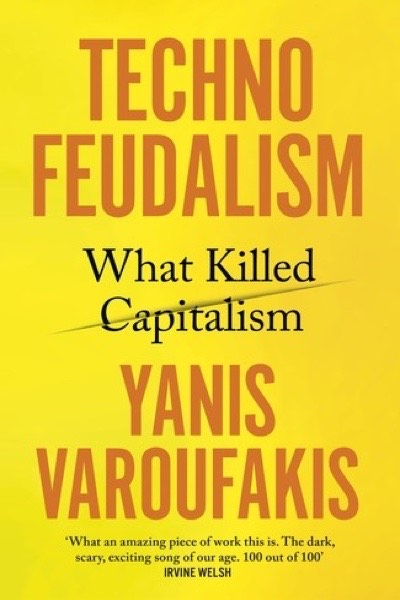
Varoufakis argues capitalism is dead, replaced by technofeudalism: cloud capital has overthrown profit and markets with cloud rent and cloud fiefs.
This Greek economist and former Finance Minister goes beyond activist rage at Big Tech. He pinpoints exactly where the fundamental transformation occurred: when Bezos, Zuckerberg, and Musk built cloud capital that turned all of us into cloud serfs working for free to reproduce their power.
The irony at the heart of his argument: what killed capitalism is capital itself. Cloud capital, a new mutation distinct from machines and factories, grew so powerful that, like a voracious virus, it killed its own host.
This book matters for three reasons. First, it provides a conceptual framework for understanding why traditional antitrust solutions fail against Big Tech. Second, it explains the connection between the 2008 crisis, central bank money printing, and the rise of cloudalists. Third, it envisions a way out through the fundamental democratization of cloud capital, going far beyond regulation or monopoly-breaking.
Who is this book for? You who sense something is fundamentally wrong with the modern digital economy and want language to articulate it. You who believe "capitalism with problems" can be fixed with regulation alone. You who want to understand why Big Tech wealth grows exponentially while the real economy stagnates.
Key Points
-
Cloud capital is a new mutation - Cloud capital possesses a third capability never before held by capital: produced means of behavioural modification and individuated command, reaching far beyond ordinary machines or software. Alexa goes far beyond speeding up work; she trains us to train her to train us in an endless dialectical loop.
-
Profit replaced by cloud rent - The difference between rent and profit is qualitative: profit is vulnerable to market competition, rent is not. Apple and Google collect 30 percent ground rent from all developer revenue without producing anything. This is pure rent for controlling access, far removed from profit earned through a better product.
-
Markets replaced by cloud fiefs - Amazon.com looks like a market but is not a market. Cloudalist algorithms isolate each buyer from other buyers, each seller from other sellers, then match them centrally, the exact opposite of a decentralized market.
-
Universal exploitation replaces traditional exploitation - While capitalists can only exploit their own employees, cloudalists benefit from the exploitation of everyone. Cloud serfs work for free, cloud proles work at depressed wages, vassal capitalists pay cloud rent. Cloudalists extract value from everyone without exception.
-
Central banks funded the rise of technofeudalism - Between 2010 and 2021, the wealth of Bezos and Musk rose from less than $10 billion to approximately $200 billion each. The rise came because central bank money flowed freely post-2008 crisis, pumping up tech giant stock prices, well beyond what traditional profit could explain. In attempting to save capitalism, central banks funded its transformation into technofeudalism.
-
The New Enclosures: privatization of digital identity - Like the Enclosure of common land in the 18th century, cloudalists have enclosed our digital identity. Facebook owns who you like, Google owns what you search, Apple owns where you go, Spotify owns what you feel. You own nothing. This is a political choice that could be made differently, far from any technological inevitability.
-
Cloud rebellion: collective action calculus reversed - Cloud mobilization reverses conventional logic: instead of maximum personal sacrifice for minimal collective gain, now minimal personal sacrifice (not visiting Amazon for one day) produces massive collective gain (stock price collapse). The infrastructure cloudalists use to dominate us can also become a tool to fight them.
-
Fundamental democratization that goes deeper than superficial regulation - Varoufakis proposes democratizing corporations (one employee one share one vote), democratizing money (central banks provide free digital wallets for all with UBI), and democratizing the cloud (media algorithms calibrated by local public media centers). This is genuinely pro-market, far removed from any anti-market stance.
Cloud Capital: A New Power Surpassing Traditional Capital
Cloud capital is an agglomeration of networked machinery, software, AI-driven algorithms, and communications hardware spanning the entire planet. Physically, it is not much different from the digital infrastructure we know: server farms, fiber optic cables, data centers. What makes it revolutionary is its function.
Traditional capital has two properties: as a means of production (machines, buildings) and as a social relation that gives its owner extractive power over non-owners. The plow is capital because it increases agricultural productivity. The plow is also capital because if I own it and you do not, I gain the power to make you work for me for wages.
Cloud capital adds a third dimension never before possessed by capital: produced means of behavioural modification and individuated command. It transforms millions of ordinary people into unpaid workers who voluntarily reproduce cloud capital itself, reaching far beyond ordinary acceleration of labor or production.
From Don Draper to Alexa: The Leap in Power
Varoufakis uses a sharp comparison between Don Draper and Alexa to illustrate the leap in cloud capital power. Don Draper, the legendary creative director from the television advertising era, represents the peak of capitalism's ability to modify consumer behavior. He sells us the sizzle, leaving the steak as an afterthought. He weaponizes our nostalgia to sell chocolate bars and greasy burgers.
With Don, at least we had a fighting chance. It was his intelligence against ours. Don worked through a one-way street: through the television medium, he planted manufactured desires in our subconscious. Done. We could still, if conscious enough, resist his manipulation.
With Alexa, we have no chance. Her commanding power is systemic, crushing, cosmic. Alexa ensnares us in an infinite dialectical loop: we train Alexa to do things on our behalf. After we train her algorithm and give her data about our habits, Alexa begins to train us. She trains us to train her to train us to train her to train us endlessly.
Don Draper might be a genius. He was still human, prone to fatigue, prone to misjudgment, and could only manipulate the masses in aggregate. Alexa stays tireless, learns continuously from every error, and most importantly: she modifies behavior individually. Each user receives manipulation customized specifically for them. This is a form of power without precedent in the history of capitalism.
Key insight: Cloud capital marks a qualitative leap in the nature of capital itself, from a means of production to a means of individuated and unlimited behavioral modification.
Two Pillars of Capitalism That Collapsed
Cloud capital has destroyed the two main pillars of capitalism: markets and profits. Of course, markets and profits still exist everywhere. Even under feudalism they did. What has changed is they no longer run the show. In the last two decades, profit and markets have been expelled from the center of our economic system, pushed to the periphery, and replaced.
Markets Replaced by Cloud Fiefs
Digital trading platforms like Amazon.com or alibaba.com look like markets but are not markets. The reason is that cloudalist algorithms successfully isolate each buyer from every other buyer, and each seller from every other seller. As a result, the cloudalist algorithm concentrates in itself the power to match buyers and sellers, which is the exact opposite of what a market should be: decentralized.
In a true market, prices are determined by free interaction between many buyers and many sellers. No single party controls information or access. On Amazon, the algorithm determines which products you see, in what order, at what price. Sellers cannot communicate directly with other buyers to learn competitive prices. Buyers cannot communicate with other buyers to coordinate. All communication must pass through the cloud fief controlled by Amazon.
This is a radical centralization of what should be a decentralized process. Cloud fiefs replace markets, far beyond any evolution within them.
Profit Replaced by Cloud Rent
Under capitalism, the difference between rent and profit is qualitative: profit is vulnerable to market competition, rent is not. Sony's profit from the Walkman was eroded by competitors until Apple entered with the iPod. Meanwhile, Jack's rent from land in a gentrifying neighborhood rises even if he does nothing. He becomes richer while sleeping.
Cloud rent is a stronger new form than feudal rent. Apple and Google collect 30 percent ground rent from all revenue of third-party developers selling apps through the App Store or Google Play. This is pure rent, digital ground rent, extracted because they control access to consumers, far removed from profit earned through a better product. Developers have no choice: to reach users, they must pay tribute.
The difference from traditional feudal rent is that cloud rent is not geographically limited and can be extracted from millions of vassal capitalists simultaneously. A feudal landlord could only extract rent from farmers on his land. Cloudalists extract rent from millions of businesses worldwide that need access to their platforms. This is exploitation at a scale rarely seen before.
Key insight: When Jeff Bezos becomes richer not because Amazon sells more of its own products, but because millions of businesses pay for access to his platform, we know capitalism has been replaced by something else.
New Class Structure: From Bourgeoisie-Proletariat to Cloudalists-Serfs
Technofeudalism creates a class structure different from classical capitalism. Marx identified two main classes: the bourgeoisie (owners of means of production) and the proletariat (sellers of labor). Varoufakis shows that a new class structure has emerged.
Cloudalists: The New Ruling Class
Cloudalists are the new ruling class, owners of cloud capital like Jeff Bezos (Amazon), Mark Zuckerberg (Meta), Larry Page and Sergey Brin (Google), Jack Ma (Alibaba), Pony Ma (Tencent). They own the digital infrastructure that serves as the gateway to modern economic access, far beyond merely being rich.
The difference between traditional capitalists and cloudalists is fundamental. Henry Ford owned a car factory. Bezos owns the infrastructure that is a prerequisite for participating in the digital economy. Ford had to compete in the car market. Bezos owns the market itself.
Vassal Capitalists: Capitalists Who Pay Tribute
Vassal capitalists are capitalist producers who, to sell their commodities, must pay cloud rent for access to cloudalist cloud fiefs. This includes millions of small businesses selling on Amazon, app developers who must go through the App Store, even large manufacturers like Sony or Blackberry who had to install Android to survive.
They are still capitalists in the sense that they own means of production and exploit labor. At the same time, they are vassals in the sense that they must pay tribute to cloudalists for access to consumers. Their relationship with cloudalists is more like that of farmers with feudal landlords than the relationship between two capitalists in a competitive market.
Cloud Serfs: All of Us Working for Free
Cloud serfs are people who work for free to reproduce cloud capital. Every time you upload a photo to Instagram, write a review on Amazon, post a video on TikTok, or even just search and click, you are a cloud serf working without wages to enrich cloudalists.
Feudal serfs worked on the landlord's land to produce surplus extracted as rent. Cloud serfs work on cloudalist platforms to produce data, content, and network effects extracted as cloud rent. The difference is that cloud serfs do it voluntarily, even happily, because algorithms have trained us to train them.
Cloud Proles: Workers Commanded by Algorithms
Cloud proles are wage workers whose work is guided and accelerated by cloud capital, Amazon warehouse workers whose every movement is monitored by algorithms, Uber drivers whose routes are determined by apps, call center workers whose scripts and performance are managed by AI.
They differ from the traditional proletariat in one important way: their boss is an unaccountable algorithm, with no human counterpart open to negotiation. Traditional strikes assume there is a human on the other side willing to bargain. Algorithms refuse to negotiate.
Universal Exploitation: Exploitation Without Limits
This class structure creates what Varoufakis calls universal exploitation: while capitalists can only exploit their own employees, cloudalists benefit from the exploitation of everyone. Cloud serfs work for free. Cloud proles work at depressed wages. Vassal capitalists pay cloud rent from the surplus value they extract from their employees. Cloudalists extract value from everyone without exception.
The concept of universal exploitation is the central theoretical contribution of this book. It explains why cloudalist wealth grows exponentially while the real economy stagnates. They profit from their own production and, beyond that, extract rent from the entire digital economic ecosystem, and in the modern world, almost all economy is digital.
Key insight: Capitalist Ford only profits if he sells cars. Cloudalist Bezos profits every time anyone sells anything on his platform, every time anyone clicks anything on his website, every time anyone uploads a product review. This is not profit; this is universal rent.
How Central Banks Funded the Cloudalist Kingdom
The crucial question: how did cloudalists build their kingdom without doing the things capitalists usually must do, borrow from banks, sell shares, or generate big profits? The answer: they helped themselves to rivers of money printed by the central banks of advanced capitalist nations.
Morning of August 12, 2020: When the Money World Split From the Real World
The morning of August 12, 2020, in London was a marker moment. UK national income fell 20.4 percent, the worst recession in history. Fifteen minutes later, the London Stock Exchange rose 2.3 percent. The money world had split from the capitalist world.
Traders thought: "When things are this bad, the Bank of England panics. And what have panicking central banks been doing since the 2008 crisis? They print money and give it to us."
In the fifteen years since the 2008 crisis, central bankers have been printing money and channeling it to financiers. In their minds, they have been saving capitalism. In reality, they have been reversing it by helping to fund the emergence of cloud capital. But that is how history arrives: in the wake of unintended consequences.
From Crisis to Kingdom: The Bailout Path to Cloud Capital
Between 2010 and 2021, the paper wealth of Bezos and Musk rose from less than $10 billion to approximately $200 billion each. The rise came from central bank money flowing freely, pumping up tech giant stock prices, which allowed them to convert paper wealth into real cloud capital, far beyond what traditional profit or bank loans could explain.
The mechanism: Central banks print money and buy government bonds and corporate bonds from banks. Banks with this fresh money lend to hedge funds and financiers at low interest rates. They buy tech company stocks, raising valuations. Tech CEOs use highly valued stock as collateral for cheap loans, then use the cash to build server farms, acquire competitors, and expand cloud capital.
The painful irony: in attempting to save capitalism, central banks funded its transformation into something worse. The 2008 bailout was meant to prevent the collapse of the financial system. The result was the birth of technofeudalism. The printed money flowed to the accumulation of cloud capital, far away from productive investment or worker wages.
Key insight: Technofeudalism is the result of policy choices: central bank bailouts that flowed to cloudalists, well beyond the real economy, far removed from any inevitability of technology. We could have chosen differently.
The New Enclosures: Privatization of Digital Identity
As with the original Enclosure of common land in the 18th century, some form of fencing was needed to keep the masses out of vital resources. In the eighteenth century, what was denied access was land. In the twenty-first century, what is denied access is our own identity.
From Common Land to Digital Commons
The early internet was a capitalism-free zone. A centrally designed network, state-owned, non-commercial. The Pentagon chose centrally to finance the design and construction of a decentralized computer network for nuclear confrontation with the Soviet Union. Internet One, the original internet, was built and maintained by military scientists, academics, and researchers.
The Pentagon also chose to make GPS available to everyone, to surrender it to the digital commons. That was a political decision. So too was the malicious decision to deny you and me any way to establish our online identity, another political decision by the US government aimed at enhancing Big Tech's power over us.
Who Owns You?
Our digital identity is owned neither by us nor by the state. It is scattered across privately owned digital territories:
- Facebook owns who you like
- Google owns what you search
- Apple owns where you go
- Spotify owns what you feel
- Amazon owns what you buy
- TikTok owns what entertains you
You own nothing.
Imagine if to enter a physical store, you had to provide information about every other store you have ever visited, every product you have ever looked at, every conversation you have ever had about that product. Imagine if that store then sold this information to third parties who use it to manipulate your future purchasing decisions. This is what happens in the digital world, and we accept it as normal.
Why Is There No Digital GPS for Identity?
The Pentagon chose to make GPS available to everyone as a public commons. They could have made the same choice for digital identity: a decentralized system where everyone owns a portable and self-sovereign digital identity.
The technology for this has existed for decades. A political decision was made not to implement it. The question we must ask is: who benefits from this decision? The answer is clear: cloudalists.
Without self-owned digital identity, we are forced to create separate accounts on each platform. Each account is a data prison that binds us to that platform. Switching costs become high: if you leave Facebook, you lose your social network. If you leave Google, you lose your email, calendar, contacts. If you leave Apple, you lose all the apps you have ever purchased.
This is the New Enclosure: privatization of the digital commons that should belong to all of us.
Key insight: The New Enclosure is not technological inevitability. It is political choice. We could have an internet that is decentralized where everyone owns their own digital identity. The decision was made not to do so, and we must ask who benefits.
Global Impact: The New Cold War and Europe's Fate
The US-China Dark Deal: Exploitation on Both Sides of the Pacific
Varoufakis calls the US-China economic relationship the "Dark Deal", an implicit agreement between the ruling classes of both nations. America offered: we will keep demand for your products high. We will also move industrial production to your factories. In return, you must invest your profits in our FIRE (Finance, Insurance, Real Estate) sector.
Why is it called "dark"? Because in the fine print of this deal is written the misery of workers on both sides of the Pacific. American workers face exploitation due to underinvestment and the hollowing out of its industrial heartland. Chinese workers suffer harsh exploitation tied to overinvestment.
This was the foundation of globalization for decades. The official narrative that globalization was a triumph of free markets and benefits for everyone turned out to hide an agreement between ruling classes that deliberately designed a system where workers in both countries lose.
Technofeudalism with Chinese Characteristics
Chinese Big Tech, Alibaba, Tencent, Baidu, Ping An, JD.com, are not mere copies of Silicon Valley. They are seamless integrations of communications, entertainment, e-commerce, foreign investment, and online financial services.
WeChat sends 38 billion messages in a single day. Its users can make payments, send money, invest, all without leaving the app. With this giant leap into financial services, Chinese cloudalists gain a 360-degree view of their users' social and financial lives.
If cloud capital is the means of production for behavioral modification, Chinese cloudalists have accumulated cloud capital beyond the wildest dreams of their Silicon Valley competitors. They know what you click and buy, and they know where every yuan goes, who you pay, who pays you, what your bank balance is.
The Threat of Cloud Finance and the Ukraine War
TikTok can siphon cloud rent from the US market to China without relying on America's trade deficit or dollar supremacy. This is an existential threat to dollar hegemony without precedent.
When Putin invaded Ukraine, the Federal Reserve froze hundreds of billions of dollars of Russian central bank reserves. This was the first time in the history of capitalism that a major central bank's money was effectively confiscated by another central bank. The impact: capitalists and rentiers from around the world began seeking alternatives to the dollar system, and Chinese cloud finance stands ready to accommodate them.
The Ukraine War, seemingly unrelated to tech competition, became a catalyst accelerating the world's bifurcation into two super cloud fiefs. The seizure of Russian assets sent a signal around the world: dollar ownership is no longer safe from arbitrary action. In the long run, this may prove more important than the military outcome of the war itself.
Europe Without Cloud Capital: Spectator in the Clash of Titans
Europe does not have a single Big Tech company that can compete with Silicon Valley, and its financial system is completely dependent on Wall Street. The absence of European cloud capital means the New Cold War, along with the energy shocks caused by the war in Ukraine, has rendered Europe geostrategically irrelevant.
Europe's condition is a stark warning. For decades, Europe has focused on regulation: GDPR, antitrust fines against Google and Amazon, restrictions on Big Tech. All of this helps, yet falls short. Without its own cloud capital, Europe is merely a spectator in the struggle between American and Chinese cloudalists.
Regulation without alternatives only makes Europe more dependent on foreign cloudalists. When you do not own your own digital infrastructure, you have no leverage to set terms. You can only choose between being a Silicon Valley cloud fief or a Beijing cloud fief, and even that choice is narrowing.
Key insight: Europe shows the limits of a regulation-only strategy. Without its own cloud capital, regulation only determines how you are exploited, not whether you are exploited. Digital sovereignty requires digital infrastructure.
The Way Out: Democratization vs Regulation
The Death of the Liberal Individual and the Impossibility of Social Democracy
Cloud capital has fragmented the individual into data fragments, identities composed of choices expressed through clicks, manipulable by algorithms. We are no longer possessive individuals (who own ourselves) but possessed individuals (possessed by algorithms that train us).
Curating online identity is not a choice, it is the most important work that must be done. Every photo uploaded, every status posted, every like given is unpaid work to reproduce cloud capital and build the digital profile then used to manipulate us.
Social democracy is impossible in the era of technofeudalism because:
- Cloudalists do not fear strong labor unions (cloud proles are too weak and fragmented to form them)
- Cloudalists do not fear price regulation (their services are already free or cheapest)
- Cloudalists hold our data hostage (if we dare to leave, we lose network effects, history, and our digital identity)
The traditional tools of social democracy, labor unions, regulation, the welfare state, were designed to regulate capitalism. They are ineffective against technofeudalism because technofeudalism operates with different logic.
The False Promise of Cryptocurrency
Any cryptocurrency that begins to succeed as currency will inevitably stop functioning as currency and turn into a pyramid scheme. The reason is simple: if Bitcoin's value rises, no one wants to use it to buy coffee, everyone wants to hold it as an investment. If its value falls, no one wants to accept it as payment.
The true beneficiaries of crypto technology are the very institutions that crypto was supposed to overthrow: J.P. Morgan, Goldman Sachs, even Visa and Mastercard now run their own blockchain projects. They use the same technology to strengthen their control, with democratization of finance left out of the picture.
In an era when many see cryptocurrency as a way out from the power of bankers and cloudalists, Varoufakis shows that crypto actually strengthens the institutions it was supposed to overthrow. This is an important lesson about how technology can be hijacked by the forces it intended to oppose.
Fundamental Democratization: Corporations, Money, and Land
Varoufakis proposes three fundamental democratizations, not superficial regulation:
Democratized Corporations Every employee owns one non-transferable share, giving one vote. All decisions are made collectively. Bezos, Zuckerberg, Musk would wake up to find they only own one share giving one vote, the same as a warehouse worker or content moderator.
This is democratization in its full sense, far removed from any form of nationalization. Companies remain competitive, must still generate profit, must still innovate. What changes is who controls decisions and who benefits from surplus value.
Democratized Money Central banks provide free digital wallets for everyone. A stipend is credited monthly to each account, realizing universal basic income. Central banks transform from servants of private bankers to monetary commons overseen by Monetary Oversight Juries randomly selected from citizens.
This is not fantasy. Central banks have already printed trillions for banker bailouts. Why not print for the people? Digital technology makes this easier than ever.
Cloud and Land as Commons Media algorithms are calibrated and maintained by local public media centers. No advertising, no behavioral modification algorithms. Social platforms become public utilities like water and electricity.
Land is divided between commercial and social zones, with rent from the former funding social housing in the latter. This eliminates land speculation as a source of inequality.
These proposals may sound utopian, but Varoufakis argues they are more consistent with well-functioning competitive markets than existing capitalism. Democratizing corporations eliminates incentives for rent-seeking. Democratizing money eliminates parasitic financialization. Democratizing the cloud returns the internet to its original vision as a commons. This is genuinely pro-market in its truest sense, far removed from any anti-market stance.
Cloud Rebellion: Reversing the Logic of Collective Action
To overthrow technofeudalism, we need to assemble the traditional proletariat, the cloud proles, the cloud serfs, and even some vassal capitalists. Imagine a campaign that convinces enough users and customers globally to skip Amazon's site for just one day.
The beauty of cloud mobilization is that it reverses the conventional calculus of collective action. Instead of maximum personal sacrifice for minimal collective gain, we now have the opposite: minimal personal sacrifice (skipping Amazon for one day) produces massive collective and personal gain (stock price collapse).
Traditional strikes require great sacrifice from workers: lost wages, risk of firing, confrontation with police. The impact is often limited: production stops temporarily, the company can survive.
Cloud rebellion requires minimal sacrifice: skipping the platform for a day. The impact can be devastating because cloudalist valuations depend heavily on user growth metrics. Even a 10 percent drop in daily active users can destroy their stock prices.
The infrastructure cloudalists use to dominate us (the cloud itself) can also become a tool to fight them. The transparency they force on us (tracking every click) can be reversed into collective transparency (global coordination for digital strikes). The network effects that lock us into their platforms can be reversed into network effects for collective mobilization.
Key insight: Cloud rebellion is not utopia. It is a strategy that uses the logic of technofeudalism against itself. Cloudalist dependence on growth metrics is a weakness that can be exploited by coordinated collective action.
Critical Assessment
Strengths
Sharp Conceptual Framework Varoufakis provides language for phenomena we sense but cannot yet articulate. The concepts of cloud capital, cloud rent, cloud fiefs, universal exploitation are analytical tools that open new understanding of the digital economy, far beyond mere jargon.
Deep Political Economy Analysis This book is more than moral critique of Big Tech. It is rigorous political economy analysis, tracing the transformation from feudalism to capitalism to technofeudalism with theoretical precision. The connection between the 2008 bailout, central bank money printing, and the rise of cloudalists is sharp insight.
Concrete Alternative Vision Unlike many critiques of capitalism that stop at diagnosis, Varoufakis offers a concrete alternative vision: democratization of corporations, money, and the cloud. These proposals are implementable policy proposals, far removed from utopian fantasy.
Global Perspective The analysis of the US-China Dark Deal, technofeudalism with Chinese characteristics, and Europe's condition provides global perspective often absent in US-centric Big Tech critiques.
Limitations
Overly Broad Generalization The claim that "capitalism is dead" may be too dramatic. In many economic sectors, manufacturing, construction, agriculture, traditional capitalism still dominates. Technofeudalism might be more accurately understood as a new mode of production coexisting with capitalism, not completely replacing it.
Underestimate Capitalism's Resilience Varoufakis may underestimate capitalism's ability to adapt. Stronger antitrust enforcement, platform digital regulation, wealth taxation, all of these could modify technofeudalism without overthrowing capitalism. History shows capitalism is adaptive.
Excessive Optimism about Cloud Rebellion While the concept of cloud rebellion is theoretically attractive, in practice it may be far harder. Global coordination for digital strikes faces large collective action problems. Even if successful once, cloudalists could adapt by diversifying or changing their valuation metrics.
Lack of Detail on Transition The proposals for democratizing corporations, money, and the cloud are attractive, but how do we get from here to there? This book lacks detail on concrete political strategy for transition, the resistance that will be faced, and implementation stages.
Conclusion
Technofeudalism is an important contribution to our understanding of digital political economy. Varoufakis shows that what is happening is a fundamental transformation in the mode of production, far beyond "capitalism with problems" fixable by cosmetic regulation.
Who must read this book:
- Political economy thinkers who want to understand fundamental transformation in capitalism
- Activists and organizers seeking a framework to fight Big Tech
- Policymakers who want to understand why traditional antitrust is not enough
- Anyone who senses something is fundamentally wrong with the modern digital economy
Varoufakis does not offer easy solutions. He offers sharp diagnosis and a challenging alternative vision. Will we take the path toward Star Trek (democratization of technology for shared prosperity) or The Matrix (permanent digital enslavement)? The question is open, and the answer depends on the political choices we make today.
Rating 5/5 because this book shifted how I think about the digital economy, beyond the question of whether I agree with every claim Varoufakis makes. This is the mark of an important book.
FAQ
Q: What is the difference between capitalism and technofeudalism? A: Capitalism is driven by profit and markets. Technofeudalism is driven by cloud rent and cloud fiefs. In capitalism, profit is vulnerable to competition. In technofeudalism, cloud rent is extracted without competition because cloudalists control access to platforms that serve as gateways to the digital economy.
Q: Who are cloudalists and how do they differ from regular capitalists? A: Cloudalists are owners of cloud capital like Bezos, Zuckerberg, Musk. Unlike regular capitalists who profit from selling products, cloudalists extract rent from controlling access to digital infrastructure. Henry Ford had to compete in the car market. Bezos owns the market itself.
Q: What are cloud serfs and why do we work for free for cloudalists? A: Cloud serfs are all of us who upload photos to Instagram, write reviews on Amazon, post videos on TikTok. Every time we do this, we work without wages to reproduce cloud capital. Algorithms train us to train them in a long dialectical loop, and we do it happily.
Q: How did the 2008 crisis cause the rise of technofeudalism? A: Central banks printed trillions for bailouts. This money flowed to asset markets, not the real economy. Tech giants with access to cheap capital used it to build cloud capital. Between 2010-2021, Bezos and Musk's wealth rose from $10 billion to $200 billion each, funded by central bank money intended to save capitalism.
Q: Why are regulation and antitrust not enough to fight Big Tech? A: Traditional tools were designed for capitalism, with technofeudalism out of their reach. Antitrust assumes the problem is lack of competition. But cloudalists do not fear competition, their services are already free or cheapest. The real problem lies in rent extraction and behavioral modification, far beyond questions of monopoly pricing. We need fundamental democratization that goes deeper than superficial regulation.
Q: What is universal exploitation and how does it differ from traditional exploitation? A: Capitalists can only exploit their own employees. Cloudalists extract value from everyone: cloud serfs work for free, cloud proles work at depressed wages, vassal capitalists pay cloud rent. This is exploitation at a scale rarely seen before, without geographic or economic sector limits.
Q: What is the New Enclosure and how does it relate to digital identity? A: Like the Enclosure of common land in the 18th century, cloudalists have enclosed our digital identity. Facebook owns who you like, Google owns what you search, Apple owns where you go. You own nothing. This is a political choice not to make digital identity a public commons, far removed from any technological inevitability.
Q: What is cloud rebellion and how does it work? A: Cloud rebellion is collective mobilization that reverses the logic of collective action. Instead of maximum personal sacrifice for minimal gain (like traditional strikes), cloud rebellion requires minimal sacrifice (skipping Amazon for one day) but produces large impact (stock price collapse). Cloudalist valuations depend on user growth metrics, this is a weakness that can be exploited.
Q: Is cryptocurrency a solution to fight the power of cloudalists and bankers? A: No. Any cryptocurrency that begins to succeed as currency will stop functioning as currency and become a pyramid scheme. The true beneficiaries of crypto technology are the very institutions it was supposed to overthrow: J.P. Morgan, Goldman Sachs, even Visa and Mastercard now run their own blockchain projects to strengthen their control.
Q: What is Varoufakis's solution to technofeudalism? A: Fundamental democratization in three areas: (1) Corporations, every employee one share one vote, including Bezos and Zuckerberg; (2) Money, central banks provide free digital wallets for all with UBI; (3) Cloud, media algorithms calibrated by local public media centers, set apart from profit or manipulation motives. This is democratization in its truest sense, far removed from any form of nationalization.
Q: Is technofeudalism really worse than capitalism? A: In many ways, yes. Capitalism at least has competitive dynamics that can erode profit. Feudal rent is not vulnerable to competition. Cloud rent is worse: it can be extracted from millions of vassal capitalists simultaneously without geographic limits. Universal exploitation means few can escape, even non-workers are exploited as cloud serfs working for free.