Why Read This
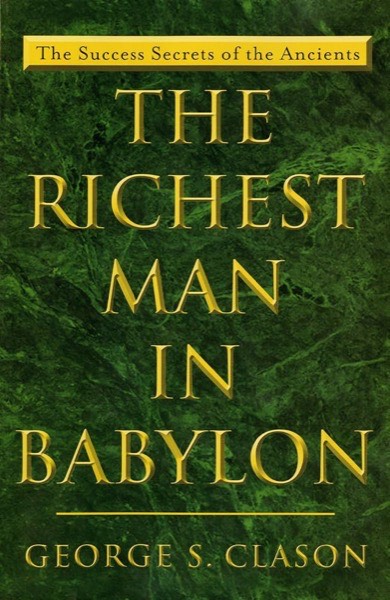
George S. Clason teaches 6,000-year-old financial wisdom from ancient Babylon: save 10%, invest wisely, and eliminate debt. This book is the foundational text of personal finance written as parables from ancient Babylon, the richest city in the world in its time. It delivers practical principles without complex economic theory or sophisticated MBA-level investment strategies.
The book's core thesis is brutal in its simplicity:
Wealth is determined by how much you save, how you make it work, and how disciplined you are in following principles proven over millennia.
Babylon is living proof. A city built in a barren desert with no natural resources, no gold mines, no forests, and no strategic location. All they had was land and river water. From that, they built the richest empire in ancient history with one thing: wisdom about money.
Why this book matters to you:
Because you live in an era with greater income than Babylonian merchants, unlimited access to information, and investment instruments they never imagined, yet you (and most people) still feel like you don't have enough money.
Why? Because the laws of finance haven't changed in 6,000 years. Only the tools have changed. People once traded with camels, now with apps. The underlying principles remain: save a portion, invest wisely, don't borrow for lifestyle, and continuously increase your earning ability.
This "In Action" edition is special because it combines George S. Clason's classic text with modern commentary from Dan Strutzel. Each chapter ends with a "Babylon Builder" section providing concrete action steps for the 21st century. You read ancient philosophy and get a blueprint to implement tomorrow.
Key Points
-
Pay Yourself First with the 10% Rule - For every ten coins that come in, save one for investment. Arkad, the richest man in Babylon, proved that anyone who consistently sets aside 10% will build wealth over time.
-
The 10-70-20 Formula to Get Out of Debt - Dabasir taught: 10% for savings, 70% for living, 20% to pay off debt. Professor Shrewsbury in England discovered a 5,000-year-old clay tablet with this formula and successfully paid off all his debts within one year.
-
The Five Laws of Gold Are a Checklist for Every Decision - Nomasir lost all his gold within two years due to bad investments. The Five Laws of Gold helped him rebuild greater wealth in eight years. Gold can be lost, wisdom is never exhausted.
-
Your Money Must Work 24 Hours a Day - Gold that sits idle is dead gold. Gold that's invested produces children who also work for you. Don't eat your money's children. Reinvest profits for compound effect.
-
The Soul of a Slave and the Soul of a Free Man Determine Your Fate - Dabasir asked himself in the desert: "Do I have the soul of a slave or the soul of a free man?" This answer transformed his life from debt slavery to wealthy merchant.
-
Control Your Expenses with a Strict Budget - Your needs will always increase to match your income unless you fight against it. Lifestyle inflation is the trap that keeps high earners poor. A budget is the weapon to distinguish needs from wants.
-
Work Is Your Best Friend - Sharru Nada was once a slave. By loving work and always giving more, he became free and a wealthy merchant. The difference between him and other slaves who died or suffered was his attitude toward work.
-
Invest Only Within Your Circle of Competence - The fourth Law of Gold: gold flees from those who invest in areas they don't understand. Most people lose money by ignoring this simple checklist.
Pay Yourself First
Arkad, the richest man in Babylon, taught the most fundamental law: "A part of all you earn is yours to keep."
It sounds obvious. Most people never do this. They work, get paid, then pay everyone else: landlords, grocery stores, utilities, loan companies, and credit cards. At the end of the month, nothing is left for themselves.
Arkad explains sharply: "Don't you pay the tailor for your clothes? Don't you pay the sandal maker? Everyone gets a share of your income. You yourself get nothing."
The First Law of Wealth
For every ten coins that come into your purse, spend only nine. That one-tenth is yours to invest, set aside from any spending.
As soon as your salary comes in, immediately set aside at least 10% to a separate account. Don't wait until the end of the month. Don't think "later if there's something left." There will never be anything left if you don't take your share first.
Treat that 10% as already gone, like taxes automatically deducted. Live on the remaining 90%. If it feels difficult, start with 5% and increase gradually. Wealthy people often save 30-50% of their income.
Who Works for Whom
This is the deeper truth: who works for whom. If you spend 100% of your income, you work for other people. Your monthly salary flows directly into the pockets of landlords, grocery stores, car dealers, and banks.
If you set aside 10% for yourself, you begin working for your own future. Every coin saved is a seed that will grow into a tree of wealth.
What makes this principle so powerful is compound interest. $1,000 per month with 10% annual returns over 30 years becomes approximately $2.17 million. You only deposited $360,000. The rest is "children of your money" working for you.
Concrete Application
- Set up automatic debits of 10% to investment accounts on payday
- Choose equity mutual funds for long-term (10+ years)
- Never withdraw this savings for consumption
- Increase the percentage each time salary increases
- Ultimate target: save 30% for faster financial freedom
Core lesson: The difference between rich and poor lies in how much they save and invest from income, not in the income itself. This is the foundation of the compound interest concept that makes money work for unlimited time.
Control Your Expenses
Arkad taught the second law harshly: "What you call 'necessary expenses' will always grow to equal your income, unless you protest to the contrary."
This is the classic trap. Salary doubles, suddenly the car that was sufficient now feels inadequate. The house that was comfortable now feels cramped. The vacation that was luxurious now feels ordinary.
These are wants masquerading as needs.
The Lifestyle Inflation Trap
A student protested: "My income really isn't enough!" Arkad responded with a brutal question: "Are your needs now the same as ten years ago? No, more. Has your income also increased? Yes. Then you've just proven my point."
This is why high-income people often remain poor. They're trapped in lifestyle inflation, where lifestyle rises to match salary. $10,000 income feels insufficient because of a $5,000 car payment, $3,000 mortgage, $2,000 dining out. Nothing is left.
Compare this with someone who continues living on 70% as their income rises. $10,000 salary, living on $7,000. Salary rises to $20,000, still living on $14,000 (70%). The rest? Investments that keep growing.
Your Budget Is Your Weapon
A budget is your weapon. Without a budget, you don't know where your money goes. And what isn't measured can't be controlled.
- Track ALL expenses for one month
- Categorize: needs and wants
- Cut wants ruthlessly
- Set limits for each category
- Review monthly
Core lesson: Expenses will expand to fill all available income (Parkinson's Law). The only way to fight it is a strict budget and disciplined execution.
Make Your Money Work
Saving alone isn't enough. Arkad taught plainly: "Gold that sits idle is dead gold. Gold that's invested is gold that works for you 24 hours a day."
Every coin you save is a slave working for you. Every child that slave produces also becomes your slave. And the children of their children too. This is the power of compound interest.
Don't Let Money Sit Idle
Arkad told of his friend who kept gold buried underground for 20 years. Very safe, not a single piece lost. The amount remained the same. Arkad, who invested his gold, now has ten times as much.
Don't let your 10% savings sit idle in regular accounts with 0.5% interest. Invest in instruments that make your money work:
- Mutual funds - easy, automatic diversification, suitable for beginners
- Stocks - high long-term returns, requires learning fundamentals
- Bonds - more stable, lower returns than stocks
- Real estate - requires large capital, returns from appreciation and rent
- Business - most risky, most profitable if successful
Start with the simple: money market funds or deposits. As you learn, move up to equity mutual funds or direct stocks.
Don't Eat Your Money's Children
Most important: Reinvest your profits. Don't eat "the children of your money."
Arkad once made this mistake. After a successful investment, he immediately threw a party spending the profits. His mentor was angry: "You're eating the children of your money. How can they work for you if you eat them?"
The difference between rich and poor often lies in what they do with earnings, in the discipline of allocation that turns income into capital.
- Poor people: earn money → spend it all → repeat
- Rich people: earn money → save portion → invest → money generates more money → reinvest
After several years, money generated by investments exceeds money from work. This is the point where you begin to be truly wealthy. Your money works harder than you do.
Core lesson: Compound interest is the most powerful force in finance. Einstein called it "the eighth wonder of the world." Those who understand it benefit. Those who don't understand pay for others.
The Five Laws of Gold
The chapter on the Five Laws of Gold is the heart of the entire book. Arkad gave his son, Nomasir, two things: a bag of gold and a tablet containing the Five Laws. Nomasir lost ALL the gold within two years due to bad investments. With those Five Laws, he rebuilt greater wealth in eight years.
The brutal lesson: Gold can be lost. Wisdom is never exhausted.
The Checklist Before Every Decision
The Five Laws of Gold:
-
Gold comes to those who set aside one-tenth - Consistent saving of 10% is the foundation of all wealth.
-
Gold works for the wise owner, multiplying like cattle - Invest your savings so they multiply, don't let them sit idle.
-
Gold clings to the owner who invests under expert advice - Seek mentors who are proven successful in the field you're targeting.
-
Gold flees from those who invest in areas they don't understand - Stay within your circle of competence. Don't invest just because a friend says "sure profit."
-
Gold flees from those who pursue impossible returns or follow scammers - If it's too good to be true, it probably isn't.
Practical Application
Before every financial decision, whether investment, loan, or major purchase, run through this checklist:
- ☐ Have I consistently set aside 10%?
- ☐ Will this investment make my money work and multiply?
- ☐ Have I consulted with a credible proven expert?
- ☐ Do I TRULY understand how this investment works?
- ☐ Is the promised return realistic, not fantasy?
If even one box is unchecked, DON'T invest.
Modern Application Example
Your friend invites you to invest in a startup "sure to make big profits":
- Law 3: Is there an expert who approves? Or just your friend saying so?
- Law 4: Do you understand that startup's business model?
- Law 5: Is "sure big profit" a realistic promise?
If the answer is no, don't invest. Better to miss an opportunity than lose your capital.
Most people lose money because they fail to follow a simple checklist, even when their reasoning is otherwise sound. They are tempted by investments promising 10% per month (violating Law 5). They follow tips from friends who are equally broke (violating Law 3). They invest in crypto without understanding blockchain (violating Law 4).
These Five Laws are guardrails. A guarantee you will keep your capital intact through the storms of foolish mistakes, while wealth itself grows on its own timeline.
Core lesson: Margin of safety is the most important principle in investing. Protect your capital first before chasing profits. Warren Buffett has two rules: (1) Never lose money. (2) Never forget rule number one.
The 10-70-20 Formula to Get Out of Debt
Dabasir, a camel merchant who was once enslaved due to debt, left the most practical legacy: the 10-70-20 formula.
- 10% for yourself (savings/investment)
- 70% for living expenses
- 20% to pay off debt
This formula was written on a 5,000-year-old clay tablet. The tablet was discovered by archaeologists and read by Professor Shrewsbury in England, who was drowning in debt. He and his wife applied the formula. Within one year, all debts were paid off.
The Concrete Blueprint
Step 1: List ALL debts with details (amount, interest, minimum payment)
Step 2: Calculate 20% of your income
Step 3: Distribute that 20% proportionally to all creditors (or focus on highest-interest debt first with the Avalanche method)
Step 4: Communicate your payment plan to creditors
Step 5: Execute with discipline until paid off
After debt is paid off, the formula changes:
- 10% savings (stays)
- 70% living expenses (stays or reduced)
- 20% additional investment (what was for debt)
With this new formula, you're saving 30% of income every month. Compound interest will work very quickly.
The Right Question
Many people think they can't get out of debt because "income isn't enough." The 10-70-20 formula shows something different.
The question is: "Am I willing to live on 70%?"
Dabasir and his wife lived very simply, eating only vegetables and not buying new clothes, during the debt payoff process. They were consistent. Within one year, they were free. Within five years, they were wealthy.
Core lesson: Delayed gratification is the most important ability for wealth. Live simply now for financial freedom later. Many people choose the other path: live lavishly now with debt, then suffer later.
The Soul of a Slave and the Soul of a Free Man
Dabasir taught the deepest lesson through one question: "Do I have the soul of a slave or the soul of a free man?"
The Difference That Determines Fate
Soul of a slave:
- Accepts fate as is
- Blames circumstances
- Has no plan
- Lives day to day
- Doesn't believe change is possible
Soul of a free man:
- Takes responsibility for life
- Has a plan to get out of problems
- Works toward goals
- Believes change is possible
- Doesn't give up
Dabasir was sold as a slave due to debt. In the desert, he asked himself that question. His answer changed his life: "I have the soul of a free man. And I will prove it."
He escaped, returned to Babylon, and faced all his creditors with a payment plan. He stood before them, and confronted every debt with an honest reckoning.
Modern Slavery Without Chains
In modern times, we're not sold as slaves due to debt. The slavery remains real:
- You work hard, your salary immediately goes to payments
- You can't take risks (change jobs, start business) because you're afraid you can't pay debts
- You stress every month thinking about bills
- You have no freedom to choose
This is slavery without visible chains.
And Strutzel adds a terrifying statistic: 96% of Americans don't achieve financial independence by age 65. Meaning, of 100 people who start working at age 25, only 4 will be independent. The other 96 will still be dependent or must keep working.
Why? Because they have the soul of a slave toward money. They accept that "everyone has debt." They never make a plan. They blame circumstances.
Questions for Yourself
Ask yourself today:
- Am I working for my future, or to pay for my past?
- Do I have a long-term financial plan, or just surviving month to month?
- Do I believe I can achieve financial freedom, or have I accepted my "fate" to work until old age?
Honest answers to these questions will determine the next 20 years of your life.
Core lesson: Locus of control determines financial fate. Internal locus (I'm responsible) produces wealth. External locus (everything is fate's fault) produces permanent failure.
Work Is Your Best Friend
The final chapter teaches a lesson often forgotten: work is your best friend.
Sharru Nada, a wealthy merchant, was once a slave. In the slave market, three people had different fates:
- Pirate (hated work, rebellious) → died at the wall
- Zabado (avoided work, lazy) → suffered all his life
- Sharru Nada (loved work, proactive) → free and wealthy
They started from the same point. Their attitudes were different.
Giving More Than Asked
Sharru Nada didn't just do what was asked. He looked for ways to give more. He learned to make bread, then honey cakes, then sold them in the streets. His hard work made him VALUABLE, the kind of worker a master would pay to keep.
Many people see work as a burden. Successful people see work as an opportunity.
The difference between slave soul and free soul in the context of work:
Slave soul:
- "I work because I'm forced"
- "I only do what's asked"
- "I wait for quitting time"
Free soul:
- "I work because this builds my future"
- "I look for ways to give more"
- "I focus on results, not hours"
21 Secrets of Millionaire Success
Dan Strutzel adds 21 Secrets of Millionaire Success from Brian Tracy. One of the most important: Work longer and harder.
The point is giving more than asked, finishing faster, offering more, and learning deeper, day after day, until the habit hardens into reputation.
Compound effect applies to career as it does to investment. People who work 10% harder every day don't get 10% more results. They get 100x more in 10 years because of reputation, skills, and connections built.
Core lesson: Reputation as a hard worker is the strongest signal in career. Warren Buffett looks for three things in employees: intelligence, energy, and integrity. "Without integrity, intelligence and energy will destroy you."
Further Reading and Related Sources
After completing Babylon's principles, study modern implementation and related topics:
Relevant Books:
- Your Money or Your Life (Joe Dominguez & Vicki Robin) - Practical application of the 10% rule for financial freedom (FIRE movement)
- The Simple Path to Wealth (JL Collins) - Concrete guide to compound interest over 30+ years
- Rich Dad Poor Dad (Robert Kiyosaki) - Alternative perspective on passive income and entrepreneurship
Related Mental Models:
- Compound Interest - The exponential power that Arkad used to build wealth
- Locus of Control - The "slave soul and free man soul" mindset in financial decisions
- Lifestyle Inflation - Why high income doesn't guarantee financial freedom
- Circle of Competence - The fourth Law of Gold: invest only in areas you understand
Complementary Topics:
- Behavioral economics and delayed gratification (psychology of money)
- Asset allocation and diversification for beginners
- Calculating financial independence number (FI Number) for freedom targets
Q&A
Q: How long does it take to achieve financial freedom with Babylon principles? A: Depends on savings rate and investment returns. Saving 10% with 10% annual returns takes about 40 years. Saving 30% with the same returns can be achieved in 20-25 years. Nomasir rebuilt his wealth in 8 years after losing all his gold.
Q: Is 10% enough in today's world with inflation and high cost of living? A: 10% is the absolute minimum. Arkad himself said this is the starting point. Modern wealthy people often save 30-50% of income. Start with 10%, then increase each time salary rises. Don't let lifestyle inflation erode your income increases.
Q: What if my income is truly tight and I can't set aside 10%? A: Arkad answered this brutally: your needs will always grow to match your income. If you feel $5,000 isn't enough, $10,000 won't be enough either. Start with 5% if 10% feels impossible. What matters is building the habit of paying yourself first.
Q: What investment is most suitable for beginners just starting to apply Babylon principles? A: Start with money market funds or deposits to build the habit. After 6 months of consistency, move up to equity mutual funds for long-term. Arkad emphasized: invest under expert advice and only in areas you understand. Don't be tempted by complex instruments before learning fundamentals.
Q: Can the 10-70-20 formula really pay off debt with limited income? A: Professor Shrewsbury proved it. The real question is "am I willing to live on 70%," not "is my income enough." Dabasir and his wife lived very simply, eating only vegetables and not buying new clothes. They were consistent. Within one year, all debts were paid. This is about priorities and discipline.
Q: How do I practically distinguish needs from wants? A: Ask: "Do I NEED this to survive, or do I WANT this for status/comfort?" Food is a need, eating at expensive restaurants is a want. Transportation is a need, a new car is a want. Housing is a need, a house in a prestigious location is a want.
Q: Are Babylon principles still relevant in the digital era with cryptocurrency and fintech? A: Very relevant. The instruments change, the principles don't. People once invested in physical gold, now mutual funds or crypto. The Five Laws of Gold still apply: invest under expert advice, only in areas you understand, avoid promises of unrealistic returns. Many people lose money in crypto by violating these laws.
Q: What should I do with the 10% savings once a large amount accumulates? A: Never stop saving. Reinvest profits. Don't "eat the children of your money." Arkad invested his gold in caravan business, property, and productive loans. Modern equivalents: mutual funds, blue-chip stocks, bonds, or real estate. Diversify to reduce risk.
Q: How do I apply Babylon principles to business as well as personal finance? A: Exactly the same. Business must "pay itself first" by setting aside 10% of profits for reserve fund before distribution to owners. Avoid debt for operational consumption. Invest profits for productive expansion. Dabasir applied the same principles to build his camel merchant business.
Q: Should I pay off all debt first before starting to invest? A: The 10-70-20 formula teaches doing BOTH simultaneously. 10% for investment (building the habit), 20% for debt (escaping slavery). Don't wait for debt to be paid off to start investing, because you'll lose compound interest momentum. Prioritize high-interest debt (credit cards, payday loans) to pay off first.
Critical Assessment
Strengths
1. Brutal Simplicity
No technical jargon. No complex formulas. Just principles that could be understood by camel merchants 5,000 years ago and apply to crypto traders today. The 10-70-20 formula can be implemented tomorrow by anyone with any income.
2. Cross-Time Proof
These principles have endured 6,000 years. Professor Shrewsbury proved a 5,000-year-old tablet still works in 1930s England. You can prove it today. Time-tested is the strongest validation for financial principles.
3. Concrete Action Framework
The Five Laws of Gold are a checklist. The 10-70-20 formula is a blueprint. The "In Action" edition adds "Babylon Builder" in each chapter with concrete steps to apply tomorrow. You finish reading, immediately know what to do.
4. Deep Psychology
The concept of "slave soul and free man soul" is the strongest framework for financial mindset. This is about identity, the deepest layer beneath every spreadsheet. The question "Do I have the soul of a slave or free man?" is more life-changing than any Excel spreadsheet.
Limitations
1. Very Different Historical Context
Babylon was an agrarian economy with physical gold and camel caravans. Modern economy has complexity they never imagined: progressive taxes, inflation, global recessions, fintech, and cryptocurrency. The principles apply. The application requires significant adaptation.
2. Oversimplification
The 10-70-20 formula assumes you have 100% of income to allocate. Many people have large family obligations, emergency medical costs, or live in high-cost cities where 70% truly isn't enough. This book doesn't address special cases.
3. Lack of Detail on Investment Instruments
"Invest wisely" is good advice that isn't specific. Arkad invested in camel caravans and property. What are the safe modern equivalents? This book doesn't provide detailed guidance on asset allocation, diversification, or risk management.
4. Strong Narrative Bias
All stories are success stories. There are no merchants who consistently saved 10% then still failed due to external factors (war, disaster, disease). Survivorship bias makes the principles appear more "guaranteed to succeed" than reality.
Conclusion
Who Should Read This Book:
- You who have tight income and feel you'll never be wealthy
- You who have high income and still broke every end of month
- You who are drowning in debt and don't know where to start
- You who have money and are afraid to invest because you don't understand
Who Doesn't Need This Book:
- You who already have financial freedom (net worth >25x annual expenses)
- You seeking advanced investment strategies or tax optimization
- You expecting get-rich-quick schemes or shortcuts
Rating: 5/5
The Richest Man in Babylon deserves to be mandatory personal finance scripture for one simple reason: its principles have been proven for 6,000 years.
What makes this book so powerful is its simplicity. Plain principles, written in the language of camel merchants, proven through six thousand years of human commerce.
Simplicity doesn't mean easy. Most people KNOW these principles and don't DO them. They know they should save 10%, never do it. They know they should budget, never discipline themselves.
The difference between rich and poor lies in EXECUTION.
Babylon proved that wisdom and discipline are more determinative than location, resources, or luck. Babylon was built in a barren desert, where land and river water were the only inheritance. From that thin soil, the city grew the richest empire of its age, lifted by wisdom and discipline.
You live in an era with more opportunities than Babylonian merchants. You also live in an era with more temptations. Ads everywhere. 0% installments. One-click loans. Lifestyle inflation on social media.
The final question you must ask yourself:
Do I have the soul of a slave or the soul of a free man?
The slave soul accepts fate. Blames circumstances. Has no plan. Lives paycheck to paycheck until old age.
The free man soul takes responsibility. Makes a plan. Executes with discipline. And one day, financially free.
The choice is in your hands. The wisdom has existed for 6,000 years. It's up to you whether to apply it or not.