Why Read This
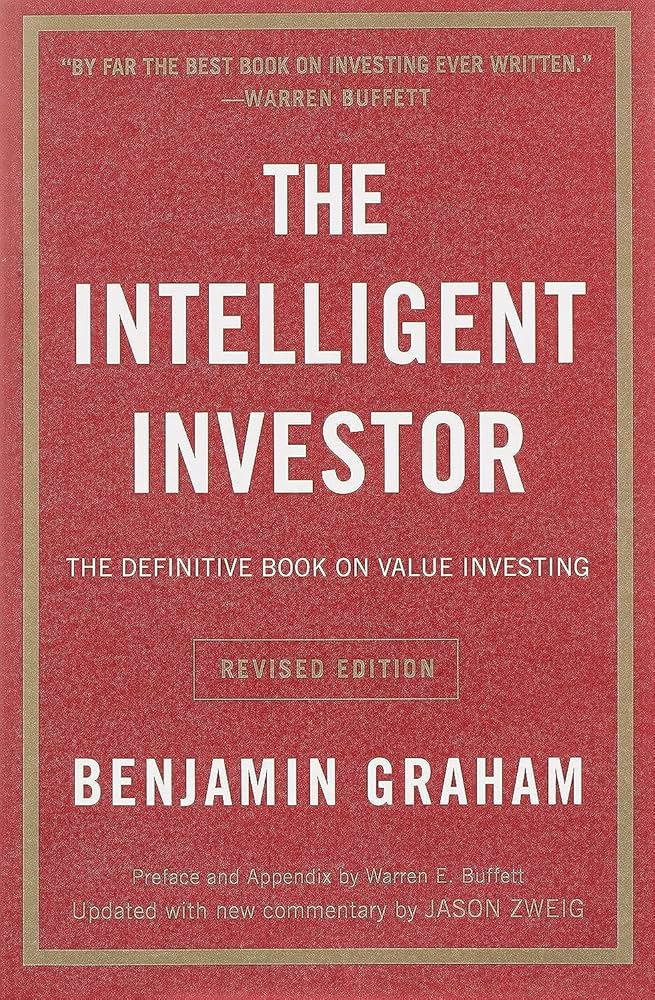
Benjamin Graham wrote The Intelligent Investor in 1949, distilling decades of experience managing funds through the 1929 crash and Great Depression. Graham offers a practical framework for average investors to achieve satisfactory results without needing genius-level intelligence or taking excessive risks, far beyond promises of getting rich quick or secret formulas for spectacular returns.
His central thesis is simple: successful investing is about buying assets below their intrinsic value with an adequate margin of safety, far beyond picking stocks that will rise fastest. Graham draws a sharp distinction between true investment (based on thorough analysis, focusing on safety of principal and adequate return) and speculation (based on price predictions, chasing maximum profit with high risk).
What makes Graham's teachings timeless is his focus on fundamental principles, with specific techniques playing only a supporting role. In the era of algorithmic trading and meme stocks, the line between investing and speculation has become increasingly blurred. Most people who call themselves "investors" are actually unconscious speculators. They buy because prices are rising, sell because they're falling, and let emotions dictate decisions.
Graham offers an antidote: a framework grounded in arithmetic, with optimism set aside; margin of safety provable with numbers, with feelings set aside; and emotional discipline more important than high IQ. Warren Buffett, Graham's most famous student, calls this book "the best book on investing ever written" and claims that Chapter 8 on Mr. Market and Chapter 20 on Margin of Safety alone are sufficient to make someone a competent investor.
Key Points
-
Investment versus Speculation. Graham defines investment with three equal elements: thorough analysis of the company, deliberate protection against serious loss, and aspiration for adequate, dependable performance, content to leave the extraordinary to speculators. Everything outside this is speculation. Investors measure market price against established standards of value, while speculators base their value standards on market price.
-
Mr. Market Allegory. Graham created the most brilliant allegory in investment history: imagine a business partner named Mr. Market who daily offers to buy or sell your ownership stake at wildly fluctuating prices. Sometimes his prices make sense, often they're absurd because he's driven by enthusiasm or fear. You only need to pay attention to Mr. Market when he quotes ridiculously high prices (opportunity to sell) or ridiculously low ones (opportunity to buy).
-
Margin of Safety. The central concept that determines everything. Margin of safety is the gap between the price paid and adequate intrinsic value to protect against analytical errors or misfortune. Its function is rendering unnecessary an accurate estimate of the future. If the margin is large enough, it's sufficient to assume that future earnings won't fall far below the past to feel protected.
-
Defensive versus Enterprising Investor. Defensive investors prioritize safety and simplicity with a 50-50 bond-stock portfolio, rebalancing to 25-75% depending on market conditions. Enterprising investors are willing to devote time and effort to deep analysis, seeking consistently better-than-average opportunities with strategies that are inherently sound but unpopular on Wall Street.
-
Process Over Outcomes. Graham doesn't promise extraordinary returns. He offers sound processes that, if followed with discipline, lead to satisfactory results with high probability. Success is measured by putting in place a financial plan and behavioral discipline that gets you where you want to go, far beyond the question of beating the market. If your plan requires 7-8% annual return to achieve your goals, why take risks chasing 15-20%?
-
Emotional Discipline Over Intelligence. The investor's chief problem and worst enemy is likely to be himself. Virtues like energy, study, and native ability can become handicaps if channeled in wrong directions. Neuroscience explains: brain regions automatically anticipate that events will repeat after occurring just two or three times, flooding the brain with euphoria. The pain of financial loss is more than twice as intense as the pleasure of equivalent gain.
-
Chief Losses Come from Good Times. Observation over many years taught Graham that chief losses to investors come from buying low-quality securities at times of favorable business conditions, far more than from buying good-quality stocks too high. When everything looks great, when earnings are growing rapidly, when optimism reigns. That's precisely when people buy securities without margin of safety and ultimately suffer disturbing losses.
-
Timing versus Pricing. Graham is convinced that timing (trying to predict market direction) is speculation that will end with speculative results, while pricing (buying when price is below fair value, selling when above), if done with discipline, can deliver satisfactory results. To beat the market, we must do something that is inherently sound but not popular on Wall Street.
Investment versus Speculation: The Defining Difference
Graham defines investment with three equal elements: thorough analysis of the company and its underlying business, deliberate protection against serious loss, and aspiration for adequate, dependable performance, content to leave the extraordinary to speculators. Everything outside this definition is speculation.
This isn't semantic wordplay. Investors measure market price against established standards of value; speculators base their value standards on market price. This difference in perspective determines whether we'll succeed or fail in the long run.
Defensive Investor: Safety and Simplicity
Graham identifies two valid investor types: defensive investors who prioritize safety and simplicity, and enterprising investors willing to devote time and effort to deep analysis. Both can succeed as long as they operate with discipline and clear understanding of risks.
For defensive investors, Graham recommends a simple portfolio policy: divide holdings between high-grade bonds and leading common stocks in a 50-50 proportion, with flexibility to go 25-75% depending on market conditions. When the market is too high, reduce stocks to 25%. When price declines make stocks more attractive, increase to 75%.
This policy works because it's mechanical and emotion-free. We don't need to predict market direction or identify the best stocks. Simply maintain the allocation range, rebalance when drift exceeds the threshold. This automatically buys more stocks when cheap and sells when expensive.
Enterprising Investor: Analysis and Independence
For enterprising investors, the challenge is greater. To enjoy reasonable chances of consistently better-than-average results, investors must follow policies that are inherently sound and promising, AND unpopular on Wall Street.
This is a disconcerting logical conclusion: if everyone already knows and believes in a certain strategy, prices already reflect that expectation and the advantage disappears. Edge comes from doing what few are willing to do: thorough analysis, contrarian thinking, patience to wait for fat pitches, far beyond simply knowing what everyone else knows.
Graham provides a classic example from June 1962, when the Wall Street Journal ran the headline "Small Investors Bearish, They Are Selling Odd-Lots Short." The media called "investors" ordinary people who were short-selling stocks they didn't own based on emotional conviction. This wasn't investing; it was pure speculation, ironically done at the worst timing because the market had already declined and would soon rebound.
The Crowd Is Always Wrong at Turning Points
The recurring irony: in 1948, 90% of the public considered stocks too risky and refused to buy them, precisely when stocks were sold on the most attractive basis and would begin the greatest advance in history. At the opposite moment, when stocks had risen to dangerous levels, everyone considered them safe investments.
This lesson resonates strongly with the mental model of second-order thinking. Most people only think first-order: "Price is rising, that means it's good, buy!" Graham forces us to think second-order: "If everyone thinks this is good and the price is already high, is there still a margin of safety? What are others not seeing?"
This concept also connects with the principle of contrarian thinking. When everyone is afraid, that's precisely when the best opportunities exist. When everyone is confident, that's when the danger is greatest. This doesn't mean we should always go against the crowd, but we must think independently and not let crowd psychology dictate our decisions.
Key insight: Before buying any security, ask yourself: Am I buying this based on solid value analysis, or because the price is rising and I'm afraid of missing out? Do I have a margin of safety provable with numbers, or just hope that someone will pay more tomorrow?
Mr. Market: Exploiting Market Irrationality
Graham created the most brilliant allegory in investment history: Mr. Market. Imagine we own a stake in a private business. One of our partners, named Mr. Market, is very obliging. Every day he tells us what he thinks our interest is worth, and offers to buy us out or sell us additional interest based on that valuation.
Sometimes Mr. Market's idea of value seems reasonable and justified by business developments we know about. Often, on the other hand, Mr. Market lets his enthusiasm or fears take over, and the value he proposes seems absurd.
The Market Is a Servant, Not an Oracle
The question is simple: will we let Mr. Market's daily communications determine our view of the value of our ownership in the enterprise? Of course not. We only need to pay attention to Mr. Market when he quotes ridiculously high prices (opportunity to sell) or ridiculously low ones (opportunity to buy). The rest of the time, we're wiser to form our own ideas about the value of our holdings based on full reports from the company about its operations and financial position.
The true investor is in exactly the same position when owning listed common stock. He can take advantage of daily market prices or leave them alone, according to his own judgment and inclination. He must pay attention to important price movements, because otherwise his judgment has nothing to work on. Conceivably, price movements could give him warning signals worth heeding.
In Graham's view, such signals are misleading at least as often as they're helpful. Basically, price fluctuations have only one significant meaning for the true investor: they provide opportunities to buy wisely when prices fall sharply and to sell wisely when they advance a great deal. At other times, he will do better to forget about the stock market and pay attention to his dividend returns and the company's operating results.
Timing versus Pricing: The Fundamental Difference
Graham distinguishes two approaches to fluctuations: timing (trying to predict market direction) and pricing (buying when price is below fair value, selling when above). He's convinced that timing is speculation that will end with speculative results, while pricing, if done with discipline, can deliver satisfactory results.
Jason Zweig provides a powerful modern example of Mr. Market's bipolar behavior: Inktomi Corp. On March 17, 2000, Inktomi stock hit $231.625 with a total market value of $25 billion for a tiny business that never made a dime in profits. Mr. Market was pricing Inktomi shares at 250 times revenues.
On September 30, 2002, just 2.5 years later, Inktomi's stock closed at 25 cents. Total market value collapsed from $25 billion to less than $40 million, even though the company was still generating $113 million in revenues. Mr. Market was now only willing to pay 0.35 times revenues. On December 23, 2002, Yahoo announced it would buy Inktomi for $1.65 per share, nearly seven times the September 30 price.
A&P: Classic Graham Bargain
Graham also provides the example of A&P. In 1938, shares fell to a new low of 36. This price was extraordinary: the preferred and common together were selling for $126 million, even though the company had just reported holding $85 million in cash alone and working capital of $134 million. A&P was the largest retail enterprise in America with a continuous impressive record.
Why was it valued at less than its current assets? Threats of special taxes, net profits had fallen off, the general market was depressed. The first was groundless fear, the other two were temporary influences. In 1939, A&P shares advanced to 117.5, three times the 1938 low.
Neuroscience Explains Our Weakness
The Mr. Market allegory teaches us a fundamental principle about the relationship between investor and market. The market is a moody servant we can exploit or ignore according to our interests, far removed from any role as wise oracle that we must follow.
This is a radical shift in perspective. Most people view market movements as signals of truth about the value of their securities. When prices fall, they panic and sell. When they rise, they're euphoric and buy more. Graham flips this logic: fluctuations are opportunities to exploit others' irrationality, far beyond serving as signals about value.
Neuroscience explains why we struggle to ignore Mr. Market. Brain regions called the anterior cingulate and nucleus accumbens automatically anticipate that an event will repeat after occurring just two or three times in a row. If it repeats, dopamine is released, flooding the brain with euphoria. We effectively become addicted to our own predictions.
When stocks drop, financial loss fires up the amygdala, the part of the brain that processes fear and anxiety. The pain of financial loss is more than twice as intense as the pleasure of equivalent gain. So many investors buy high (euphoria) and sell low (panic). They're not being stupid; they're being human.
Key insight: We have a basic advantage that professional fund managers don't: freedom. They're forced to buy high and sell low, following the market's every move because of billions under management, investor redemptions, benchmark pressures. We can choose to think for ourselves, buy when others panic, hold when others trade frantically. This freedom is our superpower.
Margin of Safety: The Central Concept That Determines Everything
If asked to distill the secret of sound investment into three words, Graham offers the motto: MARGIN OF SAFETY. This is the thread running through all discussion of investment policy in the book, often explicitly, sometimes less directly.
Margin of safety is a concept already established in bond investment: a railroad must earn total fixed charges better than five times for its bonds to qualify as investment-grade. Past ability to earn in excess of interest requirements constitutes the margin of safety expected to protect the investor against loss in the event of future decline in net income.
Graham's genius was extending this concept to common stocks. In ordinary common stock bought under normal conditions, the margin of safety lies in expected earning power considerably above the going rate for bonds. If earning power is 9% and the bond rate is 4%, the stock buyer has an average annual margin of 5% accruing in his favor.
Rendering Unnecessary an Accurate Estimate
The most powerful function of margin of safety is rendering unnecessary an accurate estimate of the future. If the margin is a large one, it's sufficient to assume that future earnings will not fall far below those of the past for the investor to feel sufficiently protected against the vicissitudes of time.
Margin of safety always depends on the price paid. It will be large at one price, small at some higher price, nonexistent at some still higher price. This is the most fundamental principle in investing.
Graham explains with figures: assume in a typical case that earning power is 9% on the price and the bond rate is 4%. Then the stock buyer will have an average annual margin of 5% accruing in his favor. Over a ten-year period, the typical excess of stock earning power over bond interest may aggregate 50% of the price paid. This figure is sufficient to provide a very real margin of safety.
If such a margin is present in each of a diversified list of twenty or more stocks, the probability of favorable results under fairly normal conditions becomes very large. That's why the policy of investing in representative common stocks doesn't require high qualities of insight and foresight to work out successfully.
National Presto: Graham's Ideal Example
Graham provides the example of National Presto Industries stock, which sold for a total enterprise value of $43 million in 1972. With its $16 million of recent earnings before taxes, the company could easily have supported this amount of bonds. Common stocks bought under such circumstances supply the ideal combination of safety and profit opportunity.
For bargain issues, the margin-of-safety idea becomes much more evident. We have, by definition, a favorable difference between price on one hand and indicated or appraised value on the other. That difference is the safety margin. It's available for absorbing the effect of miscalculations or worse-than-average luck.
Chief Losses Come from Good Times
Graham notes that chief losses to investors come from the purchase of low-quality securities at times of favorable business conditions. Purchasers view current good earnings as equivalent to earning power and assume that prosperity is synonymous with safety.
It's in those years that bonds and preferred stocks of inferior grade can be sold to the public at prices around par. These securities do not offer an adequate margin of safety in any admissible sense of the term. Coverage of interest charges and preferred dividends has to be tested over a period of years, including preferably a number of years of subnormal conditions.
Most counterintuitively, observation over many years taught Graham that chief losses to investors come from buying low-quality securities at times of favorable business conditions, far more than from buying good-quality stocks too high. When everything looks great, when earnings are growing rapidly, when optimism reigns. That's precisely when people buy securities without margin of safety and ultimately suffer disturbing losses.
Arithmetic Proof, Not Subjective Hope
True margin of safety isn't subjective feeling or hunch. It's one that can be demonstrated by figures, persuasive reasoning, and reference to a body of actual experience. Speculators believe they have the odds in their favor based on feelings that timing is propitious or skill is superior. Investors demand arithmetic proof that the margin exists and is adequate.
Margin of safety is a brilliant application of the mental models of redundancy and antifragility. In engineering, redundancy means building in extra capacity so the system doesn't collapse when one component fails. In investing, margin of safety means buying at a price so that even if our analysis is somewhat wrong or luck runs against us, we're still protected.
This also connects with the concept of asymmetric risk-reward from Nassim Taleb. When we buy with a large margin of safety, the downside is limited (because the price is already low relative to value) while the upside is substantial (because the market eventually recognizes value). We create a situation where we have little to lose and much to gain, the opposite of speculation.
Key insight: Before buying any security, calculate the margin of safety explicitly. What is the intrinsic value based on conservative estimates? What is the current price? What is the gap? Is the gap large enough to protect against analytical errors or bad luck? If you can't answer these questions with concrete numbers, you're speculating, not investing.
Integration and Connections with Mental Models
The three main concepts (the distinction between investment and speculation, the Mr. Market allegory, and margin of safety) form a cohesive framework that mutually reinforces.
The distinction between investment and speculation is the philosophical foundation. It determines the fundamental mindset: do we approach the market as business owners who analyze value, or as gamblers who bet on price movements? This choice determines everything.
Mr. Market is the practical application of that philosophy. After deciding to be true investors, we need a framework for interacting with the market. The Mr. Market allegory teaches: don't let the market dictate our view of value; use the market only when advantageous for transactions; welcome volatility as a source of opportunity.
Margin of safety is the operational criterion that determines when we act. After deciding to be investors and understanding how to relate to Mr. Market, we need a clear criterion for buying and selling. Margin of safety provides that criterion: buy when the gap between price and value is large enough to protect against errors and bad luck.
Circle of Competence
Graham emphasizes "know what you are doing - know your business." Don't try to make business profits from securities unless you know as much about security values as you know about the value of merchandise you manufacture or deal in. This is respect for the boundaries of competence.
Charlie Munger, Warren Buffett's partner and also a Graham student, develops this further in Poor Charlie's Almanack: "You have to figure out what your own aptitudes are. If you play games where other people have the aptitudes and you don't, you're going to lose." Circle of competence is about knowing the boundaries, far more important than the size of the circle itself.
Second-Order Thinking
To beat the market, we must do something that is inherently sound but not popular on Wall Street. This requires thinking beyond first-order "what's hot now" to second-order "what will others miss?"
Ray Dalio explains in Principles: "First-order consequences often have opposite desirabilities from second-order consequences." Buying stocks when everyone else is buying (first-order: feels safe) often leads to losses (second-order: overvalued). Buying when everyone is selling (first-order: feels scary) often leads to gains (second-order: undervalued).
Inversion
Instead of asking "what to buy to make money," Graham inverts: "how to avoid losing money?" Margin of safety, defensive investing, focus on downside protection: all these are applications of inversion thinking.
Carl Jacobi, the famous mathematician, said: "Invert, always invert." In investing, this means focusing on what can go wrong before focusing on what can go right. This protects against overconfidence and blind optimism.
Antifragility
A portfolio with margin of safety in each position benefits from volatility. When Mr. Market panics and offers absurd prices, investors with cash and discipline gain. Losses are bounded by margin of safety, gains are unlimited by the market's eventual recognition of value.
Nassim Taleb explains in Antifragile: "Some things benefit from shocks; they thrive and grow when exposed to volatility, randomness, disorder, and stressors." Graham's approach is antifragile; it gets stronger from market chaos.
Systems Thinking
Graham doesn't focus on individual stock picks, but on systems: defensive allocation, rebalancing rules, diversification requirements, margin of safety criteria. The system approach removes emotions and creates repeatability.
Daniel Kahneman in Thinking, Fast and Slow shows that human judgment is unreliable, especially under pressure. We need systems and rules to protect us from our own cognitive biases: anchoring, availability heuristic, confirmation bias, recency bias.
Practical Implications
For Individual Investors
Define Your Type: Determine whether you're a defensive or enterprising investor. Defensive focuses on safety and simplicity with 50-50 bond-stock allocation. Enterprising is willing to dedicate time to analysis for potentially better returns. Don't attempt the enterprising approach without the required time and skill.
Critical question: how many hours per week can you dedicate to investment analysis? If less than 10 hours per week, stick to the defensive approach. Enterprising investing requires substantial time commitment: reading annual reports, analyzing financial statements, understanding competitive dynamics, tracking management quality.
Establish Margin of Safety Criteria: Before buying any security, calculate explicit margin of safety. For bonds, check the coverage ratio: interest should be covered at least 5 times by earnings. For stocks, compare earning power with price paid, with a minimum 50% discount to intrinsic value.
Intrinsic value calculation methods: discounted cash flow analysis, comparison to similar companies, asset-based valuation. Use conservative assumptions. Better to miss an opportunity than buy without adequate margin.
Use Dollar-Cost Averaging: Invest a fixed amount regularly regardless of market conditions. This automatically buys more shares when prices are low, fewer when high. Removes emotion from timing decisions.
Example: invest $1,000 every month into an index fund. When the market drops 30%, your $1,000 buys 43% more shares. When the market rises 30%, your $1,000 buys 23% fewer shares. Over time, you average out volatility and benefit from the market's long-term growth.
Rebalance Mechanically: Set allocation ranges (e.g., 25-75% stocks) and rebalance when drift exceeds the threshold (e.g., 5%). This forces selling high and buying low without requiring market predictions.
Example: start with a 50-50 split. If stocks surge and allocation becomes 65-35, sell 15% of stocks and buy bonds to restore 50-50. If stocks crash and allocation becomes 35-65, sell 15% of bonds and buy stocks. Mechanical rules override emotional impulses.
Diversify Adequately: A single position with margin of safety can still fail. A portfolio of twenty or more positions with margins creates high probability of favorable aggregate results. This is the application of the insurance principle.
Graham recommends a minimum of 10 positions, preferably 20-30 for adequate diversification. This protects against company-specific risks: fraud, management incompetence, technological disruption, regulatory changes. Even with thorough analysis, individual companies can fail. The portfolio approach ensures that a few failures don't destroy overall results.
For Portfolio Management
Separate Investment from Speculation: If you want to speculate, set aside a small separate fund with an explicit limit: maximum 10% of investable assets. Never mix speculative and investment operations in the same account or thinking. Failure to separate these is a source of major losses.
Label accounts explicitly: "Investment Portfolio" and "Speculation Fund." Different rules apply. Investment account: buy based on value analysis, hold indefinitely, rebalance mechanically. Speculation account: bet on short-term trends, accept possibility of total loss, treat as entertainment budget.
Focus on Downside Protection: Before asking "how much can I make?", ask "how much can I lose?" Construct a portfolio so that even if multiple things go wrong, aggregate losses are manageable. The upside will take care of itself if the downside is protected.
Stress test your portfolio: what happens if the market drops 50%? What if interest rates double? What if inflation surges? What if you're unemployed for a year? Your portfolio should survive these scenarios without forcing distress selling.
Ignore Short-Term Noise: Daily, monthly, even yearly fluctuations are noise. Focus on longer timeframes of three to five years minimum. Don't measure performance or make decisions based on short-term movements. This feeds emotional reactions and poor timing.
Graham recommends checking your portfolio quarterly at most. Daily checking triggers loss aversion and recency bias. Annual reports and quarterly earnings give sufficient information for informed decisions. More frequent monitoring adds noise, not signal.
Develop Analytical Independence: Form views based on full reports about operations and financial position, not on market price or analyst opinions. You are neither right nor wrong because the crowd disagrees. You are right because the data and reasoning are right.
Read primary sources: annual reports (10-K), quarterly filings (10-Q), proxy statements. Don't rely on analyst summaries or media headlines. Form independent judgment about business quality, competitive position, management integrity, financial strength. Only then check the market price to see if Mr. Market is offering a bargain.
For Decision-Making
Apply Business Principles: Treat investing as a business venture. Would you start a business or buy merchandise with the same casual analysis that people apply to stocks? Demand the same rigor: understand the value, calculate profit opportunity, assess risks, have the courage of sound conclusions.
Ask business questions: What does this company actually do? How does it make money? Who are the competitors? What is the competitive advantage? Is management capable and honest? Are the financials strong? What are the major risks? Only after answering these should we consider price.
Recognize Behavioral Traps: Our brains are hardwired to see patterns that don't exist, addicted to predictions, feel pain from loss twice as intensely as pleasure from equivalent gain. Acknowledge these biological limitations. Implement mechanical rules to override emotional impulses.
Common traps: anchoring (fixating on purchase price or past highs), confirmation bias (seeking information that confirms existing beliefs), recency bias (overweighting recent events), herd mentality (following the crowd for comfort), overconfidence (believing we can beat professionals without equivalent effort).
Distinguish Probabilities from Consequences: Per Pascal's Wager and Peter Bernstein's interpretation, under uncertainty, consequences must dominate probabilities. We never know the future. But we do have control over the consequences of being wrong: through diversification, margin of safety, refusing to fling money at the latest fashions.
Example: the probability of an individual stock failing might be low (10%), but the consequence is severe (100% loss). Even with a 90% success rate, a string of positions without diversification can destroy a portfolio. The probability of the market dropping 50% in any year is low, but the consequence for a leveraged investor is catastrophic. Manage consequences first, probabilities second.
Limit Ambition to Capacity: To achieve satisfactory investment results is easier than most realize; to achieve superior results is harder than it looks. Don't attempt superior results without superior knowledge, time, and discipline. Better to achieve satisfactory results with certainty than chase superior results and achieve losses.
Graham's wisdom: "The investor's chief problem, and even his worst enemy, is likely to be himself." Most people would be better off with a simple index fund and mechanical rebalancing than attempting stock picking without adequate preparation. Boring works. Exciting usually doesn't.
FAQ
Q: What is the main difference between investment and speculation according to Benjamin Graham? A: Investment has three elements: thorough analysis of the company, deliberate protection against loss, and aspiration for adequate, dependable returns, content to leave the extraordinary to speculators. Speculation is activity outside this definition, usually based on price predictions and chasing maximum profit with high risk.
Q: Who is Mr. Market and why is this concept important? A: Mr. Market is Graham's allegory describing the market as a moody business partner who daily offers to buy or sell ownership at wildly fluctuating prices. This concept teaches investors to exploit market irrationality and stay free of its mood: buy when Mr. Market quotes ridiculously low, sell when ridiculously high.
Q: What is margin of safety and how do you calculate it? A: Margin of safety is the gap between the price paid and adequate intrinsic value to protect against analytical errors. For stocks, Graham suggests a buying price at least 50% below intrinsic value. Example: if earning power is 9% and the bond rate is 4%, the margin is 5% annually, over 10 years aggregating 50% of the price paid.
Q: What is the minimum number of stocks needed for adequate diversification? A: Graham recommends a minimum of 10 positions, preferably 20-30 for adequate diversification. This protects against company-specific risks like fraud, management incompetence, or technological disruption. Even with thorough analysis, individual companies can fail; the portfolio approach ensures a few failures don't destroy overall results.
Q: Is the defensive investor or enterprising investor approach better? A: Neither is inherently superior. The defensive investor approach suits those who prioritize safety and don't have time for analysis: simple 50-50 bond-stock allocation with mechanical rebalancing. The enterprising investor approach suits those willing to dedicate significant time (10+ hours per week) to deep analysis. The key is being honest about time and capability.
Q: How do you determine when a stock is overvalued or undervalued? A: Graham uses several metrics: price-to-earnings ratio (P/E), price-to-book ratio (P/B), dividend yield, and earning power relative to bond rates. Rule of thumb: P/E above 25 suggests overvaluation, below 10 suggests potential bargain. Must combine with analysis of business fundamentals, competitive position, and financial strength.
Q: Can market timing work according to Graham? A: Graham is convinced that timing (predicting market direction) is speculative and unlikely to succeed consistently. Instead, focus on pricing: buying when price is below fair value, selling when above. Difference: timing requires predicting the future, pricing requires analyzing the present. The former is speculation, the latter is investment.
Q: What is a realistic return target for defensive investors? A: Graham argues that defensive investors should target satisfactory returns (7-8% annually over the long term), content to forgo the chase for superior returns. Chasing superior results without superior effort usually leads to inferior results. A simple 50-50 portfolio with rebalancing has historically delivered this range with moderate risk.
Q: What is the biggest mistake investors make according to Graham? A: Chief losses come from buying low-quality securities at times of favorable business conditions. When everything looks great, earnings are growing, optimism reigns. That's precisely when people buy securities without margin of safety. Emotional discipline matters more than intelligence; the investor's worst enemy is himself.
Q: Are Graham's teachings still relevant in the era of algorithmic trading and meme stocks? A: They're more relevant than ever. The gap between investing and speculation has widened. The majority of participants trade on sentiment, with business analysis pushed to the margins. This creates enormous opportunity for the minority willing to actually invest: analyze fundamentals, demand margin of safety, wait patiently. Edge comes from superior temperament, with information advantages now widely shared.
Critical Assessment
Strengths
1. Timeless, Principle-Based Framework Graham focuses on fundamental principles (margin of safety, business analysis, emotional discipline) that outlast techniques which quickly become obsolete. Specific formulas may be outdated, but the underlying philosophy remains relevant 75 years later. This makes the book valuable across generations and market cycles.
2. Profound Psychological Insight Long before behavioral economics became mainstream, Graham understood that the investor's chief problem is emotional discipline, not intellectual capacity. The Mr. Market allegory brilliantly captures market psychology. Recognition that we are biological creatures with predictable biases was revolutionary for its era.
3. Emphasis on Process Over Outcomes Graham doesn't promise get-rich-quick or secret formulas. He offers sound processes that lead to satisfactory results with high probability. This honesty and focus on realistic expectations is a refreshing contrast to modern investment marketing that oversells and underdelivers.
4. The Defensive Investor Option Recognition that not everyone can or should be an enterprising investor is wisdom. Offering a simple, mechanical approach (50-50 allocation with rebalancing) that works for busy professionals is a major contribution. Most investment advice assumes everyone wants to beat the market; Graham acknowledges that many just want to participate sensibly.
Limitations
1. Outdated Specific Recommendations Formulas and specific techniques from 1949 (or even the 2003 revision) are inevitably outdated. Graham's criteria for stock selection (P/E below 15, P/B below 1.5, dividend yield above 2/3 of AAA bond yield) made sense in his era but are less applicable now. Readers must distinguish timeless principles from dated specifics.
2. Limited Consideration of Growth Stocks Graham is extremely skeptical of growth stocks and companies trading at high multiples. While this skepticism is protective, it also means missing legitimate growth opportunities. Amazon, Google, Netflix would fail Graham's screens in their early years, yet delivered extraordinary returns. Balance is needed between Graham's conservatism and recognition of genuine growth.
3. Changed Market Structure Today's market is fundamentally different: algorithmic trading, index fund dominance, retail access, information speed. Some Graham assumptions (like market inefficiency allowing easy bargains) are less true. Professional management is more sophisticated. Easier information access means the advantages of analysis are smaller. That said, behavioral biases persist, perhaps even amplified by social media.
4. Lacks Portfolio Construction Detail While Graham offers broad guidelines (diversification, rebalancing, allocation ranges), he lacks specific portfolio construction methodology. How exactly to select from a universe of stocks that meet the screens? How to size positions? When exactly to sell? These operational details are underdeveloped relative to the philosophy.
Conclusion
The Intelligent Investor is a foundational text for serious investors. Its strength lies in the timeless framework for thinking about investing, far beyond any specific stock pick or market prediction.
Who should read this:
- Individual investors who want to understand the philosophy behind sound investing
- Professionals who need reminders about first principles amid market noise
- Speculators who realize they're gambling and want to transition to investing
- Students of behavioral economics interested in early recognition of psychological factors
- Anyone managing significant capital who wants a systematic approach to risk management
Rating: 5/5. Essential reading with the caveat that readers must distinguish timeless principles from dated specifics. Best approached with the mindset of learning philosophy, not copying formulas.
Warren Buffett summarizes perfectly: "By far the best book on investing ever written." Chapter 8 (Mr. Market) and Chapter 20 (Margin of Safety) alone justify buying the book. Reading it with commentary by Jason Zweig helps bridge Graham's era with modern context.
Final wisdom: investing ultimately isn't about beating others at their game. It's about controlling yourself in your own game. Success is measured not by beating the market, but by putting in place a financial plan and behavioral discipline that gets you where you want to go. If you can internalize this, you've learned Graham's most important lesson.
Related Resources
To deepen understanding of value investing and related mental models:
-
Poor Charlie's Almanack: Charlie Munger (Warren Buffett's partner, also a Graham student) develops a framework of 100+ mental models for superior decision-making. Extends Graham's emphasis on multidisciplinary thinking and psychological awareness.
-
Principles: Ray Dalio explains the systematic approach to decision-making at the world's largest hedge fund. Resonates with Graham's emphasis on process over outcomes and mechanical rules to override emotions.
-
Thinking, Fast and Slow: Daniel Kahneman provides the neuroscience and research behind behavioral biases that Graham intuitively understood. Essential for understanding why Mr. Market behaves irrationally and why we struggle to exploit it.
Relevant mental models:
- Second-Order Thinking: Critical for understanding contrarian opportunities
- Inversion: Graham's approach to risk management
- Circle of Competence: Know what you know and the boundaries thereof
- Margin of Safety: Engineering principle applied to investing