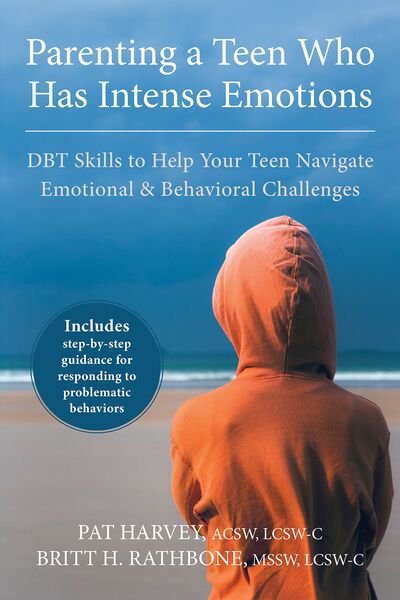
Parenting a Teen Who Has Intense Emotions
Authors: Pat Harvey & Britt H. Rathbone Publisher: New Harbinger Publications (2015) Subtitle: DBT Skills to Help Your Teen Navigate Emotional and Behavioral Challenges
Why Read This
Pat Harvey, a therapist who works with parents, and Britt H. Rathbone, a therapist who works with teens, carry Marsha Linehan's dialectical behavior therapy (DBT) into the hands of parents. The book is written for homes in turmoil: a teen or young adult whose emotions explode, who shuts down, self-harms, uses substances, avoids school, or handles food in frightening ways.
Its foundation is one sentence that deliberately holds two sides: people need to be accepted in order to change, and acceptance and change are both necessary. Three layers grow from that sentence. The first explains where the trouble comes from through the biosocial theory. The second offers inner tools, namely three states of mind, mindfulness, validation, and radical acceptance. The third offers tools for action: weighing pros and cons, acting opposite, setting priorities, using reinforcement, managing stress, and communicating with a clear goal.
The tone is warm and free of blame. The authors acknowledge the parent's feelings first, then offer a next step, and they keep returning to one assumption: your teen is doing the best she can right now, and so are you.
I read this book from two angles I know well, leadership and education. The patterns of emotion regulation born at home turn out to be borrowable for leading a team and for supporting teenage learners. Each section below names the limits of that borrowing, since the patterns were designed for parents and teens with intense emotions, a situation that differs from an office or a classroom.
Who it's for: parents and guardians of emotionally intense teens, learning mentors, tutors, teachers, school counselors, and team leaders who want to understand how people react under pressure.
Important note: the book itself states that it does not replace professional assessment and treatment, especially in its safety chapters.
Core Idea 1: The Biosocial Theory and the Invalidating Environment
Two Things That Meet
Emotion dysregulation is born where two things meet. One is a child whose brain is more sensitive, reacting quickly and strongly to things others barely feel. The other is an environment that, often with no ill intent, shrinks those reactions down. The theory is transactional, so no one is cast as the culprit.
An emotionally intense child goes from 0 to 100 in seconds and is slow to return to baseline. Confused parents try to help through three habits: telling the child to forget it, soothing or cheering them up, and fixing the situation with advice. To the child, all three sound like a message that the feeling is unimportant or makes no sense.
"Teens whose emotions are dismissed, even inadvertently, do not then learn effective skills to manage them."
From Self-Doubt to Other Forms of Relief
A child whose feelings keep getting shrunk begins to doubt their own inner experience. They take two paths that often alternate: expressing emotion more loudly so it will be believed, or hiding it until it explodes. Having never learned that they can bear painful emotions, they look for other relief, often in unsafe ways.
The authors put this theory in the first chapter because its effect is immediate. When it is explained to parents and teens, they say, relief can be felt across the room. Teens start to see that their feelings were never a character flaw, and parents finally get an explanation for something that felt inexplicable for years. Temperament and brain development complete the picture: the parts of the brain built for logical response are still under construction while the emotional centers are already running at full power.
What Leaders Can Borrow
The theory earns its keep through its usefulness. It moves the question from "whose fault is this" to "what works". The authors cite Linehan without presenting research data in the pages of the book, so I treat it as a useful working framework whose scientific weight still needs to be measured.
The mechanism worth borrowing is this: well-meant responses can impoverish the person who receives them. A leader who jumps straight to solutions, or tells an overwhelmed team member "don't worry about it", is running the same habit, with the same effect on that person's trust in their own feelings.
Core Idea 2: The Story of Emotion and the Function of Behavior
A Chain You Can Read
Emotions develop through a recognizable chain, and each link opens a gap where a different response becomes possible. The authors call it the story of emotion:
- Vulnerability factors. Fatigue, hunger, illness, disrupted routines. Teens add hormones, friendship troubles, and fear of disappointing their parents.
- Prompting event. The trigger itself is out of your control, and what you can change is the response.
- Thoughts. Inner sentences, often automatic.
- Body sensations. Butterflies in the stomach, tense shoulders, clenched fists.
- Naming the emotion. Many teens only know "annoyed" or "angry".
- Behavior. The way the emotion is expressed is what creates the problem.
- Aftereffects. The consequences of the action, which can become a vulnerability for the next story.
"Emotional experiences don't just happen."
The authors also separate primary emotions, the direct reaction that lasts a few seconds, from secondary emotions, the feelings about feelings, such as shame at having been angry. Secondary emotions can last far longer and harden into a mood.
Take Karen, sixteen, who has a learning disability and stays up late catching up on an English assignment. Her parents try to talk with her while she is working, she explodes, and the assignment goes unfinished. The authors replay the story. If her parents recognize Karen's vulnerability, they postpone the conversation. If Karen notices the tension in her neck and fists, she can stretch. If her thought shifts to "my parents are trying to help", her anger eases. Changing one story often changes the other, because the parent's story and the teen's story keep setting each other off.
Why the Dangerous Option Is So Tempting
Behavior that makes no sense to an adult almost always serves a function for the teen: it reduces pain right away. The authors ask parents to write two sets of lists, the consequences of the chosen behavior and the consequences of a safe alternative, and then to look at the timing.
"The pros of a dangerous behavior are immediate, while the cons are longer term."
Reva is eighteen, shy, and easily anxious around peers. For six months she secretly drank wine and vodka from her parents' cabinet and felt calmer and more liked. Drinking gave her instant relief, while staying sober meant feeling again the anxiety and loneliness she wanted to escape. Understanding a function does not mean excusing it, and the book is firm about that in chapter 7.
What Teams and Classrooms Can Borrow
The frame of "immediate gain, delayed cost" explains substances and risky behavior. It also explains why people procrastinate, avoid hard conversations, or resist feedback: the relief arrives today and the bill comes next month. In a performance review, the question "what does this person get from this behavior today?" often opens a more honest answer than "why do you keep doing this?".
Two more practical lessons follow. The timing of a message shapes the outcome as much as its content, so checking the other person's vulnerability, and your own, before a hard conversation is part of leading. For teenage learners, shame as a secondary emotion explains why a student who fails often blames someone else: the shame is too heavy to carry, so it gets redirected.
Core Idea 3: Three States of Mind and Six Assumptions
Who Holds the Wheel
Effective parenting means doing what works to reach your goals, now and later. The entry point is calm, and calm begins with recognizing which state of mind is holding the wheel.
- Emotion mind: emotion is driving. The signs are shouting, slammed doors, or withdrawal.
- Reasonable mind: logic is driving. The signs are a parent lecturing or handing over an article to prove a point.
- Wise mind: emotion and reason come together with long-term goals. Decisions feel whole and effective, and they are often bitter even when you know they are needed.
The road to wise mind is mindfulness, through five skills: slow down, notice the situation and your surroundings, focus on the present, describe without judging, and do what works.
"The first and most helpful thing you can do to lessen your emotional reactivity is to slow down."
The exercises are small and concrete. To practice slowing down, print your own name very slowly for two minutes, and notice that even automatic acts can be slowed. To practice describing without judgment, consider that the word "manipulative" makes a parent angry, while "doing whatever it takes to meet her needs" changes the feeling and eventually the action. Nonjudgmental language is a separate thing from positive language: praising with a label such as "good kid" is still a judgment.
Six Assumptions That Ease Reactivity
- Your teen is doing the best she can right now, and so are you.
- Your teen needs to change to get the life she wants, and so do you.
- Your teen wants her life to improve, and her life right now is unsatisfying.
- Your teen may not have caused her problems, and only she can change them.
- Your teen needs to learn to behave well in every area of life.
- There is truth in differing points of view.
"The fact that you may have made mistakes does not negate that you did the best you could."
The fourth assumption brings great relief to many parents because it frees them from the impossible hope of changing another person. They can still open access to treatment, change how they parent, and improve the environment.
A Map of the Self for Leaders
I read the three states of mind as a map of myself. When I argue with data while the other person is hurting, I am in reasonable mind. When I answer in a tone as loud as theirs, I am in emotion mind. The skill of describing without judgment travels most easily: "the report is three days late and the figures on page two differ from the appendix" carries information, whereas "you're careless" triggers defensiveness.
The first assumption is easy to mistake for an excuse. I read it as lowering the level of accusation while the demand for change stays alive. A team treated on the assumption that "they are doing the best they can" is more willing to report problems.
Core Idea 4: Validation, Radical Acceptance, and Dialectical Thinking
Validation: "I Understand" Without "I Agree"
Validation tells your teen that you understand what they feel within the context of their life and experience. It requires neither agreement nor approval. The authors place it at the center of the relationship between parent and teen.
Listen for the feeling beneath the words. "You're the worst parent ever" may mean "I'm angry and frustrated with how you treat me". The guideline: stop, listen, observe, then respond to the feeling behind the words. Hold back advice and fixes unless you are asked. Validation must be genuine, because a sensitive teen knows when you are pretending. Your own emotion is the biggest obstacle, so calm yourself first.
"Invalidation leads to anger and frustration; validation has the potential to lead to understanding and calmer interactions."
Jared, fourteen, is hurt at not being invited to a party. Three well-meant parental responses (minimizing, distracting, blaming) leave him feeling misunderstood. The effective response acknowledges his sadness and anger first. Only after the intensity drops can Jared hear a conversation about his own part in losing his friends. That order is the heart of it: validation first, feedback after.
Radical Acceptance
Radical acceptance means fully accepting that "it is what it is" and that much lies beyond our control.
"Radical acceptance means fully and completely accepting that "it is what it is" and that often things are beyond our control (Linehan 1993b)."
Refusing to accept keeps us stuck, while accepting frees energy to move. For parents, accepting that their child has emotional difficulties is a repeated grieving, since the child they have differs from the child they imagined. The image is simple: a baseball game rained out. You can walk around angry about the unfairness, or you can plan another way to spend the day with your family.
I use this paradox on myself. Many decisions stall because we have not finished grieving a plan that failed. In business it looks like this: accept that the market or the team is in this state, then build a realistic plan. The check has to be honest, since acceptance used to cover a reluctance to act produces the opposite of what the book intends.
Dialectical Thinking and the Middle Path
Emotionally intense teens often see the world in rigid pairs such as good versus bad or right versus wrong. Dialectical thinking recognizes the truth on opposing sides and then joins them into a new path. The concrete tools come in two. First, replace the connecting word that splits two sides with "and". Second, use a both/and pattern, and cut back on absolute words like "always" and "never".
"Using "and" gives validity to all perspectives."
"I'm glad this report is tidy, and I want next quarter's numbers to be sharper" keeps both messages alive. The authors also design a ladder of trust: freedom returns through five gradual steps, each with its guardrails, such as a phone kept on, regular check-ins, and a ride home at any hour with no questions asked. The design transfers straight into management, with access and autonomy rising alongside a track record both sides can see. The chapter closes on a single image: give roots of belonging and wings to explore.
Core Idea 5: Six Tools for Action
Chapter 3 turns inner stance into working tools. All of them are run through one continuing case: Sheila, eighteen, who was once hospitalized for wanting to die and now refuses therapy.
Weighing pros and cons. Sheila's parents write out the consequences of saying yes to her request for concert tickets and of saying no. They discover that the old pattern will change nothing, and that their decision works in the short term while confirming Sheila's belief that threats pay off. The anchor: you have to be able to live with your decision.
Understanding your own story of emotion. Parents have vulnerabilities and triggers of their own, complete with secondary emotions. Vulnerability is reduced through sleep, food, exercise, and planning for situations that set off anxiety.
Acting opposite. When an emotion pushes you toward an action that makes things worse, do the opposite: when anxiety makes you want to avoid, move closer; when anger makes you want to shout, speak gently.
Setting priorities. When the teen is unsafe, protecting her life outranks every other issue, including school and work. When she is safe, other concerns rise, and personal decisions follow the parents' values.
Using consequences wisely. A response that increases a behavior is a reinforcer, and one that decreases it is a punishment. The authors stress that reinforcement works better, since punishment fails to teach what is expected. A parent's attention is itself a powerful reinforcer, including when it is given to negative behavior. Intermittent reinforcement, the "no, no, no, yes" pattern, is the hardest to extinguish, like a slot machine. Behavior may even get worse before it gets better, and that is expected.
"Consistent limits and follow-through are keys to effective parenting."
Managing stress and communicating. The picture is the flight attendant telling you to put on your own oxygen mask first. For communication, decide the goal of the interaction (making a request, saying no, keeping the relationship, keeping self-respect), describe the situation, state the request clearly, offer something in return, and decide the limits of negotiation.
If I had to pick the two most useful tools for a team leader, I would choose intermittent reinforcement and priority-setting. Intermittent reinforcement explains why escalation succeeds in so many organizations: when loud demands are occasionally granted, the whole team learns that raising your voice is the way. Priorities remind me of the logic of margin of safety: some things are non-negotiable, and the rest can flex. My critical note: some tools, such as ignoring certain behaviors or withholding privileges, were designed for children in a parent's care. Among adults, the fitting version is clear expectations and consequences agreed in advance. Recognition of what goes well also needs to stay in place.
Core Idea 6: Hard Terrain, Self-Care, and Siblings
The final four chapters run the whole toolkit through the hardest terrain. I have written the safety and eating sections faithfully to the authors' guidance, without adding clinical advice of my own.
Suicide and Self-Harm
All self-harming behavior is serious and dangerous, with or without an intent to die, and it is the top priority for clinical treatment and for parental response alike. According to the authors, the original intent is usually to relieve emotional pain, while the result can be a learned way of "succeeding" in getting attention. Talk of wanting to die is taken seriously, especially when there is a plan.
"You cannot assess whether or not your teen "means it," and you'll need to find ways to keep her safe and have her evaluated by a mental health professional."
The authors' further guidance includes removing access to means and locking up all medications, putting safety ahead of privacy, telling professionals the history and the actual behavior in plain words, and validating the pain while withholding approval of the behavior. Threats should be neither obeyed nor ignored. The authors also warn that no safety contract is guaranteed to work, and that in the end it is the teen who decides to change her own behavior.
The advice that parents avoid adding attention to self-harm is tied, in the authors' account, to a situation in which the teen is in treatment and a professional is involved. Readers should keep it inside that context.
Disruptive Behavior and Substance Use
Aggression and dangerous behavior can mostly be understood in the context of pain, boredom, and impulsivity. Substances reinforce immediately because they relieve stress, which is why they win out over worry about consequences. The authors set out the parents' priorities: emotional and physical safety at home come first. Reward is named the strongest driver of change, and natural consequences in the real world teach most effectively.
"Reward is a powerful change agent."
Eric is arrested for marijuana, uses it again, and takes money from his parents. His parents lock their private spaces, limit credit cards, and set priorities: aggression at home, treatment, marijuana, and then the legal trouble. The authors sum up their feelings in one line: they are afraid of Eric and afraid for Eric. The warning applies to any leader as well: a threat you cannot carry out is better left unspoken.
When Anxiety Takes Over
Behind behavior that looks defiant, lazy, or willful there is often anxiety. The avoidance loop runs like this: the teen stays away from the trigger, the relief reinforces the avoidance, and life narrows. The three parental temptations of reassuring, dismissing, and protecting by allowing avoidance all fail to help. The remedy is gradual exposure at a manageable dose, alongside a mental health professional.
"Her response to her anxiety actually exacerbates her anxiety!"
Magda, a high school sophomore, misses three weeks of school with an infection and then cannot go back. The plan is stepped: sitting in the school parking lot, meeting the counselor, walking to the building door, attending one or two classes with no obligation to participate, and then adding hours gradually. Her parents stay with her and hold off on taking her home until she has entered the building.
This section sits closest to the world of education. A learner who looks lazy or indifferent may be anxious, so every added delay makes things heavier. Tutors can borrow three things. First, break a large task into small pieces and acknowledge each step. Second, validate the fear while avoiding false promises of certainty. Third, lend your own confidence first. A learning mentor's role differs from a therapist's, and the gradual exposure in the book is carried out together with professionals.
Disordered Eating
The authors put safety and a professional team first. For anorexia they give a firm warning: it can be fatal, and specialized treatment is essential. Their general guidance is to validate the teen's emotions, build a team of a doctor, a nutritionist, and a mental health practitioner, and provide a structure of healthy eating at home while accepting that the teen's choices are beyond your control.
"A medical evaluation is an important first step when you have concerns about your teen's eating and health."
I do not translate this section into any context outside the family and its health care team, because the risks are serious and the authors place medical assessment first.
Self-Care and Remembering the Siblings
The authors ask readers to resist the instinct to sacrifice their own enjoyment for the child.
"Remember that the only way that you'll have the energy and resources to help your teen is if you take care of yourself."
Parents practice supportive sentences for answering other people's judgments. They also recognize their personal limits and keep to them. One example is declining to help with homework at half past ten at night, since by then energy is gone and communication is usually ineffective. Siblings carry part of the load too, often in silence: they are confused, afraid, feel unseen, and hide their own worries so they don't add to their parents' burden.
"Siblings need you, too."
In an organization, the team member who looks steady while a colleague struggles needs the same things. They need to be heard and kept out of the monitor's role. They also need permission to carry on with their own work without guilt. A leader's personal limits can become information for the team as well, for example "I don't make big decisions after a certain hour."
Borrowing the Patterns for Leadership and Learning
The book works like a machine with three interlocking gears. The first gear is understanding, through the biosocial theory and the story of emotion. The second is self-calming, through the three states of mind, mindfulness, and the six assumptions. The third is the action strategies, which jam without the second gear. Validation and acceptance are the lubricant, and dialectics is the axle that keeps all three from snapping toward one extreme.
For leaders and learning mentors, the practical summary:
- In a hard conversation, validate first and state expectations afterward.
- Describe behavior as it is and leave labels like "careless" or "doesn't care" behind.
- Break tasks into small steps and acknowledge each one.
- Set limits you can actually enforce, then keep them consistent.
- If signs of wanting to die or of self-harm appear, follow the book's guidance: take it seriously, and involve responsible adults and professionals.
Key Points
-
Validation comes before feedback, and the order must never be swapped. This is the backbone of the book. The authors show it through Jared, fourteen, who was not invited to a party: three well-meant parental responses (minimizing, distracting, blaming) all left him feeling misunderstood. Once his sadness and anger were acknowledged, the intensity fell, and only then could he hear a conversation about his own part. Validation asks for no agreement, and it does demand sincerity, because a sensitive teen knows when you are pretending. For leaders, the practical version is to acknowledge what is valid in a person's experience first, then state expectations.
-
Dangerous behavior has a function: it relieves pain right now. The gain arrives at once and the cost comes later, which is why weighing long-term consequences feels so hard for a brain still maturing. Reva chose wine and vodka because staying sober meant feeling again the anxiety and loneliness she wanted to escape. Understanding the function never becomes a justification.
-
The biosocial theory moves the question from "whose fault" to "what works". A more emotionally sensitive child meets an environment that unintentionally dismisses their feelings, and dysregulation grows from that meeting. The authors report relief felt across the room when the theory is explained.
-
Radical acceptance frees energy to move. Accepting that "it is what it is" reduces suffering and expands the capacity to solve problems. In the chapters on specific behaviors, what gets accepted is the reality that the teen is trying to manage painful emotions, while the behavior itself is still refused.
-
Consistency with limits costs less than repeated escalation. Intermittent reinforcement, the "no, no, no, yes" pattern, is the hardest to extinguish. Empty threats teach that you don't mean it.
-
Talk of wanting to die is always taken seriously. Parents cannot judge on their own whether their teen means it, so an evaluation by a mental health professional is sought.
-
Self-care is a condition for staying alongside. Parents who run out of energy cannot parent effectively.
Critical Assessment
Strengths
1. The authors' humility
Harvey and Rathbone promise no results. They admit that strategies can fail, that behavior often worsens before it improves, and they keep turning the spotlight back to the exhausted parent. That warmth is what makes the tools feel livable.
2. Concrete running cases
Karen, Reva, Jared, Sheila, Ava, Eric, Magda, and Diane keep the theory meeting real situations. Readers can recognize their own home in one of them, and that speeds understanding.
3. Acceptance and change paired in every chapter
Nearly every chapter closes with a section on acceptance, so dialectics becomes a pattern practiced again and again until it feels natural.
Limitations
1. Evidence left off the page
The key claims rest on clinical experience and the DBT framework, with references to Linehan and Fruzzetti. Research data are not presented in the book. Treat it as a useful working framework, and ask a professional about the evidence for any specific condition.
2. Designed for parents and children in their care
Some tools, such as withholding privileges or ignoring behavior, cannot be carried wholesale into an adult team or a classroom. Moving them means borrowing their logic and leaving part of the toolkit behind.
3. No replacement for professional care
The authors say so themselves, especially in the safety chapters. The book is a companion for families who have sought or are seeking help, so readers in a crisis need to involve a professional right away.
Conclusion
This book is worth reading for parents of emotionally intense teens, and its patterns are worth borrowing for leaders and learning mentors. I take three things home. First, validation comes before feedback. Second, consistent limits cost less than repeated escalation. Third, self-care is the condition for continuing to stand by others. Rating: 4 out of 5.
Related Reading
Complementary Books
- The Dialectical Behavior Therapy Skills Workbook by Matthew McKay, Jeffrey Wood, and Jeffrey Brantley (2007). DBT exercises you can use directly to train mindfulness and emotion regulation.
- Building a Life Worth Living by Marsha M. Linehan (2020). A memoir by the creator of DBT, the original source of the framework this book uses.
- Nonviolent Communication by Marshall B. Rosenberg (2003). An approach to communication in step with nonjudgmental description.
- Crucial Conversations by Kerry Patterson and colleagues (2002). A complement for leaders who want to practice hard conversations.
On This Site
- Emotional Intelligence by Daniel Goleman, for a broader grounding in emotional intelligence beyond the family setting.
- Behave by Robert Sapolsky, for the biology behind a teenage brain whose emotions are already firing while its controls are still being built.
- The mental models feedback loops, which explain how the parent's and the teen's stories of emotion set each other off, and margin of safety, which fits the logic of putting safety first.
FAQ
Q: Does validation mean you agree with your teen's behavior? A: No. Validation only conveys that you understand the feeling. With a teen who steals, a parent acknowledges the emotional need driving it and withholds approval of the theft.
Q: If a teen explodes several times a day, where do you start? A: With yourself. The authors name slowing down as the first and most helpful thing you can do, since your own emotion is the biggest obstacle to validation. Once you are calm, start with one small thing: listening without offering advice.
Q: Isn't understanding the reasons behind dangerous behavior the same as excusing it? A: The book answers directly in chapter 7: understanding why a teen behaves this way never becomes a justification for the behavior.
Q: Doesn't this book end up blaming parents? A: The authors write in a tone that supports parents. The biosocial theory is transactional, and the first assumption says your teen is doing the best she can, and so are you. The authors state that the fact you may have made mistakes does not negate that you did the best you could.
Q: If a teen says they want to die, what is the first step according to the book? A: Take it seriously, especially if there is a plan. The authors state that parents cannot judge on their own whether their teen means it, so the steps lead to a therapist, a mobile crisis team where one exists, or an emergency room for evaluation by a mental health professional. Also remove access to dangerous means and lock up all medications.
Q: Does this book apply to managers and their teams? A: The patterns do, and some of the tools. Validation, nonjudgmental description, and consistent limits can be used between adults. Ignoring behavior or withholding privileges were designed for the relationship between parents and children in their care.
Q: Does the book have a strong scientific basis? A: Its framework is Marsha Linehan's DBT, and the authors cite Linehan and Fruzzetti. The book presents no research data, so I treat it as a useful working framework and ask professionals about the evidence for specific conditions.
Q: If a teen refuses to go to school and seems lazy, what does the book say? A: Look for anxiety first. Avoidance feels like relief, then reinforces itself and narrows life. The authors recommend gradual exposure with a professional, with parents nudging gently and offering support, and holding back privileges during the hours when the teen should be at school.
Q: What about the other siblings? A: They need attention and validation too. Keep the healthier child out of the role of watchdog, and give them permission to enjoy life without guilt.
Sources
- Pat Harvey and Britt H. Rathbone, Parenting a Teen Who Has Intense Emotions: DBT Skills to Help Your Teen Navigate Emotional and Behavioral Challenges (Oakland: New Harbinger Publications, 2015), 224 pages, ISBN 978-1626251885.
- The chapters this page draws on: "Teens, Emotions, and Behaviors"; "Effective Parenting"; "Parenting Strategies"; "Balanced Parenting"; "Suicidal and Self-Harming Behaviors"; "Disruptive, Risky, and Substance-Abusing Behaviors"; "When Anxiety Disrupts Life, School, and Independence"; "Disordered Eating Behaviors"; "Self-Care for Parents"; "Siblings and Extended Family Members"; and "Balanced and Effective Parenting: A Quick Guide".